
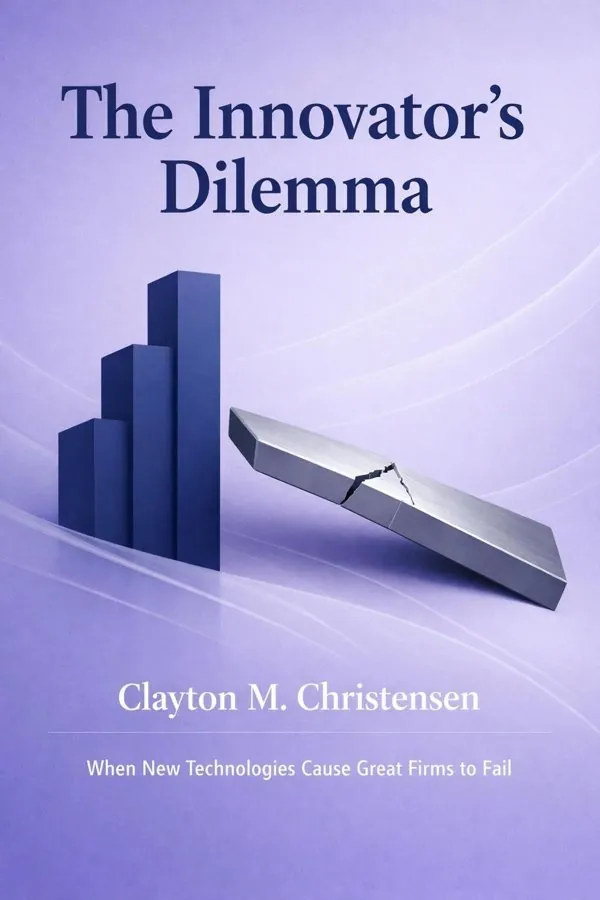
The Innovator’s Dilemma: When New Technologies Cause Great Firms to Fail: Summary & Key Insights
 10 min10 chaptersAudio available
Key Takeaways from The Innovator’s Dilemma: When New Technologies Cause Great Firms to Fail
The most dangerous innovations are often the ones that look least impressive at first.
If you want to see disruption in its purest form, study an industry where technology changes fast and outcomes are easy to track.
One of the book’s boldest claims is that listening to customers can lead companies in the wrong direction.
Companies do not fail only because leaders make poor choices; they fail because organizations are built to keep making the same kinds of choices.
Disruption is not limited to glamorous digital industries; it appears wherever performance trajectories and market needs diverge.
What Is The Innovator’s Dilemma: When New Technologies Cause Great Firms to Fail About?
The Innovator’s Dilemma: When New Technologies Cause Great Firms to Fail by Clayton M. Christensen is a strategy book spanning 10 pages. Why do well-managed companies so often lose when industries change? In The Innovator’s Dilemma, Harvard Business School professor Clayton M. Christensen answers that unsettling question with a theory that transformed modern strategy. His central claim is counterintuitive: great firms frequently fail not because they are badly run, but because they listen carefully to customers, invest aggressively in profitable innovations, and allocate resources rationally. Those very strengths can blind them to disruptive technologies—simpler, cheaper, initially inferior offerings that begin in small or overlooked markets and steadily improve until they redefine the mainstream. Drawing on detailed case studies from disk drives, mechanical excavators, steel, and retailing, Christensen shows that disruption follows recognizable patterns. Established companies excel at sustaining innovations that improve performance for their best customers, but they struggle when a new technology does not initially meet existing customer demands or profit expectations. That mismatch creates openings for entrants. Christensen’s authority comes from rigorous research, sharp strategic reasoning, and a framework that remains essential for founders, executives, investors, and product leaders. This book matters because it explains not just how firms grow, but why success itself can become a trap.
This FizzRead summary covers all 10 key chapters of The Innovator’s Dilemma: When New Technologies Cause Great Firms to Fail in approximately 10 minutes, distilling the most important ideas, arguments, and takeaways from Clayton M. Christensen's work. Also available as an audio summary and Key Quotes Podcast.
The Innovator’s Dilemma: When New Technologies Cause Great Firms to Fail
Why do well-managed companies so often lose when industries change? In The Innovator’s Dilemma, Harvard Business School professor Clayton M. Christensen answers that unsettling question with a theory that transformed modern strategy. His central claim is counterintuitive: great firms frequently fail not because they are badly run, but because they listen carefully to customers, invest aggressively in profitable innovations, and allocate resources rationally. Those very strengths can blind them to disruptive technologies—simpler, cheaper, initially inferior offerings that begin in small or overlooked markets and steadily improve until they redefine the mainstream.
Drawing on detailed case studies from disk drives, mechanical excavators, steel, and retailing, Christensen shows that disruption follows recognizable patterns. Established companies excel at sustaining innovations that improve performance for their best customers, but they struggle when a new technology does not initially meet existing customer demands or profit expectations. That mismatch creates openings for entrants. Christensen’s authority comes from rigorous research, sharp strategic reasoning, and a framework that remains essential for founders, executives, investors, and product leaders. This book matters because it explains not just how firms grow, but why success itself can become a trap.
Who Should Read The Innovator’s Dilemma: When New Technologies Cause Great Firms to Fail?
This book is perfect for anyone interested in strategy and looking to gain actionable insights in a short read. Whether you're a student, professional, or lifelong learner, the key ideas from The Innovator’s Dilemma: When New Technologies Cause Great Firms to Fail by Clayton M. Christensen will help you think differently.
- ✓Readers who enjoy strategy and want practical takeaways
- ✓Professionals looking to apply new ideas to their work and life
- ✓Anyone who wants the core insights of The Innovator’s Dilemma: When New Technologies Cause Great Firms to Fail in just 10 minutes
Want the full summary?
Get instant access to this book summary and 100K+ more with Fizz Moment.
Get Free SummaryAvailable on App Store • Free to download
Key Chapters
The most dangerous innovations are often the ones that look least impressive at first. Christensen’s foundational distinction is between sustaining technologies and disruptive technologies. Sustaining innovations make good products better along dimensions valued by mainstream customers: more speed, more capacity, higher quality, better reliability. Established firms are usually very good at these because they align with customer requests, existing profit models, and internal performance metrics. Disruptive innovations are different. They typically begin as cheaper, simpler, more convenient, or more accessible alternatives that underperform on the features mainstream buyers care about most.
Because disruptions start out weak by conventional standards, market leaders tend to dismiss them. Their best customers do not want them, their margins look unattractive, and the initial markets seem too small to matter. Yet over time, disruptive products improve. Once they become “good enough” for a broader market, they can overtake incumbents that spent years moving upmarket and overserving customer needs.
Think about how a premium software company might keep adding complex enterprise features while a simple cloud-based tool wins small teams that only want ease of use and low cost. Or how low-cost education platforms first served casual learners before competing with more formal institutions. The key is not whether the technology is objectively superior at launch, but whether it creates a new trajectory of improvement and adoption.
Actionable takeaway: Classify new technologies by the market they serve and the job they do, not by their initial performance alone. Ask which “inferior” offering might become good enough tomorrow.
If you want to see disruption in its purest form, study an industry where technology changes fast and outcomes are easy to track. Christensen uses the disk drive industry as a central laboratory because it experienced repeated waves of innovation: 14-inch drives gave way to 8-inch drives, then 5.25-inch, then 3.5-inch. In transition after transition, established leaders failed while entrants rose to dominance.
The striking lesson is that incumbents were rarely asleep. They invested heavily, studied trends, and often possessed the technical capability to build the new products. What held them back was not ignorance but rationality. Their current customers wanted larger, higher-capacity drives with better margins, not smaller drives designed for emerging applications. Sales teams resisted pushing products existing buyers did not value. Financial systems deprioritized markets too small to move the needle. Executives made sensible decisions according to the information and incentives they had.
Meanwhile, entrants happily sold smaller drives into niche markets such as minicomputers or portable devices. Those foothold markets looked insignificant at first, but they allowed newcomers to improve their products, lower costs, and build capabilities. When the new form factor became attractive to larger markets, the entrants were ready and the incumbents were trapped by their own business logic.
This pattern repeats in many industries today, from electric mobility to AI tools to fintech platforms. Early customers often differ radically from mainstream customers, which means the next giant market may be invisible if you only listen to your biggest accounts.
Actionable takeaway: Track fringe and emerging markets as seriously as core ones. Small markets can become strategic battlegrounds long before they become large revenue pools.
One of the book’s boldest claims is that listening to customers can lead companies in the wrong direction. That sounds reckless until you see Christensen’s point. Successful firms are taught to stay close to customers, invest where demand is strongest, and prioritize high-margin opportunities. Those practices are usually smart. The problem is that existing customers are excellent guides to sustaining innovation and poor guides to disruption.
Mainstream customers generally ask for better versions of what they already use. They want more performance, greater reliability, and lower cost within familiar use cases. They rarely ask for products that are simpler, less powerful, or designed for entirely new contexts. By the time established customers begin requesting a disruptive product, it is often too late for incumbents to build leadership.
Imagine a company serving large banks with sophisticated analytics software. Its top clients demand more integration, customization, and support. Meanwhile, startups and small businesses adopt a stripped-down self-serve platform that is far less powerful but much easier to implement. If the incumbent follows only its biggest customers, it may become stronger in the current market while missing the future one.
Christensen does not argue that companies should ignore customers. He argues they must understand which customers are shaping strategy. Existing high-profit buyers will naturally pull a firm upmarket. If managers rely on them exclusively, they will neglect nonconsumers, low-end buyers, and emerging use cases where disruption often begins.
Actionable takeaway: Supplement customer interviews with noncustomer research. Study who finds current offerings too expensive, too complex, or unnecessary—and design experiments for them before incumbents dismiss the opportunity.
Companies do not fail only because leaders make poor choices; they fail because organizations are built to keep making the same kinds of choices. Christensen emphasizes that resources, processes, and values determine what a company can and cannot do. Resources include people, cash, technology, and relationships. Processes are the routines and methods used to make decisions and deliver results. Values are the criteria by which opportunities are prioritized, such as margin thresholds, market size expectations, and growth targets.
This framework explains why large firms can possess abundant resources and still struggle with disruptive change. Resources are flexible; people and capital can be reassigned. Processes and values are much harder to change. A company optimized for large customers, long sales cycles, and premium margins will naturally reject small, uncertain, low-margin opportunities. Even if executives want to pursue disruption, the existing organization often filters it out.
Consider a global hardware company trying to launch a low-cost subscription service. The engineering team may be capable, but the approval process favors large capital projects, the sales organization is rewarded for enterprise contracts, and the finance team expects margins that the new business cannot yet deliver. The opportunity dies not from incompetence, but from organizational mismatch.
This is why disruption is so difficult inside mature firms. The challenge is not simply to approve a new project; it is to place that project in an environment whose processes and values fit its needs.
Actionable takeaway: Diagnose whether a proposed innovation matches your organization’s current processes and values. If it does not, create a different structure rather than forcing an ill-fitting initiative through the core business.
Disruption is not limited to glamorous digital industries; it appears wherever performance trajectories and market needs diverge. Christensen’s study of the mechanical excavator industry demonstrates that the theory applies even in heavy equipment. Hydraulic excavators began as a disruptive technology relative to cable-actuated machines. At first, they were not attractive to dominant manufacturers serving established customers in major applications. But in simpler and smaller use cases, hydraulics offered meaningful advantages and a new path of improvement.
The significance of this case is that it broadens the theory beyond electronics. Managers often assume disruption belongs to software, consumer tech, or venture-funded startups. Christensen shows that the underlying mechanism is structural, not fashionable. When incumbents are tied to existing customers and performance measures, they are vulnerable to entrants serving markets the leaders consider unattractive or peripheral.
This has broad practical implications. In healthcare, lower-cost clinics and telemedicine can start by serving less complex needs before expanding. In professional services, standardized digital offerings can first appeal to price-sensitive clients before moving toward the mainstream. In manufacturing, modular or lower-cost solutions can begin at the edge and steadily challenge integrated incumbents.
The excavator example also highlights that new technologies need not dominate immediately. They need a foothold, a learning environment, and a trajectory of improvement. Once those conditions exist, conventional wisdom about “inferior” products can collapse surprisingly fast.
Actionable takeaway: Look for disruptive threats in overlooked segments of even traditional industries. If a simpler solution is improving in a niche market, assume it may eventually move into your core.
A company’s success depends not only on its product but on the value network in which it operates. Christensen uses the term value network to describe the ecosystem of customers, suppliers, cost structures, performance expectations, and profit formulas that shape what a business finds attractive. In one value network, a product may be too cheap, too low-performance, or too low-margin to matter. In another, it may be exactly right.
This insight explains why the same technology can be embraced by one firm and rejected by another. Established organizations do not evaluate opportunities in a vacuum. They judge them through the economics of their current network. A disruptive innovation often looks weak because it does not fit the incumbent’s margins, channels, or customer priorities. But in a different network—one serving smaller customers, lower prices, or simpler needs—the innovation can thrive.
Think of how a major bank evaluates a digital-only account versus how a fintech startup evaluates it. For the incumbent, low-balance customers may seem unattractive relative to branch economics and cross-selling expectations. For the startup, those customers may represent a scalable, efficient market. The product is not inherently good or bad; its attractiveness depends on the surrounding business model.
Managers often miss this because they ask, “Is this a good opportunity for us?” when they should also ask, “In what value network does this become a great opportunity?” That shift in thinking changes strategy. Sometimes the right answer is not to adapt the core business but to build a new network where the economics make sense.
Actionable takeaway: Evaluate innovations in the context of the value network they require. If the economics do not work in your current model, consider building or partnering into a different one.
Many innovations fail inside large firms because they are placed in the wrong organizational home. Christensen argues that disruptive projects often need independent teams or autonomous business units because the core organization is optimized for a different job. When a small, uncertain opportunity competes for resources against large, proven revenue streams, the established business will almost always win. Independence protects the disruptive initiative from being crushed by sensible corporate routines.
This does not mean every new idea deserves a spinout. The point is structural fit. Sustaining innovations should often remain within the core, where existing capabilities, brands, and customer relationships provide advantages. Disruptive innovations, by contrast, usually need smaller cost structures, different success metrics, faster learning cycles, and freedom to serve customers the main organization does not prioritize.
A practical example is a media company trying to build a low-cost creator platform while its core business depends on premium advertising and expensive content production. If the new platform is forced to meet the same profitability standards and approval processes as the legacy division, it will likely be strangled. In a separate unit with distinct metrics, it can test the market, iterate quickly, and develop a business model appropriate to its audience.
Christensen’s insight is managerial humility: not every opportunity should be absorbed into the existing machine. Sometimes leadership means creating a new machine.
Actionable takeaway: Before launching a disruptive initiative, decide where it should live. Match the project’s market, margin, and learning needs to an organization designed for those realities, not to the assumptions of the core business.
Large companies often ignore disruptive opportunities because emerging markets are too small to satisfy growth expectations. Christensen shows why this is a costly mistake. Startups can be excited by a $5 million or $20 million market because it can sustain their early development. For a multibillion-dollar company, the same opportunity may look irrelevant. Yet nearly all major markets begin small. If incumbents wait until a market is large enough to matter financially, they usually enter after the most important learning and positioning advantages are gone.
This asymmetry is central to the innovator’s dilemma. The very size and success of a company create incentives to reject small markets. Managers are not foolish when they do so; they are responding to capital allocation logic. But disruption exploits exactly this blind spot. Entrants can grow with the market, refine the product, and establish relationships long before the incumbent feels compelled to act.
You can see this in enterprise software, consumer subscriptions, and climate technologies. A niche user base that seems commercially trivial today may be the training ground for tomorrow’s dominant product. What matters early is not market size alone, but whether the market enables learning, iteration, and a path toward broader adoption.
For leaders, this means redefining how opportunities are judged. Small markets should not be dismissed simply because they cannot move current earnings. They can be treated as options, laboratories, or platforms for capability building.
Actionable takeaway: Create a separate investment logic for emerging markets. Evaluate them by strategic learning and future optionality, not only by near-term revenue impact on the core business.
One of Christensen’s most practical lessons is that disruptive innovation rarely looks attractive at the moment you should invest in it. Early on, data is noisy, customer demand is ambiguous, and financial returns are uncertain. Established firms prefer evidence, scale, and predictability. But by the time a disruptive market becomes clearly attractive, competitive advantages often belong to someone else.
This is why managing under uncertainty matters. Companies cannot wait for traditional planning tools to validate every disruptive move. Instead, they need discovery-based approaches: small experiments, low-cost pilots, rapid iteration, and direct engagement with emerging customers. The goal is not to forecast perfectly but to learn quickly enough to shape the market before it matures.
Suppose a logistics company sees early signals that AI-driven autonomous coordination tools could simplify operations for small fleets. The economics may look weak at first and the product may not meet enterprise standards. A traditional ROI model might reject the investment. A strategic experimentation model, however, would ask what can be learned with a modest dedicated team serving early adopters. That learning may prove invaluable once the tools improve and broader adoption begins.
Christensen’s broader message is that disruption demands a different management discipline. Leaders must become comfortable backing projects that look small, imperfect, and financially unattractive when judged by conventional standards.
Actionable takeaway: Build an experimentation portfolio for uncertain opportunities. Fund low-cost tests with explicit learning goals so you can enter early without making reckless all-or-nothing bets.
The innovator’s dilemma is not a single mistake to avoid; it is a recurring strategic condition that must be managed deliberately. Christensen’s final contribution is hopeful: firms can improve their odds if they stop assuming that better execution alone will protect them. The real challenge is to design organizations and decision processes that can handle both sustaining and disruptive innovation at the same time.
Escaping the dilemma requires leaders to accept several uncomfortable truths. First, profitable core customers will not reliably guide you toward the future. Second, disruptive opportunities may look financially unattractive until after the window to lead has passed. Third, existing processes and values can be more constraining than a lack of talent or capital. And fourth, separate structures are often essential, not optional.
This does not mean incumbents are doomed. It means they must act with structural courage. They need mechanisms to explore low-end and new-market opportunities, governance systems that protect emerging businesses, and evaluation criteria suited to uncertainty. They also need the discipline to let new ventures serve different customers with different economics, even if that feels threatening to the core.
For modern leaders, this lesson is especially relevant in a world shaped by AI, platform shifts, decarbonization, and changing consumer expectations. The next disruptive threat may already be visible, but only if you are willing to look where your existing business has taught you not to.
Actionable takeaway: Treat disruption as an ongoing leadership responsibility. Build structures, incentives, and review processes that allow your company to nurture businesses the core would otherwise reject.
All Chapters in The Innovator’s Dilemma: When New Technologies Cause Great Firms to Fail
About the Author
Clayton M. Christensen (1952–2020) was an American academic, business consultant, and one of the most influential thinkers in modern management. He served as a professor at Harvard Business School and became globally known for developing the theory of disruptive innovation, a framework that transformed how leaders understand technological change, market entry, and corporate failure. Christensen’s work bridged rigorous research and practical strategy, making his ideas highly influential among executives, entrepreneurs, investors, and policymakers. In addition to The Innovator’s Dilemma, he wrote several acclaimed books on innovation, growth, education, healthcare, and personal purpose. Admired for both intellectual clarity and moral seriousness, Christensen left a lasting legacy in business thought by showing that success itself can create the conditions for decline if organizations fail to adapt.
Get This Summary in Your Preferred Format
Read or listen to the The Innovator’s Dilemma: When New Technologies Cause Great Firms to Fail summary by Clayton M. Christensen anytime, anywhere. FizzRead offers multiple formats so you can learn on your terms — all free.
Available formats: App · Audio · PDF · EPUB — All included free with FizzRead
Download The Innovator’s Dilemma: When New Technologies Cause Great Firms to Fail PDF and EPUB Summary
Key Quotes from The Innovator’s Dilemma: When New Technologies Cause Great Firms to Fail
“The most dangerous innovations are often the ones that look least impressive at first.”
“If you want to see disruption in its purest form, study an industry where technology changes fast and outcomes are easy to track.”
“One of the book’s boldest claims is that listening to customers can lead companies in the wrong direction.”
“Companies do not fail only because leaders make poor choices; they fail because organizations are built to keep making the same kinds of choices.”
“Disruption is not limited to glamorous digital industries; it appears wherever performance trajectories and market needs diverge.”
Frequently Asked Questions about The Innovator’s Dilemma: When New Technologies Cause Great Firms to Fail
The Innovator’s Dilemma: When New Technologies Cause Great Firms to Fail by Clayton M. Christensen is a strategy book that explores key ideas across 10 chapters. Why do well-managed companies so often lose when industries change? In The Innovator’s Dilemma, Harvard Business School professor Clayton M. Christensen answers that unsettling question with a theory that transformed modern strategy. His central claim is counterintuitive: great firms frequently fail not because they are badly run, but because they listen carefully to customers, invest aggressively in profitable innovations, and allocate resources rationally. Those very strengths can blind them to disruptive technologies—simpler, cheaper, initially inferior offerings that begin in small or overlooked markets and steadily improve until they redefine the mainstream. Drawing on detailed case studies from disk drives, mechanical excavators, steel, and retailing, Christensen shows that disruption follows recognizable patterns. Established companies excel at sustaining innovations that improve performance for their best customers, but they struggle when a new technology does not initially meet existing customer demands or profit expectations. That mismatch creates openings for entrants. Christensen’s authority comes from rigorous research, sharp strategic reasoning, and a framework that remains essential for founders, executives, investors, and product leaders. This book matters because it explains not just how firms grow, but why success itself can become a trap.
More by Clayton M. Christensen
Competing Against Luck: The Story of Innovation and Customer Choice
Clayton M. Christensen, Taddy Hall, Karen Dillon, David S. Duncan
10 min
The Innovator's DNA: Mastering the Five Skills of Disruptive Innovators
Jeff Dyer, Hal Gregersen, Clayton M. Christensen
10 min
The Innovator's Prescription: A Disruptive Solution for Health Care
Clayton M. Christensen, Jerome H. Grossman, Jason Hwang
10 min
How Will You Measure Your Life?
Clayton M. Christensen
10 minYou Might Also Like

Mastery
Robert Greene
10 min
Cut Costs Not Corners: A Practical Guide to Staying Competitive and Improving Profits
Colin Barrow
10 min
Good Strategy/Bad Strategy: The Difference and Why It Matters
Richard P. Rumelt
10 min
On Grand Strategy
John Lewis Gaddis
10 min
The Six Disciplines of Digital Transformation
George Westerman
10 min
7 Powers: The Foundations of Business Strategy
Hamilton Helmer
10 minBrowse by Category
Ready to read The Innovator’s Dilemma: When New Technologies Cause Great Firms to Fail?
Get the full summary and 100K+ more books with Fizz Moment.