
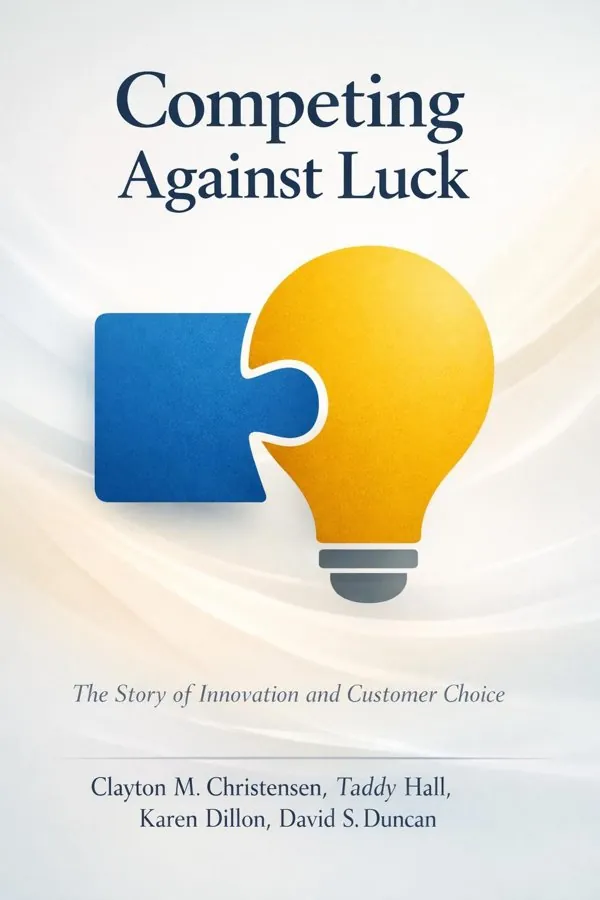
Competing Against Luck: The Story of Innovation and Customer Choice: Summary & Key Insights
by Clayton M. Christensen, Taddy Hall, Karen Dillon, David S. Duncan
 10 min4 chaptersAudio available
What Is Competing Against Luck: The Story of Innovation and Customer Choice About?
Competing Against Luck: The Story of Innovation and Customer Choice by Clayton M. Christensen, Taddy Hall, Karen Dillon, David S. Duncan is a strategy book spanning 4 pages. In this influential work, Clayton M. Christensen and his coauthors introduce the 'Jobs to Be Done' theory, explaining how successful innovation stems from understanding the real jobs customers are trying to accomplish. The book provides a framework for predicting innovation success by focusing on customer motivations rather than demographics or product features.
This FizzRead summary covers all 4 key chapters of Competing Against Luck: The Story of Innovation and Customer Choice in approximately 10 minutes, distilling the most important ideas, arguments, and takeaways from Clayton M. Christensen, Taddy Hall, Karen Dillon, David S. Duncan's work. Also available as an audio summary and Key Quotes Podcast.
Competing Against Luck: The Story of Innovation and Customer Choice
In this influential work, Clayton M. Christensen and his coauthors introduce the 'Jobs to Be Done' theory, explaining how successful innovation stems from understanding the real jobs customers are trying to accomplish. The book provides a framework for predicting innovation success by focusing on customer motivations rather than demographics or product features.
Who Should Read Competing Against Luck: The Story of Innovation and Customer Choice?
This book is perfect for anyone interested in strategy and looking to gain actionable insights in a short read. Whether you're a student, professional, or lifelong learner, the key ideas from Competing Against Luck: The Story of Innovation and Customer Choice by Clayton M. Christensen, Taddy Hall, Karen Dillon, David S. Duncan will help you think differently.
- ✓Readers who enjoy strategy and want practical takeaways
- ✓Professionals looking to apply new ideas to their work and life
- ✓Anyone who wants the core insights of Competing Against Luck: The Story of Innovation and Customer Choice in just 10 minutes
Want the full summary?
Get instant access to this book summary and 100K+ more with Fizz Moment.
Get Free SummaryAvailable on App Store • Free to download
Key Chapters
At the heart of this work lies the simple yet profound observation that customers don’t buy products—they hire them. This concept emerged as my research team and I sought to understand why innovations fail even when companies do everything 'right.' Market segmentation models, psychographic data, and satisfaction scores were not explaining real success. A breakthrough came when we looked at what customers were trying to achieve, rather than who they were.
Think of the classic case of milkshakes at a fast-food chain. The company wanted to sell more milkshakes, so it studied its customers—mostly young men, middle-aged commuters, families—yet no amount of segmentation boosted sales. Then, through careful observation and interviews, we realized people were hiring milkshakes to solve two very different jobs. Morning customers wanted something easy to consume on the commute that would stave off hunger until lunch; afternoon customers wanted a fun treat for their children. The same product was being hired for fundamentally different progress in life. Once the company understood this, it could shape the product experience around those jobs—thickness for long commutes, flavor variety for family enjoyment—and sales improved dramatically.
This example captures the essence of 'Jobs to Be Done.' The job itself, not the demographic or product category, defines the opportunity. Every purchase is a moment of progress in a circumstance—an intersection of problem, aspiration, and context. As innovators, our task is to understand that circumstance deeply enough that we can build something worth hiring. When we understand the job, we no longer throw random ideas into the market hoping to get lucky. We innovate deliberately because we know what will help customers move forward.
In real terms, the Jobs theory shifts focus away from what customers say they want and toward what they actually need to get done. It appreciates that customers may not articulate their jobs clearly—they experience them emotionally and situationally. Our discipline, then, becomes uncovering those dimensions of motivation, listening not for product features but for stories of struggle and aspiration. Innovation stops being guesswork when we can answer this question with precision: 'What job is my customer trying to get done?'
Businesses have long relied on segmentation models that group customers by age, income, gender, or region. These categories are tidy, and they give decision-makers numbers to work with. Yet they tell us little about why people make choices. Two consumers might share the same demographics yet hire completely different products for entirely different reasons. To innovate reliably, we must abandon the illusion that demographic sameness implies behavioral predictability.
I’ve seen countless organizations misinterpret their customers by focusing on averages and abstractions instead of circumstances. Demographics describe people; jobs describe progress. When you understand the job, the market becomes fluid, often crossing categories that would seem unrelated. A parent might hire a video game for their child not out of entertainment desire but to teach patience and persistence—an emotional and social job hidden inside a product typically labeled 'fun.'
Segmentation fails because it does not capture context. Customers operate within complex lives, shaped by timing, geography, emotion, and social expectations. The 'Jobs' lens restores that complexity and allows companies to uncover rich insights they never could with static classifications. Consider Airbnb—not merely disrupting the hotel industry but addressing entirely different jobs. Some guests hire Airbnb for adventure and authenticity; others hire it for budget control or the feeling of belonging. Demographics alone cannot explain this diversity of purpose.
When companies step away from demographic boxes and instead seek to understand the true job—the struggle in a given situation—they unlock innovation opportunities invisible to their competitors. They begin designing around human progress rather than group identity, aligning every element of their strategy with the reality of customer motivation. Only then does the market reveal itself not as a collection of 'segments' but as a landscape of circumstances and desired progress.
+ 2 more chapters — available in the FizzRead app
All Chapters in Competing Against Luck: The Story of Innovation and Customer Choice
About the Authors
Clayton M. Christensen (1952–2020) was a professor at Harvard Business School and one of the world’s leading thinkers on innovation and business strategy. He is best known for developing the theory of disruptive innovation and authored several landmark books including 'The Innovator’s Dilemma' and 'The Innovator’s Solution'.
Get This Summary in Your Preferred Format
Read or listen to the Competing Against Luck: The Story of Innovation and Customer Choice summary by Clayton M. Christensen, Taddy Hall, Karen Dillon, David S. Duncan anytime, anywhere. FizzRead offers multiple formats so you can learn on your terms — all free.
Available formats: App · Audio · PDF · EPUB — All included free with FizzRead
Download Competing Against Luck: The Story of Innovation and Customer Choice PDF and EPUB Summary
Key Quotes from Competing Against Luck: The Story of Innovation and Customer Choice
“At the heart of this work lies the simple yet profound observation that customers don’t buy products—they hire them.”
“Businesses have long relied on segmentation models that group customers by age, income, gender, or region.”
Frequently Asked Questions about Competing Against Luck: The Story of Innovation and Customer Choice
Competing Against Luck: The Story of Innovation and Customer Choice by Clayton M. Christensen, Taddy Hall, Karen Dillon, David S. Duncan is a strategy book that explores key ideas across 4 chapters. In this influential work, Clayton M. Christensen and his coauthors introduce the 'Jobs to Be Done' theory, explaining how successful innovation stems from understanding the real jobs customers are trying to accomplish. The book provides a framework for predicting innovation success by focusing on customer motivations rather than demographics or product features.
You Might Also Like

Mastery
Robert Greene
10 min
Cut Costs Not Corners: A Practical Guide to Staying Competitive and Improving Profits
Colin Barrow
10 min
Good Strategy/Bad Strategy: The Difference and Why It Matters
Richard P. Rumelt
10 min
On Grand Strategy
John Lewis Gaddis
10 min
The Six Disciplines of Digital Transformation
George Westerman
10 min
7 Powers: The Foundations of Business Strategy
Hamilton Helmer
10 minFeatured In
Browse by Category
Ready to read Competing Against Luck: The Story of Innovation and Customer Choice?
Get the full summary and 100K+ more books with Fizz Moment.