
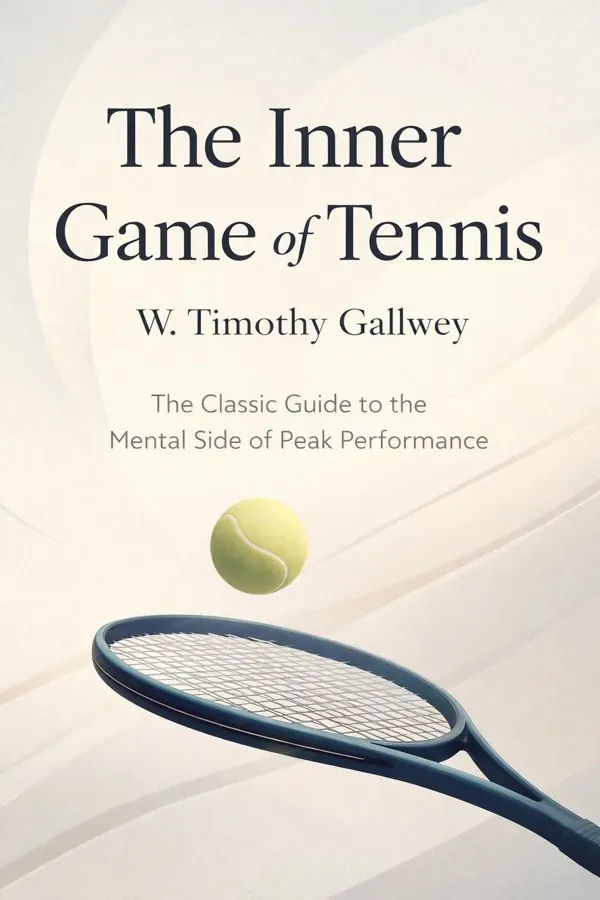
The Inner Game of Tennis: The Classic Guide to the Mental Side of Peak Performance: Summary & Key Insights
 10 min8 chaptersAudio available
Key Takeaways from The Inner Game of Tennis: The Classic Guide to the Mental Side of Peak Performance
One of the book’s most powerful insights is that the real battle in performance is not between you and an opponent, but between two parts of yourself.
Peak performance often looks effortless, and Gallwey explains why: the best moments happen when the mind is quiet enough for the body to act without obstruction.
Improvement accelerates when observation replaces criticism.
Confidence is often misunderstood as a feeling of certainty.
Many performance problems are not technical problems at all; they are fear problems.
What Is The Inner Game of Tennis: The Classic Guide to the Mental Side of Peak Performance About?
The Inner Game of Tennis: The Classic Guide to the Mental Side of Peak Performance by W. Timothy Gallwey is a mindset book spanning 6 pages. Most people assume better performance comes from more effort, more instruction, and tighter control. W. Timothy Gallwey argues the opposite. In The Inner Game of Tennis, he shows that the greatest obstacle to excellence is often not a lack of talent or discipline, but the constant mental interference that disrupts natural ability. Using tennis as his laboratory, Gallwey reveals how self-criticism, overthinking, and fear of mistakes keep players from performing at their best. What made this book revolutionary is that it shifted attention from mechanics alone to the mind behind the motion. Gallwey’s famous distinction between the judging, controlling “Self 1” and the intuitive, capable “Self 2” gave athletes, coaches, and professionals a new language for understanding performance. Rather than forcing improvement through endless correction, he encourages awareness, trust, and relaxed concentration. Though rooted in sport, the book’s lessons extend far beyond the court. Anyone who has ever choked under pressure, doubted their abilities, or tried too hard to succeed will find something transformative here. Gallwey’s insight is simple but powerful: peak performance emerges when the mind becomes quiet enough to let natural intelligence work.
This FizzRead summary covers all 8 key chapters of The Inner Game of Tennis: The Classic Guide to the Mental Side of Peak Performance in approximately 10 minutes, distilling the most important ideas, arguments, and takeaways from W. Timothy Gallwey's work. Also available as an audio summary and Key Quotes Podcast.
The Inner Game of Tennis: The Classic Guide to the Mental Side of Peak Performance
Most people assume better performance comes from more effort, more instruction, and tighter control. W. Timothy Gallwey argues the opposite. In The Inner Game of Tennis, he shows that the greatest obstacle to excellence is often not a lack of talent or discipline, but the constant mental interference that disrupts natural ability. Using tennis as his laboratory, Gallwey reveals how self-criticism, overthinking, and fear of mistakes keep players from performing at their best.
What made this book revolutionary is that it shifted attention from mechanics alone to the mind behind the motion. Gallwey’s famous distinction between the judging, controlling “Self 1” and the intuitive, capable “Self 2” gave athletes, coaches, and professionals a new language for understanding performance. Rather than forcing improvement through endless correction, he encourages awareness, trust, and relaxed concentration.
Though rooted in sport, the book’s lessons extend far beyond the court. Anyone who has ever choked under pressure, doubted their abilities, or tried too hard to succeed will find something transformative here. Gallwey’s insight is simple but powerful: peak performance emerges when the mind becomes quiet enough to let natural intelligence work.
Who Should Read The Inner Game of Tennis: The Classic Guide to the Mental Side of Peak Performance?
This book is perfect for anyone interested in mindset and looking to gain actionable insights in a short read. Whether you're a student, professional, or lifelong learner, the key ideas from The Inner Game of Tennis: The Classic Guide to the Mental Side of Peak Performance by W. Timothy Gallwey will help you think differently.
- ✓Readers who enjoy mindset and want practical takeaways
- ✓Professionals looking to apply new ideas to their work and life
- ✓Anyone who wants the core insights of The Inner Game of Tennis: The Classic Guide to the Mental Side of Peak Performance in just 10 minutes
Want the full summary?
Get instant access to this book summary and 100K+ more with Fizz Moment.
Get Free SummaryAvailable on App Store • Free to download
Key Chapters
One of the book’s most powerful insights is that the real battle in performance is not between you and an opponent, but between two parts of yourself. Gallwey calls them Self 1 and Self 2. Self 1 is the voice in your head that instructs, criticizes, compares, and worries. It says things like, “Keep your elbow up,” “Don’t miss this shot,” or “You always fail under pressure.” Self 2 is the part of you that actually performs. It is your body’s natural intelligence, your trained reflexes, your built-in capacity to learn through experience.
Gallwey observed that many players sabotage themselves not because they lack skill, but because Self 1 constantly interferes with Self 2. A player prepares to serve, then clutters the moment with technical commands and fear of error. Instead of flowing into the motion, the player tightens, hesitates, and performs below their real ability. The paradox is that trying too hard often makes performance worse.
This distinction matters because it changes how we improve. Instead of piling on more judgment and control, Gallwey suggests reducing interference so that Self 2 can function freely. Think of a musician who performs beautifully in rehearsal but stiffens on stage, or a speaker who knows their material but freezes when overthinking every sentence. In both cases, the issue is not incompetence; it is internal noise.
A practical application is to notice your inner commentary during performance. What does Self 1 say before, during, and after mistakes? Simply identifying this pattern weakens its hold. Then begin shifting attention away from self-judgment and toward direct experience: the sound of the ball, the feel of movement, the rhythm of breathing.
Actionable takeaway: The next time you perform, listen for Self 1’s voice and label it without arguing with it. Your goal is not to defeat it by force, but to stop obeying it so Self 2 can do what it already knows.
Peak performance often looks effortless, and Gallwey explains why: the best moments happen when the mind is quiet enough for the body to act without obstruction. Many players believe they need more mental control in order to perform well. Gallwey argues that what they actually need is less mental chatter. When the mind is crowded with instructions, doubts, and predictions, movement loses its fluidity.
Consider what happens when a tennis player tells themselves during a rally: “Move your feet, keep your wrist firm, hit through the ball, don’t hit long.” The intention may be good, but the result is overload. Performance becomes jerky and delayed because conscious thought is too slow and fragmented to manage a fast-moving skill in real time. Natural coordination works better when it is trusted than when it is micromanaged.
Gallwey does not recommend emptying the mind through force. Instead, he suggests giving attention something simple and immediate to rest on. On the tennis court, that might mean watching the seams of the ball, noticing the arc of its trajectory, or listening to the sound it makes on contact. This kind of focused awareness occupies the mind without filling it with judgment. It is not blankness, but absorbed presence.
This principle extends to many domains. A golfer may focus on the sensation of the swing rather than outcome. A public speaker may attend to the breath and the audience rather than rehearsing every line internally. A manager entering a difficult meeting may anchor attention in posture, tone, and listening instead of anxious prediction.
Actionable takeaway: Before your next high-pressure task, choose one neutral point of attention—a breath, a sound, a visual cue, or a physical sensation. Return to it whenever your mind starts giving commands or replaying fears.
Improvement accelerates when observation replaces criticism. Gallwey emphasizes that most people believe harsh self-evaluation helps them learn, but in reality judgment often blocks learning. When you label a shot as “terrible,” a performance as “embarrassing,” or yourself as “bad under pressure,” you add emotional noise that makes it harder to see what actually happened. Without clear perception, useful adjustment becomes difficult.
Nonjudgmental awareness means noticing reality as accurately as possible without immediately calling it good or bad. On the court, that might involve observing that your backhand consistently lands short, or that your grip tightens during important points, without turning those facts into personal failure. Once the mind stops defending itself or attacking itself, it can learn more efficiently from what it sees.
Gallwey found that players often improved faster when asked simply to notice the height of the ball over the net or the shape of their follow-through than when given elaborate corrective instructions. Awareness itself has corrective power. The body, through repetition and feedback, can self-organize if it receives clear information.
This idea is surprisingly liberating beyond sports. If you are trying to improve at writing, instead of saying, “I’m terrible at structure,” you might notice, “My introduction is clear, but my middle sections drift.” If you are improving your leadership, rather than “I’m bad at conflict,” you might observe, “I interrupt people when I feel challenged.” Observation creates possibility; judgment creates resistance.
The key is not passivity. Nonjudgmental awareness is active attention without emotional distortion. It allows mistakes to become data instead of identity. That shift transforms the learning process from punishment into discovery.
Actionable takeaway: After your next mistake, describe what happened in factual terms only, as if you were a neutral observer. Replace “I messed up” with a precise observation you can learn from.
Confidence is often misunderstood as a feeling of certainty. Gallwey presents a more useful view: confidence grows from trust in your natural ability to respond, not from controlling every detail. The more players try to force perfect results, the more tense they become. True concentration is relaxed, not rigid. It combines alertness with ease.
Relaxed concentration emerges when Self 2 is trusted. A tennis player who trusts their training can focus on the present ball rather than trying to engineer every stroke. This does not mean carelessness. It means full engagement without the muscular and mental tightening created by fear. You see this in athletes who appear calm under pressure. They are not necessarily less invested in the outcome; they are simply less divided within themselves.
Gallwey’s insight is practical: effort and tension are not the same thing. Many people assume that if they loosen up, they will become lazy or sloppy. But excessive strain often reduces sensitivity, timing, and adaptability. In tennis, a tight grip deadens touch. In conversation, mental tension makes listening harder. In creative work, anxiety narrows imagination.
One useful method is to separate intention from forcing. Set a clear intention—hit with topspin, speak with clarity, stay composed—then allow the action to happen without constant correction. Another method is physical relaxation: exhaling slowly, unclenching the jaw, loosening the shoulders, and reducing unnecessary muscular effort. Often, the body can guide the mind back into balance.
Over time, trust becomes self-reinforcing. The more often you experience yourself performing well without overcontrol, the easier it is to stop interfering. Confidence then becomes less about positive thinking and more about lived evidence.
Actionable takeaway: Before performing, ask yourself, “Where am I adding unnecessary tension?” Release one area in the body and one area in the mind, then focus on doing the task with alert ease instead of force.
Many performance problems are not technical problems at all; they are fear problems. Gallwey shows that players often become trapped by fear of failure, fear of looking foolish, fear of disappointing others, or fear of not meeting their own standards. These fears trigger Self 1’s chatter, which then disrupts timing, perception, and freedom of movement. The mistake happens, and the player concludes they are inadequate, when in fact they were constrained by anxiety.
A major contribution of the book is its reframing of confidence. Confidence is not built by pretending fear does not exist. It is built by reducing the mental habits that feed fear. Much of that fear comes from attaching too much meaning to each moment. One missed shot becomes proof that you are weak. One bad presentation becomes evidence that you are not leadership material. Gallwey invites readers to detach identity from immediate outcomes.
This shift can be practiced in small ways. A tennis player can approach each point as a fresh event rather than as a referendum on self-worth. A salesperson can treat a rejected pitch as feedback instead of humiliation. A student can see an exam as a chance to demonstrate learning, not as a final judgment of intelligence. When performance no longer feels like a trial of the self, the mind relaxes and capability returns.
Gallwey also encourages curiosity in place of fear. Instead of asking, “What if I fail?” ask, “What happens when I fully attend to this moment?” Curiosity opens awareness, while fear narrows it. The result is often better performance and a healthier relationship with challenge.
Actionable takeaway: Identify one fear that commonly appears before you perform. Write down the meaning you attach to failure, then challenge that meaning. Replace self-threat with a narrower, more useful question: “What does this moment actually require of me right now?”
One of Gallwey’s most radical ideas is that people often learn best not through constant correction, but through experience guided by attention. Traditional coaching assumes the instructor must supply detailed commands and the student must consciously implement them. Gallwey discovered that too much instruction can interfere with the body’s natural learning system.
When a player watches a demonstration and then imitates it without overanalyzing every component, improvement can occur surprisingly quickly. Why? Because the human nervous system is built to recognize patterns, adapt through repetition, and refine movement based on sensory feedback. This is how children learn many complex skills before they can explain them. They observe, attempt, notice, and adjust.
This does not make teaching unnecessary. It changes the teacher’s role. Instead of acting as a controller, the coach becomes a facilitator of awareness. Rather than saying, “Your racket face is wrong; change it like this,” the coach might ask the player to notice how the ball behaves with different contacts. The learner becomes more engaged, less defensive, and more self-sufficient.
The same principle applies to professional development. A manager trying to improve communication might record a meeting, review it, and notice patterns of tone, pace, and interruption rather than merely memorizing communication tips. A writer might read their work aloud and hear where rhythm breaks down. In each case, awareness supports organic correction.
Letting learning happen does not mean being passive or vague. It means trusting that clear attention plus repetition often produces smarter, deeper learning than self-punishment and overinstruction. Mastery is not only built by doing more; it is built by interfering less.
Actionable takeaway: When learning a skill this week, reduce verbal self-instruction. Watch, practice, and observe results with curiosity. Ask, “What is the task teaching me?” before asking, “How can I control this better?”
Although the book is framed around tennis, its true subject is human performance in any field where pressure, self-consciousness, and skill intersect. Gallwey uses the court because it makes inner conflict visible. A tennis player cannot hide overthinking for long; it appears immediately in timing, tension, and inconsistency. But the same internal game shows up in business, education, leadership, relationships, and creative work.
The central pattern is universal: a person has real ability, then undermines it through excessive self-monitoring, judgment, and fear. An executive enters an important presentation and mentally rehearses every possible mistake. A musician obsesses over audience reaction. A student with strong preparation panics during an exam. In each case, external difficulty is compounded by internal interference.
Gallwey’s framework is useful because it provides a practical way to respond. Instead of treating pressure as a purely external problem, you learn to work with the inner environment. Awareness, trust, focused attention, and nonjudgment become transferable skills. Once understood, the inner game can improve not only performance but also enjoyment. Activities become less exhausting when they are not burdened by constant self-evaluation.
The broader implication is that excellence and well-being are not enemies. Many people believe that if they stop judging themselves harshly, they will lose their edge. Gallwey suggests the opposite: removing unnecessary inner conflict often improves results while making the process more humane. You can pursue high standards without living in chronic self-attack.
That is why the book has remained influential far beyond sports. It speaks to anyone trying to do difficult things with grace. The court is simply the starting point.
Actionable takeaway: Choose one non-sport area of your life—work, parenting, study, or creativity—and identify how Self 1 interferes there. Apply one Inner Game principle, such as nonjudgmental observation or focused attention, to that setting this week.
Results matter, but obsession with results often damages the very performance needed to achieve them. Gallwey repeatedly points readers back to the present moment. A player who is preoccupied with winning the match, avoiding embarrassment, or protecting a reputation is mentally pulled away from the only place effective action can occur: the current point.
This is one of the most subtle traps in performance. Outcome focus feels responsible and ambitious, yet when it becomes excessive it generates tension and distracts attention from process. A tennis player worried about the score may stop seeing the ball clearly. A founder fixated on investor approval may lose touch with the actual conversation. A candidate thinking about whether they will get the job may answer less naturally in the interview.
Gallwey does not dismiss goals. Goals can provide direction and motivation. The problem begins when future results dominate present awareness. The inner game asks you to care about outcomes without mentally living inside them. The task is to return attention to what can be observed and done now.
On the court, that might mean focusing on the toss, the contact point, or the opponent’s position. In writing, it might mean attending to the next clear paragraph instead of worrying about how the whole piece will be received. In leadership, it may mean listening carefully to the person in front of you rather than planning your image.
Presence is not merely calming; it is effective. It restores access to timing, perception, responsiveness, and creativity. When attention is rooted in the now, action becomes simpler and often better.
Actionable takeaway: Before starting an important task, name the outcome you want, then set it aside. Ask, “What is the next immediate thing to notice or do well?” Keep returning to that question whenever your mind jumps ahead.
All Chapters in The Inner Game of Tennis: The Classic Guide to the Mental Side of Peak Performance
About the Author
W. Timothy Gallwey is an American author, coach, and performance pioneer best known for developing the Inner Game approach. He studied at Harvard and became a tennis instructor whose observations about learning and performance challenged conventional coaching. Rather than emphasizing nonstop correction and control, Gallwey focused on awareness, trust, and the reduction of self-interference. His 1974 book The Inner Game of Tennis became a classic and influenced not only sports psychology but also executive coaching, leadership development, education, and personal growth. Over time, Gallwey expanded his ideas into business and workplace performance, helping leaders and teams think differently about excellence. His work remains influential because it offers a clear and practical framework for understanding how the mind affects performance in nearly every domain.
Get This Summary in Your Preferred Format
Read or listen to the The Inner Game of Tennis: The Classic Guide to the Mental Side of Peak Performance summary by W. Timothy Gallwey anytime, anywhere. FizzRead offers multiple formats so you can learn on your terms — all free.
Available formats: App · Audio · PDF · EPUB — All included free with FizzRead
Download The Inner Game of Tennis: The Classic Guide to the Mental Side of Peak Performance PDF and EPUB Summary
Key Quotes from The Inner Game of Tennis: The Classic Guide to the Mental Side of Peak Performance
“One of the book’s most powerful insights is that the real battle in performance is not between you and an opponent, but between two parts of yourself.”
“Peak performance often looks effortless, and Gallwey explains why: the best moments happen when the mind is quiet enough for the body to act without obstruction.”
“Improvement accelerates when observation replaces criticism.”
“Confidence is often misunderstood as a feeling of certainty.”
“Many performance problems are not technical problems at all; they are fear problems.”
Frequently Asked Questions about The Inner Game of Tennis: The Classic Guide to the Mental Side of Peak Performance
The Inner Game of Tennis: The Classic Guide to the Mental Side of Peak Performance by W. Timothy Gallwey is a mindset book that explores key ideas across 8 chapters. Most people assume better performance comes from more effort, more instruction, and tighter control. W. Timothy Gallwey argues the opposite. In The Inner Game of Tennis, he shows that the greatest obstacle to excellence is often not a lack of talent or discipline, but the constant mental interference that disrupts natural ability. Using tennis as his laboratory, Gallwey reveals how self-criticism, overthinking, and fear of mistakes keep players from performing at their best. What made this book revolutionary is that it shifted attention from mechanics alone to the mind behind the motion. Gallwey’s famous distinction between the judging, controlling “Self 1” and the intuitive, capable “Self 2” gave athletes, coaches, and professionals a new language for understanding performance. Rather than forcing improvement through endless correction, he encourages awareness, trust, and relaxed concentration. Though rooted in sport, the book’s lessons extend far beyond the court. Anyone who has ever choked under pressure, doubted their abilities, or tried too hard to succeed will find something transformative here. Gallwey’s insight is simple but powerful: peak performance emerges when the mind becomes quiet enough to let natural intelligence work.
More by W. Timothy Gallwey
You Might Also Like



Browse by Category
Ready to read The Inner Game of Tennis: The Classic Guide to the Mental Side of Peak Performance?
Get the full summary and 100K+ more books with Fizz Moment.