
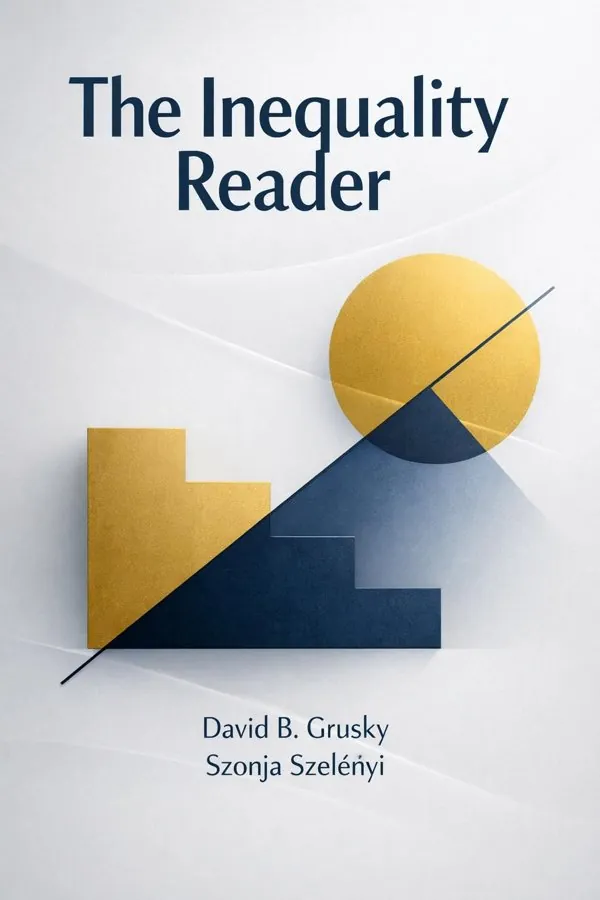
The Inequality Reader: Contemporary and Foundational Readings in Race, Class, and Gender: Summary & Key Insights
by David B. Grusky, Szonja Szelényi
 10 min9 chaptersAudio available
What Is The Inequality Reader: Contemporary and Foundational Readings in Race, Class, and Gender About?
The Inequality Reader: Contemporary and Foundational Readings in Race, Class, and Gender by David B. Grusky, Szonja Szelényi is a sociology book spanning 9 pages. The Inequality Reader is a comprehensive anthology that brings together classic and contemporary readings on social inequality. It explores the structures and processes that produce and sustain disparities in wealth, power, and opportunity across race, class, and gender. The collection includes foundational sociological texts and modern analyses, offering a broad perspective on the causes and consequences of inequality in modern societies.
This FizzRead summary covers all 9 key chapters of The Inequality Reader: Contemporary and Foundational Readings in Race, Class, and Gender in approximately 10 minutes, distilling the most important ideas, arguments, and takeaways from David B. Grusky, Szonja Szelényi's work. Also available as an audio summary and Key Quotes Podcast.
The Inequality Reader: Contemporary and Foundational Readings in Race, Class, and Gender
The Inequality Reader is a comprehensive anthology that brings together classic and contemporary readings on social inequality. It explores the structures and processes that produce and sustain disparities in wealth, power, and opportunity across race, class, and gender. The collection includes foundational sociological texts and modern analyses, offering a broad perspective on the causes and consequences of inequality in modern societies.
Who Should Read The Inequality Reader: Contemporary and Foundational Readings in Race, Class, and Gender?
This book is perfect for anyone interested in sociology and looking to gain actionable insights in a short read. Whether you're a student, professional, or lifelong learner, the key ideas from The Inequality Reader: Contemporary and Foundational Readings in Race, Class, and Gender by David B. Grusky, Szonja Szelényi will help you think differently.
- ✓Readers who enjoy sociology and want practical takeaways
- ✓Professionals looking to apply new ideas to their work and life
- ✓Anyone who wants the core insights of The Inequality Reader: Contemporary and Foundational Readings in Race, Class, and Gender in just 10 minutes
Want the full summary?
Get instant access to this book summary and 100K+ more with Fizz Moment.
Get Free SummaryAvailable on App Store • Free to download
Key Chapters
Every serious inquiry into inequality must begin with theory, because theories are the frameworks through which we recognize what counts as inequality. In this first part, I introduce you to the monumental thinkers of classical sociology — Marx, Weber, and Durkheim — each of whom saw stratification through distinct conceptual lenses. Marx understood inequality as a structural feature of capitalist production, rooted in the exploitation of labor and the concentration of surplus value. He argued that class struggle is not accidental but inherent to economic organization. By contrast, Weber expanded the idea to include not just class but also status and party, highlighting that economic position and social honor operate jointly to shape one’s life chances. Durkheim, meanwhile, examined how inequality relates to social function and solidarity, asking under what conditions differentiation leads to cohesion or breakdown.
As you read these foundational texts, notice how their insights echo through modern thought. What Marx described as alienation, Weber further developed as rationalization and bureaucracy, and Durkheim portrayed as moral integration. These perspectives are complementary and conflicting — a reminder that inequality resists reduction to a single dimension. I want you to see theory as more than historical documentation; it is the architecture of sociological imagination. Once you grasp how these thinkers defined social order and justice, you can apply their insights to modern phenomena like corporate hierarchies, state governance, and digital economies.
After grounding ourselves in theoretical approaches, we turn to the lived realities of class systems — to ask who gets ahead, who stays behind, and why mobility remains uneven despite democratic ideals. In this part, the readings guide you through empirical research on occupational stratification, income distribution, and patterns of social mobility. Scholars such as Blau and Duncan, and later Featherman and Hauser, meticulously measured how family origins shape life trajectories, revealing the enduring mechanisms through which class privilege reproduces itself.
From my perspective, what makes these studies powerful is their combination of statistical precision and moral urgency. We learn that mobility systems differ across societies — some offer the promise of meritocracy, others ossify status lines through education and inheritance. Yet beneath these differences lies a common thread: the structural linkage between opportunity and background. I encourage you to read these works not as cold data reports but as human stories encoded in numbers. They uncover how barriers form quietly through institutions and how upward movement, often celebrated, can mask deep exclusionary patterns.
+ 7 more chapters — available in the FizzRead app
All Chapters in The Inequality Reader: Contemporary and Foundational Readings in Race, Class, and Gender
About the Authors
David B. Grusky is a professor of sociology at Stanford University and director of the Center on Poverty and Inequality. Szonja Szelényi is a sociologist known for her work on social stratification and inequality, with research focusing on post-socialist societies and gender dynamics.
Get This Summary in Your Preferred Format
Read or listen to the The Inequality Reader: Contemporary and Foundational Readings in Race, Class, and Gender summary by David B. Grusky, Szonja Szelényi anytime, anywhere. FizzRead offers multiple formats so you can learn on your terms — all free.
Available formats: App · Audio · PDF · EPUB — All included free with FizzRead
Download The Inequality Reader: Contemporary and Foundational Readings in Race, Class, and Gender PDF and EPUB Summary
Key Quotes from The Inequality Reader: Contemporary and Foundational Readings in Race, Class, and Gender
“Every serious inquiry into inequality must begin with theory, because theories are the frameworks through which we recognize what counts as inequality.”
“In this part, the readings guide you through empirical research on occupational stratification, income distribution, and patterns of social mobility.”
Frequently Asked Questions about The Inequality Reader: Contemporary and Foundational Readings in Race, Class, and Gender
The Inequality Reader: Contemporary and Foundational Readings in Race, Class, and Gender by David B. Grusky, Szonja Szelényi is a sociology book that explores key ideas across 9 chapters. The Inequality Reader is a comprehensive anthology that brings together classic and contemporary readings on social inequality. It explores the structures and processes that produce and sustain disparities in wealth, power, and opportunity across race, class, and gender. The collection includes foundational sociological texts and modern analyses, offering a broad perspective on the causes and consequences of inequality in modern societies.
You Might Also Like

Between the World and Me
Ta-Nehisi Coates
10 min
Half the Sky
Nicholas D. Kristof, Sheryl WuDunn
10 min
Men Explain Things To Me
Rebecca Solnit
10 min
Rational Ritual
Michael Suk-Young Chwe
10 min
The New Jim Crow
Michelle Alexander
10 min
Beyond Culture
Edward T. Hall
10 minBrowse by Category
Ready to read The Inequality Reader: Contemporary and Foundational Readings in Race, Class, and Gender?
Get the full summary and 100K+ more books with Fizz Moment.