
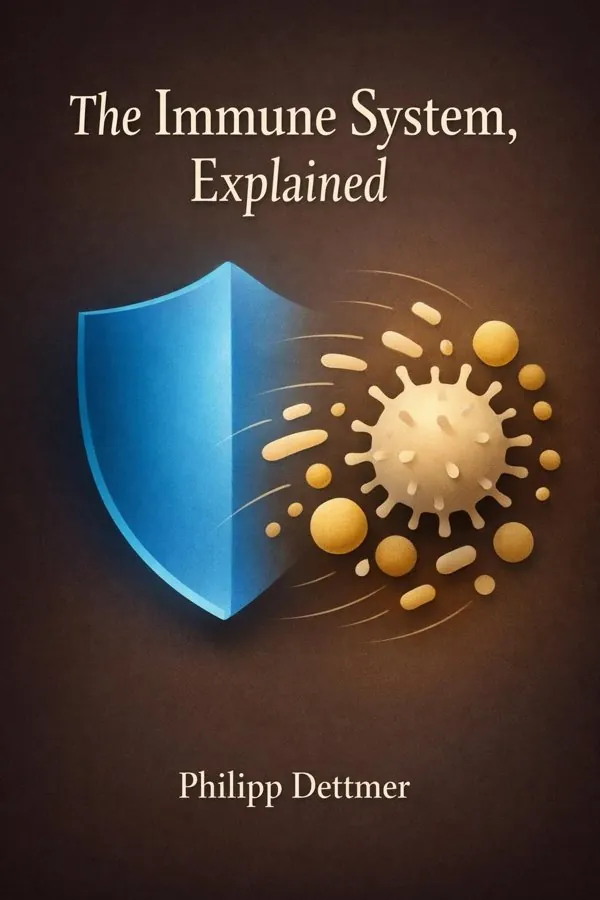
The Immune System, Explained: Summary & Key Insights
 10 min4 chaptersAudio available
What Is The Immune System, Explained About?
The Immune System, Explained by Philipp Dettmer is a life_science book spanning 4 pages. This book offers a clear and engaging explanation of how the human immune system works, using vivid metaphors and accessible language to describe complex biological processes. It explores how the body defends itself against pathogens, how immune cells communicate, and what happens during infections, allergies, and autoimmune diseases.
This FizzRead summary covers all 4 key chapters of The Immune System, Explained in approximately 10 minutes, distilling the most important ideas, arguments, and takeaways from Philipp Dettmer's work. Also available as an audio summary and Key Quotes Podcast.
The Immune System, Explained
This book offers a clear and engaging explanation of how the human immune system works, using vivid metaphors and accessible language to describe complex biological processes. It explores how the body defends itself against pathogens, how immune cells communicate, and what happens during infections, allergies, and autoimmune diseases.
Who Should Read The Immune System, Explained?
This book is perfect for anyone interested in life_science and looking to gain actionable insights in a short read. Whether you're a student, professional, or lifelong learner, the key ideas from The Immune System, Explained by Philipp Dettmer will help you think differently.
- ✓Readers who enjoy life_science and want practical takeaways
- ✓Professionals looking to apply new ideas to their work and life
- ✓Anyone who wants the core insights of The Immune System, Explained in just 10 minutes
Want the full summary?
Get instant access to this book summary and 100K+ more with Fizz Moment.
Get Free SummaryAvailable on App Store • Free to download
Key Chapters
The story of immunity begins at your borders. Imagine your body as a fortified kingdom. The first line of defense—the innate immune system—is like a standing army, always on guard, always ready to strike. Your skin, those layers of tightly packed cells, is more than a passive wrapping; it is an impenetrable wall reinforced with antimicrobial secretions and chemical deterrents. The mucous that lines your airways traps dust, pollen, and pathogens, and microscopic cilia sweep those threats away before they can dig in. Even the acid in your stomach acts as boiling oil poured upon invaders.
When something does break through, the innate immune system reacts fast. Macrophages—massive, hungry cells—act as the cleanup squads and scouts, devouring anything they recognize as foreign. Neutrophils are the shock troops, numerous and reckless, rushing into tissue like soldiers willing to die for the cause. They do not wait for orders; they attack anything suspicious within minutes. But their very enthusiasm creates collateral damage, releasing bursts of chemicals that also harm surrounding tissues.
Communication between these units is done via cytokines—tiny chemical messages that call for reinforcements, raise the local temperature, and open up blood vessels so more warriors can pour in. This collective response is what we recognize as inflammation: redness, heat, swelling, and pain. It’s not just a side effect; it’s a controlled chaos designed to trap enemies, alert allies, and rebuild damaged ground.
Then comes the adaptive immune system, the elite special forces. These units—B cells and T cells—are slower to deploy but infinitely smarter. Where the innate system sees only broad patterns, the adaptive system sees details: the unique molecular fingerprints of each invader. B cells produce antibodies, those Y-shaped molecules that mark enemies for destruction or neutralize them outright. T cells come in several varieties: the helper T cells that coordinate attacks, the killer T cells that destroy infected host cells, and the regulatory ones that call off the battle once victory is achieved.
What’s most amazing is that these adaptive troops learn. They remember. Each time you fight off an infection, your immune system refines its playbook. The next time the same pathogen attacks, your cells respond in hours instead of days. Immunity, in essence, is memory written in the language of cells and proteins.
One of humanity’s most transformative discoveries came when we realized we could train our immune army without suffering a real war. Vaccination works because your immune system doesn’t need to learn from a deadly encounter; it only needs to meet the enemy’s blueprint. When you receive a vaccine, your body is introduced to a harmless or incomplete version of a pathogen—something that mimics the real threat enough for your B and T cells to recognize it.
The immune system reacts as if it’s under attack. It mobilizes defenders, produces antibodies, and establishes a memory for the future. The next time the real pathogen appears, the army is already on alert, with specialized forces armed and ready. This pre-training is one of the most elegant human collaborations with nature—it’s not an invention, but a strategic use of the immune system’s built-in learning capacities.
Vaccines also remind us of the communal nature of immunity. A vaccinated individual is not just protecting themselves. They are plugging holes in a network that protects everyone, reducing opportunities for a virus to spread and mutate. Herd immunity is not abstract—it’s a social defense mechanism built on millions of immune systems cooperating silently.
It’s fascinating to realize that what feels like a simple jab is actually a conversation with your cells, teaching them to see, recognize, and respond to threats faster than they ever could on their own. Modern immunology continues to expand this dialogue. We can now teach the immune system to attack cancers, correct autoimmune mistakes, and even protect against pathogens that constantly mutate. Each discovery pushes us closer to understanding immunity not just as biology, but as programmable intelligence.
+ 2 more chapters — available in the FizzRead app
All Chapters in The Immune System, Explained
About the Author
Philipp Dettmer is the founder of the educational YouTube channel Kurzgesagt – In a Nutshell. He is known for making complex scientific topics understandable and visually appealing to a broad audience.
Get This Summary in Your Preferred Format
Read or listen to the The Immune System, Explained summary by Philipp Dettmer anytime, anywhere. FizzRead offers multiple formats so you can learn on your terms — all free.
Available formats: App · Audio · PDF · EPUB — All included free with FizzRead
Download The Immune System, Explained PDF and EPUB Summary
Key Quotes from The Immune System, Explained
“The story of immunity begins at your borders.”
“One of humanity’s most transformative discoveries came when we realized we could train our immune army without suffering a real war.”
Frequently Asked Questions about The Immune System, Explained
The Immune System, Explained by Philipp Dettmer is a life_science book that explores key ideas across 4 chapters. This book offers a clear and engaging explanation of how the human immune system works, using vivid metaphors and accessible language to describe complex biological processes. It explores how the body defends itself against pathogens, how immune cells communicate, and what happens during infections, allergies, and autoimmune diseases.
You Might Also Like
The Selfish Gene
Richard Dawkins
10 min
Awakenings
Oliver Sacks
10 min
Parasite Rex: Inside the Bizarre World of Nature's Most Dangerous Creatures
Carl Zimmer
10 min
The Atlas of Life on Earth
Various
10 min
The Book of Humans: The Story of How We Became Us
Adam Rutherford
10 min
The Horse
Wendy Williams
10 minBrowse by Category
Ready to read The Immune System, Explained?
Get the full summary and 100K+ more books with Fizz Moment.