
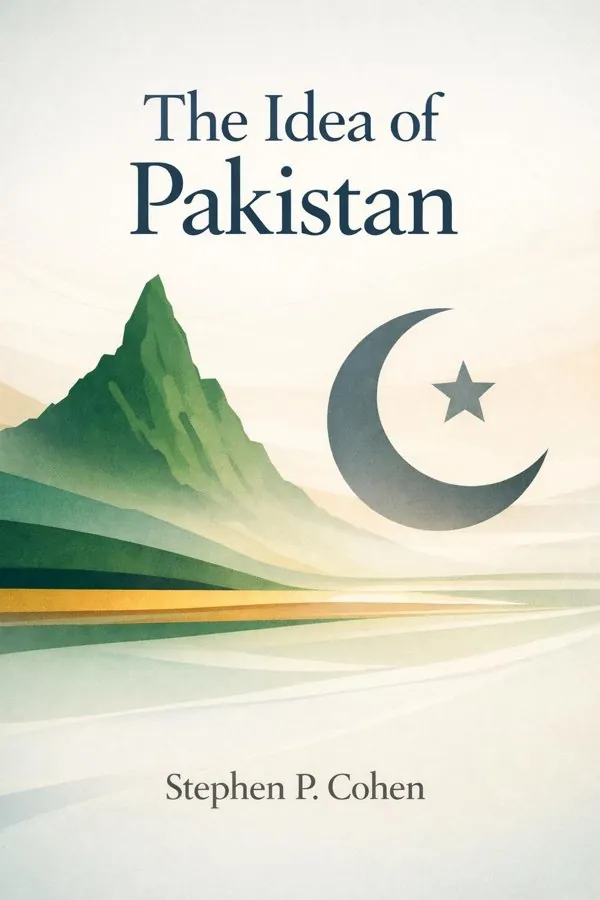
The Idea of Pakistan: Summary & Key Insights
 10 min10 chaptersAudio available
What Is The Idea of Pakistan About?
The Idea of Pakistan by Stephen P. Cohen is a politics book spanning 10 pages. In this comprehensive analysis, Stephen P. Cohen explores the historical, political, and ideological foundations of Pakistan. He examines the country's creation, its evolving identity, and the challenges it faces in balancing religion, nationalism, and modernity. The book provides a nuanced understanding of Pakistan’s domestic politics, civil-military relations, and its complex relationship with India and the wider world.
This FizzRead summary covers all 10 key chapters of The Idea of Pakistan in approximately 10 minutes, distilling the most important ideas, arguments, and takeaways from Stephen P. Cohen's work. Also available as an audio summary and Key Quotes Podcast.
The Idea of Pakistan
In this comprehensive analysis, Stephen P. Cohen explores the historical, political, and ideological foundations of Pakistan. He examines the country's creation, its evolving identity, and the challenges it faces in balancing religion, nationalism, and modernity. The book provides a nuanced understanding of Pakistan’s domestic politics, civil-military relations, and its complex relationship with India and the wider world.
Who Should Read The Idea of Pakistan?
This book is perfect for anyone interested in politics and looking to gain actionable insights in a short read. Whether you're a student, professional, or lifelong learner, the key ideas from The Idea of Pakistan by Stephen P. Cohen will help you think differently.
- ✓Readers who enjoy politics and want practical takeaways
- ✓Professionals looking to apply new ideas to their work and life
- ✓Anyone who wants the core insights of The Idea of Pakistan in just 10 minutes
Want the full summary?
Get instant access to this book summary and 100K+ more with Fizz Moment.
Get Free SummaryAvailable on App Store • Free to download
Key Chapters
To understand Pakistan, one must return to the intellectual soil of late colonial India. The movement for Pakistan did not arise overnight but grew gradually from the anxieties and aspirations of South Asian Muslims. At its core lay the Two-Nation Theory—the belief that Muslims and Hindus, although coexisting within a shared geography, represented distinct civilizations with incompatible social and political values. The leaders of the Pakistan movement, from Sir Syed Ahmad Khan to Muhammad Iqbal, nurtured the idea that safeguarding Muslim identity required political autonomy. Over decades, this concept evolved from cultural separatism into a call for a separate homeland.
Yet the idea was more political than theological. Many Muslim intellectuals were less concerned with creating a theocracy than with ensuring representation and security in a democratic India dominated by Hindu majorities. Iqbal’s vision of a 'Muslim polity' envisioned spiritual renewal through political independence, not clerical rule. When the All-India Muslim League embraced the Pakistan Resolution of 1940, it crystallized these concerns into a tangible goal: partition as political salvation. This was not merely a movement of elites—it resonated with millions of ordinary Muslims who feared subordination in a united India.
However, the origins of Pakistan also carry contradictions. The territory that eventually became Pakistan had not been central to earlier Muslim power centers, and many local leaders were only loosely connected to the nationalist vision of Jinnah’s Muslim League. This disconnection set the stage for post-independence fragmentation. What unified diverse regions—from Bengal to Punjab and Sindh—was less cultural affinity and more political expedience. Thus, from the start, Pakistan inherited a tension between the philosophical idea of Muslim unity and the practical realities of regional diversity.
Muhammad Ali Jinnah, the Quaid-e-Azam, remains Pakistan’s most enigmatic figure. His vision was clear in principle yet elusive in detail. He sought a democratic and inclusive Muslim state, not a religious autocracy. In speeches and debates leading to 1947, Jinnah emphasized constitutionalism, minority rights, and the rule of law—values drawn from his British legal training and liberal outlook. Yet the context of partition twisted those ideals. The violence and displacement that accompanied Pakistan’s birth left scars that distorted its early direction.
The new nation faced almost immediate crises: millions of refugees to resettle, contested borders with India, and administrative disarray. Jinnah, already ailing, had little time to construct strong institutions or define how Islam would function within the state. His successors inherited a blueprint that was noble but incomplete. The early years thus became a struggle to interpret Jinnah’s idea: Was Pakistan to be a secular democracy with a Muslim cultural base, or an Islamic republic governed by divine law? That ambiguity—embedded in the founding vision—shaped every subsequent debate about identity and governance.
For me, Jinnah’s legacy symbolizes both Pakistan’s best potential and its enduring uncertainty. He gave Pakistan moral legitimacy but left unanswered the hardest question: how to balance faith, diversity, and modern governance. That tension between idealism and practicality defines the very soul of Pakistan.
+ 8 more chapters — available in the FizzRead app
All Chapters in The Idea of Pakistan
About the Author
Stephen P. Cohen (1936–2019) was an American political scientist and senior fellow at the Brookings Institution. He was one of the foremost experts on South Asian security and politics, particularly India and Pakistan, and authored several influential works on the region’s strategic affairs.
Get This Summary in Your Preferred Format
Read or listen to the The Idea of Pakistan summary by Stephen P. Cohen anytime, anywhere. FizzRead offers multiple formats so you can learn on your terms — all free.
Available formats: App · Audio · PDF · EPUB — All included free with FizzRead
Download The Idea of Pakistan PDF and EPUB Summary
Key Quotes from The Idea of Pakistan
“To understand Pakistan, one must return to the intellectual soil of late colonial India.”
“Muhammad Ali Jinnah, the Quaid-e-Azam, remains Pakistan’s most enigmatic figure.”
Frequently Asked Questions about The Idea of Pakistan
The Idea of Pakistan by Stephen P. Cohen is a politics book that explores key ideas across 10 chapters. In this comprehensive analysis, Stephen P. Cohen explores the historical, political, and ideological foundations of Pakistan. He examines the country's creation, its evolving identity, and the challenges it faces in balancing religion, nationalism, and modernity. The book provides a nuanced understanding of Pakistan’s domestic politics, civil-military relations, and its complex relationship with India and the wider world.
You Might Also Like

Antifa: The Anti-Fascist Handbook
Mark Bray
10 min
Attack from Within: How Disinformation Is Sabotaging America
Barbara McQuade
10 min
Coercion, Capital, and European States, AD 990–1992
Charles Tilly
10 min
Digital Democracy: Concepts, Methodologies, Tools, and Applications
Various Authors
10 min
Fascism
Stanley G. Payne
10 min
Fire And Fury: Inside The Trump White House
Michael Wolff
10 minBrowse by Category
Ready to read The Idea of Pakistan?
Get the full summary and 100K+ more books with Fizz Moment.