
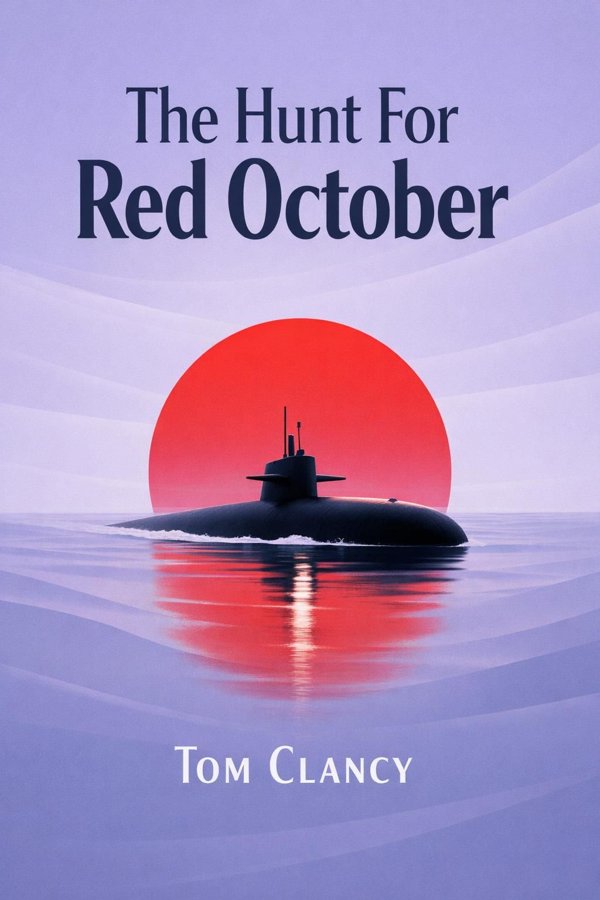
The Hunt For Red October: Summary & Key Insights
by Tom Clancy
 10 min9 chaptersAudio available
Key Takeaways from The Hunt For Red October
The Red October is not merely a vessel; it is the floating embodiment of Soviet ambition, military pride, and strategic fear.
The most dangerous rebellions are not always loud; sometimes they take the form of a quiet course correction.
Innovation is never neutral; every new machine rewrites the psychology of power.
Institutions often prefer a frightening explanation they understand to a hopeful one they do not.
In a world obsessed with force, sometimes the decisive weapon is interpretation.
What Is The Hunt For Red October About?
The Hunt For Red October by Tom Clancy is a war_military book spanning 4 pages. Tom Clancy’s The Hunt For Red October is a landmark Cold War thriller that turns submarine warfare, intelligence analysis, and political mistrust into gripping drama. At its center is Captain Marko Ramius, a brilliant Soviet naval officer who takes command of the Red October, a revolutionary nuclear submarine equipped with near-silent propulsion. When he suddenly steers his vessel away from Soviet control, both Moscow and Washington are forced to answer the same terrifying question: is this the beginning of a surprise attack, or an unprecedented defection? What follows is a high-stakes contest of sonar, strategy, and human judgment played out beneath the Atlantic. What makes the novel matter is not only its suspense, but its realism. Clancy brought uncommon technical precision to popular fiction, drawing on military systems, intelligence methods, and naval procedures with a level of detail that made readers feel they were inside the command center. More than an adventure story, the book explores trust under pressure, the danger of bureaucratic assumptions, and the thin line separating war from peace. It remains one of the defining techno-thrillers because it proves that in moments of global tension, understanding people can be as important as tracking weapons.
This FizzRead summary covers all 9 key chapters of The Hunt For Red October in approximately 10 minutes, distilling the most important ideas, arguments, and takeaways from Tom Clancy's work. Also available as an audio summary and Key Quotes Podcast.
The Hunt For Red October
Tom Clancy’s The Hunt For Red October is a landmark Cold War thriller that turns submarine warfare, intelligence analysis, and political mistrust into gripping drama. At its center is Captain Marko Ramius, a brilliant Soviet naval officer who takes command of the Red October, a revolutionary nuclear submarine equipped with near-silent propulsion. When he suddenly steers his vessel away from Soviet control, both Moscow and Washington are forced to answer the same terrifying question: is this the beginning of a surprise attack, or an unprecedented defection? What follows is a high-stakes contest of sonar, strategy, and human judgment played out beneath the Atlantic.
What makes the novel matter is not only its suspense, but its realism. Clancy brought uncommon technical precision to popular fiction, drawing on military systems, intelligence methods, and naval procedures with a level of detail that made readers feel they were inside the command center. More than an adventure story, the book explores trust under pressure, the danger of bureaucratic assumptions, and the thin line separating war from peace. It remains one of the defining techno-thrillers because it proves that in moments of global tension, understanding people can be as important as tracking weapons.
Who Should Read The Hunt For Red October?
This book is perfect for anyone interested in war_military and looking to gain actionable insights in a short read. Whether you're a student, professional, or lifelong learner, the key ideas from The Hunt For Red October by Tom Clancy will help you think differently.
- ✓Readers who enjoy war_military and want practical takeaways
- ✓Professionals looking to apply new ideas to their work and life
- ✓Anyone who wants the core insights of The Hunt For Red October in just 10 minutes
Want the full summary?
Get instant access to this book summary and 100K+ more with Fizz Moment.
Get Free SummaryAvailable on App Store • Free to download
Key Chapters
Great conflicts are often decided far from public view, and The Hunt For Red October begins by reminding us that the Cold War was as much a silent contest under the sea as it was a political rivalry on land. Tom Clancy opens the novel in a world shaped by secrecy, deterrence, and technological competition, where submarines serve as both symbols of national power and instruments of apocalyptic force. The Red October is not merely a vessel; it is the floating embodiment of Soviet ambition, military pride, and strategic fear.
By grounding the story in the oceanic front of the superpower struggle, Clancy gives readers a vivid sense of what the Cold War felt like for military professionals. Commands are filtered through ideology, every radar contact can trigger escalation, and ordinary sailors become participants in a global standoff. The sea is cold, dark, and unforgiving, but it is also politically charged. In this environment, misunderstanding is deadly. A movement detected by sonar might be an attack, a feint, or a plea for asylum.
This opening framework matters because it shows how systems of power shape personal decisions. Ramius’s later choice to defect means more because it takes place inside a machine built to eliminate individuality. For modern readers, the lesson extends beyond military history. In any high-pressure organization, context determines how actions are interpreted. A bold move may look like betrayal if others cannot imagine a different motive.
A practical way to apply this insight is to examine the environment around a major decision before judging it. Ask what assumptions govern the system, what fears are operating in the background, and how limited information distorts perception. Actionable takeaway: before evaluating any critical move, understand the larger system that makes that move seem risky, irrational, or revolutionary.
The most dangerous rebellions are not always loud; sometimes they take the form of a quiet course correction. Captain Marko Ramius is one of the novel’s most compelling achievements because he is not portrayed as a reckless traitor or a simplistic hero. He is disciplined, calculating, patriotic in his own way, and deeply aware of what his decision will cost. His attempt to defect with the Red October is rooted in personal grief, moral exhaustion, and a sober judgment about the Soviet system he serves.
Clancy uses Ramius to explore the inner life of a man trapped inside a structure that rewards obedience and punishes independent conscience. Ramius knows that by attempting defection, he risks not only his life but also the lives of his crew and potentially the stability of two nuclear powers. That burden gives his choice emotional and political gravity. He is not escaping inconvenience; he is rejecting an empire from within one of its most guarded institutions.
This makes Ramius’s arc valuable beyond the novel. In leadership, there are moments when competence alone is not enough. A person may realize that continuing to serve a system effectively also means enabling its worst tendencies. Professionals in government, business, or technology can face similar, if less extreme, dilemmas when loyalty conflicts with ethics.
A practical example is a senior employee who discovers that a successful organization is hiding dangerous flaws. Speaking up or leaving may look disloyal in the short term, but silence may carry the greater moral cost. Clancy shows that courageous judgment often involves accepting misunderstanding. Actionable takeaway: when loyalty and conscience collide, define your principles before the crisis comes, so you can act with clarity rather than panic.
Innovation is never neutral; every new machine rewrites the psychology of power. One of the book’s defining ideas is the strategic significance of the Red October’s “caterpillar drive,” a propulsion system designed to make the submarine extraordinarily quiet and therefore far harder to detect. In a world where survival depends on locating the enemy first, silence becomes a weapon more valuable than speed or firepower.
Clancy excels at showing how technical advances ripple outward. The new drive is not just an engineering marvel. It creates panic in Soviet command, suspicion in American intelligence, and urgency across multiple fleets. If the Soviets can deploy submarines that sonar cannot reliably track, the entire balance of deterrence changes. A weapon’s power lies not only in what it can destroy, but in how it forces everyone else to recalculate their assumptions.
This idea applies well beyond military hardware. In business, medicine, cybersecurity, and communications, breakthrough tools often alter the rules before institutions know how to respond. A company that adopts a powerful new AI system, for example, can unsettle competitors not merely by improving productivity but by changing what “normal” performance looks like. The first reaction from others may be denial, then fear, then an expensive scramble to catch up.
Clancy’s message is that leaders must understand technologies not as isolated gadgets but as strategic disruptors. The smartest people in the novel are those who ask what a new capability means for decision-making, not just how it works. Actionable takeaway: whenever you encounter a new technology, ask three questions immediately: what assumptions does it break, who will feel threatened by it, and how must strategy adapt in response?
Institutions often prefer a frightening explanation they understand to a hopeful one they do not. Once Ramius commits to defection, the Soviet state reacts with force and confusion. Unable or unwilling to accept that one of its finest submarine commanders could reject the system, Soviet leaders construct a more familiar narrative: mutiny, madness, or an offensive mission. Their response is to launch a massive naval pursuit, not simply to recover a submarine, but to erase the humiliation of internal betrayal.
At the same time, the United States does not immediately greet the situation with confidence or compassion. American officials fear that the apparent defection could be a deception designed to lure U.S. forces into exposure or worse, trigger a superpower incident. This dual skepticism drives much of the novel’s tension. Each side interprets the same event through its own fears. The Soviets see treason as impossible; the Americans see trickery as probable.
Clancy captures a universal truth about organizations under stress: people reach first for narratives that preserve their worldview. That tendency can be disastrous in diplomacy, intelligence, and corporate life alike. A sudden resignation might be blamed on sabotage instead of poor culture. A new competitor may be dismissed as temporary instead of taken seriously. In crises, rigid assumptions can become more dangerous than the threat itself.
The practical lesson is to separate evidence from institutional comfort. When a surprising event occurs, ask not what explanation feels most familiar, but what explanation best fits the facts. Build teams where dissenting interpretations are welcome before decisions harden. Actionable takeaway: in any high-stakes uncertainty, list at least three plausible explanations and test each one against evidence before committing to the one your system finds easiest to believe.
In a world obsessed with force, sometimes the decisive weapon is interpretation. Jack Ryan, a CIA analyst rather than a field operative or fleet commander, becomes central to the plot because he is willing to think differently. While military institutions on both sides respond according to doctrine and fear, Ryan notices patterns in Ramius’s behavior that suggest a radical possibility: the Soviet captain may be trying to defect.
This is one of Clancy’s most important contributions to thriller fiction. He elevates analysis into action. Ryan is not effective because he has the most power, but because he combines knowledge, curiosity, and the courage to make an unconventional argument. He studies Soviet naval culture, Ramius’s history, and the tactical situation, then proposes a theory that initially sounds absurd. His insight matters because he understands that human motives cannot be reduced to procedure.
For readers, this is a powerful reminder that expertise is not memorizing facts; it is connecting facts into a useful judgment. In workplaces today, analysts, researchers, and advisors often have to persuade leaders who prefer certainty over nuance. A data scientist warning about a hidden risk, or a strategist identifying a surprising opportunity, may face the same resistance Ryan does.
Clancy suggests that analysis becomes valuable only when paired with communication and conviction. Ryan has to move his idea from possibility to policy under extreme time pressure. Practical application: when you have a non-obvious interpretation, support it with evidence, state the stakes clearly, and explain why the conventional view may be wrong. Actionable takeaway: cultivate the habit of asking what others are missing, then learn to present your insight in a way decision-makers can act on.
Trust is most meaningful when it is built between people who have every reason to mistrust one another. As the hunt intensifies, one of the novel’s richest ideas emerges: beneath the layers of ideology, military rivalry, and propaganda, individuals can still recognize competence, sincerity, and shared interests. The eventual effort to establish contact between the Americans and Ramius depends on this fragile bridge of human understanding.
Clancy does not portray trust as naive optimism. It is cautious, incremental, and tied to evidence. Ryan’s belief in Ramius must be matched by precise naval maneuvering, disciplined communication, and constant contingency planning. Likewise, Ramius must decide whether the Americans will honor his intentions or exploit his vulnerability. This mutual testing gives the book emotional depth. The central question is no longer simply who can find the submarine first, but whether enemies can think their way past inherited hostility.
This idea has clear relevance in negotiation, diplomacy, and even everyday leadership. Trust rarely appears in a single dramatic moment; it is built through signals, consistency, and intelligent risk-taking. Two departments in conflict, for instance, may move toward cooperation not because they suddenly like each other, but because each side demonstrates reliability through small actions. In international affairs, back channels and limited agreements often work the same way.
Clancy’s insight is that strategic trust is not the opposite of caution; it is caution informed by empathy and evidence. You do not abandon safeguards, but you also do not let suspicion become self-fulfilling. Actionable takeaway: when cooperation seems impossible, look for one verifiable step that demonstrates good faith, and use that step as the foundation for wider trust.
Complex systems do not fail only because of enemies; they also fail because information arrives unevenly and institutions protect themselves. Throughout The Hunt For Red October, Clancy shows how military and intelligence bureaucracies can both enable and obstruct effective action. Orders move through chains of command, data is compartmentalized, and political leaders worry not just about reality but about appearances. In such environments, even capable people can make poor decisions because they do not see the whole picture.
The novel’s tension is heightened by this fragmentation. Soviet commanders act without understanding Ramius’s true intentions. American officials debate options while uncertain whether they are facing a defector, a trap, or the first stage of an attack. Individuals who grasp part of the truth must fight institutional inertia to turn that understanding into action. This is classic Clancy: suspense created not only by enemy movement, but by organizational friction.
The lesson is widely applicable. Large companies, hospitals, governments, and universities often suffer from the same problem. One team knows the technical reality, another controls messaging, a third manages legal risk, and no one can act decisively because knowledge is split across compartments. Secrecy may be necessary, but unmanaged secrecy breeds delay, duplication, and dangerous assumptions.
A practical response is to design decision processes that clarify who knows what, who decides what, and what thresholds trigger broader disclosure. Crisis planning is especially important. If your organization waits until the emergency arrives to define communication channels, confusion will dominate. Actionable takeaway: in any high-stakes system, reduce preventable blindness by mapping information flow in advance and ensuring critical decisions are not trapped inside isolated silos.
Pressure does not create character so much as reveal what was already there. In the later stages of the novel, sabotage and near-disaster test everyone aboard the Red October and the forces surrounding it. Mechanical danger, divided loyalties, and the constant risk of detection force leaders to make fast decisions with incomplete information. Clancy uses these moments not just to raise suspense, but to examine how competent leadership functions when every mistake can be fatal.
What stands out is the contrast between panic and disciplined action. Effective leaders in the novel do not eliminate fear; they organize around it. They prioritize, communicate clearly, and focus on the next solvable problem. Whether handling damage, deception, or enemy pressure, they rely on preparation and procedure without becoming slaves to routine. This balance is crucial. In crisis, blind improvisation is dangerous, but so is rigid adherence to a plan that no longer fits reality.
Readers can apply this insight in any environment where stakes feel high: emergency response, corporate turnarounds, legal disputes, or personal crises. A manager confronting a major systems failure, for example, should avoid flooding the team with speculation. Instead, identify immediate risks, assign responsibilities, verify facts, and update plans as new information arrives. Calm is contagious when it is paired with competence.
Clancy also reminds us that trust built earlier becomes decisive later. Teams perform better under stress when they already know who can handle which tasks. Preparation is what turns courage into effectiveness. Actionable takeaway: when facing a crisis, focus first on stabilizing the immediate danger, assign clear roles, and communicate only what helps people act decisively rather than react emotionally.
Machines may dominate the surface of The Hunt For Red October, but its deepest argument is about people. Submarines, sonar systems, torpedoes, and classified technologies create the framework of the story, yet the outcome depends on judgment, memory, fear, loyalty, and imagination. Clancy’s genius lies in showing that even in the most technical form of warfare, human beings remain the decisive variable.
This is why the novel endures. It satisfies readers who love military detail, but it also speaks to anyone interested in decision-making. The conflict turns on whether people can correctly read one another across barriers of ideology and secrecy. Ryan must infer Ramius’s intentions. American commanders must decide how much risk to accept. Soviet officials must choose whether to protect truth or prestige. Every major development arises from a human interpretation of uncertain information.
That insight matters today in a world fascinated by automation, algorithms, and systems thinking. Tools can extend perception and speed response, but they do not remove the need for moral judgment or strategic imagination. In business, advanced dashboards cannot replace leaders who understand culture and motive. In security, better sensors do not eliminate the possibility of misreading intent. In personal life, data can inform choices, but not define values.
Clancy invites us to respect expertise without worshipping machinery. The best operators in the novel are those who combine technical fluency with emotional intelligence and intellectual flexibility. Actionable takeaway: when evaluating any complex problem, give equal attention to systems and to the people inside them, because outcomes are often determined less by the tools available than by the judgments made under pressure.
All Chapters in The Hunt For Red October
About the Author
Tom Clancy was an American novelist whose work helped define the modern techno-thriller. Born in 1947, he became famous with his debut novel, The Hunt For Red October, which stood out for its detailed portrayal of military systems, intelligence operations, and Cold War strategy. Although he had not served in the military, Clancy earned a reputation for remarkable research and for making complex defense topics accessible and exciting to general readers. Many of his novels feature analysts, soldiers, spies, and political leaders confronting global crises shaped by technology and geopolitics. His Jack Ryan series became especially influential, inspiring films, television adaptations, and a lasting franchise. Clancy died in 2013, but his books remain central to military and espionage fiction.
Get This Summary in Your Preferred Format
Read or listen to the The Hunt For Red October summary by Tom Clancy anytime, anywhere. FizzRead offers multiple formats so you can learn on your terms — all free.
Available formats: App · Audio · PDF · EPUB — All included free with FizzRead
Download The Hunt For Red October PDF and EPUB Summary
Key Quotes from The Hunt For Red October
“Tom Clancy opens the novel in a world shaped by secrecy, deterrence, and technological competition, where submarines serve as both symbols of national power and instruments of apocalyptic force.”
“The most dangerous rebellions are not always loud; sometimes they take the form of a quiet course correction.”
“Innovation is never neutral; every new machine rewrites the psychology of power.”
“Institutions often prefer a frightening explanation they understand to a hopeful one they do not.”
“In a world obsessed with force, sometimes the decisive weapon is interpretation.”
Frequently Asked Questions about The Hunt For Red October
The Hunt For Red October by Tom Clancy is a war_military book that explores key ideas across 9 chapters. Tom Clancy’s The Hunt For Red October is a landmark Cold War thriller that turns submarine warfare, intelligence analysis, and political mistrust into gripping drama. At its center is Captain Marko Ramius, a brilliant Soviet naval officer who takes command of the Red October, a revolutionary nuclear submarine equipped with near-silent propulsion. When he suddenly steers his vessel away from Soviet control, both Moscow and Washington are forced to answer the same terrifying question: is this the beginning of a surprise attack, or an unprecedented defection? What follows is a high-stakes contest of sonar, strategy, and human judgment played out beneath the Atlantic. What makes the novel matter is not only its suspense, but its realism. Clancy brought uncommon technical precision to popular fiction, drawing on military systems, intelligence methods, and naval procedures with a level of detail that made readers feel they were inside the command center. More than an adventure story, the book explores trust under pressure, the danger of bureaucratic assumptions, and the thin line separating war from peace. It remains one of the defining techno-thrillers because it proves that in moments of global tension, understanding people can be as important as tracking weapons.
You Might Also Like
Patriot
Andrew Britton
10 min
War
John Hersey
10 min
An Army at Dawn: The War in North Africa, 1942–1943
Rick Atkinson
10 min
Brave New War: The Next Stage of Terrorism and the End of Globalization
John Robb
10 min
Catch-22
Joseph Heller
10 min
Command and Control: Nuclear Weapons, the Damascus Accident, and the Illusion of Safety
Eric Schlosser
10 minBrowse by Category
Ready to read The Hunt For Red October?
Get the full summary and 100K+ more books with Fizz Moment.