
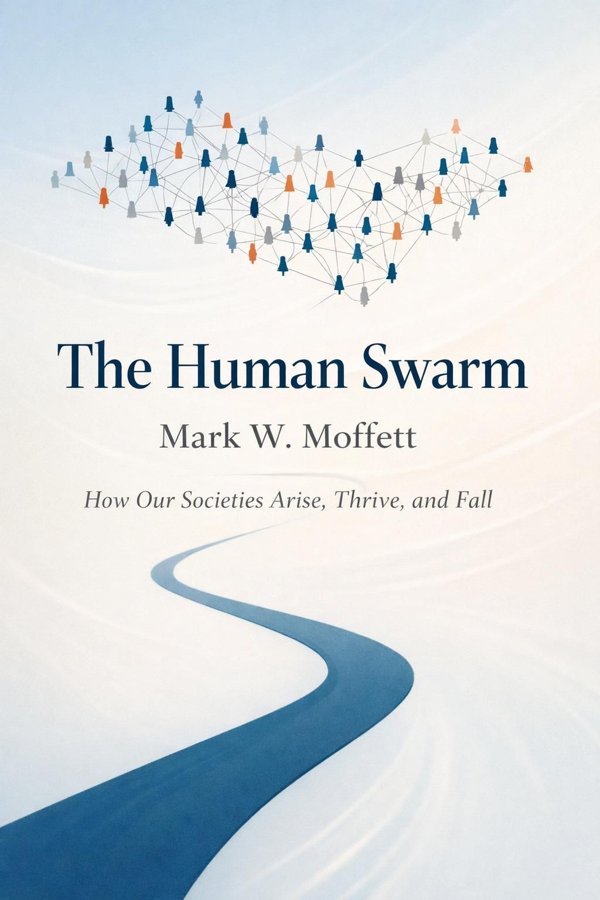
The Human Swarm: How Our Societies Arise, Thrive, and Fall: Summary & Key Insights
 10 min10 chaptersAudio available
What Is The Human Swarm: How Our Societies Arise, Thrive, and Fall About?
The Human Swarm: How Our Societies Arise, Thrive, and Fall by Mark W. Moffett is a sociology book spanning 10 pages. In this original work of social biology, Mark W. Moffett explores how human societies form, sustain themselves, and collapse. Drawing on evolutionary biology, anthropology, and psychology, Moffett compares human social organization to that of other species, explaining how identity, trust, and social cohesion enable large-scale cooperation among strangers. The book examines the mechanisms that allow societies to expand and the vulnerabilities that lead to their fragmentation.
This FizzRead summary covers all 10 key chapters of The Human Swarm: How Our Societies Arise, Thrive, and Fall in approximately 10 minutes, distilling the most important ideas, arguments, and takeaways from Mark W. Moffett's work. Also available as an audio summary and Key Quotes Podcast.
The Human Swarm: How Our Societies Arise, Thrive, and Fall
In this original work of social biology, Mark W. Moffett explores how human societies form, sustain themselves, and collapse. Drawing on evolutionary biology, anthropology, and psychology, Moffett compares human social organization to that of other species, explaining how identity, trust, and social cohesion enable large-scale cooperation among strangers. The book examines the mechanisms that allow societies to expand and the vulnerabilities that lead to their fragmentation.
Who Should Read The Human Swarm: How Our Societies Arise, Thrive, and Fall?
This book is perfect for anyone interested in sociology and looking to gain actionable insights in a short read. Whether you're a student, professional, or lifelong learner, the key ideas from The Human Swarm: How Our Societies Arise, Thrive, and Fall by Mark W. Moffett will help you think differently.
- ✓Readers who enjoy sociology and want practical takeaways
- ✓Professionals looking to apply new ideas to their work and life
- ✓Anyone who wants the core insights of The Human Swarm: How Our Societies Arise, Thrive, and Fall in just 10 minutes
Want the full summary?
Get instant access to this book summary and 100K+ more with Fizz Moment.
Get Free SummaryAvailable on App Store • Free to download
Key Chapters
If identity tells us who we are, recognition systems tell us how to maintain it. Among ants, specific pheromones define colony membership. Among humans, recognition operates on multiple levels: facial familiarity, language, clothing, symbols, even accents. I argue that such systems are the scaffolding of society; they allow trust to scale beyond the reach of personal acquaintance.
Mirror neurons, facial pattern recognition, and the human prefrontal cortex all serve as biological underpinnings for this recognition. Yet the uniquely human innovation is symbolic recognition—our capacity to mark membership through flags, shared names, and national emblems. A stranger wearing the uniform of your army or the badge of your organization instantly earns a presumption of trust. That shorthand is our biological recognition system upgraded by culture and imagination.
Recognition systems form the invisible boundary lines of societies. They not only sustain cohesion but also define norms, expectations, and pathways of trust. When recognition falters—when symbols lose shared meaning—societies experience disintegration. That is why revolutions and civil wars so often begin with disputes over symbols and language.
+ 8 more chapters — available in the FizzRead app
All Chapters in The Human Swarm: How Our Societies Arise, Thrive, and Fall
About the Author
Mark W. Moffett is an American biologist, explorer, and author known for his research on animal behavior and social organization. He has written extensively on ants and human societies and has contributed to National Geographic and other scientific publications.
Get This Summary in Your Preferred Format
Read or listen to the The Human Swarm: How Our Societies Arise, Thrive, and Fall summary by Mark W. Moffett anytime, anywhere. FizzRead offers multiple formats so you can learn on your terms — all free.
Available formats: App · Audio · PDF · EPUB — All included free with FizzRead
Download The Human Swarm: How Our Societies Arise, Thrive, and Fall PDF and EPUB Summary
Key Quotes from The Human Swarm: How Our Societies Arise, Thrive, and Fall
“Every society, no matter how rudimentary or complex, is built on identity.”
“If identity tells us who we are, recognition systems tell us how to maintain it.”
Frequently Asked Questions about The Human Swarm: How Our Societies Arise, Thrive, and Fall
The Human Swarm: How Our Societies Arise, Thrive, and Fall by Mark W. Moffett is a sociology book that explores key ideas across 10 chapters. In this original work of social biology, Mark W. Moffett explores how human societies form, sustain themselves, and collapse. Drawing on evolutionary biology, anthropology, and psychology, Moffett compares human social organization to that of other species, explaining how identity, trust, and social cohesion enable large-scale cooperation among strangers. The book examines the mechanisms that allow societies to expand and the vulnerabilities that lead to their fragmentation.
You Might Also Like
Between the World and Me
Ta-Nehisi Coates
10 min
Half the Sky
Nicholas D. Kristof, Sheryl WuDunn
10 min
Men Explain Things To Me
Rebecca Solnit
10 min
Rational Ritual
Michael Suk-Young Chwe
10 min
The New Jim Crow
Michelle Alexander
10 min
Beyond Culture
Edward T. Hall
10 minBrowse by Category
Ready to read The Human Swarm: How Our Societies Arise, Thrive, and Fall?
Get the full summary and 100K+ more books with Fizz Moment.