
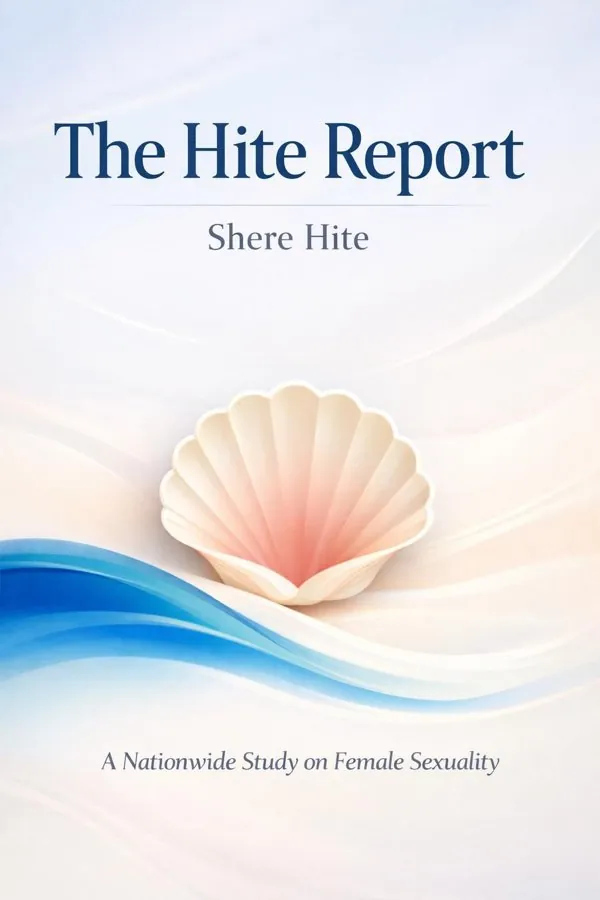
The Hite Report: A Nationwide Study on Female Sexuality: Summary & Key Insights
by Shere Hite
 10 min9 chaptersAudio available
Key Takeaways from The Hite Report: A Nationwide Study on Female Sexuality
A society often reveals its deepest blind spots not by what it studies, but by how it asks questions.
One of the book’s most powerful claims is that women’s sexuality had long been interpreted through male-centered frameworks.
Sexual freedom is not only about what happens between people; it begins with how a person inhabits her own body.
A culture’s discomfort with masturbation often reveals its discomfort with autonomy.
Few ideas in the book were more disruptive than Hite’s challenge to prevailing beliefs about female orgasm.
What Is The Hite Report: A Nationwide Study on Female Sexuality About?
The Hite Report: A Nationwide Study on Female Sexuality by Shere Hite is a sociology book spanning 14 pages. The Hite Report: A Nationwide Study on Female Sexuality is one of the most influential and controversial books ever written about women’s sexual lives. First published in 1976, it drew on thousands of anonymous questionnaire responses from women across the United States, allowing them to describe their experiences in their own words rather than fitting them into categories designed by male researchers. The result was not just a study of sexual behavior, but a sweeping portrait of how women understood pleasure, orgasm, intimacy, relationships, shame, marriage, and freedom. What made the book revolutionary was its insistence that female sexuality could not be properly understood through male assumptions, medical myths, or cultural stereotypes. Shere Hite argued that women’s lived experiences had been systematically ignored, especially when they contradicted accepted beliefs about intercourse, orgasm, and romantic fulfillment. By centering women’s voices, she challenged long-standing ideas in psychology, sociology, and popular culture. Hite’s authority came not from detached theory alone, but from her bold methodological choice: listen directly to women, at scale, and take what they say seriously. That choice transformed sexual research and helped redefine feminist debates about the body, autonomy, and equality.
This FizzRead summary covers all 9 key chapters of The Hite Report: A Nationwide Study on Female Sexuality in approximately 10 minutes, distilling the most important ideas, arguments, and takeaways from Shere Hite's work. Also available as an audio summary and Key Quotes Podcast.
The Hite Report: A Nationwide Study on Female Sexuality
The Hite Report: A Nationwide Study on Female Sexuality is one of the most influential and controversial books ever written about women’s sexual lives. First published in 1976, it drew on thousands of anonymous questionnaire responses from women across the United States, allowing them to describe their experiences in their own words rather than fitting them into categories designed by male researchers. The result was not just a study of sexual behavior, but a sweeping portrait of how women understood pleasure, orgasm, intimacy, relationships, shame, marriage, and freedom.
What made the book revolutionary was its insistence that female sexuality could not be properly understood through male assumptions, medical myths, or cultural stereotypes. Shere Hite argued that women’s lived experiences had been systematically ignored, especially when they contradicted accepted beliefs about intercourse, orgasm, and romantic fulfillment. By centering women’s voices, she challenged long-standing ideas in psychology, sociology, and popular culture.
Hite’s authority came not from detached theory alone, but from her bold methodological choice: listen directly to women, at scale, and take what they say seriously. That choice transformed sexual research and helped redefine feminist debates about the body, autonomy, and equality.
Who Should Read The Hite Report: A Nationwide Study on Female Sexuality?
This book is perfect for anyone interested in sociology and looking to gain actionable insights in a short read. Whether you're a student, professional, or lifelong learner, the key ideas from The Hite Report: A Nationwide Study on Female Sexuality by Shere Hite will help you think differently.
- ✓Readers who enjoy sociology and want practical takeaways
- ✓Professionals looking to apply new ideas to their work and life
- ✓Anyone who wants the core insights of The Hite Report: A Nationwide Study on Female Sexuality in just 10 minutes
Want the full summary?
Get instant access to this book summary and 100K+ more with Fizz Moment.
Get Free SummaryAvailable on App Store • Free to download
Key Chapters
A society often reveals its deepest blind spots not by what it studies, but by how it asks questions. Shere Hite’s first major insight is methodological: if women were going to speak honestly about sexuality, they needed privacy, control, and freedom from judgment. Instead of relying primarily on clinical interviews or laboratory observation, she used detailed anonymous questionnaires that invited women to write openly about their experiences, feelings, frustrations, and desires in their own language.
This mattered because traditional sex research frequently prioritized measurable acts over subjective meaning. It could count frequency, classify behaviors, or analyze anatomy, yet still miss what women actually felt. Hite’s approach treated personal testimony as valid evidence rather than anecdotal noise. That allowed her to capture contradictions: women who loved their partners but felt sexually dissatisfied, women who experienced pleasure but not through intercourse, and women who had learned to perform expected roles rather than express genuine desire.
The design also exposed how social pressure distorts sexual reporting. Many women admitted they had previously hidden dissatisfaction to avoid hurting partners, appearing abnormal, or violating norms of femininity. Anonymous writing reduced that pressure and made invisible experiences visible.
In practical terms, Hite’s method offers a lesson far beyond sexuality. Teachers, managers, therapists, and researchers all get better information when people feel safe enough to tell the truth. Open-ended questions, confidentiality, and nonjudgmental framing often reveal more than standardized checklists.
Actionable takeaway: when you want honest insight on sensitive topics, create conditions of privacy, respect, and open expression before expecting real answers.
One of the book’s most powerful claims is that women’s sexuality had long been interpreted through male-centered frameworks. For centuries, medicine, religion, philosophy, and psychology described women’s desire as passive, secondary, mysterious, or deficient. From classical thought to modern psychoanalysis, influential theories often assumed that women were naturally less sexual, fulfilled mainly through reproduction, or properly satisfied by male-led intercourse.
Hite argues that these inherited beliefs did not simply misdescribe women; they shaped what women were taught to expect from themselves. If a culture says “normal” female sexuality centers on pleasing men and reaching fulfillment through penile-vaginal intercourse, then women who do not experience that pattern may feel broken instead of informed. The problem is not only bad theory. It is the social authority of bad theory.
By collecting women’s own accounts, Hite exposes the gap between doctrine and lived experience. Many respondents described desire as active rather than passive, complex rather than linear, and deeply connected to context, self-knowledge, and emotional safety. Their narratives challenged the assumption that male experience could serve as the default template for human sexuality.
This insight remains relevant in everyday life. Media, advice columns, and even health education still often smuggle in narrow definitions of what “counts” as sex, pleasure, or intimacy. Whenever one group’s experience becomes universal, other experiences are pushed to the margins.
Actionable takeaway: question any sexual norm that presents itself as natural or universal, and ask whose experience it was built around in the first place.
Sexual freedom is not only about what happens between people; it begins with how a person inhabits her own body. Hite shows that many women’s sexual experiences were filtered through self-consciousness, embarrassment, and cultural judgment about appearance. Women reported worrying about weight, breasts, body hair, smell, posture, aging, and whether they looked desirable enough while being intimate. These anxieties were not superficial distractions. They directly affected relaxation, arousal, communication, and pleasure.
The book links body image to a broader social system in which women learn to see themselves from the outside. Instead of experiencing the body as a source of sensation, agency, and vitality, many are trained to treat it as an object to be evaluated. This externalized self-monitoring can split attention during intimacy: part of the mind stays busy managing how one appears rather than noticing what one feels.
Hite also suggests that shame thrives in silence. If women are rarely encouraged to discuss their bodies honestly, insecurities become private burdens that seem uniquely personal rather than socially produced. A woman who feels abnormal may simply be carrying a common insecurity alone.
The practical implications are significant. More affirming sexual education, less appearance-centered messaging, and more open conversation about real bodies can improve not just confidence but sexual well-being. On an individual level, body acceptance may start with basic sensory awareness: noticing comfort, pleasure, tension, and preference without immediate self-judgment.
Actionable takeaway: replace appearance-based self-evaluation with curiosity about sensation, comfort, and preference, especially in moments meant for intimacy and pleasure.
A culture’s discomfort with masturbation often reveals its discomfort with autonomy. Hite treats masturbation not as a marginal topic, but as essential evidence for understanding female sexuality. Women’s reports of self-stimulation showed how they actually reached pleasure when free from performance pressures, partner expectations, or myths about what should be satisfying.
This was radical because it shifted the discussion from abstract theory to direct bodily knowledge. Many respondents described learning about their own arousal patterns through self-exploration, often discovering that clitoral stimulation, rhythm, privacy, and mental relaxation mattered more than conventional scripts suggested. In contrast, women who had little opportunity or permission to explore themselves were more likely to feel uncertain about what they wanted or unable to communicate it to partners.
Hite’s broader point is that self-knowledge is foundational to sexual agency. Without it, people may depend on cultural narratives or partner assumptions to define their experience. With it, they can distinguish between obligation and desire, between performance and pleasure, and between what is common and what is personally meaningful.
This insight has practical value beyond the topic itself. Self-awareness improves communication. A person who understands what feels good, what does not, what pace works, and what emotional conditions matter is better equipped to build mutually satisfying intimacy. Sex education that omits this dimension leaves people uninformed about their own bodies.
Actionable takeaway: treat self-knowledge as a legitimate part of sexual health, and view learning your own responses as preparation for clearer, more confident communication with partners.
Few ideas in the book were more disruptive than Hite’s challenge to prevailing beliefs about female orgasm. She argued, based on women’s own accounts, that many women did not regularly reach orgasm through intercourse alone and that this should not be interpreted as dysfunction. Instead, she highlighted the central importance of clitoral stimulation and exposed how cultural and psychological theories had elevated intercourse as the benchmark of “mature” sexuality.
The significance of this finding goes beyond technique. When one sexual act is culturally crowned as the standard route to fulfillment, women whose bodies respond differently may feel inadequate, and men may misunderstand dissatisfaction as emotional rather than structural. Hite reframed the issue: the problem was not women failing a sexual norm, but the norm failing to reflect women’s anatomy and experience.
She also showed that orgasm is shaped by more than physical contact. Emotional comfort, trust, time, communication, and freedom from pressure all influenced women’s responses. For some, the demand to climax itself became an obstacle. Pleasure became performative when success was judged by whether a prescribed outcome happened on cue.
In practical relationships, this insight encourages couples to abandon rigid scripts and focus on mutual discovery. Instead of asking whether sex conforms to a standard sequence, partners can ask what kinds of touch, pacing, atmosphere, and communication actually create pleasure.
Actionable takeaway: stop measuring sexual satisfaction by conformity to a single script, and start centering anatomy, communication, and shared responsiveness in intimate experiences.
One of the most striking patterns in The Hite Report is that emotional attachment did not automatically produce sexual satisfaction. Many women described loving male partners deeply while also feeling unseen, rushed, pressured, or constrained within sexual relationships. This tension mattered because it contradicted the cultural fantasy that love naturally resolves mismatched expectations, communication problems, or unequal sexual scripts.
Hite shows that many women entered relationships shaped by gender roles that granted men more sexual initiative and women more responsibility for emotional maintenance. As a result, women often managed feelings, avoided conflict, and protected male ego even when their own needs were unmet. Some respondents described faking enthusiasm or orgasm, not because they were dishonest by nature, but because honesty felt costly. It risked conflict, embarrassment, or being labeled difficult.
The book also explores how emotional intimacy and sexual openness can diverge. A couple may share affection, history, and commitment while still lacking the language to discuss desire. In such cases, dissatisfaction becomes normalized rather than addressed.
This analysis remains highly practical. Healthy intimacy requires more than attraction and goodwill; it requires explicit communication, willingness to challenge gendered assumptions, and the capacity to hear feedback without defensiveness. Partners who ask open questions, invite honesty, and treat sexual compatibility as a shared learning process are more likely to build trust.
Actionable takeaway: do not assume love guarantees sexual understanding; make room for direct, specific, and ongoing conversations about pleasure, boundaries, and unmet needs.
Sexual behavior does not emerge in a vacuum; it is organized by social expectations about what men and women are supposed to be. Hite repeatedly connects individual experiences to broader gender conditioning. Women were taught to be desirable but not too desiring, attractive but not demanding, loving but not self-centered, available but not openly erotic on their own terms. These contradictions produced confusion and restraint.
The book argues that female sexuality had been disciplined through rewards and punishments. Women who complied with ideals of passivity and caretaking were more socially accepted, while women who voiced strong desire, insisted on satisfaction, or rejected conventional relationship roles often faced stigma. This meant that many sexual difficulties were not private failures, but predictable effects of social training.
Hite also links marriage and long-term partnership to these patterns. In many traditional arrangements, domestic labor, emotional labor, and sexual accommodation were expected from women, while their own erotic subjectivity remained secondary. Generational differences appeared too: younger women sometimes voiced more openness, but they still inherited deeply embedded norms.
The practical lesson is sociological as much as personal. Lasting change requires better education, more egalitarian relationships, and public narratives that validate women as full sexual subjects rather than supporting characters in male desire. On an individual level, people can begin by noticing where their preferences are genuinely their own and where they may be inherited obligations.
Actionable takeaway: examine how gender expectations influence your intimate choices, and intentionally separate authentic desire from roles you were taught to perform.
Another important contribution of The Hite Report is its refusal to reduce women’s sexuality to a single pathway. The book includes women’s experiences with men, with women, within marriage, outside marriage, across different ages, and across varying emotional contexts. By doing so, Hite demonstrates that sexuality is diverse in form, meaning, and expression. No single relationship structure, orientation, or life stage can capture the whole picture.
Her discussion of relationships with women is especially significant because it broadens the frame through which pleasure and intimacy are understood. These accounts helped reveal that many aspects of satisfaction often attributed to individual compatibility were also shaped by social scripts. When women described different dynamics in same-sex relationships, including communication styles and attentiveness to mutual pleasure, it raised questions about how heterosexual norms had limited expectations rather than simply reflecting nature.
Hite’s attention to generational differences adds another layer. Women from different age groups often described different degrees of shame, experimentation, resignation, or assertiveness, showing how sexuality changes across both personal development and historical context.
For readers today, the value of this diversity is liberating. It encourages humility: your experience may be real without being universal. It also supports empathy by showing how social location influences intimate life. Better conversations about sexuality begin when people stop searching for one normal and start recognizing patterns within variation.
Actionable takeaway: approach sexuality as a spectrum of lived realities, and replace rigid categories with curiosity, empathy, and respect for difference.
At the heart of Hite’s work lies a larger feminist claim: sexual fulfillment is inseparable from autonomy. Women cannot fully experience freedom in intimacy if they are denied authority over their bodies, silenced in relationships, or taught to subordinate their pleasure to social approval. The book’s cumulative evidence points toward empowerment not as a slogan, but as a practical condition for healthier sexual lives.
Autonomy in Hite’s framework includes several elements: the right to define one’s own desires, the confidence to communicate preferences, the freedom to reject unsatisfying norms, and the social legitimacy to seek pleasure without shame. It also includes intellectual autonomy: the ability to question expert claims that conflict with lived experience. Hite asks readers to take women’s testimony seriously, even when it unsettles institutions or customs.
This argument has implications for research, education, and public life. Future studies, she suggests, must center participants’ voices rather than force them into outdated models. Society must stop treating women’s sexuality as either a problem to be managed or a mystery to be decoded by others. Instead, it should be recognized as a domain of agency, complexity, and knowledge.
For individuals, the message is both personal and political. Sexual well-being grows where there is honesty, consent, self-respect, and mutuality. It declines where silence, hierarchy, and shame dominate.
Actionable takeaway: strengthen sexual autonomy by treating your own experience as meaningful data, speaking more clearly about your needs, and refusing norms that deny your full humanity.
All Chapters in The Hite Report: A Nationwide Study on Female Sexuality
About the Author
Shere Hite (1942–2020) was an American-born German sexologist, feminist thinker, and author whose work reshaped modern discussions of sexuality. She gained international recognition with The Hite Report, a groundbreaking study that used thousands of anonymous responses from women to challenge dominant assumptions about female desire, orgasm, and relationships. Unlike many earlier researchers, Hite emphasized subjective experience and open-ended testimony, arguing that women’s voices had been excluded from the construction of sexual knowledge. Her later books examined male sexuality, love, family, and gender relations more broadly. Although her work was often controversial, it had enormous cultural impact and helped expand feminist, sociological, and psychological debates about intimacy, power, and personal autonomy.
Get This Summary in Your Preferred Format
Read or listen to the The Hite Report: A Nationwide Study on Female Sexuality summary by Shere Hite anytime, anywhere. FizzRead offers multiple formats so you can learn on your terms — all free.
Available formats: App · Audio · PDF · EPUB — All included free with FizzRead
Download The Hite Report: A Nationwide Study on Female Sexuality PDF and EPUB Summary
Key Quotes from The Hite Report: A Nationwide Study on Female Sexuality
“A society often reveals its deepest blind spots not by what it studies, but by how it asks questions.”
“One of the book’s most powerful claims is that women’s sexuality had long been interpreted through male-centered frameworks.”
“Sexual freedom is not only about what happens between people; it begins with how a person inhabits her own body.”
“A culture’s discomfort with masturbation often reveals its discomfort with autonomy.”
“Few ideas in the book were more disruptive than Hite’s challenge to prevailing beliefs about female orgasm.”
Frequently Asked Questions about The Hite Report: A Nationwide Study on Female Sexuality
The Hite Report: A Nationwide Study on Female Sexuality by Shere Hite is a sociology book that explores key ideas across 9 chapters. The Hite Report: A Nationwide Study on Female Sexuality is one of the most influential and controversial books ever written about women’s sexual lives. First published in 1976, it drew on thousands of anonymous questionnaire responses from women across the United States, allowing them to describe their experiences in their own words rather than fitting them into categories designed by male researchers. The result was not just a study of sexual behavior, but a sweeping portrait of how women understood pleasure, orgasm, intimacy, relationships, shame, marriage, and freedom. What made the book revolutionary was its insistence that female sexuality could not be properly understood through male assumptions, medical myths, or cultural stereotypes. Shere Hite argued that women’s lived experiences had been systematically ignored, especially when they contradicted accepted beliefs about intercourse, orgasm, and romantic fulfillment. By centering women’s voices, she challenged long-standing ideas in psychology, sociology, and popular culture. Hite’s authority came not from detached theory alone, but from her bold methodological choice: listen directly to women, at scale, and take what they say seriously. That choice transformed sexual research and helped redefine feminist debates about the body, autonomy, and equality.
You Might Also Like

Between the World and Me
Ta-Nehisi Coates
10 min
Half the Sky
Nicholas D. Kristof, Sheryl WuDunn
10 min
Men Explain Things To Me
Rebecca Solnit
10 min
Rational Ritual
Michael Suk-Young Chwe
10 min
The New Jim Crow
Michelle Alexander
10 min
Beyond Culture
Edward T. Hall
10 minBrowse by Category
Ready to read The Hite Report: A Nationwide Study on Female Sexuality?
Get the full summary and 100K+ more books with Fizz Moment.