
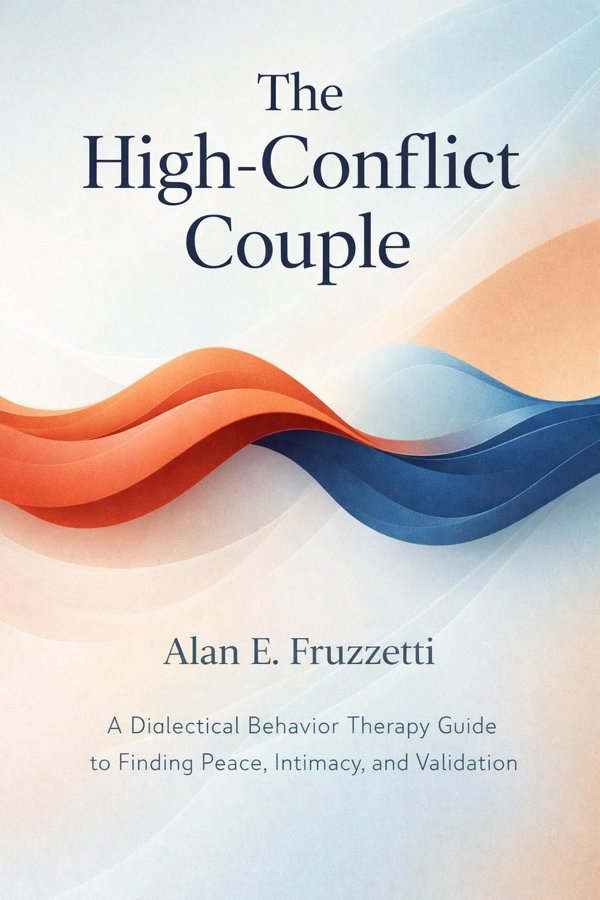
The High-Conflict Couple: A Dialectical Behavior Therapy Guide to Finding Peace, Intimacy, and Validation: Summary & Key Insights
 10 min9 chaptersAudio available
Key Takeaways from The High-Conflict Couple: A Dialectical Behavior Therapy Guide to Finding Peace, Intimacy, and Validation
The most painful relationship conflicts are rarely about the surface issue; they are about what happens emotionally underneath it.
Healthy relationships require a paradox many couples resist: you must accept emotional reality while also working to change harmful behavior.
When people are emotionally flooded, they stop hearing each other accurately.
For high-conflict couples, this is revolutionary.
People do not enter arguments as blank slates; they bring histories, sensitivities, stress loads, and bodily states that shape what feels threatening.
What Is The High-Conflict Couple: A Dialectical Behavior Therapy Guide to Finding Peace, Intimacy, and Validation About?
The High-Conflict Couple: A Dialectical Behavior Therapy Guide to Finding Peace, Intimacy, and Validation by Alan E. Fruzzetti is a relationships book spanning 11 pages. Some couples do not simply disagree—they ignite. A minor misunderstanding turns into a painful argument, both partners feel unseen, and the relationship slowly becomes organized around blame, defensiveness, and emotional exhaustion. In The High-Conflict Couple, psychologist Alan E. Fruzzetti applies Dialectical Behavior Therapy (DBT) to help partners interrupt these destructive cycles and replace them with understanding, regulation, and connection. Rather than treating conflict as proof that love is gone, Fruzzetti shows that intense conflict often reflects emotional vulnerability, poor regulation, and repeated invalidation. That distinction matters, because it means change is possible. What makes this book especially valuable is its combination of clinical depth and practical usefulness. Fruzzetti does not offer vague advice about “communicating better.” He explains why couples escalate so quickly, how each partner unintentionally contributes to the cycle, and which concrete skills can restore safety and intimacy. Drawing on his expertise as a clinical psychologist, professor, and DBT specialist, he provides a compassionate, structured guide for couples who love each other but keep hurting each other. For readers seeking a realistic path from volatility to closeness, this book is both hopeful and actionable.
This FizzRead summary covers all 9 key chapters of The High-Conflict Couple: A Dialectical Behavior Therapy Guide to Finding Peace, Intimacy, and Validation in approximately 10 minutes, distilling the most important ideas, arguments, and takeaways from Alan E. Fruzzetti's work. Also available as an audio summary and Key Quotes Podcast.
The High-Conflict Couple: A Dialectical Behavior Therapy Guide to Finding Peace, Intimacy, and Validation
Some couples do not simply disagree—they ignite. A minor misunderstanding turns into a painful argument, both partners feel unseen, and the relationship slowly becomes organized around blame, defensiveness, and emotional exhaustion. In The High-Conflict Couple, psychologist Alan E. Fruzzetti applies Dialectical Behavior Therapy (DBT) to help partners interrupt these destructive cycles and replace them with understanding, regulation, and connection. Rather than treating conflict as proof that love is gone, Fruzzetti shows that intense conflict often reflects emotional vulnerability, poor regulation, and repeated invalidation. That distinction matters, because it means change is possible.
What makes this book especially valuable is its combination of clinical depth and practical usefulness. Fruzzetti does not offer vague advice about “communicating better.” He explains why couples escalate so quickly, how each partner unintentionally contributes to the cycle, and which concrete skills can restore safety and intimacy. Drawing on his expertise as a clinical psychologist, professor, and DBT specialist, he provides a compassionate, structured guide for couples who love each other but keep hurting each other. For readers seeking a realistic path from volatility to closeness, this book is both hopeful and actionable.
Who Should Read The High-Conflict Couple: A Dialectical Behavior Therapy Guide to Finding Peace, Intimacy, and Validation?
This book is perfect for anyone interested in relationships and looking to gain actionable insights in a short read. Whether you're a student, professional, or lifelong learner, the key ideas from The High-Conflict Couple: A Dialectical Behavior Therapy Guide to Finding Peace, Intimacy, and Validation by Alan E. Fruzzetti will help you think differently.
- ✓Readers who enjoy relationships and want practical takeaways
- ✓Professionals looking to apply new ideas to their work and life
- ✓Anyone who wants the core insights of The High-Conflict Couple: A Dialectical Behavior Therapy Guide to Finding Peace, Intimacy, and Validation in just 10 minutes
Want the full summary?
Get instant access to this book summary and 100K+ more with Fizz Moment.
Get Free SummaryAvailable on App Store • Free to download
Key Chapters
The most painful relationship conflicts are rarely about the surface issue; they are about what happens emotionally underneath it. High-conflict couples do not spiral because they disagree on chores, money, parenting, or sex. They spiral because those disagreements quickly trigger fear, shame, anger, helplessness, or rejection, and each partner reacts in ways that intensify the other’s distress. Over time, the couple becomes trapped in a pattern where both people feel misunderstood and both believe the other is the problem.
Fruzzetti argues that high-conflict relationships are defined less by the number of arguments than by the speed of escalation and the severity of emotional injury. A small comment can be interpreted as criticism. A defensive response can be experienced as abandonment. Then comes attacking, withdrawing, blaming, or shutting down. Each move makes sense from the inside, yet each move also fuels the cycle.
This perspective is important because it shifts the goal from winning arguments to understanding processes. Instead of asking, “Who started it?” the better question becomes, “What happened that made both of us less able to respond well?” For example, one partner comes home late and forgets to text. The other feels ignored and lashes out. The late partner feels unfairly accused and becomes cold. Soon they are arguing about respect, reliability, and caring, even though neither intended to create a crisis.
The key insight is that recurring conflict is often systemic, not simply personal. Both partners influence the emotional climate, even when one appears more explosive or more withdrawn. Actionable takeaway: In your next argument, pause and identify the escalation sequence in order—trigger, emotion, interpretation, reaction, and counterreaction—so you can see the cycle you are in rather than only the fault you want to assign.
Healthy relationships require a paradox many couples resist: you must accept emotional reality while also working to change harmful behavior. That is the heart of Dialectical Behavior Therapy. Fruzzetti uses DBT to show that couples improve not by choosing between compassion and accountability, but by holding both at once. You can acknowledge your partner’s pain without agreeing with every conclusion they draw. You can take responsibility for your behavior without accepting a global identity of being “the bad one.”
DBT rests on several pillars that are especially useful in intimate relationships: mindfulness, emotion regulation, distress tolerance, interpersonal effectiveness, and validation. Mindfulness helps partners notice what is happening before reacting automatically. Emotion regulation teaches them to recognize vulnerability and reduce emotional intensity. Distress tolerance helps them survive heated moments without making things worse. Interpersonal effectiveness offers practical ways to ask, listen, and set boundaries. Validation creates emotional safety.
The dialectical stance is powerful because many conflicts intensify when couples think in absolutes: one person is right, the other wrong; one is caring, the other selfish; one must yield, the other must prevail. Fruzzetti argues that reality is usually more complex. A partner may be too harsh and still have a legitimate complaint. Another may be overwhelmed and still need to stay engaged. Both can be hurting. Both can contribute to repair.
Imagine one partner saying, “You overreact to everything,” while the other says, “You never care how I feel.” A DBT approach reframes this into: “Your feelings make sense given what you perceived, and the way we handled this is hurting us both.” That creates room for problem-solving.
Actionable takeaway: Practice replacing either-or statements with both-and statements, such as, “I can see why you felt hurt, and we still need a calmer way to discuss this.”
When people are emotionally flooded, they stop hearing each other accurately. Fruzzetti explains that emotional dysregulation is not simply “being too emotional.” It is a state in which feelings become so intense that thinking narrows, assumptions harden, and impulsive reactions take over. In couples, this creates ideal conditions for invalidation—the experience of having one’s inner reality dismissed, ignored, mocked, or judged.
Invalidation does not always sound cruel. It can appear as logic offered too early, advice given instead of empathy, silence that feels abandoning, or phrases like “You’re overreacting,” “That’s ridiculous,” or “Calm down.” Even if the speaker intends to soothe or defend themselves, the receiving partner often feels more alone and more activated. That activation then produces stronger expressions of emotion, which the other partner experiences as irrational or threatening. The cycle tightens.
Fruzzetti emphasizes that many invalidating exchanges are mutual and accidental. One partner may criticize because they feel desperate to be heard. The other may withdraw because they feel attacked and incapable of responding safely. Neither is trying to destroy the relationship, but both are making it less stable. For example, if one partner says, “I felt hurt when you interrupted me at dinner,” and the other answers, “That’s not what happened,” the conversation shifts instantly from emotional sharing to courtroom debate.
Understanding this cycle creates compassion and leverage for change. If high conflict is maintained by dysregulation and invalidation, then reducing either one can lower the temperature. This means sleep, stress, history, timing, and physiology all matter. It also means that validation is not a luxury skill; it is central to de-escalation.
Actionable takeaway: When conflict starts rising, stop arguing facts for a moment and first name the likely emotion underneath your partner’s reaction: hurt, fear, embarrassment, or disappointment.
One of the book’s strongest lessons is that validation is not agreement, weakness, or giving in—it is the act of communicating that another person’s inner experience makes sense in context. For high-conflict couples, this is revolutionary. Many partners fear that if they validate, they will lose the argument, reward bad behavior, or betray their own reality. Fruzzetti argues the opposite: without validation, emotionally charged conversations rarely become productive.
Validation can be as simple as attentive listening, accurate reflection, or recognizing understandable emotion. A partner might say, “Given how important punctuality is to you, I can see why my being late felt disrespectful.” That statement does not necessarily concede intentional wrongdoing. It simply acknowledges the emotional logic of the other person’s experience. Once people feel understood, they become less driven to prove themselves through escalation.
Fruzzetti describes validation as both a skill and an attitude. The skill involves observing carefully, listening without interruption, reflecting content and feelings, and responding non-defensively. The attitude requires genuine curiosity and humility: perhaps your partner’s reaction makes more sense than it first appears. Even if the expression was clumsy or intense, there is usually a kernel of meaning worth recognizing.
This also applies inwardly. Self-validation helps people regulate shame and defensiveness. If you can admit to yourself, “I’m getting flooded and I want to protect myself,” you become less likely to lash out. In practice, couples can transform arguments by validating before solving. For instance, rather than responding to “You never listen” with a rebuttal, say, “You’re feeling dismissed right now, and I want to understand what I missed.”
Actionable takeaway: In your next difficult conversation, do not defend your position until you have first reflected your partner’s feelings and perspective in a way they agree is accurate.
People do not enter arguments as blank slates; they bring histories, sensitivities, stress loads, and bodily states that shape what feels threatening. Fruzzetti highlights the importance of emotional triggers—those cues that rapidly activate old pain and make current events feel bigger than they objectively are. A forgotten text may trigger abandonment fears. A raised voice may trigger memories of humiliation. A request for space may trigger panic. Once triggered, partners often react to the past through the present.
The crucial point is that triggers are not moral failures. They are vulnerabilities that require awareness and management. Shame about being triggered usually worsens the problem, because it adds self-judgment to already intense emotion. Instead, Fruzzetti encourages couples to identify their predictable triggers, communicate them openly, and develop plans for handling them without blame.
A practical example: one partner grew up with chronic criticism and becomes highly reactive to corrective feedback. The other values directness and does not realize how sharp their tone sounds. If they do not understand this dynamic, each will keep misreading the other. The first will believe, “You think I’m never good enough,” while the second insists, “I’m just trying to solve the problem.” With trigger awareness, the conversation changes: “Feedback is hard for me to hear when I’m already stressed. Can you start with what you appreciate, then tell me what needs changing?”
Managing triggers may involve preparation, timing, physical self-care, and agreed-upon pause strategies. It also means learning your early warning signs: racing thoughts, tension, urge to interrupt, narrowed attention, or catastrophic interpretations. Noticing these signs early gives you a chance to regulate before damage occurs.
Actionable takeaway: Each partner should make a short list of three recurring triggers, three early warning signs, and three calming responses to use before continuing a difficult conversation.
Many couples think communication problems come from poor speaking, but Fruzzetti shows that poor listening is often the deeper issue. In high-conflict interactions, people listen to refute, defend, or prepare their next point. They do not listen to understand. Mindfulness interrupts this habit by training attention toward the present moment without immediate judgment. In relationships, that means noticing your partner’s words, tone, face, and emotions while also observing your own rising reactions.
Mindful listening is not passive. It requires discipline. You stay present, suspend premature conclusions, and check whether you understood correctly. Instead of responding instantly, you reflect: “What I hear you saying is that when I joked about that in front of friends, you felt embarrassed and alone.” This slows the exchange and reduces distortion. It also prevents the common pattern where one partner speaks from vulnerability and the other hears accusation.
Fruzzetti pairs mindfulness with interpersonal effectiveness. Couples need practical skills for making requests, expressing hurt, setting limits, and solving problems without contempt or avoidance. For example, “You never help around here” can become “I feel overwhelmed when the kitchen stays messy, and I’d like us to divide cleanup tonight.” The first invites defense; the second creates clarity.
A simple but powerful practice is the speaker-listener structure. One person speaks briefly while the other’s job is only to listen and reflect, not rebut. Then they switch. This sounds basic, yet it transforms conflict because it creates a moment where each partner feels cognitively and emotionally received.
Mindfulness also helps with timing. Not every issue should be discussed the moment it appears. If either partner is flooded, the quality of attention collapses.
Actionable takeaway: Try a ten-minute speaker-listener exercise this week: five minutes for one partner to speak while the other reflects only, then switch, and end by identifying one point of agreement.
Relationships deteriorate when couples overcommit to one side of a truth. Too much emphasis on acceptance becomes resignation: “This is just how we are.” Too much emphasis on change becomes relentless correction: “You need to stop being this way.” Fruzzetti’s DBT framework insists that lasting progress requires both acceptance of current reality and deliberate efforts to improve it. This balance lowers defensiveness while keeping growth possible.
Acceptance means acknowledging facts as they are: your partner has vulnerabilities, you have vulnerabilities, your conflict pattern is real, and pain already exists. It does not mean liking these facts or approving harmful behavior. It means stopping the war against reality long enough to work effectively with it. Change means using skills, agreements, and accountability to shift behaviors that keep the relationship unstable.
This dialectical balance is especially useful when couples face chronic differences. One partner may need more reassurance; the other may need more processing time. If each insists only on their own style, conflict becomes perpetual. But if both accept the legitimacy of the difference and also commit to adaptive behaviors, room opens up. The reassurance-seeking partner can ask directly and avoid repeated testing. The slower-processing partner can agree to return to the conversation within a clear timeframe instead of disappearing.
Fruzzetti also reminds readers that acceptance can itself be regulating. When people stop insisting that a painful feeling should not be happening, they often become less reactive to it. That makes wise action easier. In contrast, fighting the existence of emotion often intensifies it.
Actionable takeaway: Choose one recurring conflict and divide a page into two columns: “What we need to accept about this situation” and “What we each need to change.” Use both columns before discussing solutions.
Conflict does not only create anger; it erodes trust, tenderness, and desire. Fruzzetti makes clear that intimacy is not restored by solving logistics alone. Couples need emotional repair. That means recognizing injury, expressing remorse without defensiveness, understanding the deeper impact of one’s behavior, and reestablishing a sense of mutual care. In high-conflict relationships, partners often wait for the other person to repair first, but repair usually begins when one person chooses understanding over self-protection.
Empathy is central here. To empathize is not to erase yourself; it is to enter the other person’s experience enough to appreciate what the conflict cost them. For example, if one partner repeatedly withdraws during arguments, the issue is not merely silence. The other may experience that silence as abandonment, humiliation, or proof that their needs do not matter. Repair becomes possible when the withdrawing partner says something like, “I see that when I walked away without telling you when I’d return, it left you feeling alone and unimportant.”
Rebuilding trust often requires consistency more than intensity. Grand gestures matter less than repeated moments of reliability: following through, returning after time-outs, checking assumptions, and responding with warmth after tension. Intimacy grows when partners feel emotionally safe enough to be vulnerable again. This includes affection, sexuality, friendship, and shared meaning.
Daily life offers many small opportunities for repair. A touch on the shoulder after a tense exchange, a sincere acknowledgment of tone, a text that says, “I’ve been thinking about our conversation and I understand more now,” can all interrupt disconnection. These acts matter because they signal, “Our bond matters more than my pride.”
Actionable takeaway: After your next conflict, complete a brief repair conversation using three steps: name the injury, validate the impact, and state one concrete behavior you will do differently next time.
Insight alone rarely changes a volatile relationship. Fruzzetti emphasizes that couples improve by practicing new responses in ordinary moments, not only during major blowups. Skills must become habits. If mindfulness, validation, and regulation appear only after damage is done, they will remain fragile. The goal is to build a relational culture that lowers emotional vulnerability and makes conflict easier to handle from the start.
Daily practice begins with basics that many couples overlook: adequate sleep, manageable stress, predictable check-ins, and proactive communication. A chronically depleted nervous system is more reactive, more negative, and less flexible. Couples should not underestimate how much external strain—work pressure, parenting overload, financial stress, unresolved trauma—affects their interactions. Managing the relationship means managing the conditions that shape behavior.
Fruzzetti also addresses obstacles to growth. Some partners expect instant transformation and become discouraged when old patterns reappear. Others use slip-ups as proof that change is impossible. DBT offers a more useful stance: progress is uneven, relapse is information, and every conflict is a chance to strengthen awareness. The key is not perfection but quicker recovery and less harm.
Couples can support growth by creating rituals: a weekly relationship meeting, a shared phrase that signals rising dysregulation, a commitment to revisit paused topics within 24 hours, or a nightly habit of naming one appreciated action from the day. These structures make healthy behavior easier when emotions run high. If conflict is severe or tied to trauma, addiction, or safety concerns, professional support may be necessary.
Ultimately, the book offers hope grounded in realism. High-conflict couples do not become peaceful by waiting for emotion to disappear. They become peaceful by learning how to respond to emotion skillfully, together.
Actionable takeaway: Establish one small weekly ritual this month—a check-in, appreciation practice, or agreed repair process—and treat consistency as more important than intensity.
All Chapters in The High-Conflict Couple: A Dialectical Behavior Therapy Guide to Finding Peace, Intimacy, and Validation
About the Author
Alan E. Fruzzetti, Ph.D., is a clinical psychologist, professor, and leading expert on Dialectical Behavior Therapy, particularly its use in couples and family relationships. His work focuses on emotional dysregulation, invalidation, interpersonal conflict, and the practical skills that help people communicate more effectively under stress. Across his academic and clinical career, Fruzzetti has contributed research, teaching, and therapeutic guidance aimed at helping individuals and families move from reactivity to understanding. He is especially respected for translating DBT principles into real-world tools for intimate relationships, making complex psychological ideas accessible and useful. In The High-Conflict Couple, he brings together scientific insight and clinical compassion to offer readers a structured path toward peace, validation, and renewed intimacy.
Get This Summary in Your Preferred Format
Read or listen to the The High-Conflict Couple: A Dialectical Behavior Therapy Guide to Finding Peace, Intimacy, and Validation summary by Alan E. Fruzzetti anytime, anywhere. FizzRead offers multiple formats so you can learn on your terms — all free.
Available formats: App · Audio · PDF · EPUB — All included free with FizzRead
Download The High-Conflict Couple: A Dialectical Behavior Therapy Guide to Finding Peace, Intimacy, and Validation PDF and EPUB Summary
Key Quotes from The High-Conflict Couple: A Dialectical Behavior Therapy Guide to Finding Peace, Intimacy, and Validation
“The most painful relationship conflicts are rarely about the surface issue; they are about what happens emotionally underneath it.”
“Healthy relationships require a paradox many couples resist: you must accept emotional reality while also working to change harmful behavior.”
“When people are emotionally flooded, they stop hearing each other accurately.”
“One of the book’s strongest lessons is that validation is not agreement, weakness, or giving in—it is the act of communicating that another person’s inner experience makes sense in context.”
“People do not enter arguments as blank slates; they bring histories, sensitivities, stress loads, and bodily states that shape what feels threatening.”
Frequently Asked Questions about The High-Conflict Couple: A Dialectical Behavior Therapy Guide to Finding Peace, Intimacy, and Validation
The High-Conflict Couple: A Dialectical Behavior Therapy Guide to Finding Peace, Intimacy, and Validation by Alan E. Fruzzetti is a relationships book that explores key ideas across 9 chapters. Some couples do not simply disagree—they ignite. A minor misunderstanding turns into a painful argument, both partners feel unseen, and the relationship slowly becomes organized around blame, defensiveness, and emotional exhaustion. In The High-Conflict Couple, psychologist Alan E. Fruzzetti applies Dialectical Behavior Therapy (DBT) to help partners interrupt these destructive cycles and replace them with understanding, regulation, and connection. Rather than treating conflict as proof that love is gone, Fruzzetti shows that intense conflict often reflects emotional vulnerability, poor regulation, and repeated invalidation. That distinction matters, because it means change is possible. What makes this book especially valuable is its combination of clinical depth and practical usefulness. Fruzzetti does not offer vague advice about “communicating better.” He explains why couples escalate so quickly, how each partner unintentionally contributes to the cycle, and which concrete skills can restore safety and intimacy. Drawing on his expertise as a clinical psychologist, professor, and DBT specialist, he provides a compassionate, structured guide for couples who love each other but keep hurting each other. For readers seeking a realistic path from volatility to closeness, this book is both hopeful and actionable.
You Might Also Like

The 5 Love Languages
Gary Chapman
10 min
Men Are from Mars, Women Are from Venus
John Gray
10 min
She Comes First
Ian Kerner
10 min
No More Mr Nice Guy
Robert Glover
10 min
Hold Me Tight
Sue Johnson
10 min
Mating in Captivity
Esther Perel
10 minBrowse by Category
Ready to read The High-Conflict Couple: A Dialectical Behavior Therapy Guide to Finding Peace, Intimacy, and Validation?
Get the full summary and 100K+ more books with Fizz Moment.