
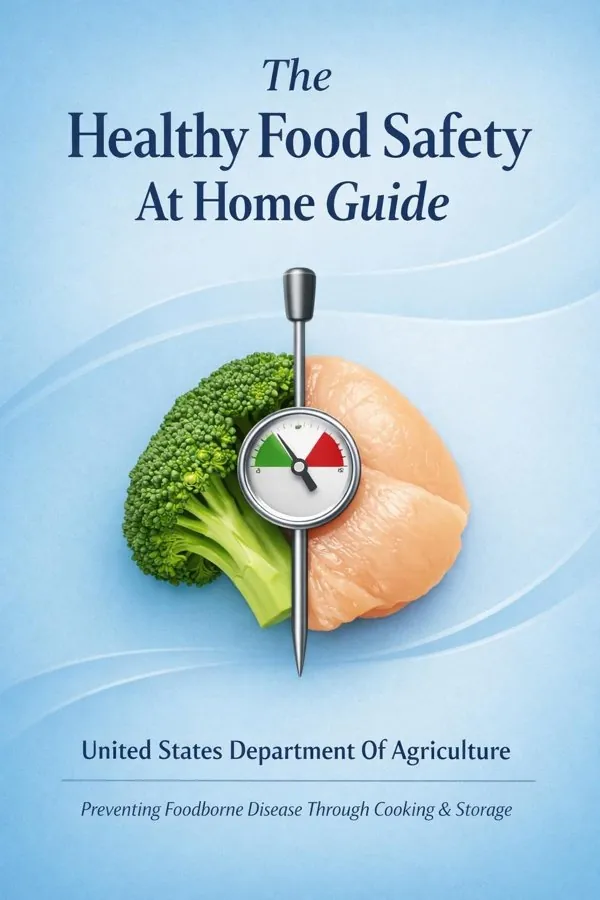
The Healthy Food Safety At Home Guide: Preventing Foodborne Disease Through Cooking & Storage: Summary & Key Insights
by United States Department Of Agriculture
 10 min8 chaptersAudio available
Key Takeaways from The Healthy Food Safety At Home Guide: Preventing Foodborne Disease Through Cooking & Storage
The most dangerous food safety threats are often invisible, odorless, and tasteless.
Food safety begins long before the stove turns on.
Cross-contamination is one of the most common and preventable causes of foodborne illness.
Many people believe experience can tell them when food is safe, but the USDA makes a different point: color, texture, and cooking time are not reliable measures of doneness.
Refrigeration is not just about keeping food fresh longer—it is one of the home cook’s strongest defenses against bacterial growth.
What Is The Healthy Food Safety At Home Guide: Preventing Foodborne Disease Through Cooking & Storage About?
The Healthy Food Safety At Home Guide: Preventing Foodborne Disease Through Cooking & Storage by United States Department Of Agriculture is a health_med book spanning 7 pages. Most cases of food poisoning do not begin in restaurants or factories alone—they often begin quietly at home, through ordinary habits that seem harmless. The Healthy Food Safety At Home Guide: Preventing Foodborne Disease Through Cooking & Storage is a practical USDA resource designed to help everyday cooks reduce that risk through smarter cleaning, cooking, storing, and shopping. In just a few pages, it translates core food safety science into clear household actions: wash hands correctly, prevent cross-contamination, cook foods to safe temperatures, refrigerate promptly, and know when to throw food away. What makes this guide especially valuable is its authority. The United States Department of Agriculture is one of the most trusted public institutions in food safety, combining scientific research, inspection expertise, and national public health guidance. Rather than relying on myths, guesswork, or inherited kitchen habits, the guide gives readers evidence-based standards that protect families, guests, children, older adults, and anyone vulnerable to foodborne illness. It is not just about avoiding mistakes—it is about building confidence. With simple rules and consistent routines, home kitchens can become much safer places to prepare and share food.
This FizzRead summary covers all 8 key chapters of The Healthy Food Safety At Home Guide: Preventing Foodborne Disease Through Cooking & Storage in approximately 10 minutes, distilling the most important ideas, arguments, and takeaways from United States Department Of Agriculture's work. Also available as an audio summary and Key Quotes Podcast.
The Healthy Food Safety At Home Guide: Preventing Foodborne Disease Through Cooking & Storage
Most cases of food poisoning do not begin in restaurants or factories alone—they often begin quietly at home, through ordinary habits that seem harmless. The Healthy Food Safety At Home Guide: Preventing Foodborne Disease Through Cooking & Storage is a practical USDA resource designed to help everyday cooks reduce that risk through smarter cleaning, cooking, storing, and shopping. In just a few pages, it translates core food safety science into clear household actions: wash hands correctly, prevent cross-contamination, cook foods to safe temperatures, refrigerate promptly, and know when to throw food away.
What makes this guide especially valuable is its authority. The United States Department of Agriculture is one of the most trusted public institutions in food safety, combining scientific research, inspection expertise, and national public health guidance. Rather than relying on myths, guesswork, or inherited kitchen habits, the guide gives readers evidence-based standards that protect families, guests, children, older adults, and anyone vulnerable to foodborne illness. It is not just about avoiding mistakes—it is about building confidence. With simple rules and consistent routines, home kitchens can become much safer places to prepare and share food.
Who Should Read The Healthy Food Safety At Home Guide: Preventing Foodborne Disease Through Cooking & Storage?
This book is perfect for anyone interested in health_med and looking to gain actionable insights in a short read. Whether you're a student, professional, or lifelong learner, the key ideas from The Healthy Food Safety At Home Guide: Preventing Foodborne Disease Through Cooking & Storage by United States Department Of Agriculture will help you think differently.
- ✓Readers who enjoy health_med and want practical takeaways
- ✓Professionals looking to apply new ideas to their work and life
- ✓Anyone who wants the core insights of The Healthy Food Safety At Home Guide: Preventing Foodborne Disease Through Cooking & Storage in just 10 minutes
Want the full summary?
Get instant access to this book summary and 100K+ more with Fizz Moment.
Get Free SummaryAvailable on App Store • Free to download
Key Chapters
The most dangerous food safety threats are often invisible, odorless, and tasteless. That is what makes foodborne illness so deceptive: food can look perfectly normal while carrying bacteria, viruses, or parasites capable of causing serious disease. The USDA emphasizes that contamination can occur at many points long before food reaches your kitchen, including during farming, processing, transport, or display. Once contaminated food enters the home, unsafe handling can allow harmful organisms to spread or multiply.
Common pathogens such as Salmonella, E. coli, Listeria, and Campylobacter thrive when food is kept in the “danger zone,” where temperatures allow rapid bacterial growth. This means a small lapse—like leaving cooked food out too long or placing raw meat above produce in the refrigerator—can create outsized health risks. Symptoms of foodborne illness may range from mild stomach upset to severe dehydration, hospitalization, or worse, especially for young children, older adults, pregnant people, and those with weakened immune systems.
The guide’s core message is that prevention matters because you cannot reliably detect risk with your senses alone. Smelling milk, checking whether meat “looks fine,” or tasting leftovers to test them is not a dependable safety strategy. Instead, food safety depends on routines based on evidence: clean surfaces, separation of raw and ready-to-eat foods, accurate cooking temperatures, and timely refrigeration.
A practical example is raw chicken. Even if it appears fresh, rinsing it in the sink may spread bacteria through splashes, and undercooking it leaves pathogens alive. Proper handling, thermometer use, and immediate cleanup are the safer path.
Actionable takeaway: Treat all perishable foods as potentially hazardous unless they are handled, cooked, and stored according to tested food safety rules.
Food safety begins long before the stove turns on. One of the guide’s strongest principles is that cleanliness is not cosmetic—it is preventive medicine. Bacteria move easily from hands to handles, from counters to cutting boards, and from utensils to finished meals. A kitchen can look neat while still harboring contamination pathways that put people at risk.
The USDA recommends frequent and proper handwashing with warm water and soap for at least 20 seconds, especially before and after handling food, after touching raw meat, after using the bathroom, after coughing or sneezing, and after handling pets or garbage. Hands are one of the fastest ways to transfer harmful microbes. Equally important is washing cutting boards, dishes, utensils, and countertops with hot soapy water after preparing each food item and before moving on to the next.
Fresh fruits and vegetables should also be rinsed under running water before eating, cutting, or cooking—even if you plan to peel them. The reason is simple: dirt and microorganisms on the outside can transfer to the inside through the knife blade. However, the guide discourages washing meat or poultry, since doing so may spread bacteria around the sink and nearby surfaces.
A practical home scenario makes this clear. If you slice raw chicken on a board and then use the same board for lettuce without washing it thoroughly, you may contaminate the salad even though it was never near the pan. Small habits shape big outcomes.
Actionable takeaway: Build a cleaning rhythm into every meal—wash hands often, sanitize food-contact surfaces between tasks, rinse produce, and never assume a visibly clean kitchen is automatically a safe one.
Cross-contamination is one of the most common and preventable causes of foodborne illness. The guide teaches that safety is not only about whether food is fresh or fully cooked; it is also about whether harmful microbes are allowed to travel from one item to another. Raw meat, poultry, seafood, and eggs can carry dangerous pathogens, and if their juices touch foods that will not be cooked again, those pathogens may go straight to the plate.
The principle of separation should guide everything from grocery shopping to storage to meal prep. In the shopping cart, raw meats should be bagged separately from produce and bakery items. In the refrigerator, they should be stored in sealed containers or leak-proof packaging on the lowest shelf so drips cannot contaminate other foods. During preparation, separate cutting boards and plates should be used for raw proteins and ready-to-eat foods like salad, bread, fruit, or cooked meat.
One common mistake the USDA warns against is reusing marinades or plates that held raw meat. For example, placing grilled burgers back on the same plate that previously held the uncooked patties can reintroduce bacteria and undo the benefit of cooking. Similarly, wiping a knife on a towel after cutting raw pork does not make it safe for slicing apples.
Separation also includes mental separation: seeing raw ingredients as a different safety category requiring special handling. This mindset helps cooks design safer workflows instead of trying to clean up risk after it has already spread.
Actionable takeaway: Create physical barriers in your kitchen—separate bags, shelves, boards, utensils, and plates for raw animal products and foods that are ready to eat.
Many people believe experience can tell them when food is safe, but the USDA makes a different point: color, texture, and cooking time are not reliable measures of doneness. A burger can turn brown before it reaches a safe internal temperature, and chicken can look done while still harboring dangerous bacteria. The only dependable way to know whether food has been cooked safely is to measure its internal temperature with a food thermometer.
The guide reinforces the “cook” principle by linking specific foods to safe minimum internal temperatures. Poultry requires higher temperatures because of the pathogens commonly associated with it, while whole cuts of meat, ground meats, egg dishes, leftovers, and casseroles each have their own standards. This precision matters because heat must reach the center of the food where bacteria survive longest. Using a thermometer also prevents another problem: overcooking. Safe cooking is about accuracy, not fear.
A practical application is holiday roasting. Many cooks rely on pop-up timers or visual cues, but the safest method is to insert a thermometer into the thickest part of the meat, away from bone, and confirm the recommended temperature. The same principle applies to reheating leftovers, which should be heated thoroughly enough to destroy any bacteria that may have multiplied during storage.
The guide also encourages understanding rest time where applicable, since temperature can remain stable or continue to rise briefly after food is removed from heat. Safe cooking is therefore a process, not a quick glance.
Actionable takeaway: Keep a food thermometer in your kitchen and use it routinely for meat, poultry, casseroles, leftovers, and any dish where undercooking could put health at risk.
Refrigeration is not just about keeping food fresh longer—it is one of the home cook’s strongest defenses against bacterial growth. The USDA’s “chill” principle explains that harmful microorganisms multiply rapidly at room temperature, especially in protein-rich and moist foods. Cooling food promptly slows that growth and helps preserve both safety and quality.
The guide recommends refrigerating perishable foods within two hours, or within one hour when the temperature is especially hot, such as during summer picnics or transport in a warm car. Refrigerators should be kept at 40°F (4°C) or below, and freezers at 0°F (-18°C). These temperatures matter because even a slightly warm refrigerator can allow bacteria to multiply more quickly than expected. An appliance thermometer is therefore a useful complement to built-in controls.
Storage method matters too. Large pots of soup or large containers of leftovers cool slowly, so dividing food into shallow containers helps it chill faster and more safely. Thawing deserves equal attention: frozen foods should be thawed in the refrigerator, in cold water changed regularly, or in the microwave—never left on the counter all day.
A familiar example is pizza left out overnight. Even if it seems unchanged by morning, it may have spent too long in unsafe temperatures. The guide’s approach is simple: if time and temperature were uncontrolled, safety is doubtful.
Actionable takeaway: Use your refrigerator proactively—monitor its temperature, refrigerate perishables quickly, cool leftovers in shallow containers, and thaw foods using approved cold methods instead of room-temperature shortcuts.
Food safety begins before food enters the kitchen. The guide extends responsibility to the grocery store, where consumer choices affect what risks come home. Selecting food carefully, reading labels accurately, and understanding spoilage signs all help prevent illness. Many people treat shopping as a convenience task, but the USDA frames it as the first stage of safe food handling.
Smart shopping starts with order and timing. Nonperishables can go in the cart first, while refrigerated and frozen items should be chosen last so they stay cold as long as possible. Packages should be inspected for leaks, tears, dents, or broken seals. Raw meat and poultry should be placed in plastic bags to contain juices. Once home, groceries should be unpacked promptly rather than left in a warm car or on the counter.
The guide also helps readers think clearly about labels. “Best if used by” dates generally refer to quality, not safety, while “use by” dates can require more care depending on the product. Consumers should not rely on dates alone; storage conditions matter just as much. Likewise, spoilage is not always obvious. Some unsafe foods will not smell sour or look discolored. On the other hand, visible mold, gas buildup, unusual textures, or off-odors are clear warnings not to consume a product.
Consider deli salads or bagged greens. They may seem safe because they are ready to eat, but if they were kept too warm during shopping or transport, the risk rises quickly. Safe purchasing and immediate refrigeration are part of prevention.
Actionable takeaway: Shop with temperature in mind, inspect packaging carefully, understand date labels correctly, and remember that when food seems questionable, the safest choice is often to throw it away.
Foodborne illness does not affect everyone equally. A meal that causes mild discomfort in one person can become a serious medical emergency for another. The USDA highlights vulnerable populations—including older adults, infants and young children, pregnant people, and individuals with weakened immune systems—as groups needing extra caution. For them, food safety is not merely a best practice; it is a critical health safeguard.
These groups are more susceptible because their immune defenses may be less able to fight infection, or because the consequences of infection are more severe. Listeria, for example, can be especially dangerous during pregnancy. Dehydration from vomiting or diarrhea can be more harmful in children and older adults. That means households caring for high-risk individuals should be particularly careful with refrigerated leftovers, deli meats, soft cheeses made from unpasteurized milk, undercooked eggs, and raw or undercooked seafood and meats.
The guide also underscores the value of trustworthy information. Kitchen myths spread easily—such as the belief that rinsing poultry makes it cleaner or that a quick sniff can confirm safety. Instead, households should rely on official resources like USDA hotlines, thermometers, and evidence-based charts for cooking and storage guidance.
A practical application is meal planning for an elderly parent or a pregnant family member. In such cases, fully cooked foods, strict refrigerator control, prompt reheating, and careful avoidance of risky items become especially important.
Actionable takeaway: If anyone in your household is medically vulnerable, raise your food safety standards even higher and rely on official guidance rather than tradition or guesswork.
Leftovers are convenient, economical, and often delicious—but they are also one of the easiest ways to mishandle food. The USDA’s guidance makes clear that the passage of time is a major food safety factor. Once food has been cooked, it is not permanently safe. Bacteria can return or multiply if leftovers are cooled too slowly, stored too long, or reheated inadequately.
Many households let meals sit on the table for extended periods after dinner, planning to refrigerate later. This is risky because the longer cooked food remains at room temperature, the more opportunity bacteria have to grow. The guide recommends refrigerating leftovers promptly and storing them in shallow containers so they cool evenly and quickly. Labeling containers with dates can also help households avoid the “mystery food” problem that encourages unsafe guessing.
Reheating is another critical step. Leftovers should be reheated thoroughly, not just warmed at the edges. Soups, gravies, and sauces should be brought to a rolling boil when appropriate, and microwaved foods should be stirred or rotated to avoid cold spots where bacteria may survive. If leftovers have been sitting out too long or storage time is uncertain, they should be discarded.
For example, a tray of casserole from a family gathering may seem too valuable to waste, but if it sat out through a long event, saving it may carry more risk than benefit. Convenience should never outweigh safety.
Actionable takeaway: Treat leftovers like fresh food with a countdown—cool them quickly, date them clearly, reheat them completely, and discard them if time or temperature control has been lost.
All Chapters in The Healthy Food Safety At Home Guide: Preventing Foodborne Disease Through Cooking & Storage
About the Author
The United States Department of Agriculture (USDA) is a major federal agency responsible for shaping and supporting the nation’s food, agriculture, nutrition, and rural development systems. Founded in 1862, it serves consumers, farmers, researchers, and communities through policy, scientific research, public education, and inspection programs. One of its most important public-facing roles is promoting food safety through evidence-based guidance on food handling, storage, preparation, and disease prevention. USDA resources are widely used by households, schools, food businesses, and health professionals because they combine scientific rigor with practical clarity. In publications like this guide, the agency translates technical food safety standards into everyday actions that help people reduce risk in their own kitchens and make safer decisions about the food they buy, cook, and serve.
Get This Summary in Your Preferred Format
Read or listen to the The Healthy Food Safety At Home Guide: Preventing Foodborne Disease Through Cooking & Storage summary by United States Department Of Agriculture anytime, anywhere. FizzRead offers multiple formats so you can learn on your terms — all free.
Available formats: App · Audio · PDF · EPUB — All included free with FizzRead
Download The Healthy Food Safety At Home Guide: Preventing Foodborne Disease Through Cooking & Storage PDF and EPUB Summary
Key Quotes from The Healthy Food Safety At Home Guide: Preventing Foodborne Disease Through Cooking & Storage
“The most dangerous food safety threats are often invisible, odorless, and tasteless.”
“Food safety begins long before the stove turns on.”
“Cross-contamination is one of the most common and preventable causes of foodborne illness.”
“Many people believe experience can tell them when food is safe, but the USDA makes a different point: color, texture, and cooking time are not reliable measures of doneness.”
“Refrigeration is not just about keeping food fresh longer—it is one of the home cook’s strongest defenses against bacterial growth.”
Frequently Asked Questions about The Healthy Food Safety At Home Guide: Preventing Foodborne Disease Through Cooking & Storage
The Healthy Food Safety At Home Guide: Preventing Foodborne Disease Through Cooking & Storage by United States Department Of Agriculture is a health_med book that explores key ideas across 8 chapters. Most cases of food poisoning do not begin in restaurants or factories alone—they often begin quietly at home, through ordinary habits that seem harmless. The Healthy Food Safety At Home Guide: Preventing Foodborne Disease Through Cooking & Storage is a practical USDA resource designed to help everyday cooks reduce that risk through smarter cleaning, cooking, storing, and shopping. In just a few pages, it translates core food safety science into clear household actions: wash hands correctly, prevent cross-contamination, cook foods to safe temperatures, refrigerate promptly, and know when to throw food away. What makes this guide especially valuable is its authority. The United States Department of Agriculture is one of the most trusted public institutions in food safety, combining scientific research, inspection expertise, and national public health guidance. Rather than relying on myths, guesswork, or inherited kitchen habits, the guide gives readers evidence-based standards that protect families, guests, children, older adults, and anyone vulnerable to foodborne illness. It is not just about avoiding mistakes—it is about building confidence. With simple rules and consistent routines, home kitchens can become much safer places to prepare and share food.
You Might Also Like

On Immunity
Eula Biss
10 min
The Three-Body Problem
Liu Cixin
10 min
Community Health Volunteer Toolkit: Training and Practical Activities
World Health Organization
10 min
Healing Back Pain: The Mind-Body Connection
John E. Sarno
10 min
Health Literacy for All: Practical Guides to Communicate Health Information (Compilations)
World Health Organization
10 min
The Complete Guide to Sports Supplements: An Evidence-Based Review
Anita Bean
10 minBrowse by Category
Ready to read The Healthy Food Safety At Home Guide: Preventing Foodborne Disease Through Cooking & Storage?
Get the full summary and 100K+ more books with Fizz Moment.