
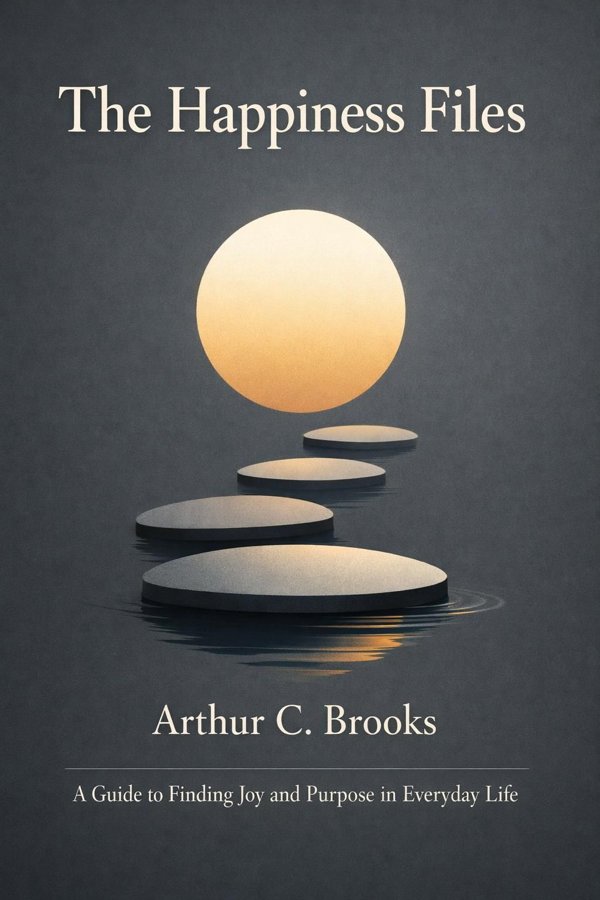
The Happiness Files: A Guide to Finding Joy and Purpose in Everyday Life: Summary & Key Insights
 10 min9 chaptersAudio available
What Is The Happiness Files: A Guide to Finding Joy and Purpose in Everyday Life About?
The Happiness Files: A Guide to Finding Joy and Purpose in Everyday Life by Arthur C. Brooks is a positive_psych book spanning 9 pages. In this book, Arthur C. Brooks explores the science and art of happiness, drawing on psychology, philosophy, and practical wisdom. He offers readers a framework for cultivating joy, meaning, and resilience in their personal and professional lives, emphasizing habits that lead to long-term well-being rather than fleeting pleasure.
This FizzRead summary covers all 9 key chapters of The Happiness Files: A Guide to Finding Joy and Purpose in Everyday Life in approximately 10 minutes, distilling the most important ideas, arguments, and takeaways from Arthur C. Brooks's work. Also available as an audio summary and Key Quotes Podcast.
The Happiness Files: A Guide to Finding Joy and Purpose in Everyday Life
In this book, Arthur C. Brooks explores the science and art of happiness, drawing on psychology, philosophy, and practical wisdom. He offers readers a framework for cultivating joy, meaning, and resilience in their personal and professional lives, emphasizing habits that lead to long-term well-being rather than fleeting pleasure.
Who Should Read The Happiness Files: A Guide to Finding Joy and Purpose in Everyday Life?
This book is perfect for anyone interested in positive_psych and looking to gain actionable insights in a short read. Whether you're a student, professional, or lifelong learner, the key ideas from The Happiness Files: A Guide to Finding Joy and Purpose in Everyday Life by Arthur C. Brooks will help you think differently.
- ✓Readers who enjoy positive_psych and want practical takeaways
- ✓Professionals looking to apply new ideas to their work and life
- ✓Anyone who wants the core insights of The Happiness Files: A Guide to Finding Joy and Purpose in Everyday Life in just 10 minutes
Want the full summary?
Get instant access to this book summary and 100K+ more with Fizz Moment.
Get Free SummaryAvailable on App Store • Free to download
Key Chapters
Every human life is shaped by emotion, ebbing and flowing like tides. Yet few of us take time to truly understand what emotions are. Through research and conversation, Brooks discovered that emotional awareness is the foundation of happiness. Emotions are biochemical signals pointing toward what we value, fear, or need—but they shouldn’t be treated as commands.
Here, readers learn to distinguish between *feelings* and *emotions*. Feelings are raw physical sensations; emotions are our interpretations of them. When the two are confused, we easily become flooded by reactive patterns. For instance, the tight chest and racing heart before a speech are physical feelings, while the ensuing anxiety and fear are emotions. The key lies in observing these signals without judgment—understanding their message without surrendering control.
Brooks draws on psychology and neuroscience, explaining how the prefrontal cortex helps us stay conscious of emotions rather than driven by them. Oprah illustrates this principle in practice: she names her emotions daily, greeting them as she would a friend—“This is fear,” “This is anger,” “This is loneliness.” When emotions are named, they gain shape and distance, giving us freedom to respond instead of react.
Emotions are not enemies. Negative feelings send messages; positive ones offer rewards. Learning this inner language is the first step toward happiness—beginning with emotional literacy and self-awareness.
Pain is not a moral failure; it is built into the structure of life. What truly harms us is lingering too long in pain, letting it exceed its natural purpose. Modern science offers ways to prevent this. Brooks notes that the human brain naturally magnifies negativity—a phenomenon called the “negativity bias.” Without tools for regulation, we become trapped within it.
The practices in this book dive deeper than simple life hacks. One essential tool is *metacognition*—the ability to observe your thoughts as separate from yourself. When you can say, “I am experiencing sadness,” rather than “I am sad,” you regain agency. Oprah speaks of using journaling and gratitude to steady her mind during times of loss and disappointment. The goal isn’t to erase pain, but to remind oneself that even amid struggle, there is still much to be grateful for.
Scientific research confirms that gratitude reshapes neural pathways, decreases the brain’s stress response, and increases dopamine-related feelings of well-being. Meditation and breathwork are equally grounded in evidence—they calm the amygdala, our center of fear. The book shares case studies of people who, through patience, forgiveness, and mindful attention, recovered balance after periods of anger or despair.
To manage negative emotion is not to suppress it but to transform it. Pain can become a temporary, instructive teacher rather than a tyrant. Mastering this process brings profound tranquility—the emotional steadiness upon which happiness rests.
+ 7 more chapters — available in the FizzRead app
All Chapters in The Happiness Files: A Guide to Finding Joy and Purpose in Everyday Life
About the Author
Arthur C. Brooks is an American social scientist, author, and professor at Harvard University. He is known for his research on happiness, leadership, and public policy, and for his work as a columnist for The Atlantic. His books often combine insights from economics, psychology, and philosophy to help readers live more fulfilling lives.
Get This Summary in Your Preferred Format
Read or listen to the The Happiness Files: A Guide to Finding Joy and Purpose in Everyday Life summary by Arthur C. Brooks anytime, anywhere. FizzRead offers multiple formats so you can learn on your terms — all free.
Available formats: App · Audio · PDF · EPUB — All included free with FizzRead
Download The Happiness Files: A Guide to Finding Joy and Purpose in Everyday Life PDF and EPUB Summary
Key Quotes from The Happiness Files: A Guide to Finding Joy and Purpose in Everyday Life
“Every human life is shaped by emotion, ebbing and flowing like tides.”
“Pain is not a moral failure; it is built into the structure of life.”
Frequently Asked Questions about The Happiness Files: A Guide to Finding Joy and Purpose in Everyday Life
The Happiness Files: A Guide to Finding Joy and Purpose in Everyday Life by Arthur C. Brooks is a positive_psych book that explores key ideas across 9 chapters. In this book, Arthur C. Brooks explores the science and art of happiness, drawing on psychology, philosophy, and practical wisdom. He offers readers a framework for cultivating joy, meaning, and resilience in their personal and professional lives, emphasizing habits that lead to long-term well-being rather than fleeting pleasure.
More by Arthur C. Brooks
You Might Also Like
Don't Sweat the Small Stuff... and It's All Small Stuff
Richard Carlson
10 min
Option B
Sheryl Sandberg & Adam Grant
10 min
Hallelujah Anyway: Rediscovering Mercy
Anne Lamott
10 min
I Can Do It: How to Use Affirmations to Change Your Life
Louise Hay
10 min
The Coffee Bean: A Simple Lesson to Create Positive Change
Jon Gordon, Damon West
10 min
The Happiness Hypothesis: Finding Modern Truth in Ancient Wisdom
Jonathan Haidt
10 minBrowse by Category
Ready to read The Happiness Files: A Guide to Finding Joy and Purpose in Everyday Life?
Get the full summary and 100K+ more books with Fizz Moment.