
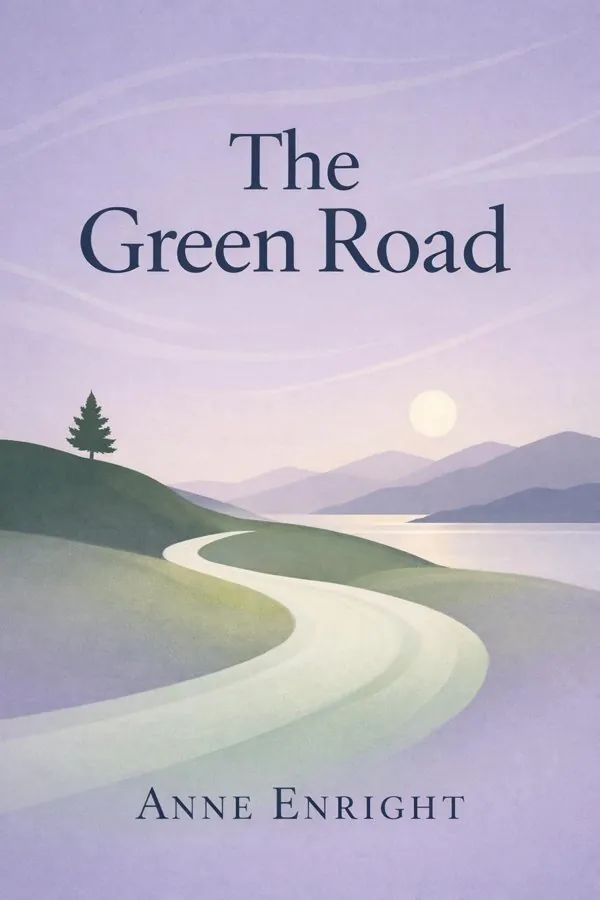
The Green Road: Summary & Key Insights
by Anne Enright
 10 min9 chaptersAudio available
Key Takeaways from The Green Road
Families often look most solid from the outside precisely when they are most fractured within.
Care can sustain a life, but it can also empty the person who gives it.
Becoming yourself often requires disappointing the world that first defined you.
It is possible to devote your life to helping others while remaining emotionally unavailable to the people closest to you.
In many families, the most responsible person is also the one least allowed to fall apart.
What Is The Green Road About?
The Green Road by Anne Enright is a bestsellers book spanning 8 pages. Anne Enright’s The Green Road is a piercing, beautifully written novel about one Irish family and the long emotional shadows cast by home, history, and memory. Set across several decades, the story follows Rosaleen Madigan and her four grown children—Dan, Constance, Emmet, and Hanna—as their lives branch outward from County Clare to Dublin, New York, Africa, and beyond, only to bend back toward a fraught Christmas reunion. Rather than offering a simple family saga, Enright builds a mosaic of loneliness, resentment, tenderness, and survival, showing how parents and children misunderstand one another even while remaining permanently bound. What makes the novel matter is the precision of its emotional intelligence. Enright captures the way families create private languages, old roles, and unresolved wounds that endure long after childhood ends. She also places the Madigans within a changing Ireland, making the novel not just intimate but historical. A Booker Prize-winning author celebrated for her sharp psychological insight and lyrical prose, Enright writes with uncommon authority about the hidden tensions beneath ordinary domestic life. The Green Road is both a deeply specific Irish story and a universal portrait of what it means to belong to a family.
This FizzRead summary covers all 9 key chapters of The Green Road in approximately 10 minutes, distilling the most important ideas, arguments, and takeaways from Anne Enright's work. Also available as an audio summary and Key Quotes Podcast.
The Green Road
Anne Enright’s The Green Road is a piercing, beautifully written novel about one Irish family and the long emotional shadows cast by home, history, and memory. Set across several decades, the story follows Rosaleen Madigan and her four grown children—Dan, Constance, Emmet, and Hanna—as their lives branch outward from County Clare to Dublin, New York, Africa, and beyond, only to bend back toward a fraught Christmas reunion. Rather than offering a simple family saga, Enright builds a mosaic of loneliness, resentment, tenderness, and survival, showing how parents and children misunderstand one another even while remaining permanently bound.
What makes the novel matter is the precision of its emotional intelligence. Enright captures the way families create private languages, old roles, and unresolved wounds that endure long after childhood ends. She also places the Madigans within a changing Ireland, making the novel not just intimate but historical. A Booker Prize-winning author celebrated for her sharp psychological insight and lyrical prose, Enright writes with uncommon authority about the hidden tensions beneath ordinary domestic life. The Green Road is both a deeply specific Irish story and a universal portrait of what it means to belong to a family.
Who Should Read The Green Road?
This book is perfect for anyone interested in bestsellers and looking to gain actionable insights in a short read. Whether you're a student, professional, or lifelong learner, the key ideas from The Green Road by Anne Enright will help you think differently.
- ✓Readers who enjoy bestsellers and want practical takeaways
- ✓Professionals looking to apply new ideas to their work and life
- ✓Anyone who wants the core insights of The Green Road in just 10 minutes
Want the full summary?
Get instant access to this book summary and 100K+ more with Fizz Moment.
Get Free SummaryAvailable on App Store • Free to download
Key Chapters
Families often look most solid from the outside precisely when they are most fractured within. The Green Road begins with the Madigans in County Clare, where Rosaleen presides over the family home like the guardian of an older Ireland—formal, watchful, loving in ways that are rarely gentle. The house itself becomes a symbol of continuity, inheritance, and pressure. It is a place the children come from, but also a place they must escape if they are to become themselves.
Enright uses the Madigans to show that family identity is built from both roots and fault lines. Each sibling carries the same childhood but interprets it differently. One remembers duty, another remembers criticism, another hunger for approval, and another the suffocating weight of expectation. Rosaleen, meanwhile, is not simply a controlling mother; she is also a woman shaped by disappointment, social convention, and the fear of abandonment. This complexity keeps the novel from becoming a simple story of blame.
In real life, many families operate the same way. Shared history does not guarantee shared meaning. A holiday meal, an old photograph, or the sale of a family home can expose just how differently people have lived the same story. Enright reminds us that the emotional architecture of a family is rarely visible until stress tests it.
A useful application is to question inherited roles. Are you still playing the peacemaker, the rebel, the achiever, or the invisible one because that is who you are—or because your family needed you to be that person? Actionable takeaway: identify one family role you have carried for years and ask whether it still serves your life now.
Care can sustain a life, but it can also empty the person who gives it. In Hanna’s section, Enright presents one of the novel’s most intimate portraits of domestic exhaustion. Hanna is a mother moving through the routines of childcare and marriage while feeling emotionally hollowed out. Her life looks ordinary from the outside, yet inside it is marked by loneliness, self-doubt, and the dull ache of disconnection.
What makes this chapter so powerful is its refusal to romanticize family life. Hanna’s struggle is not dramatic in a public sense; it is private, repetitive, and therefore easy for others to overlook. Enright understands that despair often hides inside competence. Meals are prepared, children are tended, rooms are managed—and still the self can feel like it is disappearing. Hanna’s emotional fragility also connects back to her family of origin, where old hurts and unspoken needs continue to shape her adult life.
This idea extends far beyond the novel. Many people, especially caregivers, become trapped in systems where their usefulness is valued more than their inner life. A parent, partner, or adult child caring for others may appear functional while silently nearing collapse. The lesson is not that care is a burden alone, but that care without support, recognition, and reciprocity becomes dangerous.
Practically, Hanna’s story encourages more honest conversations about depletion. Instead of waiting for a crisis, it is healthier to name fatigue early: "I need help," "I need time alone," or "I am not coping as well as I seem." Actionable takeaway: if you are carrying invisible emotional labor, name one specific support you need this week and ask for it clearly.
Becoming yourself often requires disappointing the world that first defined you. Dan’s journey takes him from the strict moral atmosphere of his Irish upbringing into the charged freedom of New York, where sexuality, faith, and identity collide. His chapter is about desire, performance, and reinvention, but also about the emotional cost of constructing a self in opposition to inherited expectations.
Dan is one of the clearest examples of how Enright connects personal freedom with cultural change. He has grown up under the influence of religion, family scrutiny, and the demand to conform. In New York, he finds a new landscape of possibility, especially in relation to his sexuality. Yet liberation is not portrayed as simple. Dan’s life is shaped by masks—some worn for protection, others for approval. Even when he moves toward honesty, he does so through uncertainty, shame, and theatrical self-presentation.
This makes his story resonate widely. Many readers will recognize the tension between belonging and authenticity: the pressure to remain loyal to one’s origins while also refusing the scripts those origins impose. Whether the issue is sexuality, career, class, religion, or lifestyle, the challenge is the same: can you build a life that is truly yours without severing every bond behind you?
Dan’s arc suggests that belonging is not found by fitting perfectly into one world or another. It comes from tolerating complexity and living more truthfully over time. For readers, this can mean asking where performance has replaced honesty. Actionable takeaway: notice one area of your life where you are managing impressions more than expressing truth, and take one small step toward greater authenticity.
It is possible to devote your life to helping others while remaining emotionally unavailable to the people closest to you. Emmet’s character embodies this paradox. He works in difficult international settings, offering aid and structure where crisis has stripped both away. He is competent, ethical, and outwardly useful. Yet in his personal life he is distant, restless, and resistant to intimacy.
Enright uses Emmet to examine a subtle form of avoidance: the ability to care in principle more easily than in proximity. Large-scale suffering gives Emmet a clear role. Family, by contrast, demands vulnerability, patience, and emotional messiness. Global compassion can be organized through tasks and missions; family responsibility cannot. The novel never reduces him to hypocrisy. Instead, it shows how some people move toward difficult work abroad partly because it feels cleaner, clearer, or more manageable than the unresolved knots of home.
This dynamic appears in many modern lives. A person may excel professionally, volunteer generously, or be deeply committed to causes while struggling to call a parent, sustain a partnership, or sit with a sibling’s pain. Public usefulness can become a shelter from private feeling. Emmet’s life raises an uncomfortable question: where are we compassionate, and where are we evasive?
The practical application is not to dismiss purpose-driven work, but to examine whether noble activity is also protecting us from personal accountability. Emotional closeness requires a different skill set than competence. It asks for presence without control. Actionable takeaway: think of one relationship you keep at arm’s length while staying busy elsewhere, and make one concrete act of contact—call, visit, or ask a sincere question and remain for the answer.
In many families, the most responsible person is also the one least allowed to fall apart. Constance, living in Limerick, appears to be the stable center among the Madigan siblings. She is practical, maternal, attentive, and deeply tuned to the needs of others. But Enright reveals that steadiness is not the same as ease. Constance carries the invisible burden of monitoring, anticipating, and holding things together.
Her storyline highlights how responsibility can become identity. She is the sibling who notices illness, tracks obligations, and remains emotionally available when others drift or resist. Yet this reliability comes with anxiety and bodily vulnerability. Her fears about health underscore one of the novel’s recurring truths: the body often records what the family cannot say openly. Worry, duty, and suppressed feeling do not vanish; they become symptoms, habits, and forms of self-surveillance.
Constance’s experience is especially recognizable to readers who have become their family’s organizer, mediator, or emotional administrator. Such people are praised for coping, but praise can turn into a trap. Once others depend on your competence, your own need for comfort may seem illegitimate or inconvenient. Enright gives this experience dignity by showing the tenderness and exhaustion woven together inside it.
The lesson here is that responsibility should not require self-erasure. Healthy care includes limits, delegation, and the right to be uncertain. In everyday life, this might mean refusing to manage every family event, sharing caregiving tasks, or admitting fear rather than translating it into more labor. Actionable takeaway: list one family or household responsibility you carry automatically and decide whether it can be shared, delayed, or declined.
The home we long for is often less a place than a story we keep telling ourselves. Rosaleen’s later-life loneliness reveals this with painful clarity. She lives amid the physical remains of family life, but the children have dispersed, the social world around her has changed, and the authority she once exercised no longer guarantees closeness. She clings to memory, ritual, and grievance because they preserve the meaning of her role.
Enright is exceptionally good at portraying aging without sentimentality. Rosaleen is difficult, manipulative at times, and emotionally demanding, but she is also deeply human in her fear of becoming irrelevant. Her nostalgia is not merely backward-looking affection; it is a defense against emptiness. The family home in County Clare stands as a repository of identity, and the possibility of losing it feels like a second loss—first the family as a living unit, then the place that proved it once existed.
Many readers will recognize this dynamic in older parents or in themselves. A house may symbolize sacrifice, belonging, status, or memory. Discussions about moving, selling, or changing routines can trigger emotions that seem disproportionate only if we ignore their symbolic weight. Home is rarely just bricks and land. It is a container for who we believed we were.
The practical lesson is to listen beneath logistical conflict. When someone resists change, they may be defending dignity, not merely resisting inconvenience. Actionable takeaway: in a difficult family conversation about home, aging, or change, ask one deeper question—"What does this place mean to you?"—before arguing about the practical details.
Time passes, but families can pull adults back into childhood in a single evening. The Christmas reunion at the center of The Green Road dramatizes this with wit, tension, and emotional precision. The Madigan siblings return home as older, supposedly independent people, yet the moment they gather around Rosaleen, old patterns re-emerge: rivalry, defensiveness, caretaking, sarcasm, nostalgia, and the longing to be seen correctly.
Enright shows that reunions are rarely about the present alone. They are crowded with former selves. The successful sibling becomes insecure, the distant one turns evasive, the responsible one starts managing everyone, and the parent resumes old judgments or emotional tactics. Nothing has to be explicitly said for the atmosphere to thicken with memory. This is why family gatherings often feel so disproportionately intense: people are not simply responding to what is happening now, but to decades of layered meaning.
This insight has practical relevance far beyond literature. Anyone who has returned home for a holiday understands how quickly maturity can disappear under familial pressure. A comment about food, a sleeping arrangement, or a late arrival may carry hidden charges from years earlier. Recognizing this can reduce confusion. We are not irrational; we are historically activated.
The reunion scenes suggest a more mindful approach to family encounters. Preparation matters. It helps to anticipate triggers, lower expectations, and separate present reality from past injury where possible. This does not erase tension, but it can prevent total regression. Actionable takeaway: before your next family gathering, identify one old pattern you expect to reappear and choose in advance how you want to respond differently.
Sometimes a family only confronts itself when one of its members vanishes from the usual script. Rosaleen’s disappearance near the end of the novel functions both as a plot event and as a symbolic rupture. Her absence forces the Madigans to act—not as abstractly connected relatives, but as people who must respond to vulnerability, fear, and unresolved dependence in real time.
The brilliance of this episode lies in how it transforms family tension into shared attention. Throughout the novel, each character has interpreted Rosaleen through private resentments and obligations. Once she is missing, those interpretations are briefly suspended by urgency. Search replaces complaint. Presence matters more than analysis. Yet the incident does not magically heal the family. Instead, it reveals that beneath irritation and distance there remains attachment, however compromised.
This is true in many families. Crises can expose both the strength and inadequacy of familial bonds. An illness, disappearance, legal problem, or sudden loss may temporarily strip away posturing and reveal what people actually mean to one another. But crisis is not the same as repair. It can open a door, not walk everyone through it.
Rosaleen’s rediscovery suggests that reconciliation is usually partial and imperfect. Families do not often achieve dramatic resolution; they endure through fragments of care, fleeting honesty, and the decision to keep showing up. For readers, this offers a grounded hope. You may not get closure, but you may still get contact, recognition, or a less damaging way forward. Actionable takeaway: do not wait for crisis to express concern—reach out now to one family member with a message that is simple, direct, and kind.
A family story is never only private; it is also shaped by the country and era through which that family moves. One of the richest achievements of The Green Road is the way it tracks social change in Ireland alongside the emotional evolution of the Madigans. The novel spans decades in which Ireland shifts culturally, economically, and morally. As the world opens, the family disperses, and the old certainties of religion, place, and hierarchy begin to loosen.
Enright does not treat history as background decoration. Instead, historical change enters the texture of daily life: migration, urbanization, global work, altered sexual norms, and a weakening of traditional authority. The Madigan children inhabit a wider world than Rosaleen did, but expansion brings fragmentation as well as freedom. The family’s scattering is both a personal story and an expression of modern Ireland’s transformation.
This broader lens deepens the novel’s relevance. Readers can see how their own families are shaped by forces that feel external but become intimate over time—economic shifts, changing gender roles, mobility, technology, or political upheaval. What appears to be a private conflict may partly reflect a generational transition. Parents and children are sometimes arguing not only with one another, but with different historical worlds.
The practical takeaway is to place personal tension in context. Doing so does not eliminate responsibility, but it can create empathy. A parent formed by scarcity, silence, or rigid norms may not love less; they may simply speak a different emotional language. Actionable takeaway: when reflecting on a family conflict, ask what historical or generational pressures shaped each person’s expectations.
All Chapters in The Green Road
About the Author
Anne Enright is an Irish novelist, short story writer, and essayist born in Dublin in 1962. She studied English and Philosophy at Trinity College Dublin and later trained in television production before turning fully to fiction. Enright is widely admired for her incisive, lyrical style and for her unmatched ability to portray family life, emotional inheritance, gender, and identity with subtlety and force. She won the Man Booker Prize in 2007 for The Gathering, one of several acclaimed novels that established her as a leading voice in contemporary literature. Her other notable works include The Green Road, Actress, and The Wren, The Wren. From 2015 to 2018, she served as Ireland’s first Laureate for Irish Fiction, further confirming her central place in modern Irish writing.
Get This Summary in Your Preferred Format
Read or listen to the The Green Road summary by Anne Enright anytime, anywhere. FizzRead offers multiple formats so you can learn on your terms — all free.
Available formats: App · Audio · PDF · EPUB — All included free with FizzRead
Download The Green Road PDF and EPUB Summary
Key Quotes from The Green Road
“Families often look most solid from the outside precisely when they are most fractured within.”
“Care can sustain a life, but it can also empty the person who gives it.”
“Becoming yourself often requires disappointing the world that first defined you.”
“It is possible to devote your life to helping others while remaining emotionally unavailable to the people closest to you.”
“In many families, the most responsible person is also the one least allowed to fall apart.”
Frequently Asked Questions about The Green Road
The Green Road by Anne Enright is a bestsellers book that explores key ideas across 9 chapters. Anne Enright’s The Green Road is a piercing, beautifully written novel about one Irish family and the long emotional shadows cast by home, history, and memory. Set across several decades, the story follows Rosaleen Madigan and her four grown children—Dan, Constance, Emmet, and Hanna—as their lives branch outward from County Clare to Dublin, New York, Africa, and beyond, only to bend back toward a fraught Christmas reunion. Rather than offering a simple family saga, Enright builds a mosaic of loneliness, resentment, tenderness, and survival, showing how parents and children misunderstand one another even while remaining permanently bound. What makes the novel matter is the precision of its emotional intelligence. Enright captures the way families create private languages, old roles, and unresolved wounds that endure long after childhood ends. She also places the Madigans within a changing Ireland, making the novel not just intimate but historical. A Booker Prize-winning author celebrated for her sharp psychological insight and lyrical prose, Enright writes with uncommon authority about the hidden tensions beneath ordinary domestic life. The Green Road is both a deeply specific Irish story and a universal portrait of what it means to belong to a family.
More by Anne Enright
You Might Also Like

The Godfather
Mario Puzo
10 min
The Handmaid's Tale
Margaret Atwood
10 min
The Hunger Games
Suzanne Collins
10 min
The Nightingale
Kristin Hannah
10 min
The Seven Husbands of Evelyn Hugo
Taylor Jenkins Reid
10 min
Backwater Justice
Fern Michaels
10 minBrowse by Category
Ready to read The Green Road?
Get the full summary and 100K+ more books with Fizz Moment.