
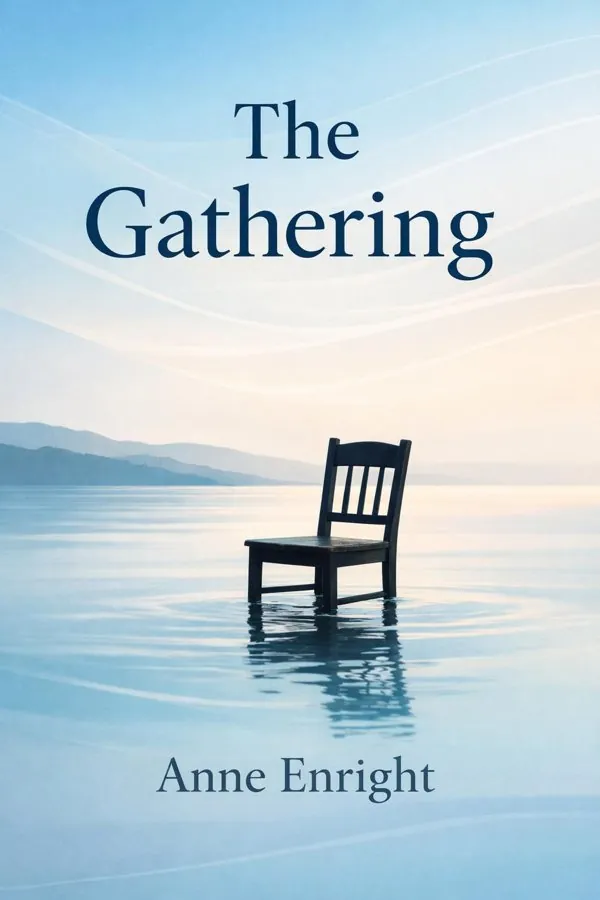
The Gathering: A Novel (Booker Prize Winner): Summary & Key Insights
by Anne Enright
 10 min9 chaptersAudio available
Key Takeaways from The Gathering: A Novel (Booker Prize Winner)
Death often feels final, but grief makes it strangely unfinished.
Families are often most revealing when they are forced together.
Every family has a mythology about where it began, but origins stories often conceal as much as they explain.
Ritual promises order, but sorrow rarely obeys ceremony.
One of the boldest things about The Gathering is that it never lets readers forget a difficult fact: memory is both essential and suspect.
What Is The Gathering: A Novel (Booker Prize Winner) About?
The Gathering: A Novel (Booker Prize Winner) by Anne Enright is a classics book spanning 4 pages. Some novels tell a story; Anne Enright’s The Gathering excavates one. Set in the aftermath of Liam Hegarty’s apparent suicide, the book follows his sister Veronica as she tries to understand what happened not only to her brother, but to the family that formed them both. As the sprawling Hegarty clan gathers in Dublin for the wake and funeral, Veronica’s narration moves between present grief, childhood fragments, family lore, and painful conjecture. The result is a novel about memory’s instability, the body’s record of suffering, and the way families survive by turning away from what they cannot bear to name. What makes The Gathering so powerful is its refusal to offer easy consolation. Enright writes with piercing intelligence about shame, desire, class, motherhood, marriage, and the private damage hidden inside ordinary domestic life. Winner of the 2007 Man Booker Prize, the novel matters because it transforms one family tragedy into a broader meditation on how trauma travels through generations. Enright, one of Ireland’s most acclaimed contemporary writers, brings emotional precision and formal daring to every page, making this a modern classic of grief, remembrance, and difficult truth.
This FizzRead summary covers all 9 key chapters of The Gathering: A Novel (Booker Prize Winner) in approximately 10 minutes, distilling the most important ideas, arguments, and takeaways from Anne Enright's work. Also available as an audio summary and Key Quotes Podcast.
The Gathering: A Novel (Booker Prize Winner)
Some novels tell a story; Anne Enright’s The Gathering excavates one. Set in the aftermath of Liam Hegarty’s apparent suicide, the book follows his sister Veronica as she tries to understand what happened not only to her brother, but to the family that formed them both. As the sprawling Hegarty clan gathers in Dublin for the wake and funeral, Veronica’s narration moves between present grief, childhood fragments, family lore, and painful conjecture. The result is a novel about memory’s instability, the body’s record of suffering, and the way families survive by turning away from what they cannot bear to name.
What makes The Gathering so powerful is its refusal to offer easy consolation. Enright writes with piercing intelligence about shame, desire, class, motherhood, marriage, and the private damage hidden inside ordinary domestic life. Winner of the 2007 Man Booker Prize, the novel matters because it transforms one family tragedy into a broader meditation on how trauma travels through generations. Enright, one of Ireland’s most acclaimed contemporary writers, brings emotional precision and formal daring to every page, making this a modern classic of grief, remembrance, and difficult truth.
Who Should Read The Gathering: A Novel (Booker Prize Winner)?
This book is perfect for anyone interested in classics and looking to gain actionable insights in a short read. Whether you're a student, professional, or lifelong learner, the key ideas from The Gathering: A Novel (Booker Prize Winner) by Anne Enright will help you think differently.
- ✓Readers who enjoy classics and want practical takeaways
- ✓Professionals looking to apply new ideas to their work and life
- ✓Anyone who wants the core insights of The Gathering: A Novel (Booker Prize Winner) in just 10 minutes
Want the full summary?
Get instant access to this book summary and 100K+ more with Fizz Moment.
Get Free SummaryAvailable on App Store • Free to download
Key Chapters
Death often feels final, but grief makes it strangely unfinished. In The Gathering, Liam Hegarty’s suicide is not simply an event that begins the story; it is the force that reorganizes everything around it. For Veronica, his sister and the novel’s narrator, Liam’s death becomes a demand. She cannot leave it alone, cannot accept the neatness of a verdict, and cannot stop circling back through memory to ask what was missed, what was hidden, and what was silently endured.
Enright shows that bereavement is not a clean emotional sequence. It is recursive, bodily, and disorienting. Veronica’s mind moves unpredictably between the practical details of the wake and funeral, memories of childhood, observations about her husband and daughters, and increasingly disturbing reflections on Liam’s vulnerability. This narrative movement mirrors real grief: the bereaved do not proceed in straight lines. They revisit, revise, and rehearse the past until memory itself becomes unstable.
What gives Liam’s death such weight is that it exposes the long life of family silence. Veronica understands that her brother did not emerge from nowhere as a damaged adult. He came from a home crowded with children, noise, ritual, affection, and neglect. His death forces her to confront not just a loss in the present, but a hidden history that may have shaped him for decades.
In everyday life, grief often awakens similar questions. A family member’s death can reopen old tensions, bring forgotten scenes back into focus, or reveal how much was never discussed. The practical lesson is not to chase certainty where certainty is impossible, but to notice what grief is asking us to examine.
Actionable takeaway: When loss stirs up buried memories, write them down without forcing them into order. Begin with fragments. Sometimes clarity starts by honoring what grief refuses to let you ignore.
Families are often most revealing when they are forced together. In The Gathering, the wake for Liam draws the Hegarty siblings back into one another’s orbit, and the reunion exposes something crucial: families do not function only through love and loyalty, but also through routines of omission. The gathering is not merely a social event or mourning ritual. It is a stage on which long-practiced silences perform themselves.
The Hegartys are a large Irish family, full of shared references, jokes, old grudges, and inherited roles. Yet what binds them is not only what they remember together; it is also what they agree not to articulate. Veronica notices the mechanics of this silence with painful precision. People speak around difficult truths. They manage appearances. They preserve continuity by refusing disruption. The funeral rituals themselves offer structure, but structure can also become concealment.
Enright’s insight is that family silence is rarely neutral. It protects the family image, but often at the expense of the vulnerable. When no one speaks plainly about suffering, harmful experiences become private burdens. Liam’s life and death suggest the cost of this arrangement. Veronica’s attempt to narrate the family past is therefore both an act of mourning and a rebellion against the social habit of smoothing over damage.
This idea resonates beyond the novel. Many families have subjects that are permanently deferred: addiction, abuse, mental illness, financial collapse, favoritism, infidelity. Gatherings often intensify these absences. Everyone senses the shape of the missing conversation, but politeness or fear keeps it unspoken.
Actionable takeaway: Notice the recurring topics your family avoids. You do not need to explode every silence, but naming one important truth with care can interrupt a pattern that has lasted for years.
Every family has a mythology about where it began, but origins stories often conceal as much as they explain. In The Gathering, Veronica’s attention turns repeatedly toward an earlier generation, especially to Ada Merriman, her grandmother, and the household arrangements that preceded the Hegarty children’s chaotic modern family life. By reconstructing this past, Veronica is not indulging nostalgia. She is looking for the seedbed of damage.
Ada’s world represents more than family background; it symbolizes the social and emotional structures that shape what later generations can know and say. Veronica imagines, revises, and reimagines scenes from this earlier time, particularly those involving Lambert Nugent. These scenes become central because they suggest that Liam’s suffering may have roots in an unacknowledged childhood violation. Crucially, Enright never presents memory as courtroom evidence. Veronica is piecing together fragments, intuition, and bodily certainty. The truth matters, but the process of approaching it is equally important.
This key idea expands the novel beyond individual tragedy. The Gathering argues that trauma is rarely self-contained. It passes through gestures, absences, habits of denial, and family arrangements that seem ordinary until their consequences emerge decades later. The younger generation inherits not just stories, but the gaps within stories.
In real life, people often discover that family pain predates the events they first associated with it. A parent’s emotional distance, a sibling’s volatility, or a grandparent’s rigidity may connect to earlier losses or violations no one fully explained. Understanding that history does not erase harm, but it can deepen compassion and sharpen accountability.
Actionable takeaway: If a family pattern feels larger than one incident, trace it backward. Ask what earlier experiences, structures, or silences may have prepared the ground for what later appeared inevitable.
Ritual promises order, but sorrow rarely obeys ceremony. In The Gathering, Liam’s wake and funeral offer a recognizable script for communal mourning: people gather, stories circulate, bodies are cared for, prayers and formalities create a sequence through which grief can move. Yet Enright is deeply aware that ritual can only contain pain, not resolve it. The funeral does not deliver revelation or healing. It creates a temporary frame inside which the family’s contradictions become visible.
For Veronica, the funeral is both practical and existential. She must navigate arrangements, social expectations, and the demands of being a daughter and sister. At the same time, she is undergoing a more intimate disturbance. Liam’s death has destabilized her marriage, intensified her self-scrutiny, and reopened questions about childhood and culpability. The funeral, then, functions as a threshold. She cannot return unchanged to the life she had before his death, even if no dramatic public confession occurs.
What emerges is not tidy reconciliation but something more fragile and believable: the possibility of continued life in the presence of unresolved knowledge. Veronica does not solve her family. She does not restore innocence. Instead, she moves toward a tentative acceptance that truth, love, resentment, and damage can coexist.
This reflects a broader reality. Funerals often produce moments of closeness, honesty, or renewed contact, but these moments are usually partial. A ceremony may soften hostilities or remind people of shared attachment, yet old patterns return unless people actively change them. Still, ritual matters. It gives grief witnesses and reminds the bereaved that private sorrow belongs to a human community.
Actionable takeaway: Treat rituals not as emotional solutions but as openings. After a major family event, follow up one meaningful conversation with sustained action rather than assuming the moment itself has changed everything.
One of the boldest things about The Gathering is that it never lets readers forget a difficult fact: memory is both essential and suspect. Veronica is not a detached chronicler. She is grieving, drinking, imagining, revising, and trying desperately to assemble a coherent narrative from fragments that resist coherence. Her uncertainty is not a flaw in the novel; it is the novel’s method.
Enright uses Veronica’s unstable recollection to explore how truth is often approached through distortion, repetition, and speculation. Veronica frequently signals that she may be inventing details or arranging scenes she could not possibly have witnessed. Yet these invented or partially imagined reconstructions are not meaningless. They reveal the emotional logic of trauma. Sometimes people do not remember events clearly, but they remember atmosphere, dread, bodily reaction, or the shape of a violation that language failed to capture at the time.
This makes the book especially powerful as a study of traumatic knowledge. Rather than presenting truth as a set of verifiable facts waiting to be discovered, Enright shows truth as something that may survive in broken forms. Veronica’s narration asks readers to take uncertainty seriously without dismissing what it points toward.
Outside literature, this insight has practical importance. People often expect memory to behave like a recording device, especially when discussing painful events. But real memory is associative and vulnerable to omission. A person may be unable to recount everything precisely and still be expressing something profoundly true about what happened.
Actionable takeaway: When trying to understand a difficult past event, separate factual certainty from emotional truth. Ask not only, “What exactly happened?” but also, “What has this memory done to me, and why does it still carry such force?”
Before the mind can explain a wound, the body often already knows it is there. Throughout The Gathering, Enright returns to the body as a site of knowledge: desire, disgust, grief, fatigue, sexuality, pregnancy, drinking, and physical unease all shape Veronica’s understanding of herself and her family. The novel’s famous insistence is that fate is written in the body, not in the stars, and this idea gives the book much of its emotional and philosophical depth.
Veronica does not process Liam’s death solely through reflection. She experiences it physically. Her narration is saturated with bodily awareness, as if thought itself were inseparable from flesh. This is especially important in a novel concerned with trauma. Harm is not only remembered in words; it can persist in habits, appetites, aversions, and forms of self-estrangement. The body stores what the family system has failed to acknowledge.
Enright also links the body to sexuality and marriage. Veronica’s relationship with her husband, Tom, becomes strained not just because she is sad, but because grief alters her sensual life, her sense of intimacy, and her tolerance for ordinary domestic closeness. The novel refuses to separate psychological crisis from physical existence.
This perspective has wide application. Many people try to think their way out of grief or trauma while ignoring how deeply those experiences are embodied. Sleeplessness, numbness, irritability, panic, compulsive behavior, or loss of desire may be part of a history the body is still carrying.
Actionable takeaway: When facing emotional upheaval, pay attention to physical signals. Track sleep, appetite, tension, and restlessness. The body may reveal patterns the conscious mind has not yet learned how to name.
Private grief does not stay private for long; it spills into the closest relationship available. In The Gathering, Veronica’s marriage to Tom becomes one of the novel’s quiet battlegrounds. Liam’s death forces Veronica inward, toward memory, suspicion, and emotional isolation, while Tom represents the ordinary life she can no longer inhabit without friction. Their marriage is not presented as failed, but as vulnerable to the way trauma rearranges intimacy.
Enright is especially sharp on the mismatch between inner crisis and domestic expectation. Veronica is a wife and mother, and those roles continue to make demands even as she is psychologically overwhelmed. She finds herself estranged from the routines that once organized her life. Tom cannot fully enter the specific terrain of her grief, and that limitation creates distance. The novel does not demonize him; instead, it shows how even decent marriages can struggle when one partner is consumed by old pain newly awakened.
This idea matters because literature often treats marriage either romantically or catastrophically. Enright offers something subtler: marriage as a structure that can absorb strain, but only up to a point, unless people learn how to communicate through altered emotional realities. Veronica’s restlessness, sexual detachment, and mental drift demonstrate how grief can feel like infidelity to the life one built.
Readers may recognize this dynamic in their own lives. After a family death, job loss, betrayal, or health crisis, couples often discover that love alone does not automatically produce understanding. One partner may need witness, while the other reaches too quickly for reassurance or normalcy.
Actionable takeaway: In times of grief, tell close partners what kind of support is actually helpful. Do not assume they can interpret silence correctly. Specific requests create more intimacy than unspoken disappointment.
In a large family, identity is rarely self-created; it is assigned, repeated, and defended over time. The Hegarty clan, with its many children and dense web of loyalties, offers Enright a perfect setting to explore how families turn people into roles: the troubled one, the practical one, the funny one, the capable one, the invisible one. Veronica’s narration shows how these labels simplify complexity while helping the group maintain balance.
Liam’s role in the family is especially revealing. His waywardness, charisma, and instability make him both beloved and difficult, but reducing him to family shorthand also obscures his suffering. Veronica, meanwhile, occupies a different role: observer, carrier of memory, reluctant truth-teller. Her perspective reveals how survival in a crowded family often requires adaptation. Children learn quickly where attention flows, what behavior is rewarded, and which emotions create too much disturbance.
Enright’s larger point is that family systems often preserve themselves by distributing pain unevenly. Some members act out what others repress. Some become repositories for anxiety. Some gain competence by becoming prematurely adult. These patterns can last well into middle age unless they are recognized and challenged.
This framework is useful beyond the novel. Many adults continue to react to siblings and parents according to scripts formed in childhood, even when circumstances have changed. Old roles can shape career choices, romantic relationships, and self-worth.
Actionable takeaway: Ask yourself what role your family assigned you early in life. Then identify one way that role still limits your choices. Awareness is the first step toward becoming more than the part you were given.
When something unbearable happens, people instinctively seek a story large enough to hold it. The Gathering is, in many ways, about that search. Veronica cannot accept Liam’s death as a bare fact. She needs sequence, cause, context, origin. She needs to tell the story of how her brother became who he was, and of how her family became a place where so much could remain unspoken. Her narration is not merely remembrance; it is an attempt to make grief narratable.
Enright understands that this search is both necessary and doomed. A story can organize suffering, but it cannot eliminate uncertainty. Veronica’s account keeps shifting because no single version can fully contain the emotional and historical complexity she confronts. Yet the act of narration itself matters. To tell a story, however imperfectly, is to resist the deadness of mute pain.
The novel therefore becomes a meditation on the human need for meaning after catastrophe. People write eulogies, revisit photographs, ask relatives for details, replay conversations, and reinterpret old events. These are not simply sentimental gestures. They are ways of rebuilding a world whose coherence has been broken.
For readers, this idea offers a humane model of coping. We do not always need definitive answers to move forward, but we often do need language. The story we tell about a loss may change over time, and that changing story can itself be a sign of healing.
Actionable takeaway: After a major loss, try writing the event from more than one angle: what happened, what you felt then, and what you think it means now. The goal is not a final version, but a more livable relationship to the truth.
All Chapters in The Gathering: A Novel (Booker Prize Winner)
About the Author
Anne Enright is an Irish novelist, short story writer, and essayist born in Dublin in 1962. She studied English and Philosophy at Trinity College Dublin and later completed creative writing studies at the University of East Anglia. Enright is widely admired for her incisive prose, psychological depth, and fearless exploration of family life, sexuality, motherhood, grief, and Irish identity. Her novels include The Wig My Father Wore, What Are You Like?, The Pleasure of Eliza Lynch, The Forgotten Waltz, and The Green Road, alongside acclaimed story collections and nonfiction. She won the 2007 Man Booker Prize for The Gathering, a novel that cemented her international reputation. Enright also served as Ireland’s first Laureate for Irish Fiction, reflecting her central place in contemporary Irish literature.
Get This Summary in Your Preferred Format
Read or listen to the The Gathering: A Novel (Booker Prize Winner) summary by Anne Enright anytime, anywhere. FizzRead offers multiple formats so you can learn on your terms — all free.
Available formats: App · Audio · PDF · EPUB — All included free with FizzRead
Download The Gathering: A Novel (Booker Prize Winner) PDF and EPUB Summary
Key Quotes from The Gathering: A Novel (Booker Prize Winner)
“Death often feels final, but grief makes it strangely unfinished.”
“Families are often most revealing when they are forced together.”
“Every family has a mythology about where it began, but origins stories often conceal as much as they explain.”
“Ritual promises order, but sorrow rarely obeys ceremony.”
“One of the boldest things about The Gathering is that it never lets readers forget a difficult fact: memory is both essential and suspect.”
Frequently Asked Questions about The Gathering: A Novel (Booker Prize Winner)
The Gathering: A Novel (Booker Prize Winner) by Anne Enright is a classics book that explores key ideas across 9 chapters. Some novels tell a story; Anne Enright’s The Gathering excavates one. Set in the aftermath of Liam Hegarty’s apparent suicide, the book follows his sister Veronica as she tries to understand what happened not only to her brother, but to the family that formed them both. As the sprawling Hegarty clan gathers in Dublin for the wake and funeral, Veronica’s narration moves between present grief, childhood fragments, family lore, and painful conjecture. The result is a novel about memory’s instability, the body’s record of suffering, and the way families survive by turning away from what they cannot bear to name. What makes The Gathering so powerful is its refusal to offer easy consolation. Enright writes with piercing intelligence about shame, desire, class, motherhood, marriage, and the private damage hidden inside ordinary domestic life. Winner of the 2007 Man Booker Prize, the novel matters because it transforms one family tragedy into a broader meditation on how trauma travels through generations. Enright, one of Ireland’s most acclaimed contemporary writers, brings emotional precision and formal daring to every page, making this a modern classic of grief, remembrance, and difficult truth.
More by Anne Enright

You Might Also Like



Browse by Category
Ready to read The Gathering: A Novel (Booker Prize Winner)?
Get the full summary and 100K+ more books with Fizz Moment.