
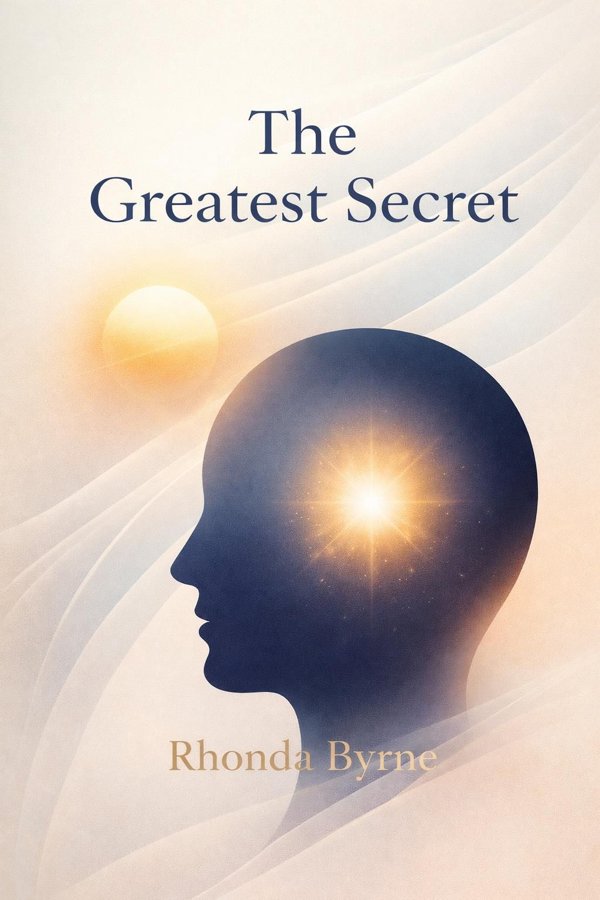
The Greatest Secret: Summary & Key Insights
by Rhonda Byrne
 10 min9 chaptersAudio available
Key Takeaways from The Greatest Secret
Most people spend their lives searching for happiness in changing circumstances, yet the book argues that true peace is already present as awareness itself.
A thought only gains power when you believe it is you.
The ego is not an evil force in Byrne’s framework; it is a mistaken sense of self built from labels, memories, fears, and preferences.
Freedom does not begin by forcing the mind to become silent; it begins by observing it.
One of the most comforting ideas in The Greatest Secret is that you do not need to become whole—you need to recognize that you already are.
What Is The Greatest Secret About?
The Greatest Secret by Rhonda Byrne is a mindset book spanning 6 pages. In The Greatest Secret, Rhonda Byrne moves beyond the popular message of manifestation that made The Secret a global phenomenon and turns toward a deeper spiritual question: who are you beneath your thoughts, emotions, and personal story? Drawing on teachings from mystics, spiritual teachers, and nondual traditions, Byrne argues that lasting happiness does not come from getting more of what the mind wants. It comes from recognizing the silent awareness that exists prior to every thought and feeling. According to the book, this awareness is our true nature, and remembering it dissolves fear, anxiety, and unnecessary suffering. What makes this book matter is its shift from external achievement to inner liberation. Instead of focusing only on attracting success, Byrne invites readers to notice the observer within—the unchanging presence behind all experience. For people overwhelmed by mental noise, stress, or a constant sense that something is missing, this message can feel both radical and relieving. Byrne writes with the authority of someone who transformed the self-help conversation once before, and here she offers what she sees as the next and most important step: freedom through awakening to consciousness itself.
This FizzRead summary covers all 9 key chapters of The Greatest Secret in approximately 10 minutes, distilling the most important ideas, arguments, and takeaways from Rhonda Byrne's work. Also available as an audio summary and Key Quotes Podcast.
The Greatest Secret
In The Greatest Secret, Rhonda Byrne moves beyond the popular message of manifestation that made The Secret a global phenomenon and turns toward a deeper spiritual question: who are you beneath your thoughts, emotions, and personal story? Drawing on teachings from mystics, spiritual teachers, and nondual traditions, Byrne argues that lasting happiness does not come from getting more of what the mind wants. It comes from recognizing the silent awareness that exists prior to every thought and feeling. According to the book, this awareness is our true nature, and remembering it dissolves fear, anxiety, and unnecessary suffering.
What makes this book matter is its shift from external achievement to inner liberation. Instead of focusing only on attracting success, Byrne invites readers to notice the observer within—the unchanging presence behind all experience. For people overwhelmed by mental noise, stress, or a constant sense that something is missing, this message can feel both radical and relieving. Byrne writes with the authority of someone who transformed the self-help conversation once before, and here she offers what she sees as the next and most important step: freedom through awakening to consciousness itself.
Who Should Read The Greatest Secret?
This book is perfect for anyone interested in mindset and looking to gain actionable insights in a short read. Whether you're a student, professional, or lifelong learner, the key ideas from The Greatest Secret by Rhonda Byrne will help you think differently.
- ✓Readers who enjoy mindset and want practical takeaways
- ✓Professionals looking to apply new ideas to their work and life
- ✓Anyone who wants the core insights of The Greatest Secret in just 10 minutes
Want the full summary?
Get instant access to this book summary and 100K+ more with Fizz Moment.
Get Free SummaryAvailable on App Store • Free to download
Key Chapters
Most people spend their lives searching for happiness in changing circumstances, yet the book argues that true peace is already present as awareness itself. Byrne presents awareness as the silent background behind every thought, sensation, memory, and emotion. Thoughts come and go. Moods rise and fall. The body changes over time. But the simple fact that you are aware remains constant. This is why she describes awareness not as something you possess, but as what you fundamentally are.
This idea matters because it shifts the search for fulfillment away from external conditions. If peace depends on money, praise, relationships, or achievement, then peace will always feel fragile. But if peace comes from resting as awareness, it is available in every moment. Byrne encourages readers to notice that even when the mind is busy, there is still a quiet presence observing it all. That observer is untouched by the drama it witnesses.
A practical way to apply this is during ordinary stress. If you feel overwhelmed at work, pause and ask: “What is aware of this stress?” You may still feel pressure, but you also begin to sense a deeper stillness beneath it. The same works in conflict, disappointment, or boredom. Instead of being swallowed by the moment, you notice the space around it.
Actionable takeaway: Several times a day, stop for 30 seconds and simply notice that you are aware. Do not try to change anything—just rest in the fact of awareness itself.
A thought only gains power when you believe it is you. One of Byrne’s central teachings is that suffering intensifies when we identify with the constant stream of mental commentary. The mind compares, predicts, complains, judges, and replays the past. Because this inner voice is so persistent, most people assume it defines who they are. Byrne argues that this mistaken identity is the root of much emotional pain.
When you say, “I am anxious,” “I am a failure,” or “I am broken,” you fuse your identity with a temporary mental or emotional state. But the book invites a subtle yet profound shift: thoughts are events appearing in consciousness, not the essence of the self. The mind may produce fearful stories about the future or painful stories about the past, but awareness remains untouched by both.
This concept becomes practical in everyday life. Imagine receiving criticism from a colleague. The mind may instantly say, “They don’t respect me. I always mess things up.” If you fully identify with those thoughts, you suffer twice: once from the event and again from the story. But if you notice, “A thought about rejection is arising,” you create distance. That distance is freedom.
Byrne does not suggest suppressing thought. Instead, she encourages seeing thought clearly. Once observed, it loses some of its authority. You stop treating every mental sentence as truth and begin relating to the mind as a tool rather than a master.
Actionable takeaway: When a painful thought appears, rephrase it as “I am noticing the thought that…” This simple language shift helps loosen identification and reduces suffering.
The ego is not an evil force in Byrne’s framework; it is a mistaken sense of self built from labels, memories, fears, and preferences. It says, “This is my story, my status, my pain, my image.” The ego survives by dividing life into me and other, success and failure, superior and inferior. Byrne explains that as long as people believe this constructed identity is their true self, they remain vulnerable to insecurity and conflict.
The ego constantly seeks reinforcement. It wants to be admired, defended, validated, and made special. Even suffering can become part of its identity: “My struggle defines me.” This is why external victories often fail to bring lasting peace. The ego may feel satisfied briefly, but soon it wants more proof of worth. Byrne’s deeper point is that a false self can never be fully secured.
In practical life, ego dynamics show up everywhere: needing to win every argument, feeling threatened by someone else’s success, obsessing over reputation, or clinging to a role such as parent, professional, or victim. The problem is not having roles; the problem is forgetting that you are more than them. When the role is challenged, the ego panics.
By observing egoic reactions without feeding them, readers can weaken their grip. If jealousy arises, the goal is not shame but recognition. If defensiveness appears, pause before speaking. Awareness exposes the ego’s patterns and makes them less convincing.
Actionable takeaway: The next time you feel offended or superior, ask, “What identity am I protecting right now?” Naming the ego’s role loosens its control.
Freedom does not begin by forcing the mind to become silent; it begins by observing it. Byrne emphasizes that witnessing thoughts and emotions changes our relationship to them. The act of observation creates a gap between awareness and mental activity. In that gap, the mind’s compulsive momentum starts to weaken.
This matters because many people try to solve suffering from within the same thought patterns that created it. They analyze endlessly, argue with themselves, or look for better thoughts to replace bad ones. Byrne points toward a more direct method: simply notice what is happening without immediately reacting. When anger, sadness, or fear appears, become the observer rather than the participant.
A useful example is emotional triggering. Suppose someone ignores your message. The mind may quickly build a case: “They are upset with me. I’m being rejected.” If you follow the story automatically, emotion escalates. But if you pause and observe the tightening in your chest, the rush of thought, and the desire to react, you interrupt the chain. Observation does not erase the feeling instantly, but it prevents unconscious identification.
Byrne’s teaching aligns with many contemplative traditions: what is fully seen begins to lose unconscious power. Observation is not passive resignation; it is a conscious stance that restores choice. Once you see the pattern, you are no longer completely trapped inside it.
Actionable takeaway: Practice a one-minute observation pause each day. Sit still, notice thoughts as they arise, and label them gently—planning, remembering, worrying, judging—without following them.
One of the most comforting ideas in The Greatest Secret is that you do not need to become whole—you need to recognize that you already are. Byrne challenges the common self-improvement assumption that fulfillment lies in fixing, upgrading, or completing the self. While growth has value, the deeper spiritual truth she presents is that awareness itself is complete, untouched, and inherently at peace.
This teaching can be especially powerful for people who feel chronically inadequate. The mind often says, “I’ll be enough when I earn more, heal completely, find love, look different, or achieve more.” Byrne suggests that this is the voice of mistaken identity. The true self is not lacking, because awareness does not depend on external conditions for its worth.
In daily life, this perspective changes how we pursue goals. You can still work hard, build relationships, improve your health, or create meaningful success. But instead of doing these things to prove your value, you do them from a place of inner sufficiency. That makes striving less desperate and more joyful.
For example, someone applying for jobs may experience less fear when they stop making employment the measure of their identity. Rejection may still sting, but it no longer defines their being. Likewise, relationship challenges become easier to navigate when love is not being used to fill a false inner emptiness.
Actionable takeaway: Notice one area where you keep saying, “I’ll be happy when…” Replace it with, “I am whole now, and I can still pursue this goal.” Repeat until it begins to feel believable.
The mind lives largely in two imaginary worlds: memory and anticipation. Byrne argues that much of human suffering comes not from the present moment itself, but from mental time—replaying what happened or fearing what might happen. Awareness, by contrast, exists only now. To return to presence is to step out of the mind’s habitual suffering loop.
This does not mean the past and future are useless. Memory helps us learn, and planning helps us act responsibly. The problem begins when they dominate consciousness. Regret, resentment, anxiety, and dread are often forms of psychological time. Byrne teaches that when attention returns fully to the present moment, these burdens temporarily lose their force.
A practical example is health anxiety. A person may feel one physical sensation and immediately imagine a catastrophic future. Another example is replaying an embarrassing conversation for days. In both cases, the mind creates suffering through projection. Presence interrupts this by bringing attention back to what is actually happening now: breathing, seeing, hearing, sitting, standing.
Byrne encourages readers to use simple anchors to return to presence. Feeling the breath, noticing bodily sensations, or hearing surrounding sounds can all re-ground awareness in the now. The present moment may contain difficulty, but it is almost always more workable than the mind’s dramatized version of it.
Actionable takeaway: Whenever anxiety spikes, name five things you can perceive right now—one sight, one sound, one sensation, one breath, and one contact point with the ground—to return attention to the present.
A core message of the book is that happiness based on conditions is unstable by nature. Byrne argues that if you believe peace depends on events going your way, you will remain vulnerable to life’s constant changes. Circumstances shift. People disappoint. Plans fail. Bodies age. The weather, economy, and opinions of others remain outside your control. If happiness is attached to these variables, it will always be temporary.
Byrne does not deny that pleasant experiences feel good. Instead, she distinguishes pleasure from abiding peace. Pleasure comes and goes. Peace arises from knowing oneself as awareness, which remains present through both gain and loss. This insight does not make life emotionally flat; rather, it creates resilience. You can enjoy success without clinging to it and endure hardship without being spiritually shattered by it.
In practical terms, this teaching helps during common frustrations. A delayed flight, a disappointing review, a family disagreement, or a financial setback may still create discomfort. But if you stop demanding that reality conform perfectly to your preferences, suffering decreases. You become less reactive because your well-being is not completely outsourced to circumstances.
This perspective can also improve relationships. When you stop expecting another person to guarantee your inner peace, love becomes less possessive and more grounded. You meet people with openness rather than silent demands.
Actionable takeaway: The next time something small goes wrong, say, “This is unpleasant, but it does not control my peace.” Use everyday inconveniences as training for inner stability.
Byrne’s teaching is deeply inward, but it is not disconnected from practical life. She suggests that when people rest more often in awareness, their decisions, relationships, and actions naturally improve. Inner stillness does not lead to passivity; it leads to clarity. When the mind is less noisy, you can respond instead of react.
This has powerful everyday implications. In parenting, stillness may prevent harsh words spoken in frustration. In leadership, it can create better listening and steadier judgment. In conflict, it allows someone to hear criticism without immediate defensiveness. In creativity, it reduces overthinking and opens space for insight. Byrne’s point is that outer effectiveness often depends on inner spaciousness.
Consider a person facing a major decision about work. If they approach it from panic, insecurity, or ego, they may choose based on fear or status. But if they first sit in stillness and notice the swirl of thoughts without being ruled by them, the decision often becomes clearer. Similarly, in relationships, awareness helps reveal whether you are speaking from love or from the need to control.
The book ultimately presents awakening not as a mystical escape from ordinary life, but as a better way of living it. The more anchored you are in awareness, the less life feels like a battlefield and the more it feels like a field for conscious participation.
Actionable takeaway: Before sending an important message, making a key decision, or entering a difficult conversation, pause for three conscious breaths and let stillness lead the next action.
The greatest secret, according to Byrne, is not a hidden technique for getting what you want. It is the realization that who you truly are is not the person constructed by thought, but the awareness in which the person appears. This is the book’s most radical and liberating claim. If it is true, then freedom is not something to manufacture in the future; it is something to recognize in the present.
This idea reframes the entire self-help journey. Instead of endlessly trying to improve the imagined self, Byrne invites readers to question the self they have been defending and enhancing. Personal development still has value, but it becomes secondary to awakening. You are not asked to become superhuman. You are asked to see clearly.
In everyday life, this remembrance can soften almost every form of struggle. Fear loses some of its urgency. Shame loses some of its weight. Desire loses some of its desperation. Even success changes character—it is enjoyed, but not used as proof of existence. You still play your human roles, but with less attachment and more freedom.
Byrne presents this recognition as available now, not after years of perfect discipline. While practice helps, the truth itself is immediate. The moment you notice that thoughts are being observed, you have already touched the awareness the book points to. The invitation is simply to return again and again until this becomes your living center.
Actionable takeaway: Begin and end each day with this question: “If I am aware of my thoughts, who is the awareness?” Sit with the question quietly rather than trying to answer it intellectually.
All Chapters in The Greatest Secret
About the Author
Rhonda Byrne is an Australian author, television writer, and producer who became internationally famous through The Secret, a bestselling book and film that brought the law of attraction into mainstream culture. Her work has influenced millions of readers seeking greater success, happiness, and personal empowerment. Over the years, Byrne has expanded her message beyond positive thinking and manifestation into broader spiritual themes, including consciousness, awareness, and inner peace. Her books often combine accessible language with insights drawn from spiritual teachers, philosophers, and transformational thought leaders. In The Greatest Secret, Byrne presents what she considers her deepest teaching yet: that true freedom is found not in changing the outer world alone, but in recognizing the awareness that exists beyond the mind and ego.
Get This Summary in Your Preferred Format
Read or listen to the The Greatest Secret summary by Rhonda Byrne anytime, anywhere. FizzRead offers multiple formats so you can learn on your terms — all free.
Available formats: App · Audio · PDF · EPUB — All included free with FizzRead
Download The Greatest Secret PDF and EPUB Summary
Key Quotes from The Greatest Secret
“Most people spend their lives searching for happiness in changing circumstances, yet the book argues that true peace is already present as awareness itself.”
“A thought only gains power when you believe it is you.”
“The ego is not an evil force in Byrne’s framework; it is a mistaken sense of self built from labels, memories, fears, and preferences.”
“Freedom does not begin by forcing the mind to become silent; it begins by observing it.”
“One of the most comforting ideas in The Greatest Secret is that you do not need to become whole—you need to recognize that you already are.”
Frequently Asked Questions about The Greatest Secret
The Greatest Secret by Rhonda Byrne is a mindset book that explores key ideas across 9 chapters. In The Greatest Secret, Rhonda Byrne moves beyond the popular message of manifestation that made The Secret a global phenomenon and turns toward a deeper spiritual question: who are you beneath your thoughts, emotions, and personal story? Drawing on teachings from mystics, spiritual teachers, and nondual traditions, Byrne argues that lasting happiness does not come from getting more of what the mind wants. It comes from recognizing the silent awareness that exists prior to every thought and feeling. According to the book, this awareness is our true nature, and remembering it dissolves fear, anxiety, and unnecessary suffering. What makes this book matter is its shift from external achievement to inner liberation. Instead of focusing only on attracting success, Byrne invites readers to notice the observer within—the unchanging presence behind all experience. For people overwhelmed by mental noise, stress, or a constant sense that something is missing, this message can feel both radical and relieving. Byrne writes with the authority of someone who transformed the self-help conversation once before, and here she offers what she sees as the next and most important step: freedom through awakening to consciousness itself.
More by Rhonda Byrne

You Might Also Like
Browse by Category
Ready to read The Greatest Secret?
Get the full summary and 100K+ more books with Fizz Moment.