
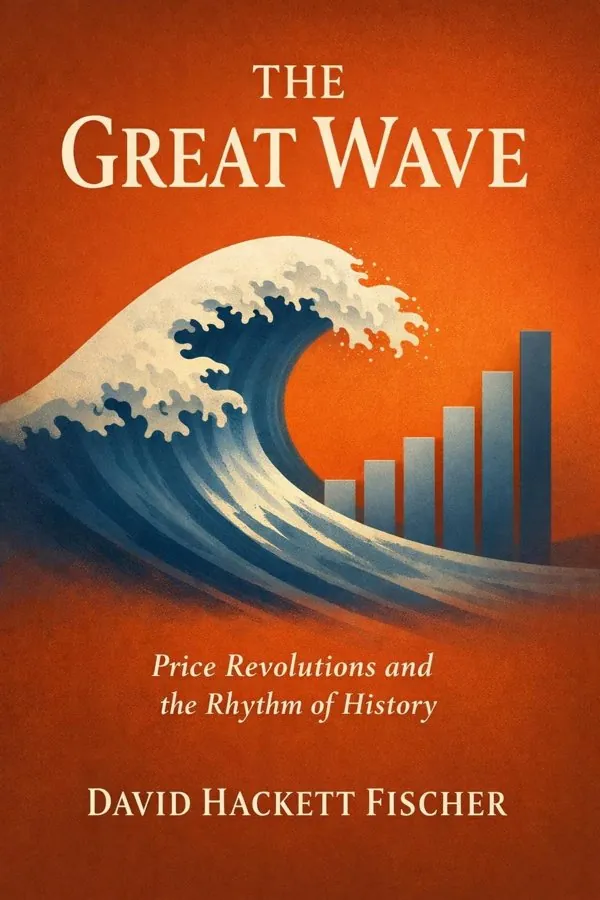
The Great Wave: Price Revolutions and the Rhythm of History: Summary & Key Insights
 10 min9 chaptersAudio available
Key Takeaways from The Great Wave: Price Revolutions and the Rhythm of History
Most people think of prices as background noise, but Fischer treats them as one of history’s deepest signals.
Periods of apparent stability often contain the seeds of upheaval.
Some eras do not merely experience inflation; they are reorganized by it.
Rising prices frighten societies, but falling prices can be just as corrosive.
History rarely repeats mechanically, but it often returns in recognizable form.
What Is The Great Wave: Price Revolutions and the Rhythm of History About?
The Great Wave: Price Revolutions and the Rhythm of History by David Hackett Fischer is a economics book spanning 5 pages. History often looks chaotic on the surface, but David Hackett Fischer argues that beneath wars, revolutions, and social upheavals lies a recurring economic pattern: long waves of rising and falling prices. In The Great Wave, he traces these price revolutions across centuries, showing how inflation and deflation do far more than change what things cost. They reshape class relations, destabilize governments, alter moral expectations, and transform the everyday lives of ordinary people. Rather than treating inflation as a narrow economic issue, Fischer presents it as a civilizational force. What makes this book especially powerful is its scope. Fischer moves from medieval Europe to the modern world, combining economic history with political, social, and cultural analysis. He shows that price instability is rarely just about money supply or markets alone; it grows from deeper interactions among population, resources, institutions, expectations, and human behavior. The result is a sweeping reinterpretation of historical change. Fischer writes with the authority of a distinguished historian known for rigorous scholarship and broad historical vision. For readers trying to understand recurring crises in our own age, this book offers both perspective and warning.
This FizzRead summary covers all 9 key chapters of The Great Wave: Price Revolutions and the Rhythm of History in approximately 10 minutes, distilling the most important ideas, arguments, and takeaways from David Hackett Fischer's work. Also available as an audio summary and Key Quotes Podcast.
The Great Wave: Price Revolutions and the Rhythm of History
History often looks chaotic on the surface, but David Hackett Fischer argues that beneath wars, revolutions, and social upheavals lies a recurring economic pattern: long waves of rising and falling prices. In The Great Wave, he traces these price revolutions across centuries, showing how inflation and deflation do far more than change what things cost. They reshape class relations, destabilize governments, alter moral expectations, and transform the everyday lives of ordinary people. Rather than treating inflation as a narrow economic issue, Fischer presents it as a civilizational force.
What makes this book especially powerful is its scope. Fischer moves from medieval Europe to the modern world, combining economic history with political, social, and cultural analysis. He shows that price instability is rarely just about money supply or markets alone; it grows from deeper interactions among population, resources, institutions, expectations, and human behavior. The result is a sweeping reinterpretation of historical change.
Fischer writes with the authority of a distinguished historian known for rigorous scholarship and broad historical vision. For readers trying to understand recurring crises in our own age, this book offers both perspective and warning.
Who Should Read The Great Wave: Price Revolutions and the Rhythm of History?
This book is perfect for anyone interested in economics and looking to gain actionable insights in a short read. Whether you're a student, professional, or lifelong learner, the key ideas from The Great Wave: Price Revolutions and the Rhythm of History by David Hackett Fischer will help you think differently.
- ✓Readers who enjoy economics and want practical takeaways
- ✓Professionals looking to apply new ideas to their work and life
- ✓Anyone who wants the core insights of The Great Wave: Price Revolutions and the Rhythm of History in just 10 minutes
Want the full summary?
Get instant access to this book summary and 100K+ more with Fizz Moment.
Get Free SummaryAvailable on App Store • Free to download
Key Chapters
Periods of apparent stability often contain the seeds of upheaval. In Fischer’s account of the late medieval world, Europe did not move smoothly from one equilibrium to another. Beginning around the thirteenth century, population growth accelerated, towns expanded, trade networks thickened, and demand pressed more heavily on land and resources. The result was a sustained rise in prices that disrupted older patterns of social life.
This medieval price revolution mattered because medieval society was built on custom, hierarchy, and relatively stable expectations. When grain, rents, and necessities began to climb, those expectations broke down. Lords, peasants, merchants, and urban workers did not experience the change equally. Those living on fixed obligations or customary incomes often suffered, while others with access to trade or assets could adapt more effectively. Fischer shows that inflation destabilized inherited arrangements and contributed to broader tensions in social order.
The period also reveals an important lesson: inflation is not always caused by one thing. Population pressure, expanding commerce, monetary conditions, and institutional rigidity interacted. This complexity is one of Fischer’s major strengths. He resists simplistic explanations and instead presents price revolutions as the product of multiple systems moving together.
A modern application is clear. When societies face rising population demands, strained housing supply, resource scarcity, or infrastructure bottlenecks, prices can become a signal that institutions are lagging behind reality. The medieval world reminds us that inflation often reflects structural imbalance rather than temporary mismanagement.
Actionable takeaway: When costs rise persistently, look for underlying pressures in population, supply, and institutions instead of assuming the problem is purely financial or short-term.
Some eras do not merely experience inflation; they are reorganized by it. Fischer presents the sixteenth-century price revolution as one of the most dramatic in recorded history. Across Europe, prices rose sharply over generations, and the consequences spread through every level of society. This was not a brief disturbance but a prolonged restructuring of economic life.
Several forces drove the change. Population growth increased demand for food and land. Expanding markets connected local economies more tightly. Most famously, silver from the New World entered European circulation in enormous quantities, enlarging the money supply. Yet Fischer avoids monocausal reasoning. Precious metals mattered, but so did demographic pressures, institutional limitations, and the inability of wages and social systems to adjust fairly.
The social consequences were severe. Landlords often benefited where contracts could be revised, merchants could exploit expanding opportunities, and states sought greater fiscal extraction. Wage earners and the poor, however, were squeezed by rising prices for necessities. Inflation widened inequality and increased resentment. It also pushed governments into more aggressive taxation and administration, strengthening some states while provoking resistance in others.
This idea has striking contemporary relevance. When new money, credit expansion, global trade shifts, or asset booms reshape an economy, the key question is not simply whether prices rise. It is who can adapt. Owners of scarce assets may thrive while workers on fixed incomes fall behind. Fischer helps readers see inflation as a distributional event, not just an abstract macroeconomic trend.
Actionable takeaway: In times of sustained inflation, focus on relative effects—who has pricing power, who holds assets, and who depends on fixed earnings—because that is where social and political consequences begin.
Rising prices frighten societies, but falling prices can be just as corrosive. Fischer’s treatment of the seventeenth-century crisis and deflation overturns the assumption that lower prices automatically bring relief. In many historical settings, deflation did not produce broad prosperity. Instead, it deepened debt burdens, weakened trade, reduced investment, and intensified political stress.
When prices fall, the value of money rises. That sounds beneficial for buyers, but it can devastate debtors, farmers, merchants, and states whose obligations remain fixed while incomes decline. Economic actors become more cautious. Lending tightens. Production slows. Social conflict can sharpen as different groups struggle over shrinking resources. Fischer places this economic contraction alongside the wider crises of the seventeenth century, when many regions experienced war, political disorder, and institutional strain.
The key lesson is psychological as well as economic. Inflation encourages urgency, speculation, and adaptation. Deflation encourages delay. People postpone purchases, creditors gain leverage, and public confidence weakens. In a fragile political environment, these pressures can feed unrest and paralysis.
A practical application appears in modern downturns. When demand collapses and debt remains high, simply celebrating lower prices misses the broader picture. Falling prices in housing, wages, or commodities may signal reduced opportunity and mounting financial stress. Policymakers, business leaders, and households must ask whether nominal declines are easing life or making obligations harder to bear.
Fischer’s broader point is balance. Neither inflation nor deflation is harmless. Both can reorder society when sustained long enough.
Actionable takeaway: Do not assume cheaper prices always mean healthier conditions; assess whether incomes, debt burdens, and confidence are moving in the same direction.
History rarely repeats mechanically, but it often returns in recognizable form. Fischer’s account of the eighteenth-century price revolution shows another prolonged inflationary wave emerging under new conditions. Population growth resumed, commercial networks expanded further, consumption patterns changed, and governments became more deeply involved in war finance and imperial competition. Prices rose again, but this time within a more complex and increasingly global economy.
The importance of this episode lies in its connection to social expectation. As markets widened and consumer goods became more visible, people measured their lives not only by subsistence but by comparative status. Inflation therefore carried moral and political consequences. Rising prices for food and basic necessities could provoke outrage because they violated assumptions about fairness, customary rights, and the obligations of rulers. In this environment, price instability contributed to political radicalization.
Fischer helps explain why economic grievances often become ideological movements. Inflation does not merely hurt budgets; it changes how people interpret authority. When governments appear unable or unwilling to stabilize conditions, legitimacy weakens. This dynamic mattered in the broader age of revolution, when anger over prices, taxation, scarcity, and privilege merged with new political ideas.
For modern readers, the lesson is that inflation becomes especially explosive when it collides with visible inequality and rising expectations. People do not judge prices in a vacuum. They compare what they can afford with what others consume and with what institutions promise.
Actionable takeaway: To understand political unrest, examine not only absolute hardship but also whether rising prices are undermining public ideas of fairness, legitimacy, and social reciprocity.
Modern economies pride themselves on sophistication, yet Fischer argues that the nineteenth and twentieth centuries still moved through recognizable price waves. Industrialization, financial innovation, imperial expansion, gold standards, central banking, and global trade changed the mechanisms, but not the underlying rhythm. Periods of inflation and deflation continued to redistribute power, remake expectations, and generate political upheaval.
What changes in the modern world is speed and scale. Railways, factories, mass finance, and global commodity markets amplified economic shifts. Governments gained new tools to manage currency and credit, but they also became more entangled in economic life. Fischer shows that inflation in the modern period could be linked to war finance, industrial demand, population growth, and monetary expansion, while deflation could accompany financial crises, debt stress, and rigid policy regimes.
One of the most useful insights here is that modernity does not eliminate historical patterns; it complicates them. New institutions may delay, redirect, or intensify the effects of price movements, but they do not abolish them. This is why the modern era still saw panics, depressions, speculative booms, and social polarization.
The practical application is straightforward. Today’s investors, citizens, and policymakers often assume that better data and stronger institutions guarantee stability. Fischer warns against that confidence. Even advanced societies remain vulnerable when price signals disconnect from wages, production, and social trust. Modern tools help, but they cannot cancel the historical tendency of prolonged imbalances to create upheaval.
Actionable takeaway: Treat modern economic systems as historically contingent, not immune; use past price waves to test present claims that policy or technology has permanently solved instability.
Economic change becomes politically dangerous when it starts to feel morally illegitimate. One of Fischer’s most penetrating contributions is his insistence that price revolutions are not just numerical events. They alter the moral economy of a society—the shared beliefs about fairness, obligation, reciprocity, and acceptable gain. When prices move far from customary expectations, people do not simply adjust. They often experience the change as betrayal.
This helps explain why inflation repeatedly produces anger that seems larger than spreadsheets would predict. If wages lag while speculators prosper, if essentials become unaffordable while luxury consumption expands, or if elites appear protected from hardship, then rising prices become evidence of a broken social contract. Riots over bread, protests over fuel, labor agitation over wages, and resentment toward financiers all make more sense through this lens.
Fischer’s perspective also deepens historical interpretation. Popular unrest is not only material. It is interpretive. People ask whether suffering is natural, deserved, temporary, or imposed by human greed and political failure. Once inflation becomes moralized, reform becomes harder because trust has already eroded.
In contemporary life, this insight applies to debates about housing affordability, healthcare costs, tuition, and food prices. Even moderate inflation can generate intense political reaction when it lands on already unequal structures. Leaders who address only the technical side of inflation may miss the emotional and ethical dimensions driving public backlash.
Actionable takeaway: When evaluating economic stress, ask not only whether prices are rising but whether people still believe the system distributing pain and opportunity is fair.
Single-cause explanations are intellectually comforting, but Fischer’s book is strongest when it resists them. Price revolutions arise from interacting forces: population growth, resource constraints, monetary expansion, trade integration, political institutions, and social expectations. The great wave is not a formula but a pattern produced by systems colliding over time.
This matters because many debates about inflation still seek one villain: central banks, greedy corporations, immigration, war, or supply chains. Fischer shows why that approach is usually incomplete. A society may face rising prices because more people are competing for limited land or housing, because money supply expands faster than output, because transport systems cannot absorb new demand, or because governments intensify extraction during war. Often several of these dynamics occur together.
His historical method encourages layered diagnosis. In the medieval and early modern worlds, demography often mattered enormously. In later periods, global trade, finance, and state policy gained greater weight. Yet the broader principle remains the same: economic instability reflects the fit or misfit between human demand and institutional capacity.
A practical example is urban housing today. If populations grow, zoning remains restrictive, construction lags, credit is abundant, and investors treat property as a store of value, housing inflation cannot be explained by any one factor alone. Fischer’s framework teaches readers to think systemically.
This is one reason the book endures. It does not offer neat ideological certainty. It offers a disciplined way to connect economics with lived history.
Actionable takeaway: When analyzing any inflationary problem, map at least three interacting causes—demographic, monetary, and institutional—before drawing conclusions or proposing solutions.
The deepest value of Fischer’s book is not prediction in a narrow sense; it is pattern recognition. He does not claim history repeats on schedule, but he does argue that long rhythms in prices recur often enough to deserve serious attention. These rhythms do not determine events mechanically, yet they create conditions under which certain outcomes become more likely: widening inequality, declining trust, political conflict, moral anxiety, and institutional strain.
This way of thinking is especially useful in a culture obsessed with immediate news. Fischer encourages long-range attention. Instead of asking only what central bank decision or election result moved markets this month, he asks what cumulative pressures have been building for decades. Are households carrying more debt? Are wages detached from asset values? Are essentials consuming larger shares of income? Are public institutions losing legitimacy as economic pressure spreads? These are historical questions with present-day urgency.
For readers, the practical benefit is strategic patience. Families can think more carefully about debt exposure, savings vulnerability, and the real cost of living. Leaders can recognize that technical adjustments may fail if deeper structural imbalances remain. Citizens can interpret social unrest with more empathy and less surprise.
Fischer ultimately offers a form of historical prudence. Societies ignore long waves at their peril because by the time crisis becomes visible, the underlying pressures are often already old.
Actionable takeaway: Build habits of long-term observation—track wages, essentials, debt, and public trust over years, not weeks—so you can recognize structural change before it becomes open crisis.
All Chapters in The Great Wave: Price Revolutions and the Rhythm of History
About the Author
David Hackett Fischer is an American historian acclaimed for his wide-ranging scholarship, methodological rigor, and narrative power. A longtime professor at Brandeis University, he built his reputation through influential works in American and Atlantic history, including Albion’s Seed, Paul Revere’s Ride, and Washington’s Crossing, which won the Pulitzer Prize for History. Fischer is also known for Historians’ Fallacies, a respected guide to historical reasoning and interpretation. His work often combines deep archival research with ambitious arguments about large patterns in culture, politics, and social life. In The Great Wave, he brings that same interdisciplinary strength to economic history, examining how long cycles of inflation and deflation shape civilizations. Fischer is widely regarded as a historian who can make complex historical dynamics both intellectually serious and vividly readable.
Get This Summary in Your Preferred Format
Read or listen to the The Great Wave: Price Revolutions and the Rhythm of History summary by David Hackett Fischer anytime, anywhere. FizzRead offers multiple formats so you can learn on your terms — all free.
Available formats: App · Audio · PDF · EPUB — All included free with FizzRead
Download The Great Wave: Price Revolutions and the Rhythm of History PDF and EPUB Summary
Key Quotes from The Great Wave: Price Revolutions and the Rhythm of History
“Most people think of prices as background noise, but Fischer treats them as one of history’s deepest signals.”
“Periods of apparent stability often contain the seeds of upheaval.”
“Some eras do not merely experience inflation; they are reorganized by it.”
“Rising prices frighten societies, but falling prices can be just as corrosive.”
“History rarely repeats mechanically, but it often returns in recognizable form.”
Frequently Asked Questions about The Great Wave: Price Revolutions and the Rhythm of History
The Great Wave: Price Revolutions and the Rhythm of History by David Hackett Fischer is a economics book that explores key ideas across 9 chapters. History often looks chaotic on the surface, but David Hackett Fischer argues that beneath wars, revolutions, and social upheavals lies a recurring economic pattern: long waves of rising and falling prices. In The Great Wave, he traces these price revolutions across centuries, showing how inflation and deflation do far more than change what things cost. They reshape class relations, destabilize governments, alter moral expectations, and transform the everyday lives of ordinary people. Rather than treating inflation as a narrow economic issue, Fischer presents it as a civilizational force. What makes this book especially powerful is its scope. Fischer moves from medieval Europe to the modern world, combining economic history with political, social, and cultural analysis. He shows that price instability is rarely just about money supply or markets alone; it grows from deeper interactions among population, resources, institutions, expectations, and human behavior. The result is a sweeping reinterpretation of historical change. Fischer writes with the authority of a distinguished historian known for rigorous scholarship and broad historical vision. For readers trying to understand recurring crises in our own age, this book offers both perspective and warning.
You Might Also Like
Business Adventures
John Brooks
10 min
Nudge
Richard H. Thaler, Cass R. Sunstein
10 min
The Hitchhiker"s Guide to the Galaxy
Douglas Adams
10 minThe Muqaddimah
Ibn Khaldun
10 minThe Outsiders
William N. Thorndike
10 min
A Little History of Economics
Niall Kishtainy
10 minBrowse by Category
Ready to read The Great Wave: Price Revolutions and the Rhythm of History?
Get the full summary and 100K+ more books with Fizz Moment.