
David Hackett Fischer Books
David Hackett Fischer is an American historian and professor at Brandeis University, known for his works on American history and historical methodology. He is the author of several acclaimed books, including 'Washington's Crossing', which won the Pulitzer Prize for History.
Known for: The Great Wave: Price Revolutions and the Rhythm of History
Books by David Hackett Fischer
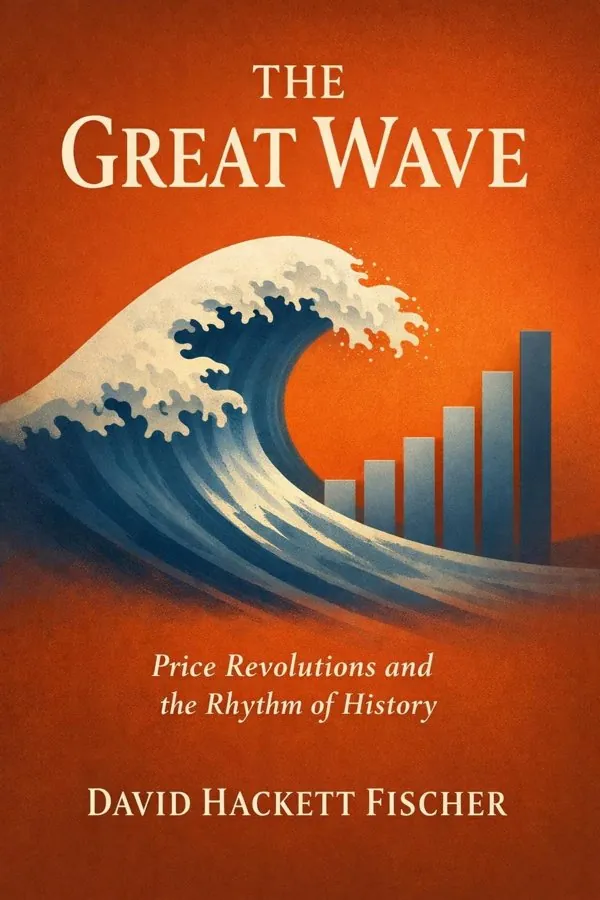
The Great Wave: Price Revolutions and the Rhythm of History
History often looks chaotic on the surface, but David Hackett Fischer argues that beneath wars, revolutions, and social upheavals lies a recurring economic pattern: long waves of rising and falling prices. In The Great Wave, he traces these price revolutions across centuries, showing how inflation and deflation do far more than change what things cost. They reshape class relations, destabilize governments, alter moral expectations, and transform the everyday lives of ordinary people. Rather than treating inflation as a narrow economic issue, Fischer presents it as a civilizational force. What makes this book especially powerful is its scope. Fischer moves from medieval Europe to the modern world, combining economic history with political, social, and cultural analysis. He shows that price instability is rarely just about money supply or markets alone; it grows from deeper interactions among population, resources, institutions, expectations, and human behavior. The result is a sweeping reinterpretation of historical change. Fischer writes with the authority of a distinguished historian known for rigorous scholarship and broad historical vision. For readers trying to understand recurring crises in our own age, this book offers both perspective and warning.
Read SummaryKey Insights from David Hackett Fischer
Prices Reveal History’s Hidden Pulse
Most people think of prices as background noise, but Fischer treats them as one of history’s deepest signals. A loaf of bread, a day’s wage, the rent on land, or the cost of fuel can reveal broad transformations long before political leaders name them. His central insight is that long-term movements...
From The Great Wave: Price Revolutions and the Rhythm of History
The Medieval Price Revolution Emerges
Periods of apparent stability often contain the seeds of upheaval. In Fischer’s account of the late medieval world, Europe did not move smoothly from one equilibrium to another. Beginning around the thirteenth century, population growth accelerated, towns expanded, trade networks thickened, and dema...
From The Great Wave: Price Revolutions and the Rhythm of History
The Sixteenth Century Changes Everything
Some eras do not merely experience inflation; they are reorganized by it. Fischer presents the sixteenth-century price revolution as one of the most dramatic in recorded history. Across Europe, prices rose sharply over generations, and the consequences spread through every level of society. This was...
From The Great Wave: Price Revolutions and the Rhythm of History
Deflation Can Be Equally Destructive
Rising prices frighten societies, but falling prices can be just as corrosive. Fischer’s treatment of the seventeenth-century crisis and deflation overturns the assumption that lower prices automatically bring relief. In many historical settings, deflation did not produce broad prosperity. Instead, ...
From The Great Wave: Price Revolutions and the Rhythm of History
Eighteenth-Century Inflation Reshapes Society Again
History rarely repeats mechanically, but it often returns in recognizable form. Fischer’s account of the eighteenth-century price revolution shows another prolonged inflationary wave emerging under new conditions. Population growth resumed, commercial networks expanded further, consumption patterns ...
From The Great Wave: Price Revolutions and the Rhythm of History
Modern Waves Follow Familiar Patterns
Modern economies pride themselves on sophistication, yet Fischer argues that the nineteenth and twentieth centuries still moved through recognizable price waves. Industrialization, financial innovation, imperial expansion, gold standards, central banking, and global trade changed the mechanisms, but...
From The Great Wave: Price Revolutions and the Rhythm of History
About David Hackett Fischer
David Hackett Fischer is an American historian and professor at Brandeis University, known for his works on American history and historical methodology. He is the author of several acclaimed books, including 'Washington's Crossing', which won the Pulitzer Prize for History.



Frequently Asked Questions
David Hackett Fischer is an American historian and professor at Brandeis University, known for his works on American history and historical methodology. He is the author of several acclaimed books, including 'Washington's Crossing', which won the Pulitzer Prize for History.
Read David Hackett Fischer's books in 15 minutes
Get AI-powered summaries with key insights from 1 book by David Hackett Fischer.