
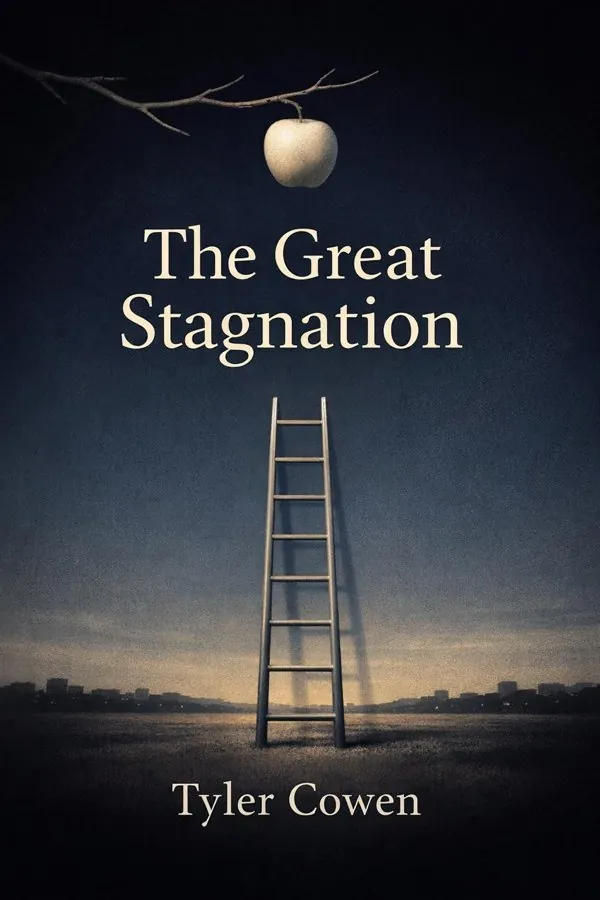
The Great Stagnation: How America Ate All the Low-Hanging Fruit of Modern History, Got Sick, and Will (Eventually) Feel Better: Summary & Key Insights
by Tyler Cowen
 10 min10 chaptersAudio available
What Is The Great Stagnation: How America Ate All the Low-Hanging Fruit of Modern History, Got Sick, and Will (Eventually) Feel Better About?
The Great Stagnation: How America Ate All the Low-Hanging Fruit of Modern History, Got Sick, and Will (Eventually) Feel Better by Tyler Cowen is a economics book spanning 10 pages. In this influential essay, economist Tyler Cowen argues that the United States has reached a period of economic stagnation due to the exhaustion of easy sources of growth—such as cheap land, technological breakthroughs, and educational expansion. He explores how this slowdown affects productivity, wages, and innovation, and suggests ways society might adapt to a future of slower progress.
This FizzRead summary covers all 10 key chapters of The Great Stagnation: How America Ate All the Low-Hanging Fruit of Modern History, Got Sick, and Will (Eventually) Feel Better in approximately 10 minutes, distilling the most important ideas, arguments, and takeaways from Tyler Cowen's work. Also available as an audio summary and Key Quotes Podcast.
The Great Stagnation: How America Ate All the Low-Hanging Fruit of Modern History, Got Sick, and Will (Eventually) Feel Better
In this influential essay, economist Tyler Cowen argues that the United States has reached a period of economic stagnation due to the exhaustion of easy sources of growth—such as cheap land, technological breakthroughs, and educational expansion. He explores how this slowdown affects productivity, wages, and innovation, and suggests ways society might adapt to a future of slower progress.
Who Should Read The Great Stagnation: How America Ate All the Low-Hanging Fruit of Modern History, Got Sick, and Will (Eventually) Feel Better?
This book is perfect for anyone interested in economics and looking to gain actionable insights in a short read. Whether you're a student, professional, or lifelong learner, the key ideas from The Great Stagnation: How America Ate All the Low-Hanging Fruit of Modern History, Got Sick, and Will (Eventually) Feel Better by Tyler Cowen will help you think differently.
- ✓Readers who enjoy economics and want practical takeaways
- ✓Professionals looking to apply new ideas to their work and life
- ✓Anyone who wants the core insights of The Great Stagnation: How America Ate All the Low-Hanging Fruit of Modern History, Got Sick, and Will (Eventually) Feel Better in just 10 minutes
Want the full summary?
Get instant access to this book summary and 100K+ more with Fizz Moment.
Get Free SummaryAvailable on App Store • Free to download
Key Chapters
From its founding, America’s economic story has been one of extraordinary momentum. Three engines powered it: cheap land, transformative technology, and an expanding education system. Each of these contributed in ways that built upon one another. The open frontier provided boundless opportunity, technological progress magnified human capacity, and education made workers more productive and adaptable.
The 19th and early 20th centuries were, economically speaking, a feast. Uncultivated land to the West invited settlers who dreamt not just of property, but of reinvention. Railroads connected farms to cities, factories to markets. Then came the technological revolutions—the telegraph, electricity, indoor plumbing, automobiles—all of which multiplied output and well-being in almost unimaginable measure. Later, the 20th century met its greatest social investment: public education. Every new classroom, every college degree, was another rung in America’s ascent.
But here’s the crucial insight: much of this prosperity was based on discoveries and resources that could only be exploited once. You can only settle a frontier once, electrify cities once, build interstate highways once. These were singular transformations. By the late 20th century, we had built a modern world so efficiently that the biggest, easiest gains were gone. The frontier was closed, education’s transformative leaps were largely realized, and technology, while inventive, produced incremental comforts rather than epochal shifts.
If you look back to early American growth, the abundance of land shaped not only our economy but our national psychology. It offered an escape hatch for ambition: if wages were low in the city, a working man could move west and start anew. Land was a democratizing force. It absorbed labor surpluses and kept opportunity elastic.
But imagine how this mechanism worked: it wasn’t simply about the soil or crops. Cheap land meant cheap housing, cheap energy, and cheap new markets. It meant the ability to add more of everything—more farms, more goods, more consumers. This created self-reinforcing expansion, where supply and demand grew in tandem.
Now contrast that with today’s landscape. The physical frontier closed long ago. Urban real estate is scarce and increasingly costly, and environmental constraints limit new development. We can no longer expand simply by moving outward. Growth must come from within—from better ideas, not more acreage. This shift transforms the dynamics of opportunity. The old escape routes for economic dissatisfaction have vanished; in their place, we must learn to innovate smarter and live more densely. Productivity, once tied to widening space, must now stem from deepening intelligence.
+ 8 more chapters — available in the FizzRead app
All Chapters in The Great Stagnation: How America Ate All the Low-Hanging Fruit of Modern History, Got Sick, and Will (Eventually) Feel Better
About the Author
Tyler Cowen is an American economist, professor at George Mason University, and co-author of the economics blog Marginal Revolution. He is known for his work on cultural economics, public choice theory, and the economics of innovation.
Get This Summary in Your Preferred Format
Read or listen to the The Great Stagnation: How America Ate All the Low-Hanging Fruit of Modern History, Got Sick, and Will (Eventually) Feel Better summary by Tyler Cowen anytime, anywhere. FizzRead offers multiple formats so you can learn on your terms — all free.
Available formats: App · Audio · PDF · EPUB — All included free with FizzRead
Download The Great Stagnation: How America Ate All the Low-Hanging Fruit of Modern History, Got Sick, and Will (Eventually) Feel Better PDF and EPUB Summary
Key Quotes from The Great Stagnation: How America Ate All the Low-Hanging Fruit of Modern History, Got Sick, and Will (Eventually) Feel Better
“From its founding, America’s economic story has been one of extraordinary momentum.”
“If you look back to early American growth, the abundance of land shaped not only our economy but our national psychology.”
Frequently Asked Questions about The Great Stagnation: How America Ate All the Low-Hanging Fruit of Modern History, Got Sick, and Will (Eventually) Feel Better
The Great Stagnation: How America Ate All the Low-Hanging Fruit of Modern History, Got Sick, and Will (Eventually) Feel Better by Tyler Cowen is a economics book that explores key ideas across 10 chapters. In this influential essay, economist Tyler Cowen argues that the United States has reached a period of economic stagnation due to the exhaustion of easy sources of growth—such as cheap land, technological breakthroughs, and educational expansion. He explores how this slowdown affects productivity, wages, and innovation, and suggests ways society might adapt to a future of slower progress.
More by Tyler Cowen

Big Business: A Love Letter to an American Anti-Hero
Tyler Cowen
10 min
Stubborn Attachments: A Vision for a Society of Free, Prosperous, and Responsible Individuals
Tyler Cowen
10 min
Average Is Over: Powering America Beyond the Age of the Great Stagnation
Tyler Cowen
10 min
The Complacent Class: The Self-Defeating Quest for the American Dream
Tyler Cowen
10 minYou Might Also Like
Business Adventures
John Brooks
10 min
Nudge
Richard H. Thaler, Cass R. Sunstein
10 min
The Hitchhiker"s Guide to the Galaxy
Douglas Adams
10 minThe Muqaddimah
Ibn Khaldun
10 minThe Outsiders
William N. Thorndike
10 min
A Little History of Economics
Niall Kishtainy
10 minBrowse by Category
Ready to read The Great Stagnation: How America Ate All the Low-Hanging Fruit of Modern History, Got Sick, and Will (Eventually) Feel Better?
Get the full summary and 100K+ more books with Fizz Moment.