
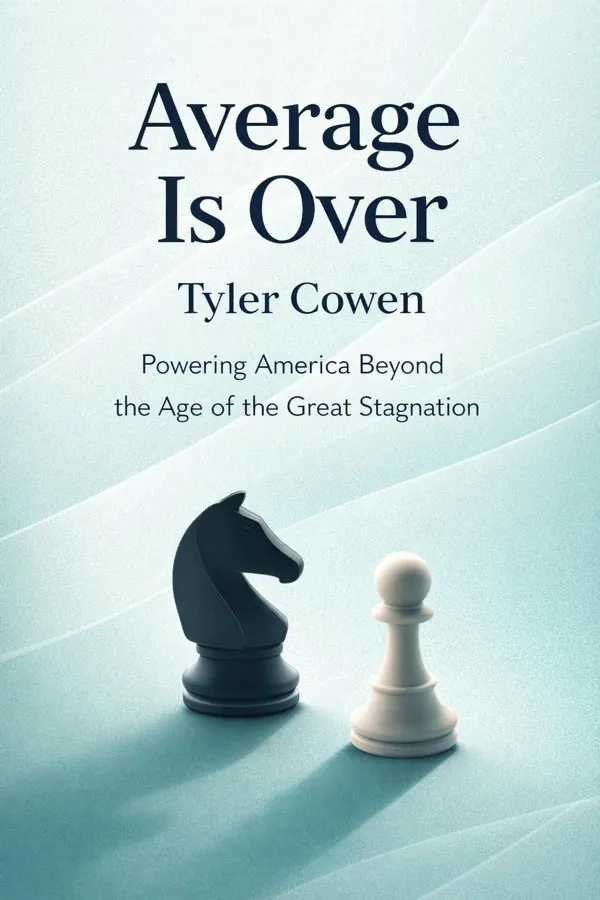
Average Is Over: Powering America Beyond the Age of the Great Stagnation: Summary & Key Insights
by Tyler Cowen
 10 min10 chaptersAudio available
What Is Average Is Over: Powering America Beyond the Age of the Great Stagnation About?
Average Is Over: Powering America Beyond the Age of the Great Stagnation by Tyler Cowen is a economics book spanning 10 pages. In this influential work, economist Tyler Cowen explores how advances in technology, automation, and globalization are reshaping the labor market and widening the gap between high achievers and everyone else. He argues that the future belongs to those who can work effectively with intelligent machines, while average workers will face increasing challenges. The book offers a provocative look at the economic and social transformations defining the 21st century.
This FizzRead summary covers all 10 key chapters of Average Is Over: Powering America Beyond the Age of the Great Stagnation in approximately 10 minutes, distilling the most important ideas, arguments, and takeaways from Tyler Cowen's work. Also available as an audio summary and Key Quotes Podcast.
Average Is Over: Powering America Beyond the Age of the Great Stagnation
In this influential work, economist Tyler Cowen explores how advances in technology, automation, and globalization are reshaping the labor market and widening the gap between high achievers and everyone else. He argues that the future belongs to those who can work effectively with intelligent machines, while average workers will face increasing challenges. The book offers a provocative look at the economic and social transformations defining the 21st century.
Who Should Read Average Is Over: Powering America Beyond the Age of the Great Stagnation?
This book is perfect for anyone interested in economics and looking to gain actionable insights in a short read. Whether you're a student, professional, or lifelong learner, the key ideas from Average Is Over: Powering America Beyond the Age of the Great Stagnation by Tyler Cowen will help you think differently.
- ✓Readers who enjoy economics and want practical takeaways
- ✓Professionals looking to apply new ideas to their work and life
- ✓Anyone who wants the core insights of Average Is Over: Powering America Beyond the Age of the Great Stagnation in just 10 minutes
Want the full summary?
Get instant access to this book summary and 100K+ more with Fizz Moment.
Get Free SummaryAvailable on App Store • Free to download
Key Chapters
The defining force of our era is the rise of computational intelligence. Machines no longer merely follow human instructions—they increasingly make decisions, detect patterns, and learn from data. This transformation is not uniform across industries but is universally influential. Algorithms run the stock market, select the news you read, and even determine how your car insurance is priced. For many jobs, the contribution of human value is now intertwined with how effectively one collaborates with a machine.
It’s crucial to understand that these machines do not replace creativity or motivation. Rather, they augment those who can harness them. A chess grandmaster today doesn’t lose to a computer alone, nor does the computer always win solo; the most formidable player is a human-machine team. I call this the 'centaur model,' where human strategic intuition merges with computational precision. The same principle applies across professions—from radiology to logistics, from translation to law.
But the implications are uneven. Those unable to complement algorithms, who rely on habits of procedural task performance, face decline. Machines are tireless, exact, and scalable; human workers must thrive where data need interpretation, context, and ethics. The boundary between what machines can do and what humans must do has shifted, and those who can constantly redefine that line become indispensable. In this chapter, I urge my readers to embrace this complexity—not to fear being replaced, but to learn how to cooperate intelligently with tools that magnify your thinking.
The labor market you are entering—or already working within—is no longer governed by linear progression or secure averages. It is bifurcated, dynamic, and tilted toward those who can exceed predictable performance. A small set of individuals, often those who link technology with judgment, reap disproportionately large rewards. They may be the data scientist, the software integrator, or the entrepreneur using analytic feedback to set strategy. Their income and influence rise fast because they leverage scalable systems.
Meanwhile, traditional middle-skill jobs—the backbone of twentieth-century growth—have eroded. Automation doesn’t eliminate all work; instead, it reallocates value. Many workers still find employment but at lower wages, with reduced security, and in less cognitively demanding roles. The new economy offers efficiency but not universal dignity by default.
This can sound harsh, but it also highlights the importance of learning how value is now created. Workers must become adaptive learners—able to interpret feedback, to reinvent themselves, and to understand the logic by which algorithms measure performance. The new market rewards those who fuse human insight with technological literacy.
+ 8 more chapters — available in the FizzRead app
All Chapters in Average Is Over: Powering America Beyond the Age of the Great Stagnation
About the Author
Tyler Cowen is an American economist, professor at George Mason University, and co-author of the popular economics blog Marginal Revolution. Known for his work on cultural economics and technological change, Cowen has written several acclaimed books examining the intersection of innovation, inequality, and global trends.
Get This Summary in Your Preferred Format
Read or listen to the Average Is Over: Powering America Beyond the Age of the Great Stagnation summary by Tyler Cowen anytime, anywhere. FizzRead offers multiple formats so you can learn on your terms — all free.
Available formats: App · Audio · PDF · EPUB — All included free with FizzRead
Download Average Is Over: Powering America Beyond the Age of the Great Stagnation PDF and EPUB Summary
Key Quotes from Average Is Over: Powering America Beyond the Age of the Great Stagnation
“The defining force of our era is the rise of computational intelligence.”
“The labor market you are entering—or already working within—is no longer governed by linear progression or secure averages.”
Frequently Asked Questions about Average Is Over: Powering America Beyond the Age of the Great Stagnation
Average Is Over: Powering America Beyond the Age of the Great Stagnation by Tyler Cowen is a economics book that explores key ideas across 10 chapters. In this influential work, economist Tyler Cowen explores how advances in technology, automation, and globalization are reshaping the labor market and widening the gap between high achievers and everyone else. He argues that the future belongs to those who can work effectively with intelligent machines, while average workers will face increasing challenges. The book offers a provocative look at the economic and social transformations defining the 21st century.
More by Tyler Cowen

Big Business: A Love Letter to an American Anti-Hero
Tyler Cowen
10 min
Stubborn Attachments: A Vision for a Society of Free, Prosperous, and Responsible Individuals
Tyler Cowen
10 min
The Great Stagnation: How America Ate All the Low-Hanging Fruit of Modern History, Got Sick, and Will (Eventually) Feel Better
Tyler Cowen
10 min
The Complacent Class: The Self-Defeating Quest for the American Dream
Tyler Cowen
10 minYou Might Also Like

Business Adventures
John Brooks
10 min
Nudge
Richard H. Thaler, Cass R. Sunstein
10 min
The Hitchhiker"s Guide to the Galaxy
Douglas Adams
10 minThe Muqaddimah
Ibn Khaldun
10 minThe Outsiders
William N. Thorndike
10 min
A Little History of Economics
Niall Kishtainy
10 minBrowse by Category
Ready to read Average Is Over: Powering America Beyond the Age of the Great Stagnation?
Get the full summary and 100K+ more books with Fizz Moment.