
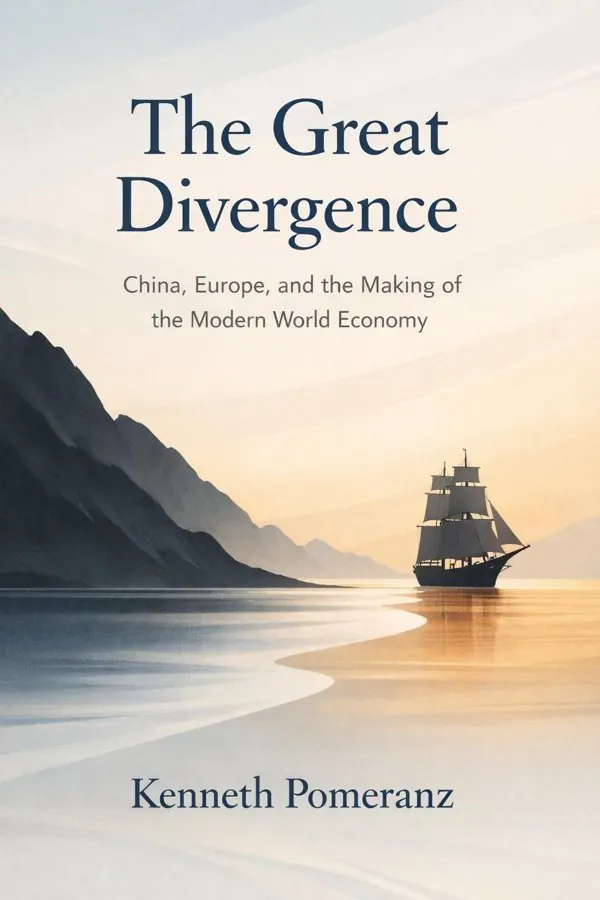
The Great Divergence: China, Europe, and the Making of the Modern World Economy: Summary & Key Insights
 10 min10 chaptersAudio available
Key Takeaways from The Great Divergence: China, Europe, and the Making of the Modern World Economy
The most important questions in history often depend on what we choose to compare.
One of Pomeranz’s most provocative insights is that early modern China was not a stagnant giant waiting to be surpassed.
Before fossil fuels transformed production, every economy lived under the shadow of nature.
Sometimes world-changing advantages are buried underground.
Europe’s rise, in Pomeranz’s account, cannot be understood without the Americas.
What Is The Great Divergence: China, Europe, and the Making of the Modern World Economy About?
The Great Divergence: China, Europe, and the Making of the Modern World Economy by Kenneth Pomeranz is a economics book spanning 10 pages. Why did industrial capitalism emerge first in Western Europe rather than in other highly developed parts of the world, especially China’s prosperous Yangzi Delta? In The Great Divergence, historian Kenneth Pomeranz tackles this foundational question with unusual rigor and originality. Instead of assuming that Europe was always destined for modernity, he compares the most advanced regions of Europe and East Asia on equal terms, showing that as late as the eighteenth century they shared many economic strengths: sophisticated markets, commercial agriculture, skilled labor, and impressive living standards. Pomeranz’s bold claim is that Europe’s breakthrough was not simply the product of superior culture, institutions, or rationality. Rather, it depended heavily on ecological luck and global advantage—especially accessible coal deposits and the vast land, raw materials, and coerced labor of the New World. This argument reshaped debates in global history because it challenged deeply rooted Eurocentric narratives. Written by one of the leading scholars of comparative economic history, the book remains essential for anyone seeking to understand industrialization, world inequality, and the historical forces that made the modern global economy.
This FizzRead summary covers all 10 key chapters of The Great Divergence: China, Europe, and the Making of the Modern World Economy in approximately 10 minutes, distilling the most important ideas, arguments, and takeaways from Kenneth Pomeranz's work. Also available as an audio summary and Key Quotes Podcast.
The Great Divergence: China, Europe, and the Making of the Modern World Economy
Why did industrial capitalism emerge first in Western Europe rather than in other highly developed parts of the world, especially China’s prosperous Yangzi Delta? In The Great Divergence, historian Kenneth Pomeranz tackles this foundational question with unusual rigor and originality. Instead of assuming that Europe was always destined for modernity, he compares the most advanced regions of Europe and East Asia on equal terms, showing that as late as the eighteenth century they shared many economic strengths: sophisticated markets, commercial agriculture, skilled labor, and impressive living standards. Pomeranz’s bold claim is that Europe’s breakthrough was not simply the product of superior culture, institutions, or rationality. Rather, it depended heavily on ecological luck and global advantage—especially accessible coal deposits and the vast land, raw materials, and coerced labor of the New World. This argument reshaped debates in global history because it challenged deeply rooted Eurocentric narratives. Written by one of the leading scholars of comparative economic history, the book remains essential for anyone seeking to understand industrialization, world inequality, and the historical forces that made the modern global economy.
Who Should Read The Great Divergence: China, Europe, and the Making of the Modern World Economy?
This book is perfect for anyone interested in economics and looking to gain actionable insights in a short read. Whether you're a student, professional, or lifelong learner, the key ideas from The Great Divergence: China, Europe, and the Making of the Modern World Economy by Kenneth Pomeranz will help you think differently.
- ✓Readers who enjoy economics and want practical takeaways
- ✓Professionals looking to apply new ideas to their work and life
- ✓Anyone who wants the core insights of The Great Divergence: China, Europe, and the Making of the Modern World Economy in just 10 minutes
Want the full summary?
Get instant access to this book summary and 100K+ more with Fizz Moment.
Get Free SummaryAvailable on App Store • Free to download
Key Chapters
The most important questions in history often depend on what we choose to compare. Kenneth Pomeranz begins by rejecting the habit of measuring the whole of Asia against the most dynamic parts of Europe, a method that almost guarantees a European victory. Instead, he compares Europe’s leading regions—especially England—with China’s most commercially advanced core, the Yangzi Delta. This shift is crucial because it prevents us from confusing regional variation with civilizational destiny.
Pomeranz shows that if we compare like with like, the story becomes much less flattering to traditional Western triumphalism. The Yangzi Delta had dense markets, sophisticated agriculture, extensive handicraft production, strong commercialization, and highly developed consumer activity. In many respects, it resembled northwestern Europe more than it resembled China’s poorer hinterlands. By putting these areas side by side, the book demonstrates that the central puzzle is not why “Europe beat Asia,” but why one particular part of Europe escaped constraints that trapped other advanced regions.
This comparative method also teaches a broader lesson about modern analysis. We often explain success by attributing it to culture or institutions without checking whether supposedly lagging societies had similar features. In business, politics, and development policy, bad comparisons still produce bad conclusions. Comparing a rich city-state to an entire continent is as misleading today as comparing industrial England to all of imperial China.
The practical application is simple: always compare equivalent units. If you want to understand why one society, firm, or region advanced faster than another, isolate similar starting conditions before drawing grand conclusions. Actionable takeaway: challenge broad civilizational explanations by asking whether the comparison is fair, regional, and historically specific.
One of Pomeranz’s most provocative insights is that early modern China was not a stagnant giant waiting to be surpassed. The lower Yangzi region, in particular, was highly productive, densely commercialized, and deeply integrated into market exchange. Farmers specialized in cash crops, households participated in textile production, merchants moved goods across long distances, and consumers demanded a wide range of products. This was not an economy frozen in tradition; it was a dynamic and adaptive one.
Pomeranz uses evidence on land use, labor intensity, consumption patterns, and regional trade to argue that parts of China reached levels of development comparable to Europe’s most advanced regions. This does not mean China and England were identical. It means that the usual explanations for Europe’s rise—such as superior markets, industriousness, or commercial sophistication—lose much of their force when examined closely. If China also had active markets and productive agriculture, then these factors alone cannot explain why industrialization began in Britain.
This matters because narratives of backwardness shape how societies judge themselves and others. Once a region is labeled “traditional,” every complex achievement disappears from view. Pomeranz insists on taking Chinese economic performance seriously, which restores historical balance and forces a better explanation of divergence.
There is a contemporary lesson here too. Rapid development is often underestimated when it occurs outside familiar Western models. Economies can be innovative without following the exact path taken by Europe. Actionable takeaway: when evaluating why one system transformed and another did not, first identify the real strengths of both rather than assuming one side lacked modern economic capacity.
Before fossil fuels transformed production, every economy lived under the shadow of nature. Pomeranz argues that both Europe and East Asia were pushing against ecological ceilings by the eighteenth century. Population growth raised demand for food, fuel, fiber, and building materials, while available land remained finite. The more successful these economies became, the more pressure they placed on forests, soils, and agricultural systems.
This ecological perspective is one of the book’s greatest strengths. Economic growth in a preindustrial world depended on sunlight converted through land. More people meant more mouths to feed and more animals to support, which in turn meant greater pressure on farmland, pasture, and woodlands. Regions could respond through intensification, trade, and specialization, but these strategies had limits. The Yangzi Delta and England alike became highly efficient at squeezing more output from scarce resources. Yet efficiency did not eliminate the underlying problem: organic economies struggle to sustain endless expansion.
Pomeranz’s argument challenges the tendency to treat industrialization as a purely institutional or cultural achievement. It was also an environmental escape. Europe’s later prosperity was not simply a matter of better ideas; it involved access to energy and land substitutes that loosened the grip of ecological scarcity.
This idea has obvious relevance today. Modern economies may seem far removed from wood shortages and land constraints, yet they remain dependent on energy, minerals, water, and ecological systems. Growth still runs into material boundaries, even when technology postpones them.
Actionable takeaway: whenever you analyze economic development, include environmental constraints in the picture. Ask not only what a society wanted to produce, but what energy and resource base made that production possible.
Sometimes world-changing advantages are buried underground. Pomeranz argues that Britain’s ready access to coal was one of the decisive factors that enabled it to break free from the land constraints facing advanced agrarian economies. Coal mattered not simply because it existed, but because it was abundant, accessible, and located close enough to key centers of production and transport to be economically transformative.
In an organic economy, fuel comes mainly from forests and agricultural byproducts. But wood is bulky, land-intensive, and increasingly expensive when populations grow. Coal offered Britain a substitute for timber and charcoal on a massive scale. It could heat homes, power industry, and eventually drive steam technology. This was not just a technological story; it was an ecological one. Coal effectively replaced huge quantities of land that would otherwise have been needed for fuel production.
Pomeranz does not claim that coal alone caused industrialization. Rather, he shows that it removed a major bottleneck at the right time. Britain could sustain urban growth, metalworking, and energy-intensive production without exhausting nearby forests. Regions lacking such energy advantages faced harder trade-offs between preserving land for food and using it for fuel.
The broader implication is that development often depends on access to strategic inputs that reduce core constraints. In modern terms, coal functioned like a powerful scalability resource. It expanded what Britain could do without proportionally expanding its land base.
Actionable takeaway: look for the hidden constraint in any system. Progress often accelerates not when people work harder, but when a key bottleneck—energy, logistics, data, capital, or time—is dramatically eased.
Europe’s rise, in Pomeranz’s account, cannot be understood without the Americas. This is one of the book’s most consequential arguments. The New World supplied Europe with enormous quantities of land-intensive goods—especially sugar, cotton, timber, dyes, and later grain—while also absorbing population and generating profits through trade and empire. These resources effectively expanded Europe’s usable ecological base far beyond its own territory.
Pomeranz emphasizes that this was not a marginal bonus. It was central to Europe’s escape from resource limits. Colonies and plantation zones, built on conquest, slavery, and coercion, provided what Europe itself increasingly lacked: land. Cotton from the Americas fed British industry. Sugar transformed consumption. Silver linked global exchange. Overseas territories also created outlets for migration and markets for manufactured goods. The result was a powerful external support system for European growth.
This argument overturns older stories that explain Western success mainly through internal virtues. Europe did not develop in isolation. It drew heavily on global asymmetries created through imperial power. Recognizing this does not deny European innovation; it places that innovation in the material context that helped sustain it.
The practical lesson is that economic success often rests on externalized costs and invisible support structures. Firms depend on supply chains, nations depend on imported energy and raw materials, and consumers benefit from distant labor and land they rarely see. Actionable takeaway: whenever a growth story looks self-generated, ask what outside resources, territories, or unequal relationships made that success possible.
At first glance, China also appears to have had room to expand. It possessed a vast empire, internal frontier zones, and diverse regional economies. So why didn’t these internal frontiers serve the same role for China that the New World served for Europe? Pomeranz’s answer is subtle: China’s frontier expansion did matter, but it did not generate the same kind of sustained ecological relief or industrial stimulus that Europe gained from overseas colonies.
Chinese expansion into interior and frontier regions increased cultivated land and linked distant zones more closely to the imperial economy. Yet these lands were not equivalent to the exceptionally favorable windfall Europe obtained in the Americas. Many frontier regions were environmentally fragile, less productive, or harder to integrate at low cost. They also did not provide the same large-scale stream of plantation goods for an industrial takeoff centered on mechanized manufacturing.
Moreover, China’s core regions remained heavily dependent on labor-intensive strategies that maximized output from scarce land. This was impressive and adaptive, but it did not fundamentally alter the ecological equation. Internal expansion helped postpone crisis; it did not create an escape route comparable to the combination of coal and New World resources available to Britain.
This distinction matters because it shows that “having a large territory” is not the same as having a strategically transformative frontier. Not all expansion opportunities are equal. Geography, transport costs, crop suitability, labor systems, and political control all shape whether a frontier becomes a growth engine.
Actionable takeaway: don’t assume that scale automatically creates advantage. Evaluate whether available resources are accessible, productive, and capable of relieving a system’s deepest constraints.
Trade is often described as a supplement to development, but in Pomeranz’s account it was part of the structure that made divergence possible. Europe’s participation in expanding global trade networks connected it to silver flows, colonial commodities, slave labor systems, and long-distance markets that changed what was economically feasible at home. These networks did not merely enrich merchants; they altered the material foundations of growth.
Pomeranz pays close attention to the ways global exchange redistributed resources across continents. American silver fueled trade with Asia. Tropical goods reshaped European consumption. Raw cotton from slave plantations fed British textile manufacturing. Maritime networks lowered the cost of moving bulky goods and linked distant production zones into a larger economic whole. Europe’s rise was therefore not just a national story, nor even a continental one. It was embedded in a global web of extraction, exchange, and advantage.
This perspective also complicates simplistic free-market narratives. Trade can generate prosperity, but the terms of trade matter. Empires, naval power, colonial monopolies, and coerced labor all influenced who benefited most. Pomeranz’s history reminds us that markets are never entirely detached from power.
Today’s global economy still works this way. Access to supply chains, shipping routes, reserve currencies, strategic ports, and geopolitical influence shapes competitive outcomes as much as domestic efficiency does. Actionable takeaway: when analyzing economic success, look beyond internal productivity and ask how external trade networks, power relations, and resource flows amplify or constrain growth.
A common explanation for Europe’s rise is that it had better institutions, freer markets, stronger property rights, or a more rational economic culture. Pomeranz does not dismiss institutions, but he argues that they cannot bear the full explanatory weight assigned to them. Parts of China also had sophisticated markets, private property arrangements, active merchants, and flexible labor allocation. If both regions had meaningful market mechanisms, then markets alone cannot explain why Britain industrialized first.
This is an important corrective to monocausal thinking. Historical outcomes rarely result from a single superior trait. Pomeranz shows that market development is necessary to understand early modern growth, but not sufficient to explain the great divergence. The decisive question is why similar commercial dynamism led to different long-term results. His answer points us back to material circumstances: energy access, ecological pressures, colonial land, and contingent geographic advantages.
The argument also has implications for modern development theory. Policymakers often assume that once markets are liberalized, growth will naturally follow. But markets operate within physical, political, and global contexts. Two regions with equally vibrant entrepreneurship can still diverge sharply if one has access to cheaper energy, larger external markets, or more favorable resource endowments.
Pomeranz’s deeper lesson is intellectual humility. Institutions matter, but they do not operate in a vacuum. Material realities shape what institutions can achieve.
Actionable takeaway: resist one-factor explanations. When evaluating success or failure, examine how institutions interact with geography, energy, labor systems, and international power rather than treating markets as a standalone answer.
One of the book’s most liberating ideas is that industrialization was not the predetermined destiny of Europe. Pomeranz replaces triumphalist inevitability with contingency. As late as the eighteenth century, the most advanced parts of Europe and East Asia shared many similarities in productivity, commercialization, and demographic pressure. The eventual breakthrough in Britain emerged from a historically specific combination of conditions rather than from a timeless civilizational superiority.
This argument changes how we think about modernity itself. If Europe was not always fated to lead, then the modern world economy was made through chance, geography, empire, and resource access as much as through ideas and institutions. That means world inequality is not simply the reward for virtue or innovation. It is also the cumulative result of unequal starting points, fortunate accidents, and violent global restructuring.
Pomeranz’s emphasis on contingency makes history more open and more honest. It reminds us that alternative paths were possible. China was not “waiting to fail,” and Europe was not “born to win.” Such a perspective helps us avoid reading later dominance backward into earlier periods.
There is a practical lesson for the present. People often mistake current leadership for permanent superiority. Nations, firms, and industries that appear naturally dominant may simply occupy favorable positions created by historical accidents and external supports. Actionable takeaway: treat success as conditional, not automatic. Study the specific circumstances that enabled it, because those conditions can change—and because different futures remain possible.
At its deepest level, The Great Divergence is not just an economic history book; it is a challenge to the way world history has been told. Pomeranz asks readers to abandon narratives in which Europe rises because of inherent excellence while Asia declines because of internal deficiency. He does not reverse the bias by romanticizing China. Instead, he insists on a more demanding standard of explanation: if Europe truly diverged, we must identify the specific mechanisms that produced that divergence rather than rely on flattering myths.
This reassessment matters because Eurocentric narratives shape more than academic debates. They influence education, public memory, development policy, and contemporary assumptions about civilization and progress. By showing that China and Europe were closer in economic capability than many historians assumed, Pomeranz destabilizes stories that present Western dominance as the natural endpoint of history.
His work helped inspire a broader movement in global history that pays attention to interdependence, comparison, ecology, empire, and contingency. It encourages readers to see the modern world economy as co-produced through connections among Europe, Asia, Africa, and the Americas—not as a purely Western creation.
The book’s practical importance lies in how it trains historical judgment. Better history makes for better politics because it weakens simplistic claims of civilizational superiority. Actionable takeaway: whenever you encounter a story of inevitable Western success, ask what evidence has been ignored, what comparisons are unfair, and what global relationships made that success possible.
All Chapters in The Great Divergence: China, Europe, and the Making of the Modern World Economy
About the Author
Kenneth Pomeranz is an American historian and leading scholar of Chinese, comparative, and global economic history. He is best known for challenging conventional narratives about the rise of the West and for showing how deeply the modern world economy was shaped by environmental limits, regional comparison, and global interconnection. Educated at Cornell University and Yale University, Pomeranz has held major academic positions, including at the University of Chicago. His research focuses on late imperial China, world history, economic development, and the historical roots of modern inequality. With The Great Divergence, he became one of the most influential voices in debates over industrialization and Eurocentrism. His work is widely admired for its analytical rigor, comparative scope, and ability to connect regional history to global transformations.
Get This Summary in Your Preferred Format
Read or listen to the The Great Divergence: China, Europe, and the Making of the Modern World Economy summary by Kenneth Pomeranz anytime, anywhere. FizzRead offers multiple formats so you can learn on your terms — all free.
Available formats: App · Audio · PDF · EPUB — All included free with FizzRead
Download The Great Divergence: China, Europe, and the Making of the Modern World Economy PDF and EPUB Summary
Key Quotes from The Great Divergence: China, Europe, and the Making of the Modern World Economy
“The most important questions in history often depend on what we choose to compare.”
“One of Pomeranz’s most provocative insights is that early modern China was not a stagnant giant waiting to be surpassed.”
“Before fossil fuels transformed production, every economy lived under the shadow of nature.”
“Sometimes world-changing advantages are buried underground.”
“Europe’s rise, in Pomeranz’s account, cannot be understood without the Americas.”
Frequently Asked Questions about The Great Divergence: China, Europe, and the Making of the Modern World Economy
The Great Divergence: China, Europe, and the Making of the Modern World Economy by Kenneth Pomeranz is a economics book that explores key ideas across 10 chapters. Why did industrial capitalism emerge first in Western Europe rather than in other highly developed parts of the world, especially China’s prosperous Yangzi Delta? In The Great Divergence, historian Kenneth Pomeranz tackles this foundational question with unusual rigor and originality. Instead of assuming that Europe was always destined for modernity, he compares the most advanced regions of Europe and East Asia on equal terms, showing that as late as the eighteenth century they shared many economic strengths: sophisticated markets, commercial agriculture, skilled labor, and impressive living standards. Pomeranz’s bold claim is that Europe’s breakthrough was not simply the product of superior culture, institutions, or rationality. Rather, it depended heavily on ecological luck and global advantage—especially accessible coal deposits and the vast land, raw materials, and coerced labor of the New World. This argument reshaped debates in global history because it challenged deeply rooted Eurocentric narratives. Written by one of the leading scholars of comparative economic history, the book remains essential for anyone seeking to understand industrialization, world inequality, and the historical forces that made the modern global economy.
More by Kenneth Pomeranz
You Might Also Like

Business Adventures
John Brooks
10 min
Nudge
Richard H. Thaler, Cass R. Sunstein
10 min
The Hitchhiker"s Guide to the Galaxy
Douglas Adams
10 minThe Muqaddimah
Ibn Khaldun
10 minThe Outsiders
William N. Thorndike
10 min
A Little History of Economics
Niall Kishtainy
10 minBrowse by Category
Ready to read The Great Divergence: China, Europe, and the Making of the Modern World Economy?
Get the full summary and 100K+ more books with Fizz Moment.