
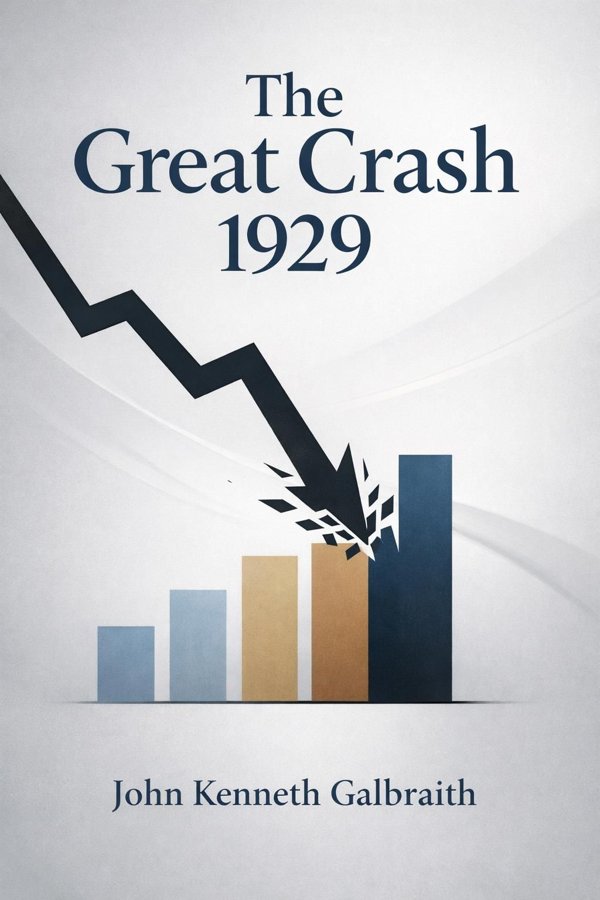
The Great Crash 1929: Summary & Key Insights
 10 min10 chaptersAudio available
Key Takeaways from The Great Crash 1929
Boom times often hide structural weakness better than hard times do.
The most dangerous bubbles begin when speculation stops feeling risky and starts feeling normal.
A bubble becomes truly dangerous when rising prices are financed with borrowed money.
Financial disasters are rarely caused by emotion alone; they also require mechanisms that transmit emotion into damage.
Speculative eras do not merely reveal public gullibility; they also invite private opportunism.
What Is The Great Crash 1929 About?
The Great Crash 1929 by John Kenneth Galbraith is a economics book spanning 10 pages. The Great Crash 1929 is John Kenneth Galbraith’s brilliant, unsettling account of how a modern economy talked itself into disaster. More than a simple history of the Wall Street collapse, the book examines the culture of speculation, the financial structures that magnified risk, and the failures of judgment that turned exuberance into catastrophe. Galbraith shows that the crash was not an inexplicable accident. It was the result of familiar forces: easy money, weak safeguards, rising leverage, corporate manipulation, and a widespread belief that prosperity had become permanent. What makes the book enduring is its emphasis on human behavior. Markets may change their technology, but greed, overconfidence, and denial remain remarkably constant. Galbraith writes with the authority of one of the twentieth century’s great economists and public intellectuals, combining archival detail with sharp wit and moral clarity. His analysis helps readers understand not only 1929, but every era in which financial euphoria outruns economic reality. For anyone interested in economics, investing, public policy, or the psychology of bubbles, this remains one of the most illuminating books ever written about financial collapse.
This FizzRead summary covers all 10 key chapters of The Great Crash 1929 in approximately 10 minutes, distilling the most important ideas, arguments, and takeaways from John Kenneth Galbraith's work. Also available as an audio summary and Key Quotes Podcast.
The Great Crash 1929
The Great Crash 1929 is John Kenneth Galbraith’s brilliant, unsettling account of how a modern economy talked itself into disaster. More than a simple history of the Wall Street collapse, the book examines the culture of speculation, the financial structures that magnified risk, and the failures of judgment that turned exuberance into catastrophe. Galbraith shows that the crash was not an inexplicable accident. It was the result of familiar forces: easy money, weak safeguards, rising leverage, corporate manipulation, and a widespread belief that prosperity had become permanent. What makes the book enduring is its emphasis on human behavior. Markets may change their technology, but greed, overconfidence, and denial remain remarkably constant. Galbraith writes with the authority of one of the twentieth century’s great economists and public intellectuals, combining archival detail with sharp wit and moral clarity. His analysis helps readers understand not only 1929, but every era in which financial euphoria outruns economic reality. For anyone interested in economics, investing, public policy, or the psychology of bubbles, this remains one of the most illuminating books ever written about financial collapse.
Who Should Read The Great Crash 1929?
This book is perfect for anyone interested in economics and looking to gain actionable insights in a short read. Whether you're a student, professional, or lifelong learner, the key ideas from The Great Crash 1929 by John Kenneth Galbraith will help you think differently.
- ✓Readers who enjoy economics and want practical takeaways
- ✓Professionals looking to apply new ideas to their work and life
- ✓Anyone who wants the core insights of The Great Crash 1929 in just 10 minutes
Want the full summary?
Get instant access to this book summary and 100K+ more with Fizz Moment.
Get Free SummaryAvailable on App Store • Free to download
Key Chapters
Boom times often hide structural weakness better than hard times do. Galbraith begins by placing the crash in the broader economic atmosphere of the 1920s, a decade celebrated for technological innovation, rising output, consumer credit, and mass prosperity. Automobiles, radios, chain stores, and modern advertising helped create the impression that the United States had entered a permanently richer age. Yet beneath this confidence were imbalances that made the economy fragile. Wealth was unevenly distributed, many industries had excess capacity, farm incomes were weak, and consumers increasingly depended on debt to sustain rising levels of spending. The country looked prosperous, but much of that prosperity was narrower and less durable than public rhetoric suggested.
Galbraith’s point is crucial: speculative bubbles rarely arise from pure fantasy alone. They build on genuine advances, then exaggerate them into a story of limitless growth. In the 1920s, real productivity gains and business expansion encouraged people to assume that high profits and rising stock prices were natural, even inevitable. That made it easier to ignore warning signs. A modern parallel can be seen whenever new technologies lead investors to believe that old valuation rules no longer apply.
The practical lesson is to distinguish between real economic strength and the narrative built around it. A growing economy does not guarantee that asset prices are reasonable. When optimism becomes a substitute for scrutiny, danger accumulates quietly. Actionable takeaway: whenever an economy appears unstoppable, look for the neglected weaknesses beneath the celebration—debt levels, income concentration, overcapacity, and unrealistic expectations usually tell a more honest story.
The most dangerous bubbles begin when speculation stops feeling risky and starts feeling normal. Galbraith shows how, by the late 1920s, the stock market was no longer a specialized arena for financiers. It had become a national obsession. Office workers, small shopkeepers, socialites, and professionals all joined the rush to buy stocks, often with borrowed money. Newspapers celebrated market records, brokers expanded aggressively, and conversations about easy profits moved from financial districts into households and dinner parties. Speculation had become democratic in the worst possible sense: everyone felt entitled to participate, and few felt compelled to understand what they were buying.
This mattered because social enthusiasm reinforces financial excess. When friends, colleagues, and public figures all seem to be getting rich, caution starts to look foolish. People stop asking whether prices are justified by earnings or whether the market has become detached from reality. Instead, they worry about being left behind. Galbraith treats this not just as an economic condition but as a social contagion. The desire for belonging and status can be as powerful as greed.
The pattern appears repeatedly in later episodes, from internet stocks to real estate manias to speculative crypto surges. In each case, rising prices create stories of inevitability, and those stories pull in new participants who raise prices further.
The key practical application is simple but difficult: popularity is not evidence of safety. When investing becomes entertainment and everyone has a tip, discipline matters most. Actionable takeaway: if an asset is attracting widespread excitement from people who cannot explain its underlying value, treat that enthusiasm as a warning sign rather than reassurance.
A bubble becomes truly dangerous when rising prices are financed with borrowed money. One of Galbraith’s most important themes is the role of margin buying and other forms of leverage in magnifying both gains and losses. In the 1920s, investors could buy stocks by putting down only a fraction of the purchase price and borrowing the rest. As long as prices continued upward, this seemed brilliant. Small amounts of personal capital could control large positions, making returns look extraordinary. But leverage changes the character of risk. It creates a system in which even modest declines can trigger forced selling, margin calls, and panic.
Galbraith explains that this structure made the market inherently unstable. Prices were not rising only because investors believed in long-term business prospects. They were rising because borrowed money poured into speculation. Once confidence faltered, the same mechanism worked in reverse. Debt that had amplified gains now accelerated collapse. Sellers needed cash, lenders wanted protection, and falling prices fed on themselves.
This is one of the most practical lessons in the book because leverage remains central to modern financial crises. Whether in hedge funds, housing markets, private equity, or retail trading platforms, borrowed money can create the illusion of strength during expansions and expose weakness during downturns. The key question is not only whether prices are high, but how they are being financed.
Galbraith’s insight is enduring: markets can survive overvaluation longer than they can survive overvaluation built on debt. Actionable takeaway: before trusting any booming market, ask how much leverage supports it. If gains depend heavily on borrowed money, assume the downside will be faster and more brutal than most participants expect.
Financial disasters are rarely caused by emotion alone; they also require mechanisms that transmit emotion into damage. Galbraith pays close attention to the structure of the market in the late 1920s, showing that it was poorly equipped to absorb stress. Investment trusts, broker loans, opaque financing arrangements, and informal networks of support created an environment where speculation flourished without adequate transparency or restraint. Investors often had little understanding of how securities were packaged, promoted, or financed. In practice, this meant that risk was both underestimated and dispersed in ways that made the whole system vulnerable.
One important element was the rise of investment trusts, which were often sold as sophisticated vehicles for diversification. In reality, many operated with layers of leverage and self-referential ownership that made them far riskier than the public appreciated. Galbraith shows how complexity can be used not to reduce risk but to disguise it. This insight remains strikingly modern. Financial innovation is often praised as progress, but when products become too complicated for ordinary investors—or even professionals—to evaluate, complexity itself becomes a source of danger.
The broader lesson is that a market’s architecture matters. Rules, disclosure standards, capital requirements, and institutional design shape how fragile or resilient a system becomes. Confidence can endure surprisingly long in a weak structure, but when pressure arrives, hidden connections and weak safeguards are exposed quickly.
For contemporary readers, the application is clear: do not assess assets in isolation from the system surrounding them. Ask how instruments are funded, who bears the risk, and what happens under stress. Actionable takeaway: whenever an investment opportunity sounds sophisticated but hard to explain, pause and simplify the question—if you cannot understand the structure, you cannot properly understand the risk.
Speculative eras do not merely reveal public gullibility; they also invite private opportunism. Galbraith explores how corporate practices in the 1920s often intensified the market mania. Companies and financial promoters engaged in dubious accounting, overstated prospects, insider arrangements, and promotional tactics designed to lift share prices rather than build durable businesses. Pools and syndicates could be used to create the appearance of strong demand, encouraging outsiders to buy at inflated prices. In such an environment, the line between legitimate finance and manipulation became dangerously thin.
Galbraith’s argument is not that every business was fraudulent, but that weak standards and easy optimism reduced the penalties for exaggeration. When investors are eager to believe, executives and promoters face strong incentives to tell them what they want to hear. This creates a feedback loop. Corporate narratives boost stock prices, rising stock prices validate those narratives, and skepticism becomes harder to sustain. The result is not just overvaluation, but a culture in which image outruns substance.
Modern readers will recognize this pattern in overhyped earnings stories, aggressive adjusted metrics, celebrity founders, and companies that prioritize market excitement over basic profitability. The particulars change, but the temptation remains the same: in a hot market, appearance can be monetized quickly.
The practical implication is that governance and transparency are not bureaucratic niceties. They are defenses against collective self-deception. Investors should pay close attention to incentives, accounting quality, insider behavior, and whether growth claims rest on solid economics. Actionable takeaway: when a company’s story is far more compelling than its fundamentals, assume you are being asked to finance hope rather than value—and investigate twice before committing capital.
A central bank can dampen a bubble, accommodate it, or misunderstand it; in 1929, Galbraith suggests the Federal Reserve did too much of the last. He examines how monetary policy before the crash failed to address speculation effectively and consistently. The Fed was aware that stock market excess posed dangers, yet it struggled to decide whether and how to intervene. Tightening policy too broadly risked harming the real economy, while targeted restraints on speculation proved inadequate. This hesitation reflected not only technical limitations but also institutional uncertainty and imperfect judgment.
Galbraith’s treatment is subtle. He does not claim the Federal Reserve alone caused the crash. Rather, he shows that monetary authorities failed to grasp how deeply speculative psychology and leverage had infected the financial system. Once a bubble reaches a certain scale, moderate policy measures may no longer be enough. Moreover, if central bank signals are unclear, markets can interpret caution as permission. Participants convince themselves that authorities see no serious threat, or that the boom can continue safely.
This is highly relevant to modern debates about interest rates, asset bubbles, and financial stability. Policymakers often face the same dilemma: should they respond to inflation in consumer prices only, or also to dangerous inflation in asset prices? Galbraith’s account suggests that ignoring financial excess because the broader economy still looks healthy can be costly.
The lesson is not that central banks can perfectly prevent bubbles. They cannot. But delayed recognition and timid action leave economies more exposed. Actionable takeaway: when evaluating policy, look beyond official confidence and ask whether authorities are confronting systemic risk early enough—or merely hoping exuberance will correct itself without major damage.
Historic crashes are often remembered as single dramatic days, but Galbraith reminds us that collapse is usually a sequence of breaks in confidence. The famous events of October 1929—Black Thursday, Black Monday, and Black Tuesday—were not a lightning bolt out of a clear sky. They were the visible climax of growing strain within an overleveraged and overconfident market. As prices weakened, support operations by bankers and influential institutions briefly steadied sentiment. But reassurance could not restore genuine value where speculation had already run too far. Each attempt to calm the market bought time, not resolution.
Galbraith captures the drama of these days while emphasizing their mechanics. Once investors began to doubt that prices would keep rising, the psychology changed abruptly. The market no longer looked like a machine for easy wealth; it looked like a trap. Selling pressure intensified, margin calls forced liquidation, and confidence evaporated faster than official statements could rebuild it. The panic was not irrational in the narrow sense. It was a rational reaction within an irrational structure.
This distinction matters. Financial crises seem sudden to the public because the final break is dramatic, but the preconditions build over months or years. That insight helps readers resist the false comfort of thinking crashes are unpredictable freak events. They are often predictable in form, if not in timing.
For practical use, this means paying attention to fragility before the dramatic headlines begin. By the time panic is visible, many exits are already crowded. Actionable takeaway: do not wait for a crash to confirm your concerns. If valuations, leverage, and confidence all look extreme, treat that combination as your signal to reduce exposure before the market’s mood turns decisively.
A crash does not create all the damage it later reveals; it exposes and accelerates weaknesses already present. Galbraith shows that the immediate aftermath of 1929 was marked by denial, misplaced optimism, and the belief that recovery would be quick. Many leaders assumed the market break was a temporary interruption rather than a sign of fundamental economic distress. But falling wealth, tightening credit, collapsing confidence, and declining investment soon spread beyond Wall Street into the broader economy. The crash hurt not only speculators but businesses, workers, banks, and households.
Galbraith is especially effective in showing why a market collapse can have real economic consequences. When asset prices plunge, lenders become cautious, firms cut expansion plans, consumers spend less, and indebted institutions face intensifying strain. The crash was therefore not a self-contained financial event. It was a shock that interacted with existing vulnerabilities—uneven income, weak demand, and fragile banking structures—to produce broader contraction.
This remains a vital lesson in modern economics. Policymakers and investors sometimes assume that financial markets are separate from the real economy, but severe asset collapses can quickly transmit into employment, production, and social stability. Wealth effects, credit conditions, and confidence all matter.
The practical implication is that resilience must be built before downturns begin. Households need emergency savings, firms need manageable debt, banks need strong capital, and governments need the ability to respond credibly. Actionable takeaway: never treat financial turmoil as merely a problem for investors. When credit and confidence crack together, everyone is affected—so prepare for shocks at the household, business, and policy level before they arrive.
The tragedy of 1929 was not only that the market crashed, but that the economy then descended into a far deeper and longer disaster. Galbraith argues that the Great Depression cannot be understood as a simple extension of the stock market break. The crash was a trigger, but the severity of the downturn came from the interaction of financial damage, policy failures, and collapsing confidence. Banking weakness, inadequate demand, business retrenchment, and ineffective official responses turned a severe shock into a prolonged depression.
Psychology played a central role. During the boom, confidence made bad structures look sound. During the bust, fear made even sound behavior difficult. Consumers postponed purchases, businesses delayed investment, and lenders protected themselves by withholding credit. This collective caution, understandable at the individual level, became destructive at the national level. Galbraith’s insight is deeply Keynesian: what seems prudent for one actor can become ruinous when practiced by everyone at once.
He also stresses that public policy failed to counteract the downward spiral with enough force. Economic contractions require more than moral encouragement. They require institutions willing to support demand, stabilize banks, and restore trust. That is one reason the book remains so relevant whenever governments confront recession or financial panic.
The broader application extends beyond macroeconomics. In organizations and communities, fear can produce self-reinforcing paralysis if no one acts decisively to stabilize expectations. Actionable takeaway: in any crisis, assess not just the initial shock but the feedback loops that can deepen it. Breaking cycles of fear early—with liquidity, clarity, and credible action—is often the difference between setback and catastrophe.
One of Galbraith’s sharpest observations is that financial history is repetitive because collective memory is short. The psychological and social dimensions of the crash matter as much as the numbers. People wanted to believe in effortless wealth, in experts who seemed to understand the new era, and in the comforting idea that prosperity had permanently conquered risk. That desire made them receptive to extravagant claims and resistant to unwelcome evidence. The crash was therefore not just an economic breakdown, but a moral and intellectual one—a failure of skepticism.
Galbraith’s larger lesson is that societies repeatedly rediscover the same illusions. Each generation thinks its technologies, institutions, or talent have overcome the old constraints. Yet the emotional ingredients remain the same: envy, ambition, imitation, denial, and the hunger for simple stories. This is why the book still speaks powerfully to modern readers. Whether the object is stocks, property, startups, or digital assets, the social experience of mania changes less than we imagine.
Importantly, Galbraith does not recommend cynicism. He recommends historical intelligence. Progress is real, but so is self-deception. Healthy financial culture depends on memory, criticism, and institutions strong enough to resist the crowd.
For readers today, the application is straightforward. Study bubbles not as museum pieces but as recurring patterns of behavior. Notice when public conversation shifts from analysis to certainty, from valuation to slogans, from prudence to ridicule of caution. Actionable takeaway: make historical comparison a regular part of decision-making. When an investment story sounds unprecedentedly glorious, ask which old bubble it most resembles before deciding that this time is truly different.
All Chapters in The Great Crash 1929
About the Author
John Kenneth Galbraith (1908–2006) was a Canadian-American economist, diplomat, professor, and bestselling author whose work shaped public debate on economics for decades. After studying agricultural economics, he built a distinguished academic career and became a longtime professor at Harvard University. Galbraith also served in government roles during the Roosevelt, Truman, Kennedy, and Johnson eras, and later became U.S. Ambassador to India. He was known for combining economic analysis with sharp prose, historical perspective, and skepticism toward concentrated corporate and financial power. Among his most influential books are The Affluent Society, The New Industrial State, and The Great Crash 1929. His writing made complex economic issues accessible to broad audiences while challenging conventional assumptions about markets, public policy, and modern capitalism.
Get This Summary in Your Preferred Format
Read or listen to the The Great Crash 1929 summary by John Kenneth Galbraith anytime, anywhere. FizzRead offers multiple formats so you can learn on your terms — all free.
Available formats: App · Audio · PDF · EPUB — All included free with FizzRead
Download The Great Crash 1929 PDF and EPUB Summary
Key Quotes from The Great Crash 1929
“Boom times often hide structural weakness better than hard times do.”
“The most dangerous bubbles begin when speculation stops feeling risky and starts feeling normal.”
“A bubble becomes truly dangerous when rising prices are financed with borrowed money.”
“Financial disasters are rarely caused by emotion alone; they also require mechanisms that transmit emotion into damage.”
“Speculative eras do not merely reveal public gullibility; they also invite private opportunism.”
Frequently Asked Questions about The Great Crash 1929
The Great Crash 1929 by John Kenneth Galbraith is a economics book that explores key ideas across 10 chapters. The Great Crash 1929 is John Kenneth Galbraith’s brilliant, unsettling account of how a modern economy talked itself into disaster. More than a simple history of the Wall Street collapse, the book examines the culture of speculation, the financial structures that magnified risk, and the failures of judgment that turned exuberance into catastrophe. Galbraith shows that the crash was not an inexplicable accident. It was the result of familiar forces: easy money, weak safeguards, rising leverage, corporate manipulation, and a widespread belief that prosperity had become permanent. What makes the book enduring is its emphasis on human behavior. Markets may change their technology, but greed, overconfidence, and denial remain remarkably constant. Galbraith writes with the authority of one of the twentieth century’s great economists and public intellectuals, combining archival detail with sharp wit and moral clarity. His analysis helps readers understand not only 1929, but every era in which financial euphoria outruns economic reality. For anyone interested in economics, investing, public policy, or the psychology of bubbles, this remains one of the most illuminating books ever written about financial collapse.
More by John Kenneth Galbraith


You Might Also Like
Business Adventures
John Brooks
10 min
Nudge
Richard H. Thaler, Cass R. Sunstein
10 min
The Hitchhiker"s Guide to the Galaxy
Douglas Adams
10 minThe Muqaddimah
Ibn Khaldun
10 minThe Outsiders
William N. Thorndike
10 min
A Little History of Economics
Niall Kishtainy
10 minBrowse by Category
Ready to read The Great Crash 1929?
Get the full summary and 100K+ more books with Fizz Moment.