
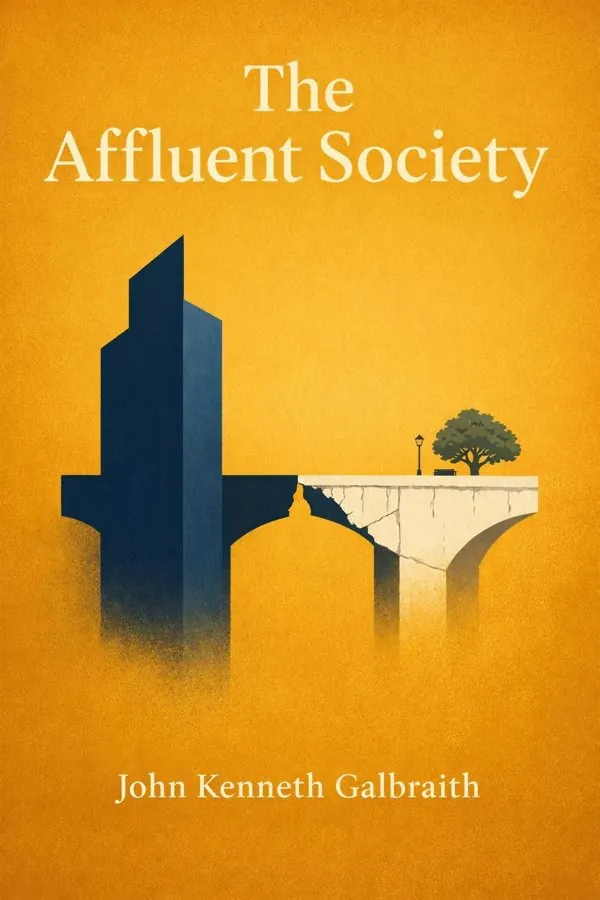
The Affluent Society: Summary & Key Insights
 10 min7 chaptersAudio available
What Is The Affluent Society About?
The Affluent Society by John Kenneth Galbraith is a economics book spanning 7 pages. The Affluent Society, first published in 1958, is a landmark work of economic thought by John Kenneth Galbraith. The book critiques the conventional wisdom of postwar economics, arguing that modern industrial societies have achieved material abundance but continue to suffer from social imbalance. Galbraith highlights the contrast between private wealth and public poverty, calling for greater investment in public goods and a rethinking of economic priorities.
This FizzRead summary covers all 7 key chapters of The Affluent Society in approximately 10 minutes, distilling the most important ideas, arguments, and takeaways from John Kenneth Galbraith's work. Also available as an audio summary and Key Quotes Podcast.
The Affluent Society
The Affluent Society, first published in 1958, is a landmark work of economic thought by John Kenneth Galbraith. The book critiques the conventional wisdom of postwar economics, arguing that modern industrial societies have achieved material abundance but continue to suffer from social imbalance. Galbraith highlights the contrast between private wealth and public poverty, calling for greater investment in public goods and a rethinking of economic priorities.
Who Should Read The Affluent Society?
This book is perfect for anyone interested in economics and looking to gain actionable insights in a short read. Whether you're a student, professional, or lifelong learner, the key ideas from The Affluent Society by John Kenneth Galbraith will help you think differently.
- ✓Readers who enjoy economics and want practical takeaways
- ✓Professionals looking to apply new ideas to their work and life
- ✓Anyone who wants the core insights of The Affluent Society in just 10 minutes
Want the full summary?
Get instant access to this book summary and 100K+ more with Fizz Moment.
Get Free SummaryAvailable on App Store • Free to download
Key Chapters
To understand how our economic philosophy went astray, one must look to its origins. Classical and neoclassical economics emerged in an era when scarcity governed life. For thinkers like Adam Smith, David Ricardo, and John Stuart Mill, the central economic question was how to allocate limited resources among competing necessities. Poverty was omnipresent, production was uncertain, and the pressing moral imperative was growth. It was natural, then, for them to equate higher output with human betterment.
But those theories persisted long after their historical basis eroded. By the mid–twentieth century, Western societies had answered the ancient challenge of scarcity. The industrial revolution, technological progress, and postwar productivity combined to deliver an unprecedented cornucopia. The shelves were full, the factories efficient, and yet the same intellectual tools that once guided policy through poverty were now dictating policy in plenty. Economists still spoke of production as the supreme virtue, ignoring that the social meaning of production had changed. The virtue of hard work had been transformed into an obsession with more—more goods, more marketing, more spending—long after the basic needs of life had been met.
Our social conversation, trained by the past, had failed to adapt. Politicians celebrated rising output as though it were still the guarantor of happiness. Economists, for their part, measured success through the growth of Gross National Product, a statistic that ignored whether new wealth enriched private comfort, public well-being, or merely filled warehouses with trivialities. The old fear of deprivation lingered in our mental habits, and with it, the worship of growth for its own sake. I sought to awaken readers to this intellectual anachronism—to show that the persistence of scarcity thinking in an age of abundance was not merely misguided, but dangerous.
Postwar America represented a turning point in human history. For the first time, a large industrial society no longer struggled primarily with hunger, disease, or shelter. Automobiles, televisions, and refrigerators filled the homes of the average citizen. This was the age of affluence, and with it came a profound change in the nature of economic life. Yet our political and moral sensibilities lagged behind.
Affluence, I argued, is not simply the possession of wealth but the presence of choice. When our productive capacity reaches the point where society can provide comfort to all, the question becomes not what we can make, but what we ought to make. The affluent age grants us the freedom to reimagine purpose—to ask whether producing more material goods is the same as creating a better life.
However, this new age also carried hidden perils. The machinery of industry could not rest; it required constant demand to sustain itself. And so, even as we reached material sufficiency, we were urged to want more. Affluence bred its own anxieties: advertising created needs where none existed, and credit systems ensured consumption even when incomes faltered. Thus, the modern consumer was both privileged and captive—enjoying abundance yet enslaved by the impulse to acquire.
The challenge of the affluent society was to recognize that having enough does not mean having meaning. True prosperity would come only when our collective wealth was matched by generosity in spirit—when we invested as much in our social institutions as in our supermarkets.
+ 5 more chapters — available in the FizzRead app
All Chapters in The Affluent Society
About the Author
John Kenneth Galbraith (1908–2006) was a Canadian-American economist, diplomat, and public intellectual. He served as a professor at Harvard University and as U.S. Ambassador to India. Galbraith was known for his influential works on economic theory, public policy, and social philosophy, including The Affluent Society and The New Industrial State.
Get This Summary in Your Preferred Format
Read or listen to the The Affluent Society summary by John Kenneth Galbraith anytime, anywhere. FizzRead offers multiple formats so you can learn on your terms — all free.
Available formats: App · Audio · PDF · EPUB — All included free with FizzRead
Download The Affluent Society PDF and EPUB Summary
Key Quotes from The Affluent Society
“To understand how our economic philosophy went astray, one must look to its origins.”
“Postwar America represented a turning point in human history.”
Frequently Asked Questions about The Affluent Society
The Affluent Society by John Kenneth Galbraith is a economics book that explores key ideas across 7 chapters. The Affluent Society, first published in 1958, is a landmark work of economic thought by John Kenneth Galbraith. The book critiques the conventional wisdom of postwar economics, arguing that modern industrial societies have achieved material abundance but continue to suffer from social imbalance. Galbraith highlights the contrast between private wealth and public poverty, calling for greater investment in public goods and a rethinking of economic priorities.
More by John Kenneth Galbraith

You Might Also Like
Business Adventures
John Brooks
10 min
Nudge
Richard H. Thaler, Cass R. Sunstein
10 min
The Hitchhiker"s Guide to the Galaxy
Douglas Adams
10 minThe Muqaddimah
Ibn Khaldun
10 minThe Outsiders
William N. Thorndike
10 min
A Little History of Economics
Niall Kishtainy
10 minBrowse by Category
Ready to read The Affluent Society?
Get the full summary and 100K+ more books with Fizz Moment.