
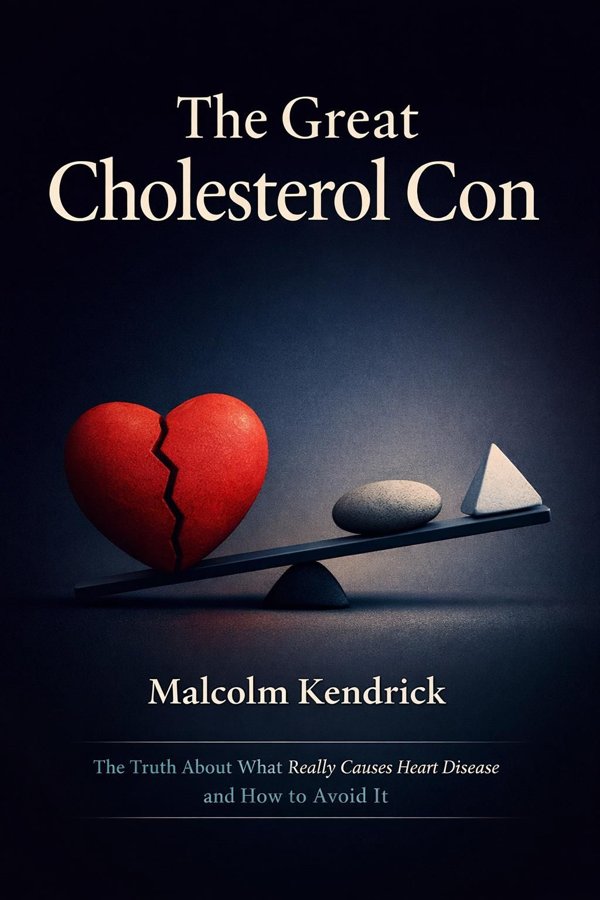
The Great Cholesterol Con: The Truth About What Really Causes Heart Disease and How to Avoid It: Summary & Key Insights
 10 min6 chaptersAudio available
What Is The Great Cholesterol Con: The Truth About What Really Causes Heart Disease and How to Avoid It About?
The Great Cholesterol Con: The Truth About What Really Causes Heart Disease and How to Avoid It by Malcolm Kendrick is a health_med book spanning 6 pages. This book challenges the conventional medical wisdom that high cholesterol causes heart disease. Dr. Malcolm Kendrick presents evidence questioning the cholesterol hypothesis and explores alternative explanations for cardiovascular disease, arguing that stress, lifestyle, and other factors play a more significant role than cholesterol levels. Written in an accessible and provocative style, it encourages readers to critically evaluate mainstream health advice.
This FizzRead summary covers all 6 key chapters of The Great Cholesterol Con: The Truth About What Really Causes Heart Disease and How to Avoid It in approximately 10 minutes, distilling the most important ideas, arguments, and takeaways from Malcolm Kendrick's work. Also available as an audio summary and Key Quotes Podcast.
The Great Cholesterol Con: The Truth About What Really Causes Heart Disease and How to Avoid It
This book challenges the conventional medical wisdom that high cholesterol causes heart disease. Dr. Malcolm Kendrick presents evidence questioning the cholesterol hypothesis and explores alternative explanations for cardiovascular disease, arguing that stress, lifestyle, and other factors play a more significant role than cholesterol levels. Written in an accessible and provocative style, it encourages readers to critically evaluate mainstream health advice.
Who Should Read The Great Cholesterol Con: The Truth About What Really Causes Heart Disease and How to Avoid It?
This book is perfect for anyone interested in health_med and looking to gain actionable insights in a short read. Whether you're a student, professional, or lifelong learner, the key ideas from The Great Cholesterol Con: The Truth About What Really Causes Heart Disease and How to Avoid It by Malcolm Kendrick will help you think differently.
- ✓Readers who enjoy health_med and want practical takeaways
- ✓Professionals looking to apply new ideas to their work and life
- ✓Anyone who wants the core insights of The Great Cholesterol Con: The Truth About What Really Causes Heart Disease and How to Avoid It in just 10 minutes
Want the full summary?
Get instant access to this book summary and 100K+ more with Fizz Moment.
Get Free SummaryAvailable on App Store • Free to download
Key Chapters
To grasp how the cholesterol story took root, we have to go back to the mid-20th century. It began with the work of Ancel Keys and his now-famous Seven Countries Study. Keys compared rates of heart disease and dietary fat intake across selected nations and concluded that societies eating more fat suffered more heart disease. The conclusion was seductive, and public health authorities—especially in the United States—adopted it enthusiastically. Fat was the enemy, cholesterol the culprit, and a sweeping campaign to change global eating patterns began.
Yet from the very beginning, the evidence was selective. Keys had data from more than twenty countries but included only seven whose trends supported the hypothesis. Others, including France, Germany, and Switzerland—nations rich in butter, cream, and cheese—showed low heart disease rates despite high fat consumption. Those inconvenient outliers were quietly omitted. Once policymakers embraced the link, industry followed. Food companies reformulated products, governments issued dietary guidelines, and the public learned to fear eggs and bacon.
What started as one questionable epidemiological study hardened into dogma. Universities taught it as fact. Journalists repeated it until it sounded like common sense. For many professionals, opposing it became career suicide. And just as the idea gained moral force, the pharmaceutical industry recognized a commercial opportunity: if cholesterol truly caused heart disease, then lowering it could be sold as salvation. The stage was set for an entire medical economy built on fear of a biochemical phantom.
In truth, the story reveals more about human psychology and institutional inertia than molecular biology. Once reputations, profits, and public trust are pinioned to a theory, it becomes nearly impossible to challenge, no matter how shaky the foundation. The cholesterol hypothesis became not a scientific question but a faith—perpetuated by repetition, not by proof.
When you look at the actual data, the supposed link between cholesterol and heart disease begins to crumble. Study after study, when properly analyzed, fails to show a consistent relationship between high cholesterol and mortality. Some large population surveys even reveal the opposite: people with higher cholesterol often live longer, particularly among the elderly. The Framingham Heart Study—the flagship of cardiovascular research—after decades of follow-up, indicated that for people over fifty, higher cholesterol levels did not predict heart disease or death.
Moreover, the fundamental assumption—that cholesterol clogs arteries—is flawed. Atherosclerotic plaques are complex lesions formed within the arterial wall, not simple accumulations of fat. They involve inflammatory processes, immune responses, and damage to the endothelium, the inner lining of blood vessels. Cholesterol is present at the scene, yes—but as part of the repair mechanism, not necessarily the cause. It’s as if we blame firefighters for the fires they attend.
The problem with much of the research lies in design and interpretation. Total cholesterol levels, for instance, combine different lipoprotein fractions—LDL, HDL, and others—whose biological roles differ substantially. Simplifying this intricate system into a single number is like judging an orchestra by one note. Add to that publication bias, selective reporting, and statistical manipulation, and the picture becomes even murkier. The truth is, the cholesterol-heart disease connection is a hypothesis corruptly supported by cherry-picked evidence and sustained by authority rather than discovery.
+ 4 more chapters — available in the FizzRead app
All Chapters in The Great Cholesterol Con: The Truth About What Really Causes Heart Disease and How to Avoid It
About the Author
Dr. Malcolm Kendrick is a British physician and author known for his critical views on mainstream medical practices, particularly regarding heart disease and cholesterol. He has written several books and articles advocating for evidence-based medicine and questioning established health dogmas.
Get This Summary in Your Preferred Format
Read or listen to the The Great Cholesterol Con: The Truth About What Really Causes Heart Disease and How to Avoid It summary by Malcolm Kendrick anytime, anywhere. FizzRead offers multiple formats so you can learn on your terms — all free.
Available formats: App · Audio · PDF · EPUB — All included free with FizzRead
Download The Great Cholesterol Con: The Truth About What Really Causes Heart Disease and How to Avoid It PDF and EPUB Summary
Key Quotes from The Great Cholesterol Con: The Truth About What Really Causes Heart Disease and How to Avoid It
“To grasp how the cholesterol story took root, we have to go back to the mid-20th century.”
“When you look at the actual data, the supposed link between cholesterol and heart disease begins to crumble.”
Frequently Asked Questions about The Great Cholesterol Con: The Truth About What Really Causes Heart Disease and How to Avoid It
The Great Cholesterol Con: The Truth About What Really Causes Heart Disease and How to Avoid It by Malcolm Kendrick is a health_med book that explores key ideas across 6 chapters. This book challenges the conventional medical wisdom that high cholesterol causes heart disease. Dr. Malcolm Kendrick presents evidence questioning the cholesterol hypothesis and explores alternative explanations for cardiovascular disease, arguing that stress, lifestyle, and other factors play a more significant role than cholesterol levels. Written in an accessible and provocative style, it encourages readers to critically evaluate mainstream health advice.
You Might Also Like
On Immunity
Eula Biss
10 min
The Three-Body Problem
Liu Cixin
10 min
Community Health Volunteer Toolkit: Training and Practical Activities
World Health Organization
10 min
Healing Back Pain: The Mind-Body Connection
John E. Sarno
10 min
Health Literacy for All: Practical Guides to Communicate Health Information (Compilations)
World Health Organization
10 min
The Complete Guide to Sports Supplements: An Evidence-Based Review
Anita Bean
10 minBrowse by Category
Ready to read The Great Cholesterol Con: The Truth About What Really Causes Heart Disease and How to Avoid It?
Get the full summary and 100K+ more books with Fizz Moment.