
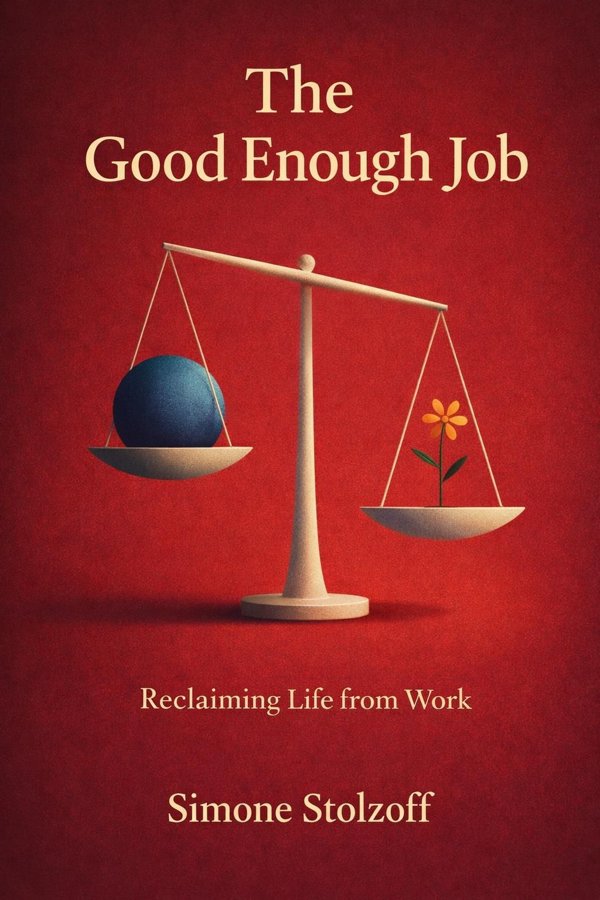
The Good Enough Job: Reclaiming Life from Work: Summary & Key Insights
 10 min9 chaptersAudio available
Key Takeaways from The Good Enough Job: Reclaiming Life from Work
One of the book’s most important insights is that our intense attachment to work is not natural, eternal, or inevitable.
A powerful illusion shapes modern life: the belief that what you do is who you are.
Few modern ideas are more seductive than “do what you love.
Abstract arguments about work become most convincing when viewed through lived experience.
The modern workplace no longer ends when people leave the office.
What Is The Good Enough Job: Reclaiming Life from Work About?
The Good Enough Job: Reclaiming Life from Work by Simone Stolzoff is a sociology book spanning 9 pages. What if the biggest problem with modern work is not that people work too hard, but that work has become the place where they expect to find identity, meaning, status, community, and self-worth all at once? In The Good Enough Job, Simone Stolzoff examines how employment expanded from an economic necessity into a defining feature of personal identity. Through reporting, interviews, cultural history, and social analysis, he shows why so many people now answer the question “Who are you?” with a job title, and why that habit leaves them vulnerable to burnout, anxiety, and disappointment. Stolzoff does not argue that work is meaningless or that ambition is bad. Instead, he offers a more grounded alternative: treat work as one important part of life, not the entire foundation of it. That idea matters in a culture of hustle, personal branding, and constant connectivity, where career success is often mistaken for human worth. As a journalist and former designer who has written extensively about work and identity, Stolzoff brings both credibility and nuance to a timely question: how can we build a life that is larger than our labor?
This FizzRead summary covers all 9 key chapters of The Good Enough Job: Reclaiming Life from Work in approximately 10 minutes, distilling the most important ideas, arguments, and takeaways from Simone Stolzoff's work. Also available as an audio summary and Key Quotes Podcast.
The Good Enough Job: Reclaiming Life from Work
What if the biggest problem with modern work is not that people work too hard, but that work has become the place where they expect to find identity, meaning, status, community, and self-worth all at once? In The Good Enough Job, Simone Stolzoff examines how employment expanded from an economic necessity into a defining feature of personal identity. Through reporting, interviews, cultural history, and social analysis, he shows why so many people now answer the question “Who are you?” with a job title, and why that habit leaves them vulnerable to burnout, anxiety, and disappointment. Stolzoff does not argue that work is meaningless or that ambition is bad. Instead, he offers a more grounded alternative: treat work as one important part of life, not the entire foundation of it. That idea matters in a culture of hustle, personal branding, and constant connectivity, where career success is often mistaken for human worth. As a journalist and former designer who has written extensively about work and identity, Stolzoff brings both credibility and nuance to a timely question: how can we build a life that is larger than our labor?
Who Should Read The Good Enough Job: Reclaiming Life from Work?
This book is perfect for anyone interested in sociology and looking to gain actionable insights in a short read. Whether you're a student, professional, or lifelong learner, the key ideas from The Good Enough Job: Reclaiming Life from Work by Simone Stolzoff will help you think differently.
- ✓Readers who enjoy sociology and want practical takeaways
- ✓Professionals looking to apply new ideas to their work and life
- ✓Anyone who wants the core insights of The Good Enough Job: Reclaiming Life from Work in just 10 minutes
Want the full summary?
Get instant access to this book summary and 100K+ more with Fizz Moment.
Get Free SummaryAvailable on App Store • Free to download
Key Chapters
One of the book’s most important insights is that our intense attachment to work is not natural, eternal, or inevitable. It was built. Stolzoff traces how, across history, labor shifted from being something people did to survive into something they were expected to use to express character, purpose, and even morality. In preindustrial societies, work was often tied to family, land, trade, or local obligation, but it was not always the center of individual identity. With industrialization, urbanization, and later the rise of corporate life, work became more structured, more public, and more central to status. In the twentieth century, especially in white-collar economies, careers became stories people told about themselves.
That historical change matters because it shows that the current model can also be changed. Many modern assumptions—that a fulfilling life requires a dream job, that ambition should be limitless, that career success proves virtue—are relatively recent cultural inventions. They were reinforced by capitalism, meritocracy, and consumer culture, all of which encourage people to see work as the main route to self-definition. If work becomes sacred, then unemployment feels like shame, stagnation feels like failure, and retirement can feel like erasure.
You can see this in everyday life: networking events ask what you do before who you are; college students are pushed to optimize résumés before developing values; parents often praise children for future careers rather than present character. Stolzoff invites readers to question that script. The practical implication is simple but powerful: when you remember that work-centered identity was made by culture, you also realize you are allowed to resist it. Actionable takeaway: examine one belief you hold about career success and ask whether it is truly yours or something history handed to you.
A powerful illusion shapes modern life: the belief that what you do is who you are. Stolzoff argues that this fusion between profession and personhood feels satisfying at first because it offers clarity, belonging, and social recognition. If you are a lawyer, teacher, founder, nurse, or designer, your role gives you a narrative. It tells others where to place you and tells you what to strive for. But when identity is overly invested in work, every professional setback becomes existential. A bad performance review does not just mean you struggled at a task; it can feel like proof that you are inadequate.
This overidentification makes people fragile. Layoffs, career pivots, illness, caregiving, or simply changing interests can trigger a crisis because the self was built on unstable economic ground. Stolzoff shows that jobs are contingent. Companies reorganize, industries shrink, managers change, and markets crash. If your self-worth depends on your role, then your emotional life is tied to forces you cannot control.
In practical terms, this can look like checking email during family dinners because responsiveness feels tied to value, or feeling embarrassed to introduce yourself without mentioning your career achievements. It can also appear in more subtle ways, such as using productivity as a proxy for worthiness. Stolzoff does not suggest that people stop caring about excellence. He suggests building a wider identity portfolio: friend, parent, neighbor, volunteer, artist, learner, citizen.
A useful application is to notice how you introduce yourself in new settings. Do you lead with your job because it is the easiest way to feel legible? Try broadening the answer. Mention interests, commitments, or relationships too. Actionable takeaway: write down five identities you value that have nothing to do with your profession, and invest time in at least one of them this week.
Few modern ideas are more seductive than “do what you love.” Stolzoff treats this phrase with care. On one hand, meaningful work can be deeply satisfying. On the other, the cultural obsession with passion can become a trap. When people are told that the ideal job should perfectly align with their deepest self, they begin to expect work to deliver purpose, joy, belonging, and transcendence all at once. That expectation sets them up for chronic dissatisfaction because all jobs involve boredom, compromise, politics, and routine.
The passion ideal also makes exploitation easier. Employers can ask workers to accept lower pay, longer hours, weak boundaries, or emotional strain if the work is framed as a calling. This is especially common in creative industries, nonprofits, education, activism, and startups, where mission is used to justify sacrifice. People stay late not just because they fear consequences, but because leaving feels like betraying their values or failing their identity.
Stolzoff’s alternative is not cynicism. He does not say passion is fake or irrelevant. He argues that passion should not be the only standard by which work is judged. A job can be “good enough” if it provides stability, decent compensation, reasonable respect, and enough energy to pursue meaning outside the office. Someone may find deeper fulfillment in parenting, friendship, religious life, sport, music, or community involvement than in employment.
In practice, this means asking better career questions. Instead of “Is this my calling?” ask “What trade-offs does this role require?” “What kind of life does it support?” and “Will I still have time and energy for what I love?” Actionable takeaway: replace the search for a perfect job with a written list of nonnegotiables, such as pay, schedule, values, flexibility, and emotional sustainability.
Abstract arguments about work become most convincing when viewed through lived experience. Stolzoff draws on case studies and interviews to show that overwork does not affect only one class, personality type, or industry. The startup founder who glorifies the grind, the nonprofit employee who cannot disconnect from mission-driven labor, the teacher who gives endlessly beyond paid hours, and the corporate professional whose calendar consumes every evening all reveal the same pattern: people stretch work far beyond its economic role because they hope it will validate who they are.
These stories matter because they reveal the emotional logic beneath overwork. Some workers stay attached to demanding jobs because work offers status. Others because it offers structure, social connection, or a sense of competence missing elsewhere. For some, especially high achievers, career intensity becomes a socially acceptable way to avoid vulnerability in other parts of life. It is easier to optimize performance than to repair a relationship, build community, or sit with uncertainty.
The case studies also show that stepping back from work does not necessarily mean becoming lazy or unambitious. It can mean redefining ambition. A person might move from a prestigious role to a less consuming one in order to regain health, care for children, make art, or simply become less anxious. Another might stay in the same job but set clearer boundaries and stop treating every task like a referendum on worth.
For readers, these examples offer a mirror. They ask: What are you really getting from work besides a paycheck? If your job vanished tomorrow, what emotional need would feel most threatened? Actionable takeaway: identify one hidden function your job serves—status, belonging, control, praise, structure—and brainstorm one nonwork way to meet that same need.
The modern workplace no longer ends when people leave the office. Stolzoff shows how technology has dissolved the boundaries that once separated labor from personal life. Smartphones, collaboration tools, messaging platforms, and email create the expectation of constant accessibility. Even when no one explicitly demands round-the-clock responsiveness, workers absorb the norm that being available signals commitment. The result is not merely longer hours, but mental occupation. People are physically present at home while psychologically still at work.
This shift is especially important because boundary erosion often masquerades as flexibility. Remote work and digital tools can provide autonomy, but they can also create invisible pressure to prove engagement. A worker who answers messages late at night may not be ordered to do so, yet still feels that silence could be read as indifference. Over time, this generates cognitive fatigue. Attention becomes fragmented, rest becomes conditional, and the mind never fully resets.
Stolzoff’s point is not that technology is inherently harmful. The issue is cultural: tools designed for convenience become systems of surveillance, acceleration, and self-imposed overperformance. A person may check Slack during a child’s soccer game, edit slides on vacation, or mentally rehearse responses before bed. The cost is cumulative. Leisure loses its restorative power when it is punctured by work alerts and anticipatory stress.
Practical changes can help. People can define response windows, remove email from phones, use delayed send features, or create end-of-day rituals that mark psychological separation. Teams can also establish norms around communication timing and urgency. Actionable takeaway: choose one digital boundary today—such as no work apps in the bedroom or no email after a set hour—and keep it consistently for the next seven days.
Many organizations say they care about employee well-being while quietly rewarding the opposite. Stolzoff examines how corporate culture often transforms overwork into a virtue. Free meals, inspiring mission statements, branded values, team-building rituals, and family-like language can make jobs feel emotionally rich, even as they normalize long hours and blurred boundaries. Workers are encouraged to bring their “whole selves” to work, but the unstated bargain is that work may then claim more of the whole self in return.
This dynamic is especially strong in workplaces that cultivate identity and belonging. If a company presents itself as a community or cause rather than simply an employer, saying no becomes harder. Turning down extra work can feel disloyal. Criticizing unhealthy norms can seem like a moral failure rather than a practical disagreement. Stolzoff highlights the machinery of overwork: performance systems, social signaling, prestige competition, and cultural narratives that celebrate hustle while treating rest as weakness.
The problem is not only external pressure. Workers internalize these norms and begin managing themselves in the employer’s interest. They volunteer for more, answer messages instantly, and frame exhaustion as evidence of importance. This is why overwork can persist even in the absence of overt coercion. The culture teaches people to police themselves.
A healthier response starts with clarity. A job is a relationship, not a family. Compensation, expectations, and obligations should be understood realistically. Employees can ask what is actually required versus what is theatrically rewarded. Managers can help by praising sustainable work habits rather than performative busyness.
Actionable takeaway: review your workplace for one norm that encourages unnecessary overwork—such as instant replies or late-night meetings—and decide how you will stop reinforcing it through your own behavior.
If work becomes the main source of meaning, then professional instability creates emotional instability. Stolzoff explores the psychological costs of overidentifying with work: anxiety, burnout, shame, loneliness, and a persistent sense that one’s value must be continually earned. In this mindset, rest feels undeserved unless productivity justifies it. Time off becomes recovery for more work rather than space for living. Even success offers only temporary relief because there is always another benchmark to meet.
This emotional pattern is intensified by comparison. Social media and professional networking platforms encourage people to perform achievement publicly. Promotions, launches, awards, and polished productivity routines create the illusion that everyone else is advancing with purpose. That environment makes ordinary seasons of uncertainty feel like personal failure. The worker who once looked to career for meaning ends up trapped in a cycle of validation-seeking and depletion.
Stolzoff’s contribution is to show that these psychological struggles are not merely individual weaknesses. They are shaped by a culture that moralizes work and privatizes distress. Someone experiencing burnout may think the answer is better self-care, when the deeper issue is that they have been taught to derive identity from output. Real relief requires a shift in values, not just more efficient coping.
Practical applications include noticing guilt around rest, tracking how often work thoughts intrude on leisure, or asking whether disappointment at work feels disproportionately personal. Therapy, community, creative hobbies, and embodied activities can help widen the self beyond performance. Actionable takeaway: the next time you feel bad about not being productive, pause and ask, “What would my worth be if no one measured my output today?”
A central argument of The Good Enough Job is that success should not be measured only by prestige, salary, or relentless upward movement. Stolzoff encourages readers to define success in ways that include energy, time, relationships, autonomy, health, and alignment with personal values. This is not a rejection of achievement. It is a refusal to let market logic become the only language for a good life.
The phrase “good enough job” is deliberately provocative because many ambitious people have been trained to seek optimization in every domain. They want the best role, the best trajectory, the best use of talent. But optimization can become a prison when it prevents people from accepting sufficiency. A “good enough job” may not be glamorous, but it may support a richer life. It may offer decent pay, humane hours, stable expectations, and freedom to invest in family, art, civic engagement, or rest.
This reframing has practical consequences. A person choosing between two roles might value flexibility over title. Another might decline a promotion because it would demand the very evenings they want to preserve. Someone else might stop treating every career move as a referendum on ambition and instead ask whether their life as a whole is becoming more livable.
Stolzoff also points toward broader cultural alternatives, including stronger labor protections, social policies that reduce dependence on work for identity, and communities that honor people for more than productivity. At the individual level, the key is conscious trade-offs. Every job gives something and takes something.
Actionable takeaway: create your own success scorecard with five categories beyond money or status—such as health, time freedom, relationships, calm, and meaning—and use it before making your next career decision.
Stolzoff does not present the problem of work-centered identity as something individuals can solve through attitude alone. Personal choices matter, but they occur inside larger systems. Economic insecurity, weak social safety nets, status competition, and organizational expectations all push people toward making work too central. That is why reclaiming life from work requires both individual boundary-setting and collective cultural change.
On the personal level, readers can diversify identity, build routines that protect nonwork time, and stop expecting jobs to satisfy every human need. They can invest in friendships, neighborhood ties, hobbies, family roles, spiritual practices, and civic life. These domains make people more resilient because they spread meaning across multiple sources. If one area falters, the whole self does not collapse.
On the cultural level, Stolzoff encourages a shift in what societies admire. Instead of celebrating only career intensity, we might honor caregiving, volunteering, craft, leisure, and community participation. Organizations can normalize boundaries. Leaders can model sustainable behavior. Public policy can reduce the existential pressure that makes workers cling to jobs for dignity as much as income.
The beauty of the book is that it offers realism without despair. Work will remain important. Most people need it, and many genuinely enjoy it. The goal is not withdrawal from labor but proportion. A healthy life gives work a place, not the throne. When people stop asking work to do everything, they can appreciate it more honestly for what it can and cannot provide.
Actionable takeaway: choose one nonwork commitment—a hobby group, recurring family ritual, volunteer role, or community event—and protect it on your calendar with the same seriousness you give a professional meeting.
All Chapters in The Good Enough Job: Reclaiming Life from Work
About the Author
Simone Stolzoff is an American journalist, author, and former design lead known for his reporting on work, identity, and modern culture. Before focusing fully on writing, he worked in the design world, including at IDEO, an experience that helped shape his understanding of how professional environments influence behavior and self-perception. His essays and reporting have appeared in prominent publications such as The Atlantic, The New York Times, and The Wall Street Journal. Stolzoff’s work often explores the social and psychological forces that shape contemporary life, especially the growing tendency to define ourselves through our jobs. In The Good Enough Job, he brings together cultural criticism, historical perspective, and firsthand interviews to challenge the idea that career should be the center of human identity.
Get This Summary in Your Preferred Format
Read or listen to the The Good Enough Job: Reclaiming Life from Work summary by Simone Stolzoff anytime, anywhere. FizzRead offers multiple formats so you can learn on your terms — all free.
Available formats: App · Audio · PDF · EPUB — All included free with FizzRead
Download The Good Enough Job: Reclaiming Life from Work PDF and EPUB Summary
Key Quotes from The Good Enough Job: Reclaiming Life from Work
“One of the book’s most important insights is that our intense attachment to work is not natural, eternal, or inevitable.”
“A powerful illusion shapes modern life: the belief that what you do is who you are.”
“Few modern ideas are more seductive than “do what you love.”
“Abstract arguments about work become most convincing when viewed through lived experience.”
“The modern workplace no longer ends when people leave the office.”
Frequently Asked Questions about The Good Enough Job: Reclaiming Life from Work
The Good Enough Job: Reclaiming Life from Work by Simone Stolzoff is a sociology book that explores key ideas across 9 chapters. What if the biggest problem with modern work is not that people work too hard, but that work has become the place where they expect to find identity, meaning, status, community, and self-worth all at once? In The Good Enough Job, Simone Stolzoff examines how employment expanded from an economic necessity into a defining feature of personal identity. Through reporting, interviews, cultural history, and social analysis, he shows why so many people now answer the question “Who are you?” with a job title, and why that habit leaves them vulnerable to burnout, anxiety, and disappointment. Stolzoff does not argue that work is meaningless or that ambition is bad. Instead, he offers a more grounded alternative: treat work as one important part of life, not the entire foundation of it. That idea matters in a culture of hustle, personal branding, and constant connectivity, where career success is often mistaken for human worth. As a journalist and former designer who has written extensively about work and identity, Stolzoff brings both credibility and nuance to a timely question: how can we build a life that is larger than our labor?
You Might Also Like

Between the World and Me
Ta-Nehisi Coates
10 min
Half the Sky
Nicholas D. Kristof, Sheryl WuDunn
10 min
Men Explain Things To Me
Rebecca Solnit
10 min
Rational Ritual
Michael Suk-Young Chwe
10 min
The New Jim Crow
Michelle Alexander
10 min
Beyond Culture
Edward T. Hall
10 minBrowse by Category
Ready to read The Good Enough Job: Reclaiming Life from Work?
Get the full summary and 100K+ more books with Fizz Moment.