
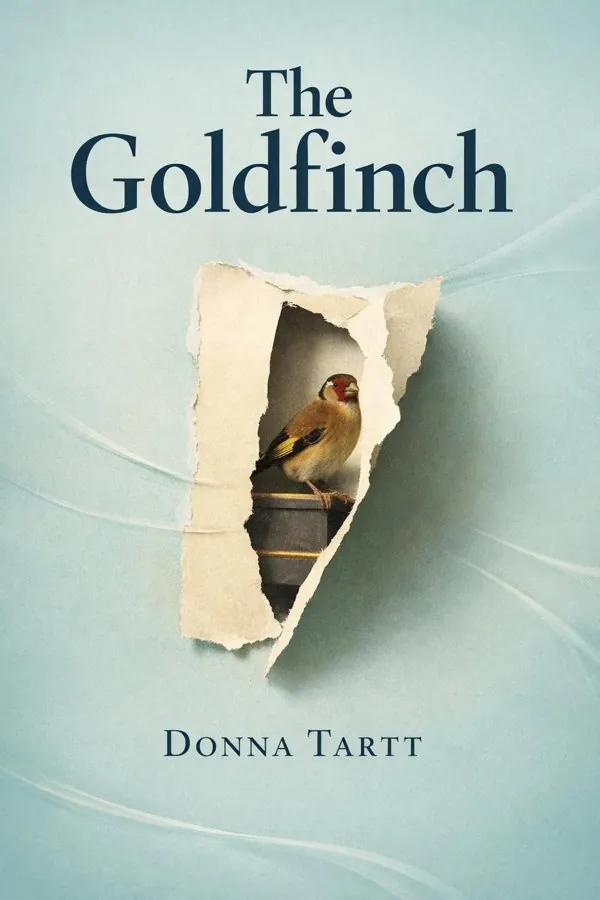
The Goldfinch: Summary & Key Insights
by Donna Tartt
 10 min9 chaptersAudio available
Key Takeaways from The Goldfinch
Some lives are divided into before and after, and Theo Decker’s life is shattered in a single instant.
Privilege can protect the surface of life while leaving the soul exposed.
Changing landscapes can alter your habits, but they rarely erase your wounds.
We often fall in love not only with people, but with versions of life we hope they will make possible.
Adulthood does not automatically resolve the unfinished business of childhood; often it merely gives us better tools to disguise it.
What Is The Goldfinch About?
The Goldfinch by Donna Tartt is a bestsellers book spanning 5 pages. What if the worst moment of your life became the moment that silently shaped everything after it? Donna Tartt’s The Goldfinch begins with disaster but expands into something far larger: a sprawling, intimate portrait of grief, survival, obsession, love, class, crime, and the strange endurance of beauty. The novel follows Theodore Decker, a thirteen-year-old boy who survives an explosion at the Metropolitan Museum of Art that kills his mother. In the confusion, he takes Carel Fabritius’s small painting The Goldfinch, an impulsive act that becomes the emotional and moral center of his life. From Manhattan drawing rooms to the emptiness of Las Vegas, from antique restoration shops to the criminal underworld of forged art, Tartt traces Theo’s long drift through loss and longing. The novel matters because it asks difficult questions without simplifying them: How do people carry trauma? Can beauty save us, or does it simply make pain sharper? What do we owe to truth when our lives are built on damage and concealment? Tartt, a Pulitzer Prize-winning novelist celebrated for her rich prose and psychological depth, turns Theo’s story into a meditation on fate, identity, and the redemptive force of art.
This FizzRead summary covers all 9 key chapters of The Goldfinch in approximately 10 minutes, distilling the most important ideas, arguments, and takeaways from Donna Tartt's work. Also available as an audio summary and Key Quotes Podcast.
The Goldfinch
What if the worst moment of your life became the moment that silently shaped everything after it? Donna Tartt’s The Goldfinch begins with disaster but expands into something far larger: a sprawling, intimate portrait of grief, survival, obsession, love, class, crime, and the strange endurance of beauty. The novel follows Theodore Decker, a thirteen-year-old boy who survives an explosion at the Metropolitan Museum of Art that kills his mother. In the confusion, he takes Carel Fabritius’s small painting The Goldfinch, an impulsive act that becomes the emotional and moral center of his life.
From Manhattan drawing rooms to the emptiness of Las Vegas, from antique restoration shops to the criminal underworld of forged art, Tartt traces Theo’s long drift through loss and longing. The novel matters because it asks difficult questions without simplifying them: How do people carry trauma? Can beauty save us, or does it simply make pain sharper? What do we owe to truth when our lives are built on damage and concealment? Tartt, a Pulitzer Prize-winning novelist celebrated for her rich prose and psychological depth, turns Theo’s story into a meditation on fate, identity, and the redemptive force of art.
Who Should Read The Goldfinch?
This book is perfect for anyone interested in bestsellers and looking to gain actionable insights in a short read. Whether you're a student, professional, or lifelong learner, the key ideas from The Goldfinch by Donna Tartt will help you think differently.
- ✓Readers who enjoy bestsellers and want practical takeaways
- ✓Professionals looking to apply new ideas to their work and life
- ✓Anyone who wants the core insights of The Goldfinch in just 10 minutes
Want the full summary?
Get instant access to this book summary and 100K+ more with Fizz Moment.
Get Free SummaryAvailable on App Store • Free to download
Key Chapters
Some lives are divided into before and after, and Theo Decker’s life is shattered in a single instant. At thirteen, he enters the Metropolitan Museum of Art with his mother on a rainy New York morning. They linger over paintings, talk about beauty, and share one of the ordinary, loving exchanges that later becomes unbearable in memory. Then a terrorist explosion tears through the museum. Theo survives; his mother does not. In the disorienting aftermath, guided by shock, injury, and a dying old man’s confused instructions, Theo takes a small Dutch painting—The Goldfinch—without fully understanding why.
This opening event is not just a plot device. It establishes the book’s deepest questions: how trauma distorts judgment, how random accidents become lifelong destinies, and how beauty can become entangled with guilt. The painting is both a relic of the moment Theo lost his mother and a secret object he cannot surrender. It becomes a physical embodiment of grief—something precious, hidden, and impossible to integrate into ordinary life.
In practical terms, Tartt shows how major trauma often leads people to attach enormous meaning to objects, places, and rituals. A photograph, a coat, a voicemail, or a piece of jewelry can become a private shrine to the lost. Theo’s attachment is extreme because the object is stolen and invaluable, but the emotional pattern is familiar: we hold onto things because they seem to hold onto the person we can no longer reach.
The lesson is not that grief makes us noble or wise. Often it makes us impulsive, secretive, and irrational. Actionable takeaway: notice the objects you use to preserve memory, and ask whether they are helping you honor loss or trapping you inside it.
Privilege can protect the surface of life while leaving the soul exposed. After the bombing, Theo is temporarily taken in by the Barbour family, wealthy Manhattan elites whose apartment, manners, and routines offer a stark contrast to his emotional chaos. Their world is elegant, hushed, and disciplined. Meals are formal, rooms are curated, and pain is managed through restraint. On paper, this is rescue. In practice, it is a form of suspension, where Theo is safe but not healed.
Through the Barbours, Tartt explores class not as a simple moral category but as an atmosphere. Wealth gives access to order, beauty, and insulation, yet it cannot restore what Theo has lost. He is surrounded by good taste, but not by the kind of emotional recognition he desperately needs. His bond with Mrs. Barbour and his affection for Andy and Kitsey give him glimpses of belonging, but he remains an outsider—a grieving boy trying to imitate normal life.
This section also deepens the novel’s fascination with appearance. The Barbour household values decorum, continuity, and inherited standards. Theo learns how easily suffering can be hidden behind civility. Many readers will recognize versions of this dynamic in professional workplaces, high-achieving families, or social environments where composure is rewarded more than honesty. People may be materially comfortable yet emotionally stranded.
Tartt’s point is subtle: wealth can soften practical hardship, but it cannot answer existential pain. Nor can beauty, tradition, or social polish substitute for genuine intimacy. Theo’s longing for acceptance makes him vulnerable to self-silencing, which becomes one of his lifelong habits.
Actionable takeaway: when supporting someone in crisis, do not confuse stability with healing. Offer not just shelter or efficiency, but direct permission for grief, confusion, and human messiness.
Changing landscapes can alter your habits, but they rarely erase your wounds. When Theo is uprooted from New York and taken to Las Vegas by his estranged father, Larry, and Larry’s girlfriend, Xandra, the novel shifts into a sun-bleached world of vacancy and false possibility. Las Vegas is the opposite of the museum and the Barbour apartment: sprawling, artificial, improvised, and emotionally lawless. Here Theo is neglected rather than contained, abandoned rather than supervised.
This period matters because it shows what happens when grief loses even the structure of social expectation. Larry is self-destructive, unreliable, and predatory in his own way, using Theo as a piece in his financial schemes. In this void Theo meets Boris, one of the novel’s most magnetic characters. Smart, damaged, funny, reckless, and fiercely attached, Boris becomes Theo’s friend, brother, corrupter, and mirror. Together they experiment with drugs, alcohol, theft, and danger, creating a bond forged through abandonment.
Las Vegas functions as a mirage of freedom. Theo has fewer rules, more autonomy, and almost no meaningful care. Yet this freedom is really drift. Tartt captures a truth many people experience in less dramatic forms: when structure disappears, unresolved pain often turns into self-medication. People tell themselves they are escaping, reinventing, or loosening up, when they may actually be rehearsing damage in new settings.
The emotional lesson is that friendship can save and endanger at the same time. Boris gives Theo connection when no one else does, but he also normalizes chaos. This duality makes their relationship unforgettable and realistic.
Actionable takeaway: if a new environment feels liberating, ask whether it is helping you grow or merely helping you avoid what hurts. Freedom without direction can become another form of captivity.
We often fall in love not only with people, but with versions of life we hope they will make possible. Throughout The Goldfinch, Theo’s emotional world is shaped by intense attachments—to his mother, to Mrs. Barbour’s household, to Boris, to Pippa, and later to the idea of a future with Kitsey. These relationships are not neatly romantic or familial; they overlap with longing, projection, guilt, dependency, and memory. Tartt treats attachment as one of the novel’s primary forces, showing how love can both anchor and distort identity.
Pippa, who also survived the museum bombing, becomes for Theo less a fully knowable person than a luminous figure linked forever to the day his life split apart. His devotion to her is sincere, but it is also suspended in trauma. She represents innocence, beauty, and the possibility that someone else might understand the precise shape of his loss. Kitsey, by contrast, is tied to class, continuity, and social legitimacy. His connection to her reflects a different desire: not transcendence, but re-entry into a stable world.
These emotional patterns are familiar beyond the novel. People often cling to those who symbolize recovery, status, safety, or a lost version of themselves. The danger is that relationships become containers for unresolved needs. We do not meet the other person fully; we ask them to carry our history.
Tartt does not mock Theo for this. She understands that broken people seek forms of belonging however they can. But she also shows the cost of confusing attachment with understanding. Love cannot do its work if it is built mainly on fantasy, nostalgia, or emotional substitution.
Actionable takeaway: when evaluating a relationship, ask not only “What do I feel?” but also “Who am I allowing this person to be—and who am I asking them to rescue?”
Adulthood does not automatically resolve the unfinished business of childhood; often it merely gives us better tools to disguise it. When Theo returns to New York after his father’s death, he is taken in by Hobie, the gentle antique restorer connected to the old man Theo met in the museum. In Hobie’s workshop, Theo finds something rare in the novel: patient care, craftsmanship, and a slower moral rhythm. Surrounded by old furniture and restoration work, he begins to build a life that appears respectable and rooted.
Yet this reinvention is compromised from the start. Theo still possesses the stolen painting, and as he grows older he becomes entangled in ethically compromised dealings in the antique trade. He learns how easy it is to blur authenticity and performance, value and fraud. This part of the novel cleverly mirrors his inner life. Just as furniture can be patched, polished, and passed off with strategic omissions, so can people. Theo develops an adult persona, but beneath it remains fear, guilt, addiction, and unresolved mourning.
This section widens the novel’s meaning beyond one personal tragedy. Tartt suggests that modern life often rewards convincing surfaces. Many people build careers, relationships, or identities that function adequately while concealing fractures underneath. The issue is not hypocrisy in a simple sense; it is the human temptation to survive by editing the truth.
Hobie stands as a counterpoint. He restores objects honestly, respecting history rather than erasing it. He represents the possibility that damage can be lived with, repaired, and integrated without deception. Theo loves him because he offers what Theo lacks: moral steadiness.
Actionable takeaway: when rebuilding after hardship, choose restoration over reinvention. Ask whether your new life includes your real history or simply hides it behind a more polished surface.
Beauty is not always comforting; sometimes it hurts because it reminds us that life could have been otherwise. The stolen painting at the center of The Goldfinch is much more than a suspense element. It becomes the novel’s meditation on why art matters at all. Theo does not cling to the painting because he is a refined connoisseur. He clings to it because beauty, encountered at the moment of catastrophe, becomes inseparable from survival, love, and memory.
Tartt treats art as something stubborn and almost sacred, not because it solves suffering but because it gives suffering a shape that can be contemplated. The little bird chained to its perch mirrors Theo himself: trapped, vulnerable, alive, and still somehow radiant. Art endures across centuries, passing through war, disaster, commerce, and theft. That endurance offers a kind of hope. Human lives are fragile and frequently unjust, yet beauty persists and continues to speak.
At the same time, the novel refuses sentimental simplification. The painting does not save Theo from addiction, dishonesty, or despair. Art is not therapy in a neat, self-improvement sense. Its power is stranger. It can intensify feeling, expose contradiction, and create a private language for what cannot be said directly. Readers may recognize this in their own lives: a song, film, novel, or image that does not fix pain but makes it bearable by making it intelligible.
Tartt’s broader claim is that aesthetic experience is not trivial decoration. It is part of how people survive time, loss, and mortality. Beauty can coexist with ruin without canceling it.
Actionable takeaway: keep one work of art close that helps you name an otherwise inexpressible feeling. Return to it deliberately, not to escape reality, but to deepen your understanding of it.
Most people do not become morally compromised in one dramatic leap; they drift there through small permissions. As Theo moves deeper into adulthood, The Goldfinch increasingly becomes a novel about crime—not only literal crime, but also the psychology of rationalization. Theo tells himself stories about necessity, loyalty, survival, and timing. He postpones confession, minimizes deception, and adapts to ethical gray zones until those zones become ordinary.
This is especially visible in his business dealings and in the long concealment of the painting. The suspense of the novel depends partly on whether Theo will be exposed, but Tartt is more interested in a subtler question: what happens to a person who lives too long in contradiction? Guilt becomes ambient. Fear becomes routine. Identity splits between the self one performs and the self one privately monitors.
Chance also plays a major role. Theo survives the bombing by accident. He acquires the painting by accident. He meets key people by accident. Tartt uses these contingencies to challenge simplistic moral narratives. Lives are not governed solely by character or choice; randomness matters. But randomness does not erase responsibility. Theo does not choose his trauma, yet he is still accountable for what he does next.
This insight applies broadly. People often excuse ongoing dishonesty by pointing to the original pain, pressure, or chaos that set events in motion. That context matters, but it cannot permanently replace agency. A bad beginning does not justify a harmful pattern.
Actionable takeaway: when you hear yourself saying “I had no choice,” pause and separate the event you did not choose from the actions you are still choosing now. That distinction is where moral clarity begins.
Sooner or later, every hidden life demands an accounting. In the novel’s final movement, Theo’s story converges in Amsterdam, where criminal intrigue, betrayal, violence, and revelation force him toward confrontation. This section raises the stakes externally, but its real power is philosophical. Theo is no longer only running from the past; he is trying to understand whether his life has any coherent meaning after so much damage, secrecy, and error.
Amsterdam becomes the setting for reckoning because it combines art, commerce, beauty, and danger—the very forces that have shaped Theo’s adulthood. Boris reenters the story in decisive ways, exposing both the chaos and strange loyalty embedded in their friendship. Revelations about the painting transform Theo’s understanding of what he has carried for years. The suspense resolves, but more importantly, the novel moves toward its deepest statement: that human beings are flawed, compromised, and often absurd, yet still capable of recognizing beauty and being changed by it.
Theo’s reflections near the end resist easy redemption. Tartt does not claim that suffering makes people better or that beauty cancels harm. Instead, she suggests that meaning emerges from our willingness to remain responsive—to art, to love, to conscience, to the fragile things that outlast destruction. This is a mature, unsentimental hope. It accepts brokenness without surrendering to nihilism.
For readers, the Amsterdam section is a reminder that reckoning is not the same as perfection. You may never undo all the consequences of earlier choices. But you can face them, tell the truth about them, and let that truth reorganize your future.
Actionable takeaway: if part of your life rests on concealment, choose one concrete act of reckoning—an admission, repair, or correction—that moves you from passive guilt toward active responsibility.
One of the novel’s quietest but strongest insights is that surviving a tragedy does not automatically teach you how to live afterward. Theo survives the bombing, but survival becomes its own burden. He carries survivor’s guilt, intrusive memory, anxiety, substance dependence, and a chronic sense of dislocation. To outsiders, he often appears functional, intelligent, even fortunate. Internally, he is fragmented.
Tartt captures the long afterlife of trauma with unusual patience. There is no tidy healing arc, no dramatic confession that resets everything. Instead, Theo drifts through years shaped by avoidance, repetition, attachment, and self-sabotage. This makes the novel especially resonant for readers who know that major losses do not end when public sympathy fades. Trauma is not only an event; it is an altered relationship to time, memory, and selfhood.
Yet the novel is not simply bleak. It proposes that living requires more than endurance. It requires attention, responsibility, and the capacity to remain vulnerable to beauty even when beauty is painful. Theo’s journey suggests that a meaningful life is not built by erasing damage but by carrying it more truthfully. Hobie’s patient work, the persistence of art, and even Theo’s flashes of moral clarity all point toward a more grounded form of survival.
In everyday terms, this insight matters for anyone emerging from grief, illness, addiction, or upheaval. Functioning is not the same as healing. Busyness is not the same as peace. Numbness is not the same as strength.
Actionable takeaway: ask yourself whether your current routines are helping you truly live or simply avoid collapse. Then make one change—a conversation, a therapy appointment, a creative practice, a sober day—that supports life beyond mere endurance.
All Chapters in The Goldfinch
About the Author
Donna Tartt is an American novelist born in Greenwood, Mississippi, in 1963. She studied at Bennington College, where her literary talent drew early attention, and she emerged as a major voice in contemporary fiction with her debut novel, The Secret History, published in 1992. Known for her meticulous style, vivid atmosphere, and psychologically rich characters, Tartt publishes slowly and with unusual precision, often taking many years between books. Her novels include The Secret History, The Little Friend, and The Goldfinch. In 2014, she won the Pulitzer Prize for Fiction for The Goldfinch, a sweeping novel that cemented her reputation as one of the most distinctive literary writers of her generation. Her work often blends classical structure, emotional intensity, and dark moral complexity.
Get This Summary in Your Preferred Format
Read or listen to the The Goldfinch summary by Donna Tartt anytime, anywhere. FizzRead offers multiple formats so you can learn on your terms — all free.
Available formats: App · Audio · PDF · EPUB — All included free with FizzRead
Download The Goldfinch PDF and EPUB Summary
Key Quotes from The Goldfinch
“Some lives are divided into before and after, and Theo Decker’s life is shattered in a single instant.”
“Privilege can protect the surface of life while leaving the soul exposed.”
“Changing landscapes can alter your habits, but they rarely erase your wounds.”
“We often fall in love not only with people, but with versions of life we hope they will make possible.”
“Adulthood does not automatically resolve the unfinished business of childhood; often it merely gives us better tools to disguise it.”
Frequently Asked Questions about The Goldfinch
The Goldfinch by Donna Tartt is a bestsellers book that explores key ideas across 9 chapters. What if the worst moment of your life became the moment that silently shaped everything after it? Donna Tartt’s The Goldfinch begins with disaster but expands into something far larger: a sprawling, intimate portrait of grief, survival, obsession, love, class, crime, and the strange endurance of beauty. The novel follows Theodore Decker, a thirteen-year-old boy who survives an explosion at the Metropolitan Museum of Art that kills his mother. In the confusion, he takes Carel Fabritius’s small painting The Goldfinch, an impulsive act that becomes the emotional and moral center of his life. From Manhattan drawing rooms to the emptiness of Las Vegas, from antique restoration shops to the criminal underworld of forged art, Tartt traces Theo’s long drift through loss and longing. The novel matters because it asks difficult questions without simplifying them: How do people carry trauma? Can beauty save us, or does it simply make pain sharper? What do we owe to truth when our lives are built on damage and concealment? Tartt, a Pulitzer Prize-winning novelist celebrated for her rich prose and psychological depth, turns Theo’s story into a meditation on fate, identity, and the redemptive force of art.
More by Donna Tartt
You Might Also Like
The Godfather
Mario Puzo
10 min
The Handmaid's Tale
Margaret Atwood
10 min
The Hunger Games
Suzanne Collins
10 min
The Nightingale
Kristin Hannah
10 min
The Seven Husbands of Evelyn Hugo
Taylor Jenkins Reid
10 min
Backwater Justice
Fern Michaels
10 minBrowse by Category
Ready to read The Goldfinch?
Get the full summary and 100K+ more books with Fizz Moment.