
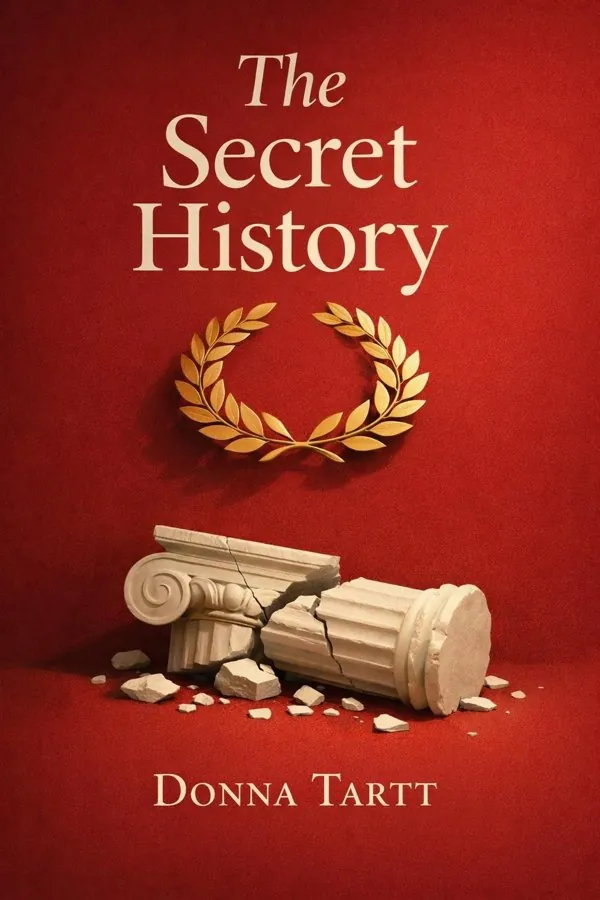
The Secret History: Summary & Key Insights
by Donna Tartt
 10 min3 chaptersAudio available
What Is The Secret History About?
The Secret History by Donna Tartt is a classics book spanning 3 pages. A group of elite college students at a small Vermont liberal arts college become entangled in a web of intellectual obsession, moral decay, and murder after their fascination with ancient Greek culture leads them to commit a terrible crime. The novel explores themes of beauty, guilt, and the corrupting influence of knowledge.
This FizzRead summary covers all 3 key chapters of The Secret History in approximately 10 minutes, distilling the most important ideas, arguments, and takeaways from Donna Tartt's work. Also available as an audio summary and Key Quotes Podcast.
The Secret History
A group of elite college students at a small Vermont liberal arts college become entangled in a web of intellectual obsession, moral decay, and murder after their fascination with ancient Greek culture leads them to commit a terrible crime. The novel explores themes of beauty, guilt, and the corrupting influence of knowledge.
Who Should Read The Secret History?
This book is perfect for anyone interested in classics and looking to gain actionable insights in a short read. Whether you're a student, professional, or lifelong learner, the key ideas from The Secret History by Donna Tartt will help you think differently.
- ✓Readers who enjoy classics and want practical takeaways
- ✓Professionals looking to apply new ideas to their work and life
- ✓Anyone who wants the core insights of The Secret History in just 10 minutes
Want the full summary?
Get instant access to this book summary and 100K+ more with Fizz Moment.
Get Free SummaryAvailable on App Store • Free to download
Key Chapters
When Richard arrives at Hampden, he stands outside a world that gleams with exclusivity. The Classics students—Henry, Bunny, Francis, and the twins, Charles and Camilla—live as though they have stepped out of another age. They read Greek not as a requirement but as a living language, discuss Plato over wine, and inhabit a universe where beauty is more than an ideal; it is the organizing principle of their lives.
Julian Morrow, their mentor, embodies that vision. He teaches them that beauty is terror—that what we call morally good may not necessarily be beautiful, and what is beautiful might destroy us. This paradox intoxicates Richard; for the first time, intellectual pursuit feels like salvation. He exchanges California’s vulgar sunshine for Vermont’s wintry austerity, finding in it a form of purification. Yet beneath this aesthetic devotion lies something more troubling: a quiet disdain for the ordinary world and those who inhabit it.
The group's dynamic deepens his fascination. Henry, their leader, is brilliant and emotionally remote, the embodiment of Platonic order. Francis is witty and mercurial, masking fragility behind charm. The twins exude an eerie intimacy, at once innocent and disturbing. Bunny, jovial and loud, seems at odds with the rest, his convivial vulgarity intruding on their cultivated silence. Richard’s longing to belong to them—to inhabit their mythic circle—drives him to abandon everything else. Hampden becomes his universe, and within it, reality begins to blur.
Yet even in those golden days, the seeds of ruin are sown. The group’s discussions of ancient rites turn gradually toward dangerous enactment. Henry’s obsession with Dionysian ecstasy leads them beyond scholarship into experience. Richard himself, though ignorant at first of what they plan, senses the gathering tension. They seek transcendence—not metaphorical but literal—and it is this desire to exceed the boundaries of reason that will usher in their tragedy.
When the story reaches its dark pivot—the night of the ritual—the group's classical romanticism fractures irreversibly. During a fevered attempt to experience a true Dionysian state, they kill a local farmer, almost by accident, yet in the exhilarating frenzy of the moment. Only Henry, Francis, and the twins are present. Richard learns the truth afterward and is both horrified and enthralled. This act, shrouded in secrecy, binds them closer than ever in mutual guilt.
What follows is an agonizing attempt to restore normal life. Julian remains oblivious; classes continue. They read Sophocles, discuss morality, laugh, and drink—but a sense of decay seeps through everything. The act has not purged them as Henry hoped; it has poisoned them. Guilt manifests differently in each of them. Henry retreats into cold discipline; Francis becomes fragile and anxious; the twins slip toward dependency and despair. Richard, strangely, feels safety in their shared silence—until Bunny begins to suspect.
Bunny’s discovery is slow and subtle, but once he understands, he becomes their tormentor. He jokes about what he knows, drops hints, demands favors, and manipulates their guilt. His presence—once boisterous, even endearing—turns menacing. Henry, ever logical, concludes that their survival demands his removal. There is no dramatic speech, no emotional rupture—only an awful calm determination.
The day they kill Bunny is bright and clear. A fall from a cliff in the mountains appears to be an accident. The sheer banality of the moment—the deceptive normalcy of it—makes their crime even more chilling. Afterward, a strange stillness descends. The tension that has defined them breaks open. Julian senses something unseen; the police circle; yet the most corrosive investigation happens within their own minds. Their friendship dissolves not in hatred but in mutual incomprehension, as if they had all glimpsed something sacred and terrible that no one else could ever understand.
+ 1 more chapters — available in the FizzRead app
All Chapters in The Secret History
About the Author
Donna Tartt is an American novelist born in 1963 in Greenwood, Mississippi. She is best known for her novels 'The Secret History', 'The Little Friend', and 'The Goldfinch', the latter of which won the Pulitzer Prize for Fiction in 2014. Tartt is known for her meticulous prose, psychological depth, and long intervals between publications.
Get This Summary in Your Preferred Format
Read or listen to the The Secret History summary by Donna Tartt anytime, anywhere. FizzRead offers multiple formats so you can learn on your terms — all free.
Available formats: App · Audio · PDF · EPUB — All included free with FizzRead
Download The Secret History PDF and EPUB Summary
Key Quotes from The Secret History
“When Richard arrives at Hampden, he stands outside a world that gleams with exclusivity.”
“When the story reaches its dark pivot—the night of the ritual—the group's classical romanticism fractures irreversibly.”
Frequently Asked Questions about The Secret History
The Secret History by Donna Tartt is a classics book that explores key ideas across 3 chapters. A group of elite college students at a small Vermont liberal arts college become entangled in a web of intellectual obsession, moral decay, and murder after their fascination with ancient Greek culture leads them to commit a terrible crime. The novel explores themes of beauty, guilt, and the corrupting influence of knowledge.
More by Donna Tartt
You Might Also Like


Browse by Category
Ready to read The Secret History?
Get the full summary and 100K+ more books with Fizz Moment.