
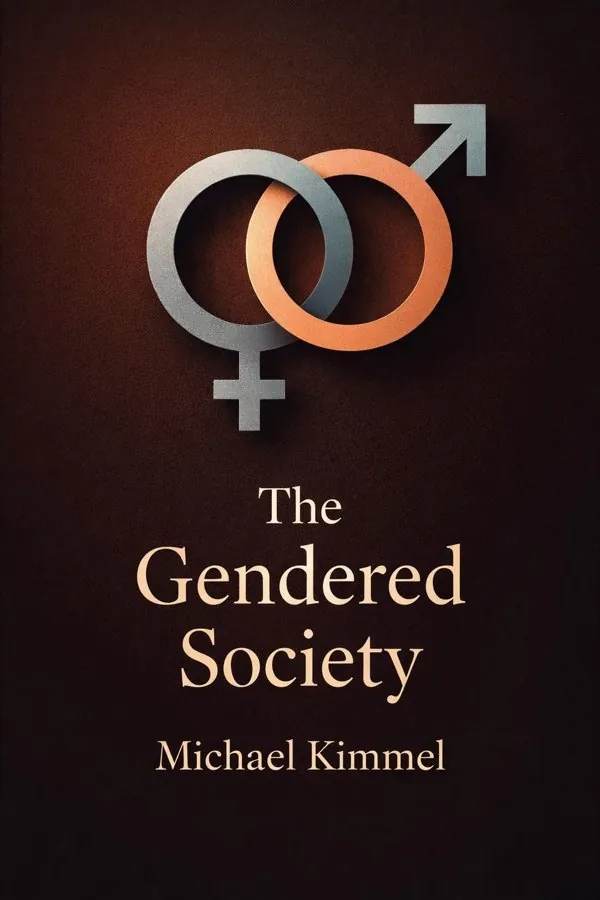
The Gendered Society: Summary & Key Insights
 10 min10 chaptersAudio available
Key Takeaways from The Gendered Society
One of Kimmel’s most important insights is that gender is not merely something we are; it is something society organizes.
A recurring temptation in discussions of gender is to treat biology as destiny.
Masculinity often appears to be a stable identity, but Kimmel reveals it as an ongoing social performance shaped by approval, fear, and competition.
Femininity is often celebrated in language but constrained in practice.
Family life often feels private and personal, yet Kimmel shows that it is one of the most important places where gender is produced and reproduced.
What Is The Gendered Society About?
The Gendered Society by Michael Kimmel is a sociology book spanning 12 pages. The Gendered Society is Michael Kimmel’s powerful examination of how gender shapes nearly every dimension of social life. Rather than treating masculinity and femininity as natural, fixed traits, Kimmel argues that gender is a social institution—something people learn, perform, enforce, and reproduce through families, schools, workplaces, politics, media, and everyday interaction. This shift in perspective changes the conversation completely: instead of asking why men and women are supposedly so different, Kimmel asks how those differences are created, maintained, and linked to power. What makes the book especially important is its breadth. Kimmel connects intimate experiences—identity, relationships, parenting, sexuality—to larger systems such as labor markets, education, culture, and global inequality. He also challenges simplistic biological explanations, showing how social expectations become so familiar that they feel natural. Kimmel writes with the authority of one of the most influential sociologists in gender studies, particularly masculinity studies. His work is widely respected for making complex theory accessible without losing depth. For readers trying to understand inequality, identity, and social change, The Gendered Society offers a clear and compelling framework that remains deeply relevant.
This FizzRead summary covers all 10 key chapters of The Gendered Society in approximately 10 minutes, distilling the most important ideas, arguments, and takeaways from Michael Kimmel's work. Also available as an audio summary and Key Quotes Podcast.
The Gendered Society
The Gendered Society is Michael Kimmel’s powerful examination of how gender shapes nearly every dimension of social life. Rather than treating masculinity and femininity as natural, fixed traits, Kimmel argues that gender is a social institution—something people learn, perform, enforce, and reproduce through families, schools, workplaces, politics, media, and everyday interaction. This shift in perspective changes the conversation completely: instead of asking why men and women are supposedly so different, Kimmel asks how those differences are created, maintained, and linked to power.
What makes the book especially important is its breadth. Kimmel connects intimate experiences—identity, relationships, parenting, sexuality—to larger systems such as labor markets, education, culture, and global inequality. He also challenges simplistic biological explanations, showing how social expectations become so familiar that they feel natural.
Kimmel writes with the authority of one of the most influential sociologists in gender studies, particularly masculinity studies. His work is widely respected for making complex theory accessible without losing depth. For readers trying to understand inequality, identity, and social change, The Gendered Society offers a clear and compelling framework that remains deeply relevant.
Who Should Read The Gendered Society?
This book is perfect for anyone interested in sociology and looking to gain actionable insights in a short read. Whether you're a student, professional, or lifelong learner, the key ideas from The Gendered Society by Michael Kimmel will help you think differently.
- ✓Readers who enjoy sociology and want practical takeaways
- ✓Professionals looking to apply new ideas to their work and life
- ✓Anyone who wants the core insights of The Gendered Society in just 10 minutes
Want the full summary?
Get instant access to this book summary and 100K+ more with Fizz Moment.
Get Free SummaryAvailable on App Store • Free to download
Key Chapters
A recurring temptation in discussions of gender is to treat biology as destiny. Kimmel challenges that reflex directly. He does not deny biological difference, but he argues that biology alone cannot explain the enormous variety in gender behavior across history, cultures, and social settings. If masculinity and femininity were simply hardwired, we would expect them to look largely the same everywhere. They do not.
Kimmel critiques biological arguments that rely on evolutionary storytelling or selective scientific findings. Claims that men are naturally competitive, women are naturally nurturing, or that brains are permanently wired for specific gender roles often ignore social context. Even when average physical or hormonal differences exist, societies decide what those differences mean. Strength, for example, can be translated into assumptions about authority. Reproductive capacity can be turned into expectations about caregiving. The leap from biology to social role is never automatic; it is cultural.
A practical example appears in education and work. Boys may be encouraged toward risk, engineering, or leadership, while girls may be praised for neatness, cooperation, or emotional sensitivity. Years later, unequal outcomes are then misread as evidence of innate preference. But preferences are often shaped by opportunity, reward, and repeated messages about who belongs.
Kimmel’s point is not that bodies are irrelevant. It is that social meanings built around bodies matter more than many people admit. Biological explanations often become convenient tools for justifying inequality because they make social arrangements seem inevitable.
Actionable takeaway: When you hear a claim that men or women are “naturally” better suited for certain roles, ask whether the evidence shows biology at work—or years of social conditioning, unequal support, and different expectations.
Masculinity often appears to be a stable identity, but Kimmel reveals it as an ongoing social performance shaped by approval, fear, and competition. Boys and men learn masculinity not simply by being male, but by proving they are not weak, dependent, emotional, or feminine. In many cultures, masculinity is less a secure status than a test that must be constantly passed.
This is why so many boys receive the same message in different forms: do not cry, do not back down, do not appear soft. Peers, family members, coaches, teachers, and media figures all participate in policing these standards. A boy who excels in sports may be rewarded as properly masculine; a boy who likes dance, tenderness, or vulnerability may be mocked. The content of masculinity can vary by class, race, sexuality, and nation, but the pressure to perform remains powerful.
Kimmel also shows that masculinity is deeply tied to hierarchy. Men are often measured not only against women but against other men. Earning money, displaying confidence, dominating space, and suppressing fear can become markers of status. This helps explain why some men feel threatened by women’s advancement or by men who reject traditional roles: when masculinity is built on proving superiority, equality can feel like loss.
In everyday life, this affects mental health, friendships, parenting, and intimate relationships. Men may struggle to seek help, express affection, or admit uncertainty because these acts risk violating masculine norms.
Actionable takeaway: Notice where masculine expectations in your life are based on fear of judgment. Challenge one of them directly—whether by expressing emotion honestly, asking for help, or affirming a broader version of what being a man can mean.
Femininity is often celebrated in language but constrained in practice. Kimmel shows that women are encouraged to embody traits such as beauty, care, warmth, modesty, and emotional attunement, yet those same traits can become tools of limitation. Femininity is not just a set of personal qualities; it is a social script that rewards compliance and often punishes ambition, assertiveness, or nonconformity.
Girls learn early that appearance matters. They may be praised for being pretty, helpful, and polite more than for being bold, loud, or self-directed. As they grow older, these expectations intensify. Women are often judged simultaneously for attractiveness and morality, confidence and likability, independence and care. The standard is contradictory: be desirable but not “too much,” competent but not threatening, nurturing but not self-sacrificing to the point of invisibility.
Kimmel highlights how femininity also intersects with class, race, and sexuality. Different women are held to different ideals, and some are excluded from dominant definitions of respectable womanhood altogether. Media images, workplace norms, and family expectations all reinforce the idea that womanhood should be tied to emotional labor and bodily discipline.
This has practical consequences. In offices, women may be expected to smooth over conflict, take meeting notes, or provide emotional support without recognition. In families, daughters and mothers may absorb more caregiving work. In public life, women leaders may be criticized for being too soft or too aggressive, with no acceptable middle ground.
Actionable takeaway: Pay attention to when femininity is being treated as a duty rather than a choice, and actively question expectations that ask women to be endlessly accommodating, attractive, or emotionally available.
Family life often feels private and personal, yet Kimmel shows that it is one of the most important places where gender is produced and reproduced. Households teach people what mothers and fathers are supposed to do, what sons and daughters are allowed to become, and how care, authority, and responsibility are distributed. The family is not outside society’s gender system; it is one of its central training grounds.
Children absorb gender long before they can analyze it. They watch who cooks, who fixes things, who interrupts, who comforts, and who earns more money. Even in families that believe in equality, subtle patterns can send strong messages. A mother who works full time may still do most of the childcare and domestic planning. A father who is loving but emotionally distant may still model the idea that men provide more than they nurture.
Kimmel also emphasizes that families respond to wider institutions. Workplaces that penalize parental leave for men encourage caregiving to remain feminized. Schools and pediatric cultures often communicate more with mothers than fathers. Consumer culture markets parenting differently by gender, reinforcing separate roles.
These patterns matter because they shape expectations for adulthood. Boys may grow up assuming domestic labor is optional for them. Girls may learn to anticipate a “second shift” of unpaid work even if they pursue careers. At the same time, changing family forms—dual-earner households, involved fathers, same-sex parents, shared caregiving—show that gendered arrangements are not fixed.
Actionable takeaway: In your home or family network, look at the invisible labor—planning, remembering, comforting, organizing—and ask whether it is being shared fairly rather than assumed to belong to one gender.
Many people imagine schools and workplaces as meritocratic spaces, but Kimmel demonstrates how deeply gender structures both. Formal rules may appear neutral, yet everyday practices often steer people toward different futures. The result is not just individual bias but patterned inequality.
In schools, gender shapes participation, discipline, confidence, and aspiration. Boys may be encouraged to take up space, interrupt, and view themselves as natural leaders, while girls may be rewarded for compliance and neatness. Subject areas become gender-coded: math, science, and technology are often associated with masculinity; care-oriented or humanities fields with femininity. These signals affect not only performance but self-belief. Students often begin to internalize what they are “supposed” to be good at.
The workplace extends these patterns. Occupations themselves become gendered, with engineering, finance, and executive leadership coded masculine, and teaching, clerical work, nursing, or caregiving coded feminine. Kimmel shows that this coding influences pay, prestige, and mobility. Jobs associated with men tend to be valued more highly, while jobs associated with women are often underpaid even when they require significant skill.
Then there is the issue of advancement. Women may face assumptions that they are less committed because of caregiving expectations, while men may be rewarded for assertiveness that would be judged harshly in women. Informal networks, mentorship, and leadership norms often favor those who fit traditional masculine styles.
The lesson is not only that discrimination exists, but that institutions are built around gendered assumptions about competence, authority, and availability.
Actionable takeaway: Whether in a classroom or workplace, examine who is encouraged to lead, who does support work, and whose style is treated as the default standard of competence.
What people desire, admire, and fear is shaped powerfully by culture. Kimmel argues that media and sexuality do not merely reflect gender norms; they actively produce and normalize them. Films, advertisements, news, music, television, and digital platforms teach us what bodies should look like, what romance should feel like, and how men and women are expected to behave in intimate life.
Media representations often exaggerate gender difference. Men are portrayed as decisive, sexually driven, strong, emotionally reserved, and action-oriented. Women are portrayed as attractive, relational, nurturing, and physically self-aware. Even when stereotypes evolve, they often survive in updated forms: the “strong woman” may still be required to remain conventionally desirable, while the “sensitive man” is accepted only within limits.
Kimmel links these portrayals to sexuality. Sexual scripts often teach that men should initiate, pursue, and accumulate experience, while women should regulate desire, protect respectability, and balance openness with restraint. Such scripts can create confusion and inequality in relationships. They can also marginalize LGBTQ+ people by assuming heterosexuality as the norm and presenting limited models of intimacy.
These norms affect self-esteem and behavior. Young people may compare themselves to unrealistic body ideals. Adults may struggle to communicate honestly because they are performing roles they have absorbed rather than expressing their needs. Media literacy becomes essential because repeated images can quietly define what feels normal.
Actionable takeaway: Start treating media as instruction, not just entertainment. Ask what kind of masculinity, femininity, body, and relationship each message is selling—and whether you actually want to live by that script.
Perhaps Kimmel’s central argument is that gender is inseparable from power. Gender categories do not simply describe difference; they organize hierarchy. Masculinity has historically been associated with authority, rationality, public life, and leadership, while femininity has been associated with dependence, emotion, private life, and care. These pairings are not innocent. They help legitimize unequal access to resources, status, and decision-making.
Kimmel emphasizes that power works both structurally and interpersonally. Structurally, men as a group have historically held more political office, higher pay, greater freedom from caregiving expectations, and more control over institutions. Interpersonally, power appears in who speaks, who is interrupted, whose anger is respected, whose labor is assumed, and whose safety is prioritized. Gender inequality is sustained not only by explicit laws or policies but by everyday routines that seem normal.
He also shows that gender never stands alone. It interacts with race, class, nationality, and sexuality. Not all men hold equal power, and not all women experience disadvantage in the same way. Still, the broader system tends to privilege what is coded masculine and devalue what is coded feminine. This helps explain why occupations become less prestigious when women enter them in larger numbers, or why men who perform femininity may face stigma.
The possibility of change begins with seeing these patterns clearly. Gender justice is not about reversing hierarchy; it is about dismantling the assumption that one set of traits, bodies, or roles deserves greater authority.
Actionable takeaway: In any group setting, ask a simple power question: who is being heard, who is doing the support work, and who gets to define what counts as normal or valuable?
If gender were fixed by nature, it would not vary so dramatically across societies and historical periods. Kimmel uses global and historical perspectives to show that gender arrangements are social creations shaped by economics, politics, religion, colonialism, and cultural norms. What counts as masculine or feminine in one place may be interpreted very differently elsewhere.
This comparative lens is essential because it breaks the illusion that current gender norms are inevitable. In some societies, men’s involvement in childcare is expected; in others, it is treated as exceptional. Some cultures allow more fluid roles or recognize more than two gender categories. Historical changes also reveal how quickly “natural” arrangements can shift. Women’s labor force participation, attitudes toward fatherhood, access to education, and ideas about sexuality have all changed dramatically within a few generations.
Kimmel also points out that globalization spreads both liberation and inequality. Economic development can create opportunities for women’s education and employment while also intensifying labor exploitation, migration pressures, and media-driven beauty ideals. Western models of gender are often exported as modern or universal, even though they are themselves culturally specific.
Understanding this variation helps readers think more critically about reform. It becomes clear that there is no single timeless gender order, only systems that people maintain or challenge under particular conditions. Social movements, policy changes, and shifts in everyday practice can transform what once seemed fixed.
Actionable takeaway: When confronted with a rigid claim about what men or women are “supposed” to be, look for evidence from other cultures or historical periods. Variation is a powerful reminder that social rules can be rewritten.
Kimmel does not present gender as an all-powerful structure that individuals are helpless against. His larger message is that gender is constantly reproduced through everyday actions, which means it can also be changed through everyday actions. Institutions matter, but so do conversations, habits, expectations, and choices about how we treat one another.
Social change happens at multiple levels. Laws can expand access to education, employment, reproductive rights, and protection from discrimination. Organizations can redesign parental leave, promotion criteria, and hiring systems. Schools can challenge stereotypes in curriculum and classroom practice. Media makers can widen the stories they tell. But Kimmel also insists that people participate in gender every day—through who apologizes, who listens, who leads, who cleans up, who risks speaking out, and who is allowed complexity.
This idea is empowering because it links personal behavior to social structure without reducing one to the other. A father taking equal responsibility at home, a teacher challenging sexist assumptions in class, a manager rewarding collaboration rather than dominance, or a friend refusing homophobic jokes—these acts may seem small, yet they interrupt the routines that keep inequality in place.
Importantly, change does not mean eliminating difference or forcing sameness. It means loosening rigid scripts so people can live more freely and fairly. A less gendered society would not erase identity; it would reduce the penalties attached to crossing boundaries.
Actionable takeaway: Choose one repeated practice in your own life—at home, at work, online, or in relationships—where you can replace a gendered assumption with a more equal and intentional behavior.
All Chapters in The Gendered Society
About the Author
Michael Kimmel is an American sociologist, educator, and leading scholar in gender studies, especially known for his work on masculinity. He has served as a distinguished professor of sociology at Stony Brook University and has spent decades researching how gender shapes identity, power, inequality, and social institutions. Kimmel’s writing is widely respected for combining academic rigor with clarity and accessibility, making complex ideas available to broad audiences. In addition to The Gendered Society, he has written influential books on men, masculinity, and social change, helping define the modern field of masculinity studies. His work often explores how traditional gender norms affect both women and men, and why greater gender equality benefits society as a whole. Through scholarship, public speaking, and teaching, Kimmel has become one of the most recognized voices in contemporary discussions of gender.
Get This Summary in Your Preferred Format
Read or listen to the The Gendered Society summary by Michael Kimmel anytime, anywhere. FizzRead offers multiple formats so you can learn on your terms — all free.
Available formats: App · Audio · PDF · EPUB — All included free with FizzRead
Download The Gendered Society PDF and EPUB Summary
Key Quotes from The Gendered Society
“One of Kimmel’s most important insights is that gender is not merely something we are; it is something society organizes.”
“A recurring temptation in discussions of gender is to treat biology as destiny.”
“Masculinity often appears to be a stable identity, but Kimmel reveals it as an ongoing social performance shaped by approval, fear, and competition.”
“Femininity is often celebrated in language but constrained in practice.”
“Family life often feels private and personal, yet Kimmel shows that it is one of the most important places where gender is produced and reproduced.”
Frequently Asked Questions about The Gendered Society
The Gendered Society by Michael Kimmel is a sociology book that explores key ideas across 10 chapters. The Gendered Society is Michael Kimmel’s powerful examination of how gender shapes nearly every dimension of social life. Rather than treating masculinity and femininity as natural, fixed traits, Kimmel argues that gender is a social institution—something people learn, perform, enforce, and reproduce through families, schools, workplaces, politics, media, and everyday interaction. This shift in perspective changes the conversation completely: instead of asking why men and women are supposedly so different, Kimmel asks how those differences are created, maintained, and linked to power. What makes the book especially important is its breadth. Kimmel connects intimate experiences—identity, relationships, parenting, sexuality—to larger systems such as labor markets, education, culture, and global inequality. He also challenges simplistic biological explanations, showing how social expectations become so familiar that they feel natural. Kimmel writes with the authority of one of the most influential sociologists in gender studies, particularly masculinity studies. His work is widely respected for making complex theory accessible without losing depth. For readers trying to understand inequality, identity, and social change, The Gendered Society offers a clear and compelling framework that remains deeply relevant.
You Might Also Like

Between the World and Me
Ta-Nehisi Coates
10 min
Half the Sky
Nicholas D. Kristof, Sheryl WuDunn
10 min
Men Explain Things To Me
Rebecca Solnit
10 min
Rational Ritual
Michael Suk-Young Chwe
10 min
The New Jim Crow
Michelle Alexander
10 min
Beyond Culture
Edward T. Hall
10 minBrowse by Category
Ready to read The Gendered Society?
Get the full summary and 100K+ more books with Fizz Moment.