
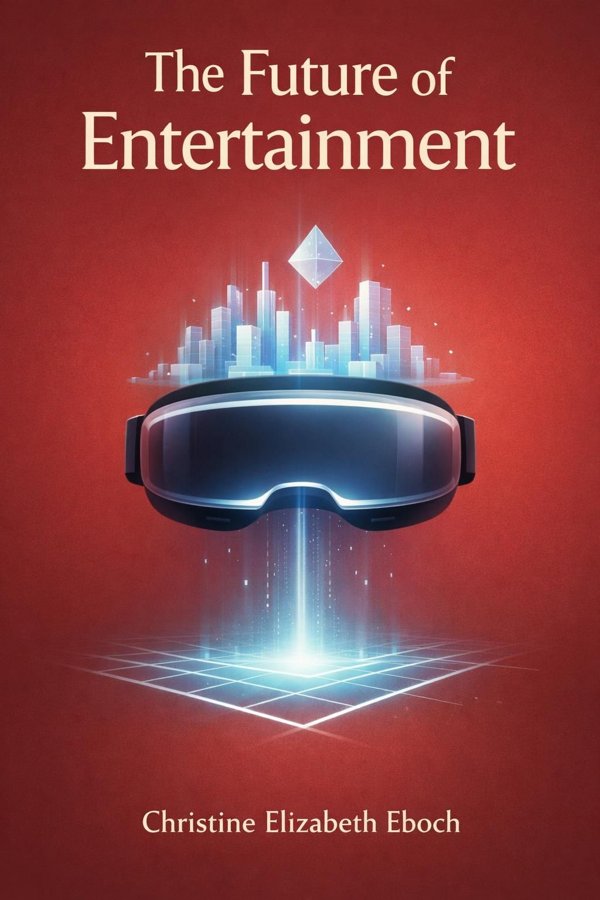
The Future of Entertainment: Summary & Key Insights
 10 min8 chaptersAudio available
Key Takeaways from The Future of Entertainment
The most powerful entertainment shift may be this: instead of watching a story from the outside, you can now step inside it.
Sometimes the future is not about leaving the real world behind but layering new possibilities onto it.
Entertainment becomes more memorable when it engages more than one sense, and future technologies aim to do exactly that.
One of the biggest entertainment revolutions is so familiar that people often forget how dramatic it is: we no longer wait for entertainment to arrive at a certain time and place.
Entertainment is no longer just something people consume alone; increasingly, it is something they build together.
What Is The Future of Entertainment About?
The Future of Entertainment by Christine Elizabeth Eboch is a popular_sci book spanning 5 pages. Entertainment has always changed with technology, from radio to television to the internet. In The Future of Entertainment, Christine Elizabeth Eboch shows young readers that the next wave of change is even more exciting: stories you can step inside, games that blend with real life, concerts performed by holograms, and media designed to engage not just your eyes and ears but all your senses. This book explores how inventions such as virtual reality, augmented reality, artificial intelligence, and streaming platforms are reshaping how people play, watch, learn, and connect. What makes this book especially valuable is its balance of wonder and responsibility. Eboch does not simply celebrate flashy gadgets; she encourages readers to think about how these tools affect creativity, friendships, privacy, fairness, and everyday life. Writing for younger audiences with clarity and enthusiasm, she makes advanced ideas easy to understand without losing their big implications. As an experienced children’s nonfiction author, Eboch brings a strong educational voice to a fast-moving topic. The result is an accessible guide to where entertainment is heading and why that future matters to everyone.
This FizzRead summary covers all 8 key chapters of The Future of Entertainment in approximately 10 minutes, distilling the most important ideas, arguments, and takeaways from Christine Elizabeth Eboch's work. Also available as an audio summary and Key Quotes Podcast.
The Future of Entertainment
Entertainment has always changed with technology, from radio to television to the internet. In The Future of Entertainment, Christine Elizabeth Eboch shows young readers that the next wave of change is even more exciting: stories you can step inside, games that blend with real life, concerts performed by holograms, and media designed to engage not just your eyes and ears but all your senses. This book explores how inventions such as virtual reality, augmented reality, artificial intelligence, and streaming platforms are reshaping how people play, watch, learn, and connect.
What makes this book especially valuable is its balance of wonder and responsibility. Eboch does not simply celebrate flashy gadgets; she encourages readers to think about how these tools affect creativity, friendships, privacy, fairness, and everyday life. Writing for younger audiences with clarity and enthusiasm, she makes advanced ideas easy to understand without losing their big implications. As an experienced children’s nonfiction author, Eboch brings a strong educational voice to a fast-moving topic. The result is an accessible guide to where entertainment is heading and why that future matters to everyone.
Who Should Read The Future of Entertainment?
This book is perfect for anyone interested in popular_sci and looking to gain actionable insights in a short read. Whether you're a student, professional, or lifelong learner, the key ideas from The Future of Entertainment by Christine Elizabeth Eboch will help you think differently.
- ✓Readers who enjoy popular_sci and want practical takeaways
- ✓Professionals looking to apply new ideas to their work and life
- ✓Anyone who wants the core insights of The Future of Entertainment in just 10 minutes
Want the full summary?
Get instant access to this book summary and 100K+ more with Fizz Moment.
Get Free SummaryAvailable on App Store • Free to download
Key Chapters
The most powerful entertainment shift may be this: instead of watching a story from the outside, you can now step inside it. Virtual reality, usually called VR, uses headsets, motion sensors, and handheld controllers to place users in a computer-generated world that responds to their movements. Turn your head, and the scene changes. Reach out your hand, and you may grab an object, paint in the air, or interact with characters around you. That creates a feeling of presence, as if you are truly in another place.
Eboch shows how this changes entertainment from passive to active. A movie in VR can feel like an adventure you are living rather than just seeing. A historical simulation can place students inside ancient Rome. A sports game can make players feel as if they are standing on the field. Theme parks, museums, and classrooms can also use VR to create memorable experiences that are hard to match with flat screens.
But VR is not only exciting because it looks realistic. Its real promise lies in empathy and immersion. Imagine experiencing a story from another person’s point of view or visiting places you could never reach in real life, such as the deep ocean or outer space. At the same time, VR raises questions about cost, screen time, and how much people should escape into digital worlds.
Actionable takeaway: The next time you hear about VR, ask not just “Is it cool?” but “How does being inside the experience change what people learn, feel, or remember?”
Sometimes the future is not about leaving the real world behind but layering new possibilities onto it. That is the promise of augmented reality, or AR. Unlike VR, which replaces your surroundings with a digital environment, AR adds digital images, sounds, and information to the world you already see. A phone camera, tablet, or special glasses can turn an ordinary room into a stage for animation, gaming, education, or performance.
Eboch explains that AR changes entertainment by making everyday spaces interactive. A living room can become part of a treasure hunt. A museum exhibit can display moving dinosaurs over real fossil bones. A sports broadcast can project live statistics onto the field. Musicians, artists, and game designers can create experiences that mix imagination with physical places, allowing people to play and explore without leaving their neighborhoods.
AR also changes how audiences participate. Instead of sitting still and receiving content, users move, scan, discover, and respond. This can make entertainment feel more social and more personal. Friends might work together to solve AR puzzles, or families might use AR apps to bring books and stories to life. Businesses also use AR to let customers “try on” costumes, makeup, or themed items before buying them.
Still, AR depends on cameras, data, and software, which means it can raise privacy concerns. It also reminds us that technology works best when it adds meaning, not just noise. The smartest AR experiences are those that enrich real places instead of distracting from them.
Actionable takeaway: When exploring AR, notice whether it deepens your attention to the real world or simply competes with it.
Entertainment becomes more memorable when it engages more than one sense, and future technologies aim to do exactly that. Eboch points to holograms, sensory technology, and artificial intelligence as tools that can make performances and media feel more alive. Holograms can project three-dimensional images that appear to float in space, letting audiences watch performers, objects, or scenes in dramatic new ways. A concert might feature a holographic singer, or a classroom presentation could display a spinning planet in the middle of the room.
Beyond sight and sound, developers are also experimenting with touch, smell, and environmental effects. Seats may vibrate during an action scene. A game controller may simulate resistance. Special devices may release scents connected to a setting, such as ocean air or fresh pine. These additions aim to make entertainment more immersive by convincing the brain that an imagined world is physically present.
Artificial intelligence adds another layer. AI can recommend songs, generate dialogue, personalize game challenges, or create interactive characters that respond differently to each user. In entertainment, this means stories may become less fixed and more adaptable. A game could learn your style. A digital assistant in a story world could answer your questions. A child’s educational program could adjust itself to hold attention and improve learning.
Yet these same tools bring big questions. If AI creates art, who owns it? If a hologram recreates a dead performer, is that respectful or exploitative? If technology manipulates emotions through sound, scent, and personalization, where should limits be set?
Actionable takeaway: Enjoy immersive technologies, but always ask who controls the experience, what data it uses, and what values are being built into it.
One of the biggest entertainment revolutions is so familiar that people often forget how dramatic it is: we no longer wait for entertainment to arrive at a certain time and place. Streaming allows people to watch films, listen to music, attend live events, and discover new creators whenever they want. Eboch highlights how internet-based platforms have changed not only what people consume, but how entire industries operate.
In earlier eras, entertainment often depended on schedules and gatekeepers. A television show aired at a fixed hour. A song had to be played on the radio. A movie required a theater trip. Streaming removed many of those limits. Audiences can now binge entire seasons, replay favorite moments, and explore content from around the world. This creates more choice and more convenience, especially for young people used to instant access.
Streaming has also widened the stage. Independent creators can upload videos, podcasts, or music without waiting for approval from major studios or labels. That allows more voices, more styles, and more niche interests to find audiences. A gamer can become a broadcaster. A teacher can become a science communicator. A small group with a clever idea can reach millions.
However, abundance has a downside. Too many choices can feel overwhelming. Algorithms may keep feeding people similar content instead of helping them broaden their interests. Subscription costs can also add up, and internet access is not equal everywhere.
Actionable takeaway: Use streaming intentionally by choosing what matters to you, supporting creators you value, and taking time to explore beyond what the algorithm suggests.
A major idea in Eboch’s book is that future entertainment will not belong only to screens. It will increasingly combine physical spaces with digital effects to create hybrid experiences. Theaters, concert halls, stadiums, museums, and theme parks are all being transformed by projection mapping, interactive lighting, wearable devices, mobile apps, and real-time digital effects. The result is a new kind of stage where the audience is surrounded by storytelling.
Projection mapping can turn a building into a giant moving canvas. Interactive exhibits can respond when a visitor steps closer. Wristbands at concerts can light up in patterns across a crowd, turning thousands of audience members into part of the show. Theme parks may use apps, sensors, and location-based storytelling to make each visitor’s journey slightly different.
This blending of physical and digital matters because it shows that technology does not have to isolate people. It can also create shared, in-person wonder. Families at an immersive exhibit, classmates at an interactive museum, or fans at a concert enhanced by synchronized digital effects are all experiencing entertainment together. The future is not simply one person alone with a device; it can also be many people connected through technology in the same space.
Still, the best hybrid experiences are not about adding technology for its own sake. If every event relies too much on apps and effects, the human performance may get lost. Great entertainment still depends on storytelling, timing, design, and emotional connection.
Actionable takeaway: When you encounter tech-enhanced events, notice whether the technology strengthens the live experience or distracts from the people and ideas at the center.
The future of entertainment is not only about new devices; it is also about new decisions being made behind the scenes. Every time a platform recommends a song, auto-plays a video, or suggests a game, it is shaping your entertainment choices. Eboch’s discussion of AI and digital systems points toward a larger truth: entertainment is becoming increasingly personalized, and that personalization affects what people discover, enjoy, and believe.
Recommendation systems can be helpful. They save time, surface content that matches your interests, and introduce creators you might never find on your own. A child who loves space documentaries may get suggestions for science podcasts. A fan of fantasy books may be guided toward games, movies, and online communities in the same genre. In that sense, personalization can deepen engagement and make entertainment feel more relevant.
But personalization can also narrow experience. If a platform only shows people what it thinks they already like, they may miss surprising ideas, different cultures, or challenging viewpoints. Algorithms may favor content that keeps attention rather than content that is thoughtful or high quality. The result can be a digital bubble where entertainment becomes repetitive and predictable.
This is especially important for young audiences, because habits form early. Learning to choose intentionally matters more than ever. People should not let invisible systems become the only curators of their imagination.
Actionable takeaway: Balance personalized recommendations with deliberate exploration—search for something new, different, or unexpected on purpose at least as often as you follow suggested content.
The most important question about entertainment may not be what technology can do, but what it should do. Eboch ends by encouraging readers to think ethically about innovation. Every exciting tool—VR, AR, AI, streaming, holograms, social media—comes with choices about fairness, safety, privacy, and human well-being. The future of entertainment will depend not just on inventors and companies, but on audiences who ask good questions.
Privacy is one major concern. Many entertainment technologies collect data about what people watch, how long they stay engaged, where they look, and sometimes even how they move. In immersive systems, that data can be deeply personal. Equity is another issue. Advanced entertainment often costs money, which may leave some communities behind. Representation matters too: who gets to create these worlds, whose stories are told, and who is missing from the picture?
There is also the question of balance. If entertainment becomes too realistic, too addictive, or too personalized, it can crowd out reflection, rest, and real-life connection. Powerful experiences can educate and inspire, but they can also manipulate attention. That is why media literacy is essential. Young readers need to understand not just how to use new technology, but how to judge it.
Eboch’s larger point is hopeful. Technology itself is not the enemy. It is a tool shaped by human values. If people use imagination responsibly, entertainment can become more inclusive, creative, educational, and meaningful.
Actionable takeaway: Whenever you encounter new entertainment technology, ask three questions: Is it fair, is it respectful, and does it help people thrive rather than just stay hooked?
All Chapters in The Future of Entertainment
About the Author
Christine Elizabeth Eboch is an American author who writes for children and young adults, with a body of work that includes both fiction and nonfiction. She is especially known for creating accessible books on subjects such as science, history, and technology, helping younger readers understand big ideas through clear explanations and engaging examples. In addition to publishing under her full name, she has also written under the pen name M. M. Eboch. Her writing often combines educational value with curiosity and imagination, making complex topics feel approachable. Based in New Mexico, Eboch has built a reputation as a versatile and reliable voice in children’s literature. In The Future of Entertainment, she brings her talent for informative storytelling to a fast-changing topic that matters to today’s digital generation.
Get This Summary in Your Preferred Format
Read or listen to the The Future of Entertainment summary by Christine Elizabeth Eboch anytime, anywhere. FizzRead offers multiple formats so you can learn on your terms — all free.
Available formats: App · Audio · PDF · EPUB — All included free with FizzRead
Download The Future of Entertainment PDF and EPUB Summary
Key Quotes from The Future of Entertainment
“The most powerful entertainment shift may be this: instead of watching a story from the outside, you can now step inside it.”
“Sometimes the future is not about leaving the real world behind but layering new possibilities onto it.”
“Entertainment becomes more memorable when it engages more than one sense, and future technologies aim to do exactly that.”
“One of the biggest entertainment revolutions is so familiar that people often forget how dramatic it is: we no longer wait for entertainment to arrive at a certain time and place.”
“Entertainment is no longer just something people consume alone; increasingly, it is something they build together.”
Frequently Asked Questions about The Future of Entertainment
The Future of Entertainment by Christine Elizabeth Eboch is a popular_sci book that explores key ideas across 8 chapters. Entertainment has always changed with technology, from radio to television to the internet. In The Future of Entertainment, Christine Elizabeth Eboch shows young readers that the next wave of change is even more exciting: stories you can step inside, games that blend with real life, concerts performed by holograms, and media designed to engage not just your eyes and ears but all your senses. This book explores how inventions such as virtual reality, augmented reality, artificial intelligence, and streaming platforms are reshaping how people play, watch, learn, and connect. What makes this book especially valuable is its balance of wonder and responsibility. Eboch does not simply celebrate flashy gadgets; she encourages readers to think about how these tools affect creativity, friendships, privacy, fairness, and everyday life. Writing for younger audiences with clarity and enthusiasm, she makes advanced ideas easy to understand without losing their big implications. As an experienced children’s nonfiction author, Eboch brings a strong educational voice to a fast-moving topic. The result is an accessible guide to where entertainment is heading and why that future matters to everyone.
You Might Also Like

Structures: Or Why Things Don"t Fall Down
J.E. Gordon
10 min
The Road to Wigan Pier
George Orwell
10 min
Bonk: The Curious Coupling of Science and Sex
Mary Roach
10 min
First Bite: How We Learn to Eat
Bee Wilson
10 min
In Pursuit Of The Unknown: 17 Equations That Changed The World
Ian Stewart
10 min
Napoleon's Buttons: 17 Molecules That Changed History
Penny Le Couteur and Jay Burreson
10 minBrowse by Category
Ready to read The Future of Entertainment?
Get the full summary and 100K+ more books with Fizz Moment.