
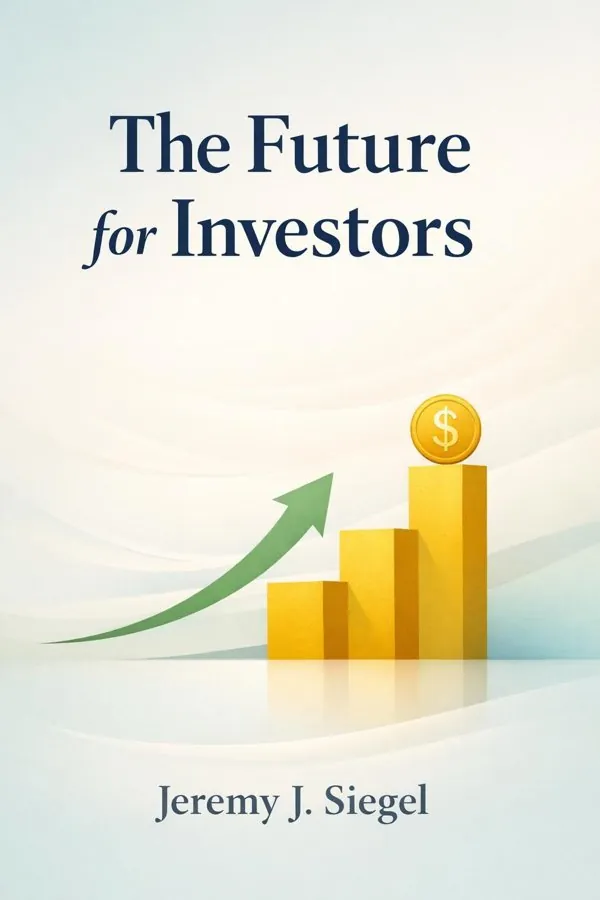
The Future for Investors: Why the Tried and the True Triumph Over the Bold and the New: Summary & Key Insights
 10 min10 chaptersAudio available
What Is The Future for Investors: Why the Tried and the True Triumph Over the Bold and the New About?
The Future for Investors: Why the Tried and the True Triumph Over the Bold and the New by Jeremy J. Siegel is a finance book spanning 10 pages. In this influential work, Jeremy J. Siegel examines historical market data to reveal that long-term investors achieve superior returns by focusing on established, dividend-paying companies rather than chasing new, high-growth firms. The book combines rigorous financial analysis with accessible insights, demonstrating how patience and discipline can outperform speculative trends. Siegel provides evidence from over a century of stock market performance to support his thesis that 'the tried and the true' triumph over 'the bold and the new.'
This FizzRead summary covers all 10 key chapters of The Future for Investors: Why the Tried and the True Triumph Over the Bold and the New in approximately 10 minutes, distilling the most important ideas, arguments, and takeaways from Jeremy J. Siegel's work. Also available as an audio summary and Key Quotes Podcast.
The Future for Investors: Why the Tried and the True Triumph Over the Bold and the New
In this influential work, Jeremy J. Siegel examines historical market data to reveal that long-term investors achieve superior returns by focusing on established, dividend-paying companies rather than chasing new, high-growth firms. The book combines rigorous financial analysis with accessible insights, demonstrating how patience and discipline can outperform speculative trends. Siegel provides evidence from over a century of stock market performance to support his thesis that 'the tried and the true' triumph over 'the bold and the new.'
Who Should Read The Future for Investors: Why the Tried and the True Triumph Over the Bold and the New?
This book is perfect for anyone interested in finance and looking to gain actionable insights in a short read. Whether you're a student, professional, or lifelong learner, the key ideas from The Future for Investors: Why the Tried and the True Triumph Over the Bold and the New by Jeremy J. Siegel will help you think differently.
- ✓Readers who enjoy finance and want practical takeaways
- ✓Professionals looking to apply new ideas to their work and life
- ✓Anyone who wants the core insights of The Future for Investors: Why the Tried and the True Triumph Over the Bold and the New in just 10 minutes
Want the full summary?
Get instant access to this book summary and 100K+ more with Fizz Moment.
Get Free SummaryAvailable on App Store • Free to download
Key Chapters
To understand the future, we must first listen to the lessons of history. My research into more than a century of U.S. and global market performance reveals a persistent pattern. When we trace data back to the dawn of the 20th century, following thousands of companies through cycles of exuberance and decline, one insight stands clear: the compounding effect of dividends and the resilience of established firms are what drive reliable wealth accumulation.
The numbers are astonishing once seen in context. Consider firms listed in the original S&P indices, or even the Dow Jones in the early years. Many of those companies—industrial titans, utilities, financial institutions—may not have dazzled with growth, but they delivered steady profits and shareholder distributions. Compared to the new and fashionable, these older firms consistently generated larger long-term total returns once dividends were reinvested.
The data also reveal an uncomfortable truth: market sentiment often overvalues novelty. During eras of technological disruption—the radio boom of the 1920s, the electronics surge of the 1960s, and the dot-com mania of the 1990s—investors convinced themselves that innovation alone would rewrite the rules of value. But when we look decades later, few of those once-celebrated names still exist, and their long-term return trails the broader market. Stability, not glamour, wins the marathon of investing.
Across time and geography, the same principle applies. Whether in the U.S., Europe, or emerging markets, value-based, dividend-oriented portfolios consistently outperform high-growth expectations. This evidence underscores that investor success depends not on predicting trends, but on participating faithfully in the enduring productivity of established enterprises. History, with all its chaotic cycles, has been remarkably consistent in rewarding patience.
I call it the growth trap: a persistent tendency among investors to equate potential with performance. The allure is understandable. When a company posts rapid sales increases or enters a new technological frontier, we imagine limitless opportunity. The market reacts with excitement, pushing valuations higher and higher until the promise itself becomes impossible to fulfill.
Overvaluation is the silent killer here. Even when a high-growth company meets its ambitious targets, the price paid for that growth often erodes future returns. Investors buy the dream rather than the reality, and dreams rarely yield dividends. The growth trap doesn’t mean innovation fails; it means investors fail to price innovation correctly.
My analysis of market history shows that the companies hailed as "next big things" often deliver poor long-term returns relative to their safer peers. The reason lies in expectations—they’re priced for perfection. Any slowdown, any policy shift, any competitive challenge can trigger dramatic repricing.
Take lessons from the technology sector during the late 1990s. Investors paid astronomical multiples for untested firms. Twenty years later, most of those names vanished. Meanwhile, companies like Procter & Gamble, Johnson & Johnson, and ExxonMobil—barely noticed amidst the frenzy—quietly compounded wealth. The data tell a humbling story: it wasn’t lack of innovation but overspending on promise that destroyed investor wealth.
Avoiding the growth trap requires a mindset of realism. Focus on the relationship between price and value, not excitement and narrative. When you learn to respect valuation, you begin to sidestep the psychological dangers of the crowd. The real growth investors should seek is the kind that comes from reinvested earnings, sustainable dividends, and long-term appreciation—not from inflated hopes.
+ 8 more chapters — available in the FizzRead app
All Chapters in The Future for Investors: Why the Tried and the True Triumph Over the Bold and the New
About the Author
Jeremy J. Siegel is a professor of finance at the Wharton School of the University of Pennsylvania. He is known for his research on long-term stock market returns and his influential book 'Stocks for the Long Run.' Siegel frequently contributes to financial media and advises on investment strategy.
Get This Summary in Your Preferred Format
Read or listen to the The Future for Investors: Why the Tried and the True Triumph Over the Bold and the New summary by Jeremy J. Siegel anytime, anywhere. FizzRead offers multiple formats so you can learn on your terms — all free.
Available formats: App · Audio · PDF · EPUB — All included free with FizzRead
Download The Future for Investors: Why the Tried and the True Triumph Over the Bold and the New PDF and EPUB Summary
Key Quotes from The Future for Investors: Why the Tried and the True Triumph Over the Bold and the New
“To understand the future, we must first listen to the lessons of history.”
“I call it the growth trap: a persistent tendency among investors to equate potential with performance.”
Frequently Asked Questions about The Future for Investors: Why the Tried and the True Triumph Over the Bold and the New
The Future for Investors: Why the Tried and the True Triumph Over the Bold and the New by Jeremy J. Siegel is a finance book that explores key ideas across 10 chapters. In this influential work, Jeremy J. Siegel examines historical market data to reveal that long-term investors achieve superior returns by focusing on established, dividend-paying companies rather than chasing new, high-growth firms. The book combines rigorous financial analysis with accessible insights, demonstrating how patience and discipline can outperform speculative trends. Siegel provides evidence from over a century of stock market performance to support his thesis that 'the tried and the true' triumph over 'the bold and the new.'
More by Jeremy J. Siegel
You Might Also Like


Browse by Category
Ready to read The Future for Investors: Why the Tried and the True Triumph Over the Bold and the New?
Get the full summary and 100K+ more books with Fizz Moment.