
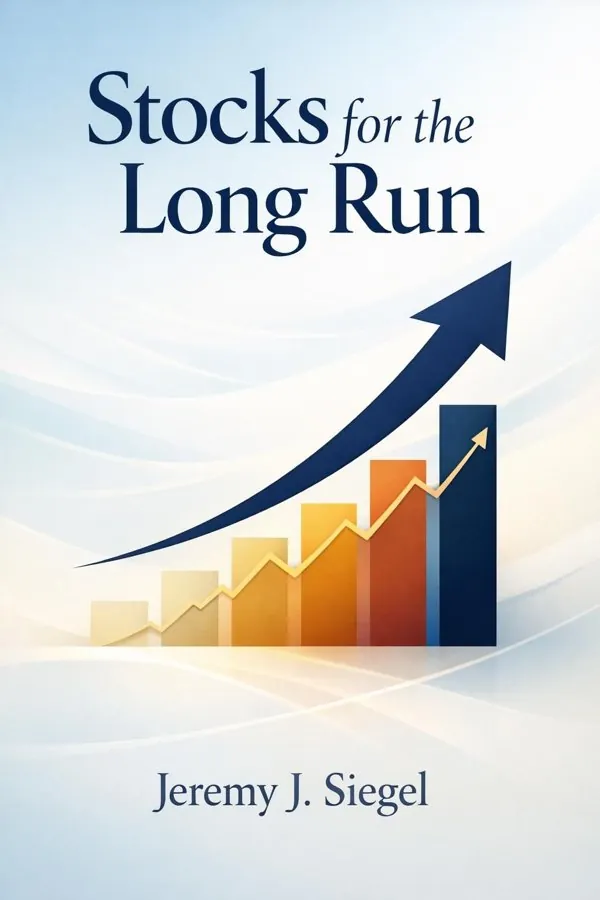
Stocks for the Long Run: The Definitive Guide to Financial Market Returns & Long-Term Investment Strategies: Summary & Key Insights
 10 min6 chaptersAudio available
What Is Stocks for the Long Run: The Definitive Guide to Financial Market Returns & Long-Term Investment Strategies About?
Stocks for the Long Run: The Definitive Guide to Financial Market Returns & Long-Term Investment Strategies by Jeremy J. Siegel is a finance book spanning 6 pages. This influential investment book by Wharton professor Jeremy J. Siegel provides a comprehensive analysis of stock market performance over the long term. It demonstrates, through historical data and economic reasoning, that equities have consistently outperformed other asset classes such as bonds and gold over extended periods. The book offers insights into market cycles, valuation metrics, and strategies for long-term investors seeking to build wealth through disciplined equity investing.
This FizzRead summary covers all 6 key chapters of Stocks for the Long Run: The Definitive Guide to Financial Market Returns & Long-Term Investment Strategies in approximately 10 minutes, distilling the most important ideas, arguments, and takeaways from Jeremy J. Siegel's work. Also available as an audio summary and Key Quotes Podcast.
Stocks for the Long Run: The Definitive Guide to Financial Market Returns & Long-Term Investment Strategies
This influential investment book by Wharton professor Jeremy J. Siegel provides a comprehensive analysis of stock market performance over the long term. It demonstrates, through historical data and economic reasoning, that equities have consistently outperformed other asset classes such as bonds and gold over extended periods. The book offers insights into market cycles, valuation metrics, and strategies for long-term investors seeking to build wealth through disciplined equity investing.
Who Should Read Stocks for the Long Run: The Definitive Guide to Financial Market Returns & Long-Term Investment Strategies?
This book is perfect for anyone interested in finance and looking to gain actionable insights in a short read. Whether you're a student, professional, or lifelong learner, the key ideas from Stocks for the Long Run: The Definitive Guide to Financial Market Returns & Long-Term Investment Strategies by Jeremy J. Siegel will help you think differently.
- ✓Readers who enjoy finance and want practical takeaways
- ✓Professionals looking to apply new ideas to their work and life
- ✓Anyone who wants the core insights of Stocks for the Long Run: The Definitive Guide to Financial Market Returns & Long-Term Investment Strategies in just 10 minutes
Want the full summary?
Get instant access to this book summary and 100K+ more with Fizz Moment.
Get Free SummaryAvailable on App Store • Free to download
Key Chapters
The foundation of the long-term case for stocks rests on history. I have tracked the performance of U.S. equities back to 1802, comparing them with bonds, Treasury bills, and gold. What emerges is remarkable consistency. Over any 20-year period in American financial history, equities have delivered inflation-adjusted gains that outstrip those of every other major asset.
In nominal terms, average stock returns have hovered around 6 to 7 percent after inflation, while long-term government bonds have yielded closer to 3 percent, and Treasury bills perhaps 2 percent. What matters most to investors is not year-to-year fluctuation but the compounding of these averages. A single percentage point’s difference becomes enormous over decades. The long-term equity investor benefits not because markets move predictably upward each year but because volatility is neutralized as time extends.
The historical data also reveals something counterintuitive: the longer you hold stocks, the lower your risk of loss becomes. The standard deviation of stock returns falls significantly over time, whereas the volatility of bonds remains roughly constant. Thus, while stocks fluctuate more in the short run, they become safer than bonds in the long run—a finding that rewrites traditional risk assumptions.
Many investors fear inflation as the silent destroyer of wealth. I share that concern, because inflation steadily erodes the purchasing power of fixed-income assets. The 1970s offered the most vivid example. Bondholders suffered deeply as inflation climbed, while stockholders—owning claims on real productive assets—fared far better over the decade.
Equities, unlike bonds, adjust naturally to inflation. When prices rise, so too do nominal earnings and dividends. Corporate profits are tied to the economic environment, not fixed by contract. This adaptive quality has historically made equities the best hedge against inflation over the long term. Bonds may appear stable in nominal terms, but in real purchasing power, they can deliver severe losses. That is why I call equities the ultimate real assets: they are woven into the productive fabric of the economy itself.
Understanding this dynamic helps investors maintain perspective during inflationary or deflationary cycles. The temptation to flee to ‘safe’ assets is strong during turmoil, but history demonstrates that in real terms, safety often lies in owning a diversified stock portfolio, not in clinging to cash or fixed income.
+ 4 more chapters — available in the FizzRead app
All Chapters in Stocks for the Long Run: The Definitive Guide to Financial Market Returns & Long-Term Investment Strategies
About the Author
Jeremy J. Siegel is a professor of finance at the Wharton School of the University of Pennsylvania. He is known for his research on long-term stock returns, monetary policy, and behavioral finance. Siegel has been a frequent commentator on financial markets and is recognized for his contributions to understanding the historical performance of equities.
Get This Summary in Your Preferred Format
Read or listen to the Stocks for the Long Run: The Definitive Guide to Financial Market Returns & Long-Term Investment Strategies summary by Jeremy J. Siegel anytime, anywhere. FizzRead offers multiple formats so you can learn on your terms — all free.
Available formats: App · Audio · PDF · EPUB — All included free with FizzRead
Download Stocks for the Long Run: The Definitive Guide to Financial Market Returns & Long-Term Investment Strategies PDF and EPUB Summary
Key Quotes from Stocks for the Long Run: The Definitive Guide to Financial Market Returns & Long-Term Investment Strategies
“The foundation of the long-term case for stocks rests on history.”
“Many investors fear inflation as the silent destroyer of wealth.”
Frequently Asked Questions about Stocks for the Long Run: The Definitive Guide to Financial Market Returns & Long-Term Investment Strategies
Stocks for the Long Run: The Definitive Guide to Financial Market Returns & Long-Term Investment Strategies by Jeremy J. Siegel is a finance book that explores key ideas across 6 chapters. This influential investment book by Wharton professor Jeremy J. Siegel provides a comprehensive analysis of stock market performance over the long term. It demonstrates, through historical data and economic reasoning, that equities have consistently outperformed other asset classes such as bonds and gold over extended periods. The book offers insights into market cycles, valuation metrics, and strategies for long-term investors seeking to build wealth through disciplined equity investing.
More by Jeremy J. Siegel

You Might Also Like




Browse by Category
Ready to read Stocks for the Long Run: The Definitive Guide to Financial Market Returns & Long-Term Investment Strategies?
Get the full summary and 100K+ more books with Fizz Moment.