
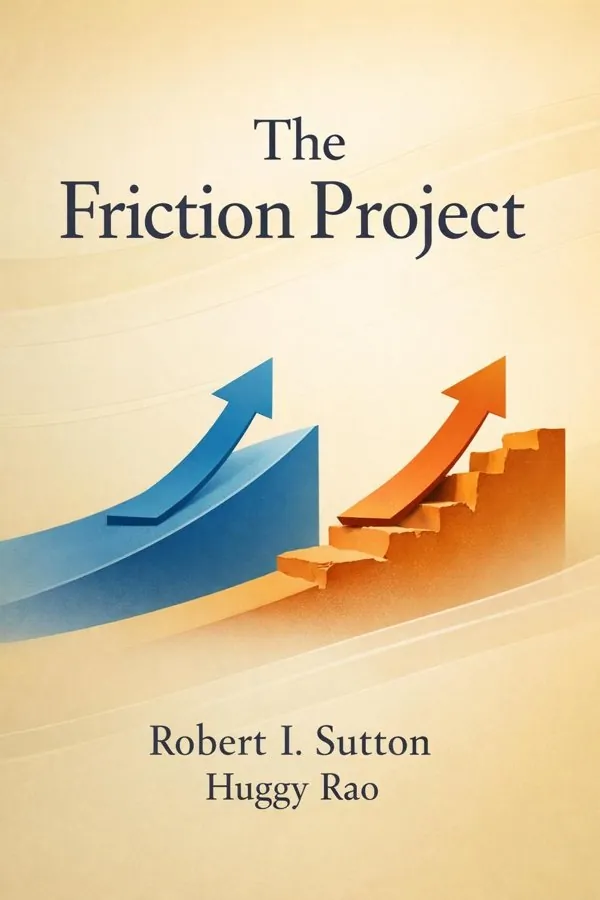
The Friction Project: How Smart Leaders Make the Right Things Easier and the Wrong Things Harder: Summary & Key Insights
by Robert I. Sutton, Huggy Rao
 10 min5 chaptersAudio available
What Is The Friction Project: How Smart Leaders Make the Right Things Easier and the Wrong Things Harder About?
The Friction Project: How Smart Leaders Make the Right Things Easier and the Wrong Things Harder by Robert I. Sutton, Huggy Rao is a leadership book spanning 5 pages. In this management and leadership book, Robert I. Sutton and Huggy Rao explore how leaders can identify and reduce organizational friction that slows progress, while strategically adding friction to prevent harmful behaviors. Drawing on research and case studies, the authors provide practical frameworks for making work processes smoother, improving collaboration, and fostering a culture of constructive efficiency.
This FizzRead summary covers all 5 key chapters of The Friction Project: How Smart Leaders Make the Right Things Easier and the Wrong Things Harder in approximately 10 minutes, distilling the most important ideas, arguments, and takeaways from Robert I. Sutton, Huggy Rao's work. Also available as an audio summary and Key Quotes Podcast.
The Friction Project: How Smart Leaders Make the Right Things Easier and the Wrong Things Harder
In this management and leadership book, Robert I. Sutton and Huggy Rao explore how leaders can identify and reduce organizational friction that slows progress, while strategically adding friction to prevent harmful behaviors. Drawing on research and case studies, the authors provide practical frameworks for making work processes smoother, improving collaboration, and fostering a culture of constructive efficiency.
Who Should Read The Friction Project: How Smart Leaders Make the Right Things Easier and the Wrong Things Harder?
This book is perfect for anyone interested in leadership and looking to gain actionable insights in a short read. Whether you're a student, professional, or lifelong learner, the key ideas from The Friction Project: How Smart Leaders Make the Right Things Easier and the Wrong Things Harder by Robert I. Sutton, Huggy Rao will help you think differently.
- ✓Readers who enjoy leadership and want practical takeaways
- ✓Professionals looking to apply new ideas to their work and life
- ✓Anyone who wants the core insights of The Friction Project: How Smart Leaders Make the Right Things Easier and the Wrong Things Harder in just 10 minutes
Want the full summary?
Get instant access to this book summary and 100K+ more with Fizz Moment.
Get Free SummaryAvailable on App Store • Free to download
Key Chapters
The word ‘friction’ evokes frustration: it’s what makes simple things hard. Yet that reaction, while human, misses a vital truth. Without friction, there’s chaos — no grip, no traction, no form. In an organizational context, friction is simply resistance within systems of work. It shows up as rules, habits, meetings, or technology protocols that slow motion. When designed poorly, it frustrates and discourages; when designed wisely, it brings order and integrity.
Huggy and I began by distinguishing two types of friction: destructive and productive. Destructive friction is the drag that drains time and morale. It’s the form that hides inside redundant processes and unclear responsibilities. It steals focus and kills initiative. Productive friction, by contrast, prevents recklessness. It’s the deliberate pause before launching a product without proper testing, or the structured debate that stops a team from blindly copying competitors. Good friction isn’t about slowing; it’s about shaping motion.
In one technology firm we studied, engineers were frustrated by endless approval layers. Their project cycle had grown to triple its original length. After conducting a friction audit — a simple diagnostic mapping how much time people spent waiting versus working — leaders discovered over sixty percent of delays came from confusion about who could authorize decisions. By removing one redundant sign-off step and adding a shared accountability dashboard, they reduced cycle times by half and improved morale dramatically. That’s friction in its harmful form — and friction cured.
But just as some friction should be erased, others must be amplified. We’ve worked with organizations where the opposite problem prevailed: decisions made at lightning speed, errors multiplying just as fast. When a medical startup introduced a mandatory checklist for product validation, what looked like extra bureaucracy actually saved millions by preventing rushed rollouts. That was good friction — resistance serving long-term readiness.
The essence of the Friction Project is recognizing these nuances. Friction isn’t inherently good or bad; its value depends on intention and context. A leader’s art lies in asking: does this resistance preserve something vital, or merely protect inertia? By learning to sense the texture of friction — whether it grates or guards — you begin mastering the invisible levers of organizational motion.
Before you can fix friction, you must see it. Yet leaders often operate blind, trapped inside systems they’ve created. We developed friction audits precisely to counter that blindness. These audits are not about assigning blame; they’re about illuminating where work slows down and why.
When we walk leaders through their organizations, we ask deceptively simple questions: Where does effort leak? What tasks spark irritation? What approvals make no one safer but everyone slower? These inquiries uncover patterns that formal metrics rarely expose. Bureaucracy grows invisibly until someone measures its movement.
Take the case of a global consumer goods company that underwent a friction audit after employee surveys revealed rising frustration. Mapping workflows revealed absurd redundancies: teams maintaining parallel reporting structures for the same metrics, compliance documents circulating endlessly without resolution, meetings scheduled to discuss meetings. Once these frictional hotspots became visible, the leadership initiated what we call friction surgery — targeted deletion of unnecessary procedures. Productivity increased not because people worked harder but because their work flowed smarter.
Effective friction audits reveal cultural friction too. Sometimes what slows an organization is not process but pride. A mid-level manager unwilling to delegate, a senior executive clinging to old approval rituals, an overemphasis on status that turns collaboration into competition — all these create psychological resistance. Diagnosing destructive friction must therefore blend quantitative maps with qualitative empathy. You listen as much as you measure.
Through this practice, leaders begin to differentiate between institutional necessity and inherited habit. They see that friction isn’t just in the paperwork; it’s in the power dynamics. It hides in the spaces people protect from change. That insight transforms a friction audit from a procedural exercise into a cultural awakening. Once awareness dawns, the organization can redesign itself around real purpose rather than outdated ritual.
+ 3 more chapters — available in the FizzRead app
All Chapters in The Friction Project: How Smart Leaders Make the Right Things Easier and the Wrong Things Harder
About the Authors
Robert I. Sutton is a professor of management science and engineering at Stanford University, known for his research on leadership, innovation, and organizational behavior. Huggy Rao is also a professor at Stanford Graduate School of Business, specializing in organizational change and scaling excellence. Together, they have coauthored several influential works on leadership and workplace culture.
Get This Summary in Your Preferred Format
Read or listen to the The Friction Project: How Smart Leaders Make the Right Things Easier and the Wrong Things Harder summary by Robert I. Sutton, Huggy Rao anytime, anywhere. FizzRead offers multiple formats so you can learn on your terms — all free.
Available formats: App · Audio · PDF · EPUB — All included free with FizzRead
Download The Friction Project: How Smart Leaders Make the Right Things Easier and the Wrong Things Harder PDF and EPUB Summary
Key Quotes from The Friction Project: How Smart Leaders Make the Right Things Easier and the Wrong Things Harder
“The word ‘friction’ evokes frustration: it’s what makes simple things hard.”
“Before you can fix friction, you must see it.”
Frequently Asked Questions about The Friction Project: How Smart Leaders Make the Right Things Easier and the Wrong Things Harder
The Friction Project: How Smart Leaders Make the Right Things Easier and the Wrong Things Harder by Robert I. Sutton, Huggy Rao is a leadership book that explores key ideas across 5 chapters. In this management and leadership book, Robert I. Sutton and Huggy Rao explore how leaders can identify and reduce organizational friction that slows progress, while strategically adding friction to prevent harmful behaviors. Drawing on research and case studies, the authors provide practical frameworks for making work processes smoother, improving collaboration, and fostering a culture of constructive efficiency.
More by Robert I. Sutton, Huggy Rao
You Might Also Like

Extreme Ownership
Jocko Willink
10 min
Dare to Lead
Brene Brown
10 min
Leaders Eat Last
Simon Sinek
10 min
The 21 Irrefutable Laws of Leadership
John Maxwell
10 min
Start With Why
Simon Sinek
10 min
How to Lead When You're Not in Charge
Clay Scroggins
10 minBrowse by Category
Ready to read The Friction Project: How Smart Leaders Make the Right Things Easier and the Wrong Things Harder?
Get the full summary and 100K+ more books with Fizz Moment.