
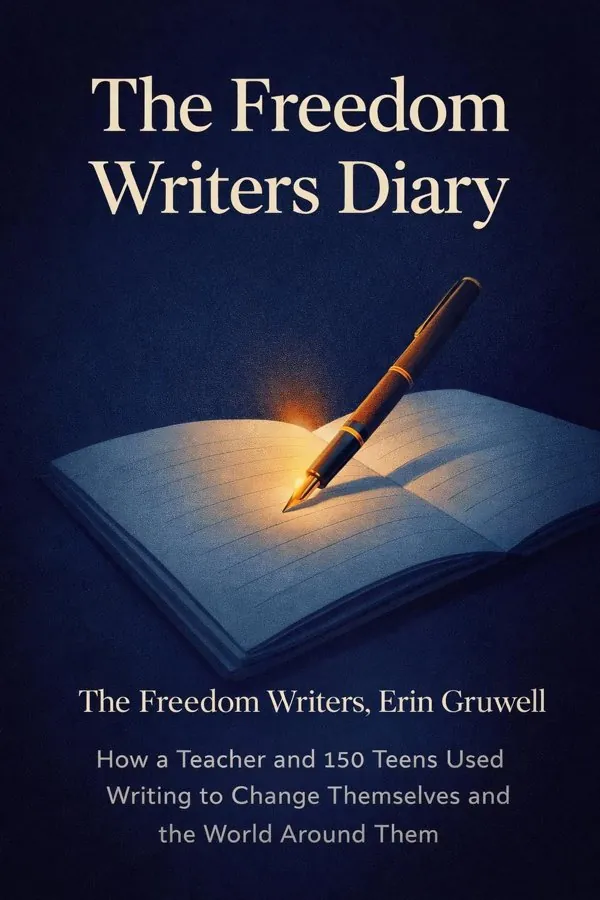
The Freedom Writers Diary: Summary & Key Insights
by Erin Gruwell
 10 min9 chaptersAudio available
Key Takeaways from The Freedom Writers Diary
A person’s life can begin to change the moment they feel heard.
Schools often reveal the fractures a society prefers to ignore.
People begin to heal differently when they realize their suffering is not isolated.
Reading can do more than inform; it can rehumanize.
Transformation begins when reflection leads to accountability.
What Is The Freedom Writers Diary About?
The Freedom Writers Diary by Erin Gruwell is a memoir book published in 1999 spanning 4 pages. The Freedom Writers Diary is a powerful memoir built from the real journal entries of students in Erin Gruwell’s English class at Woodrow Wilson High School in Long Beach, California. Set against the backdrop of racial tension, gang violence, poverty, abuse, and deep social division, the book shows how a classroom became a refuge and a catalyst for change. Rather than offering a polished academic theory of education, it presents lived experience: teenagers who had every reason to distrust school begin to trust their own voices, each other, and the possibility of a different future. What makes the book matter is not only its emotional honesty, but its insistence that literacy, empathy, and human dignity can interrupt cycles of trauma. Erin Gruwell’s authority comes from direct practice. As a young teacher facing students written off by the system, she built relationships, introduced them to stories of survival and injustice, and turned writing into a tool of self-discovery and accountability. The result is both a moving testament to resilience and a compelling argument for education as social transformation.
This FizzRead summary covers all 9 key chapters of The Freedom Writers Diary in approximately 10 minutes, distilling the most important ideas, arguments, and takeaways from Erin Gruwell's work. Also available as an audio summary and Key Quotes Podcast.
The Freedom Writers Diary
The Freedom Writers Diary is a powerful memoir built from the real journal entries of students in Erin Gruwell’s English class at Woodrow Wilson High School in Long Beach, California. Set against the backdrop of racial tension, gang violence, poverty, abuse, and deep social division, the book shows how a classroom became a refuge and a catalyst for change. Rather than offering a polished academic theory of education, it presents lived experience: teenagers who had every reason to distrust school begin to trust their own voices, each other, and the possibility of a different future. What makes the book matter is not only its emotional honesty, but its insistence that literacy, empathy, and human dignity can interrupt cycles of trauma. Erin Gruwell’s authority comes from direct practice. As a young teacher facing students written off by the system, she built relationships, introduced them to stories of survival and injustice, and turned writing into a tool of self-discovery and accountability. The result is both a moving testament to resilience and a compelling argument for education as social transformation.
Who Should Read The Freedom Writers Diary?
This book is perfect for anyone interested in memoir and looking to gain actionable insights in a short read. Whether you're a student, professional, or lifelong learner, the key ideas from The Freedom Writers Diary by Erin Gruwell will help you think differently.
- ✓Readers who enjoy memoir and want practical takeaways
- ✓Professionals looking to apply new ideas to their work and life
- ✓Anyone who wants the core insights of The Freedom Writers Diary in just 10 minutes
Want the full summary?
Get instant access to this book summary and 100K+ more with Fizz Moment.
Get Free SummaryAvailable on App Store • Free to download
Key Chapters
A person’s life can begin to change the moment they feel heard. At the start of The Freedom Writers Diary, Erin Gruwell’s classroom is not a peaceful learning environment but a tense crossroads of fear, hostility, and emotional exhaustion. Her students come from communities marked by gang conflict, unstable homes, racism, addiction, and loss. Many have learned that vulnerability is dangerous and that school is just another institution that expects them to fail. In that setting, asking students to write becomes more than an academic task; it becomes an invitation to exist honestly.
The diaries matter because they provide a private space where students can tell the truth without interruption. Some write about witnessing shootings, losing friends, enduring abuse, or feeling invisible. Others reveal anger, prejudice, or despair. The act of writing helps them move from silence to self-recognition. Before they can become successful students, they must first become narrators of their own lives. Gruwell understands that literacy starts with relevance. Instead of forcing detached assignments, she creates room for authentic expression.
This idea applies far beyond one classroom. People often carry experiences they have never fully named. Journaling, reflective writing, or even structured conversation can help transform confusion into clarity. In schools, workplaces, or families, creating spaces where people can tell the truth can reduce defensiveness and increase trust. Voice does not erase pain, but it can turn pain into insight and isolation into connection.
Actionable takeaway: Start a simple writing practice for ten minutes a day, focused not on performance but honesty. Ask one question: What am I carrying that I have not yet said aloud?
Schools often reveal the fractures a society prefers to ignore. One of the most striking insights in The Freedom Writers Diary is that Room 203 reflects the larger realities of America: segregation, prejudice, inequality, and the consequences of neglect. Students are separated not only by race and neighborhood, but by assumptions about who belongs, who is dangerous, and who deserves opportunity. Gruwell quickly realizes she is not teaching grammar in a vacuum; she is teaching in the aftermath of social failure.
The students bring survival instincts into the classroom. They sit in self-protective groups, distrust one another, and interpret difference as threat. For many of them, identity has been shaped by conflict. Gruwell’s work begins with recognizing this truth rather than pretending all students begin on equal footing. She does not romanticize their hardship, nor does she excuse destructive behavior. Instead, she acknowledges that trauma and systemic injustice influence how people learn, react, and relate.
This perspective is useful in any institution. Teams, classrooms, and communities are never neutral spaces. People arrive carrying histories, biases, and invisible burdens. Productive change requires understanding context, not merely enforcing rules. Leaders who ignore structural realities often misread resistance as laziness or hostility. Leaders who recognize context can build interventions that are humane and effective.
A practical example is to examine any group conflict by asking what larger pressure might be shaping it. Is tension really about personality, or about exclusion, insecurity, and unequal treatment? The book reminds us that meaningful education starts with social awareness.
Actionable takeaway: When facing conflict in a group, pause before judging behavior and ask what external pressures or past experiences may be influencing the people involved.
People begin to heal differently when they realize their suffering is not isolated. After her students begin writing about their own lives, Erin Gruwell introduces them to historical accounts of persecution, especially the Holocaust and other stories of intolerance. This is not a conventional history lesson. It is a deliberate effort to help students see patterns: dehumanization, silence, propaganda, prejudice, and the danger of deciding that some lives matter less than others.
For students who have experienced racism, violence, and abandonment, history becomes newly relevant. They do not connect to dates first; they connect to human testimony. Reading Anne Frank, Zlata Filipovic, and Holocaust survivors allows them to recognize that diary writing can preserve dignity under impossible circumstances. They also begin to understand that hatred escalates when ordinary people stop seeing others as fully human. The classroom expands from private pain to moral awareness.
This connection between biography and history is one of the book’s most effective educational strategies. Facts become meaningful when linked to lived experience. In daily life, the same principle applies. We understand current events better when we ask how they echo older patterns of injustice. We become less self-enclosed when we encounter stories that challenge our assumptions.
The lesson is not that every hardship is identical, but that empathy grows when we see continuity between our struggles and those of others. Personal narrative and historical study together create perspective, humility, and responsibility.
Actionable takeaway: Pair one personal challenge you are facing with a memoir or historical account on a similar theme, and ask what broader pattern your experience helps you notice.
Reading can do more than inform; it can rehumanize. In The Freedom Writers Diary, literature becomes a bridge between students who have been taught to mistrust one another and a world that has often ignored them. Gruwell does not treat books as elite cultural objects that students must passively admire. She treats them as living companions that can provoke recognition, challenge prejudice, and widen possibility.
When students encounter texts that reflect trauma, courage, resistance, and survival, they begin to see themselves in literature for perhaps the first time. That recognition matters. A student who has been dismissed as a problem suddenly realizes that stories like theirs have value. At the same time, reading introduces them to lives unlike their own, which is how moral imagination grows. They are invited not merely to decode words, but to inhabit another person’s fears, hopes, and choices.
This is why book selection matters. Students disengage when reading feels like a cultural test rather than an act of discovery. Gruwell chooses works that resonate emotionally and ethically. The result is increased investment, stronger discussion, and deeper reflection. Outside school, the principle still holds: the books we read shape the boundaries of our empathy. Reading only what confirms us can narrow us; reading what unsettles us can enlarge us.
A practical application is to alternate between books that mirror your experience and books that stretch it. For educators, it means selecting texts that invite identification and moral inquiry rather than mere compliance.
Actionable takeaway: Choose your next book using two questions: Does this story help me feel seen, and does it help me better see someone else?
Transformation begins when reflection leads to accountability. In the Freedom Writers classroom, journaling is not simply emotional release. Over time, it becomes a disciplined practice of noticing patterns, naming choices, and imagining different futures. Students who once felt trapped by circumstance begin to understand that while they cannot control everything around them, they can examine how they respond. Writing slows reaction and creates a small but crucial distance between impulse and decision.
This matters because many of the students live in environments where immediate survival dominates. Reflection is a luxury they have rarely been given. Through diaries, they can revisit events, identify triggers, and recognize the consequences of loyalty, violence, silence, or self-sabotage. They also begin to articulate goals: graduating, attending college, repairing family relationships, or simply staying alive. Language helps convert vague hope into intention.
The broader lesson is that writing can support behavior change in almost any context. Athletes review performance, therapists use thought records, leaders keep decision journals, and individuals track habits. The core mechanism is the same: when experience is recorded, it becomes available for analysis. Patterns that felt random become visible. Repeated choices can be confronted honestly.
The Freedom Writers demonstrate that reflection is most powerful when connected to community and action. Their diaries do not remain hidden forever; their stories become part of a shared mission. Writing gives them responsibility to themselves and, eventually, to one another.
Actionable takeaway: Keep a weekly reflection log with three prompts: What happened, how did I respond, and what would I like to do differently next time?
Sometimes the most radical educational act is refusing to give up on someone. Erin Gruwell’s role in The Freedom Writers Diary is not that of a savior with easy answers, but of a teacher who chooses belief over resignation. In a system where many of her students have been labeled incapable, disruptive, or disposable, her consistent message is that their lives and minds matter. That belief becomes catalytic because it counters years of diminished expectations.
Gruwell’s commitment is practical, not merely emotional. She adapts curriculum, seeks outside resources, organizes field trips, brings in guest speakers, raises money, and continually creates opportunities for her students to encounter a wider world. She also sets standards. Belief is not indulgence. She expects students to read, write, think, and take themselves seriously. In doing so, she offers a rare combination: compassion without condescension.
This idea matters because expectations shape performance. When institutions assume failure, they often produce it through neglect. When leaders communicate genuine confidence and provide tools for growth, people often exceed what seemed possible. This is true in teaching, mentoring, parenting, and management. Belief alone is insufficient, but belief paired with structure, opportunity, and persistence can be transformative.
The book also suggests that advocacy is part of effective leadership. Gruwell works within the system but does not passively accept its limitations. She challenges what her students have been denied and fights to expand their horizons.
Actionable takeaway: Identify one person you influence and pair a clear statement of belief in their potential with one concrete opportunity that helps them rise to it.
Real education does not stop at helping students endure the present; it helps them imagine a future. For many of the students in The Freedom Writers Diary, daily life is consumed by immediate threats: violence, instability, family dysfunction, and economic hardship. In that context, long-term planning can feel unrealistic. Gruwell recognizes that if education is to matter, it must connect survival to aspiration.
She does this by exposing students to new experiences and pathways they had not considered accessible. College visits, encounters with writers and survivors, public recognition, and the publication of their diaries all widen their sense of the possible. These students are not simply learning to pass a test; they are learning to envision themselves as authors, graduates, leaders, and witnesses. Hope becomes credible because it is attached to concrete experiences.
This is a crucial distinction. Telling people to dream big means little if they have never seen the bridge between where they are and where they want to go. Effective education creates that bridge. It translates ambition into steps, relationships, and visible examples. The same principle applies to career development, community work, and personal growth. People sustain effort when they can picture a reachable next stage.
A practical application is to pair inspiration with exposure. If someone wants a different future, let them meet people who have traveled a similar path, visit relevant spaces, or try small versions of the desired goal. Possibility becomes more believable when it is experienced, not merely described.
Actionable takeaway: Turn one long-term hope into a visible path by identifying one place to visit, one person to meet, or one small public step to take this month.
Private pain becomes social force when it is witnessed. One of the most enduring contributions of The Freedom Writers Diary is that the students’ journals do not remain confined to a single classroom. Their stories are edited, shared, and eventually published, allowing readers far beyond Long Beach to encounter the realities these young people have lived. This movement from personal narrative to public testimony is essential to the book’s impact.
When marginalized people tell their own stories, they challenge stereotypes created in their absence. The Freedom Writers are often perceived by institutions as troubled, dangerous, or doomed. Their diaries reveal something more complete: intelligence, grief, humor, fear, loyalty, tenderness, and determination. By speaking in their own voices, they reclaim complexity. Readers are forced to confront the gap between social labels and human reality.
This is why storytelling matters in civic life. Data can describe injustice, but stories help people feel its texture. Testimony can mobilize empathy, policy discussion, and cultural change in ways statistics alone often cannot. At the same time, the book reminds us that responsible storytelling requires dignity and context. The goal is not voyeurism, but recognition and solidarity.
In everyday life, sharing well-crafted narratives can reshape teams, communities, and institutions. A student essay, employee story, family history, or community oral archive can all deepen understanding and preserve memory. The Freedom Writers show that storytelling is not a soft supplement to change; it is one of the engines that makes change imaginable.
Actionable takeaway: Write or record one true story from your life that reveals something others often misunderstand about your experience, and share it in a setting that values listening.
All Chapters in The Freedom Writers Diary
About the Author
Erin Gruwell is an American educator, author, and motivational speaker best known for inspiring the Freedom Writers, a group of students whose journals became the bestselling book The Freedom Writers Diary. Early in her teaching career at Woodrow Wilson High School in Long Beach, California, she worked with students affected by gang violence, racial division, poverty, and trauma. Rather than accepting low expectations, she developed a classroom centered on writing, literature, empathy, and personal responsibility. Her work gained international attention for demonstrating how education can become a force for dignity and transformation. Gruwell later founded the Freedom Writers Foundation, an organization dedicated to training teachers and promoting educational equity through storytelling and student empowerment. Her legacy continues to influence discussions about literacy, trauma-informed teaching, and social justice in education.
Get This Summary in Your Preferred Format
Read or listen to the The Freedom Writers Diary summary by Erin Gruwell anytime, anywhere. FizzRead offers multiple formats so you can learn on your terms — all free.
Available formats: App · Audio · PDF · EPUB — All included free with FizzRead
Download The Freedom Writers Diary PDF and EPUB Summary
Key Quotes from The Freedom Writers Diary
“A person’s life can begin to change the moment they feel heard.”
“Schools often reveal the fractures a society prefers to ignore.”
“People begin to heal differently when they realize their suffering is not isolated.”
“Reading can do more than inform; it can rehumanize.”
“Transformation begins when reflection leads to accountability.”
Frequently Asked Questions about The Freedom Writers Diary
The Freedom Writers Diary by Erin Gruwell is a memoir book that explores key ideas across 9 chapters. The Freedom Writers Diary is a powerful memoir built from the real journal entries of students in Erin Gruwell’s English class at Woodrow Wilson High School in Long Beach, California. Set against the backdrop of racial tension, gang violence, poverty, abuse, and deep social division, the book shows how a classroom became a refuge and a catalyst for change. Rather than offering a polished academic theory of education, it presents lived experience: teenagers who had every reason to distrust school begin to trust their own voices, each other, and the possibility of a different future. What makes the book matter is not only its emotional honesty, but its insistence that literacy, empathy, and human dignity can interrupt cycles of trauma. Erin Gruwell’s authority comes from direct practice. As a young teacher facing students written off by the system, she built relationships, introduced them to stories of survival and injustice, and turned writing into a tool of self-discovery and accountability. The result is both a moving testament to resilience and a compelling argument for education as social transformation.
You Might Also Like
Featured In
Browse by Category
Ready to read The Freedom Writers Diary?
Get the full summary and 100K+ more books with Fizz Moment.