
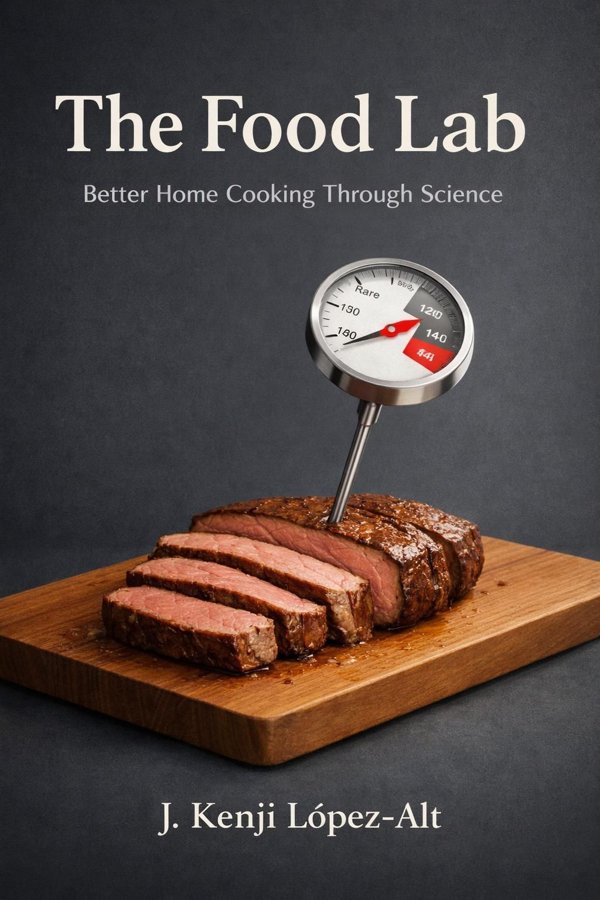
The Food Lab: Better Home Cooking Through Science: Summary & Key Insights
 10 min6 chaptersAudio available
What Is The Food Lab: Better Home Cooking Through Science About?
The Food Lab: Better Home Cooking Through Science by J. Kenji López-Alt is a popular_sci book spanning 6 pages. The Food Lab es un libro de cocina que explora la ciencia detrás de la cocina casera. J. Kenji López-Alt combina experimentación culinaria y principios científicos para explicar cómo y por qué las técnicas de cocina funcionan, ofreciendo recetas detalladas y consejos prácticos para mejorar la preparación de alimentos en casa.
This FizzRead summary covers all 6 key chapters of The Food Lab: Better Home Cooking Through Science in approximately 10 minutes, distilling the most important ideas, arguments, and takeaways from J. Kenji López-Alt's work. Also available as an audio summary and Key Quotes Podcast.
The Food Lab: Better Home Cooking Through Science
The Food Lab es un libro de cocina que explora la ciencia detrás de la cocina casera. J. Kenji López-Alt combina experimentación culinaria y principios científicos para explicar cómo y por qué las técnicas de cocina funcionan, ofreciendo recetas detalladas y consejos prácticos para mejorar la preparación de alimentos en casa.
Who Should Read The Food Lab: Better Home Cooking Through Science?
This book is perfect for anyone interested in popular_sci and looking to gain actionable insights in a short read. Whether you're a student, professional, or lifelong learner, the key ideas from The Food Lab: Better Home Cooking Through Science by J. Kenji López-Alt will help you think differently.
- ✓Readers who enjoy popular_sci and want practical takeaways
- ✓Professionals looking to apply new ideas to their work and life
- ✓Anyone who wants the core insights of The Food Lab: Better Home Cooking Through Science in just 10 minutes
Want the full summary?
Get instant access to this book summary and 100K+ more with Fizz Moment.
Get Free SummaryAvailable on App Store • Free to download
Key Chapters
If cooking is controlled transformation, heat is its primary instrument. Everything you cook—from a simple fried egg to slow-braised short ribs—depends on how heat is generated, transferred, and distributed. Understanding the three main types of heat transfer—conduction, convection, and radiation—changes how you interpret every cooking method.
Conduction is direct contact: a steak on a hot skillet, where energy moves atom by atom from pan to meat. It’s fast, efficient, and capable of creating crisp crusts and deep browning, but it’s also unforgiving if mismanaged. Convection is heat traveling through a fluid medium—air in an oven, water in a pot, oil in a fryer. It’s gentler, more consistent, ideal for even cooking. Radiation—think of broilers or glowing coals—transfers energy in waves, reaching surfaces without direct contact. Every method, from roasting to sous vide, leverages some combination of these forces.
Once you grasp these mechanisms, mysteries like why searing doesn’t 'seal in juices' or why slow oven roasting yields juicier meat start to make sense. Searing contributes flavor through the Maillard reaction, not moisture retention. A slower roast allows the internal and external temperatures of the meat to approach equilibrium, preventing a gray, overdone outer layer.
For instance, when I tested steaks cooked entirely on the stovetop against those finished in an oven, I found that the latter achieved a uniform pink interior and a more controlled crust. This wasn’t intuition—it was physics. Managing heat flow allows you to manage texture and flavor. Every cooking success begins not in guesswork, but in heat mastery.
The best cooks don’t need extravagant kitchens; they need to understand their tools. I approach equipment as an extension of scientific instruments—thermometers, pans, knives, and ovens are ways to measure and control variables. A heavy stainless-steel skillet, for example, offers consistent heat retention, preventing temperature drops when food is added. Nonstick pans have their purpose—delicate foods like eggs benefit from them—but they don’t brown as efficiently as bare metal. Even materials matter: aluminum conducts heat quickly but unevenly, while cast iron is slow but steady.
Thermometers might be the single most empowering piece of equipment a cook can own. Before I relied on them, I believed that intuition alone could tell me when meat was done. But experiments revealed my senses often lied. Measuring internal temperatures takes away the uncertainty, turning guesswork into precision.
Similarly, understanding your oven’s behavior is crucial. Most ovens cycle their heating elements, and their built-in thermostats often drift by tens of degrees. Learning where the hot spots lie and calibrating accordingly can mean the difference between perfect cookies and burnt-bottom disasters. Tools are not luxuries—they’re extensions of awareness, turning subjective impressions into data.
+ 4 more chapters — available in the FizzRead app
All Chapters in The Food Lab: Better Home Cooking Through Science
About the Author
J. Kenji López-Alt es un chef, autor y columnista estadounidense conocido por su enfoque científico de la cocina. Es el director culinario de Serious Eats y autor de varios libros de cocina galardonados. Su trabajo se centra en desmitificar la cocina mediante la experimentación y la explicación accesible de los procesos culinarios.
Get This Summary in Your Preferred Format
Read or listen to the The Food Lab: Better Home Cooking Through Science summary by J. Kenji López-Alt anytime, anywhere. FizzRead offers multiple formats so you can learn on your terms — all free.
Available formats: App · Audio · PDF · EPUB — All included free with FizzRead
Download The Food Lab: Better Home Cooking Through Science PDF and EPUB Summary
Key Quotes from The Food Lab: Better Home Cooking Through Science
“If cooking is controlled transformation, heat is its primary instrument.”
“The best cooks don’t need extravagant kitchens; they need to understand their tools.”
Frequently Asked Questions about The Food Lab: Better Home Cooking Through Science
The Food Lab: Better Home Cooking Through Science by J. Kenji López-Alt is a popular_sci book that explores key ideas across 6 chapters. The Food Lab es un libro de cocina que explora la ciencia detrás de la cocina casera. J. Kenji López-Alt combina experimentación culinaria y principios científicos para explicar cómo y por qué las técnicas de cocina funcionan, ofreciendo recetas detalladas y consejos prácticos para mejorar la preparación de alimentos en casa.
You Might Also Like

Structures: Or Why Things Don"t Fall Down
J.E. Gordon
10 min
The Road to Wigan Pier
George Orwell
10 min
Bonk: The Curious Coupling of Science and Sex
Mary Roach
10 min
First Bite: How We Learn to Eat
Bee Wilson
10 min
In Pursuit Of The Unknown: 17 Equations That Changed The World
Ian Stewart
10 min
Napoleon's Buttons: 17 Molecules That Changed History
Penny Le Couteur and Jay Burreson
10 minBrowse by Category
Ready to read The Food Lab: Better Home Cooking Through Science?
Get the full summary and 100K+ more books with Fizz Moment.