
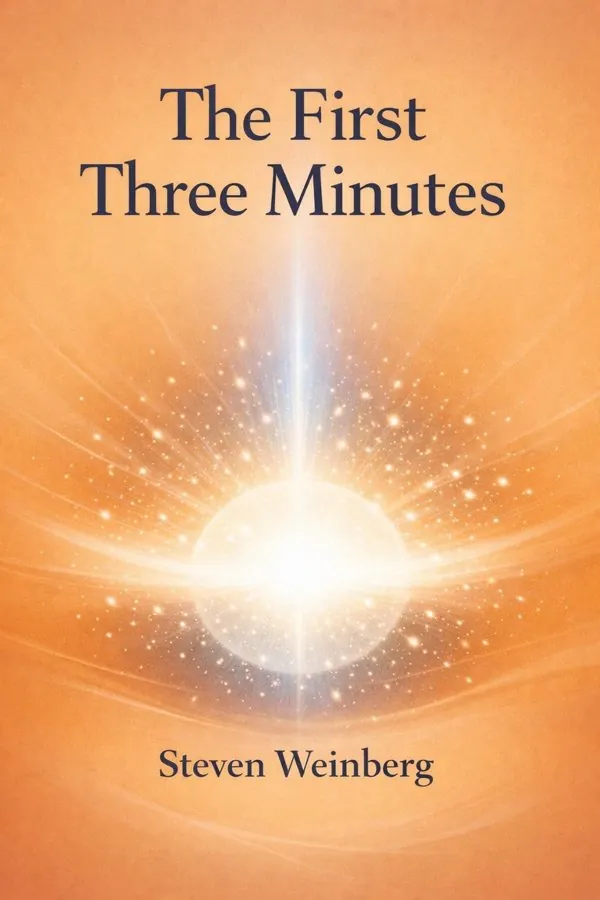
The First Three Minutes: A Modern View of the Origin of the Universe: Summary & Key Insights
 10 min9 chaptersAudio available
What Is The First Three Minutes: A Modern View of the Origin of the Universe About?
The First Three Minutes: A Modern View of the Origin of the Universe by Steven Weinberg is a popular_sci book spanning 9 pages. In this landmark work, Nobel laureate Steven Weinberg explains the first three minutes after the Big Bang, when the universe was born and the fundamental forces and particles that shape everything came into being. Written for a general audience, the book combines clarity and scientific rigor to describe how modern cosmology reconstructs the earliest moments of the cosmos and how the laws of physics reveal the universe’s origin and evolution.
This FizzRead summary covers all 9 key chapters of The First Three Minutes: A Modern View of the Origin of the Universe in approximately 10 minutes, distilling the most important ideas, arguments, and takeaways from Steven Weinberg's work. Also available as an audio summary and Key Quotes Podcast.
The First Three Minutes: A Modern View of the Origin of the Universe
In this landmark work, Nobel laureate Steven Weinberg explains the first three minutes after the Big Bang, when the universe was born and the fundamental forces and particles that shape everything came into being. Written for a general audience, the book combines clarity and scientific rigor to describe how modern cosmology reconstructs the earliest moments of the cosmos and how the laws of physics reveal the universe’s origin and evolution.
Who Should Read The First Three Minutes: A Modern View of the Origin of the Universe?
This book is perfect for anyone interested in popular_sci and looking to gain actionable insights in a short read. Whether you're a student, professional, or lifelong learner, the key ideas from The First Three Minutes: A Modern View of the Origin of the Universe by Steven Weinberg will help you think differently.
- ✓Readers who enjoy popular_sci and want practical takeaways
- ✓Professionals looking to apply new ideas to their work and life
- ✓Anyone who wants the core insights of The First Three Minutes: A Modern View of the Origin of the Universe in just 10 minutes
Want the full summary?
Get instant access to this book summary and 100K+ more with Fizz Moment.
Get Free SummaryAvailable on App Store • Free to download
Key Chapters
In the 1920s, Edwin Hubble noticed a remarkable trend: galaxies were not static. The light they emitted was shifted toward the red end of the spectrum, implying that they were moving away from us. The farther the galaxy, the greater its recession speed. This discovery shattered the long-held belief in a steady, unchanging cosmos. When I first encountered Hubble’s graphs, what struck me most was not their simplicity, but their profundity. They meant the universe was dynamic—stretching, evolving, and potentially had a beginning.
The redshift is not a Doppler effect of galaxies flying through space like bullets but rather a consequence of space itself expanding. As space stretches, the wavelengths of light traveling through it lengthen as well, painting a cosmological fingerprint that tells us how expansion has occurred over time. From this evidence emerged the Big Bang model—a theory that says the universe was once compressed into a denser, hotter state and has been expanding and cooling ever since.
For me, the beauty of this insight lay not merely in its empirical success but in its philosophical resonance. The cosmos is not eternal—it has history. Every atom of your body was once part of a primordial fireball that filled all of space. Understanding this brought together physics, astronomy, and metaphysics in a unity that underscores our deep connection to the universe’s evolution.
As we trace cosmic history backward from galaxies and stars, we find that the temperature and density rise rapidly. In those first instants, the universe was nothing but energy and elementary particles subjected to intense interactions. Matter and radiation were in thermal equilibrium—energy continually transformed into particles and back again.
At temperatures of billions of degrees, the familiar distinctions between matter and energy blur. Electrons and positrons, protons and neutrons, photons and neutrinos—all coexist in a cauldron of creation. To describe this epoch, we rely on quantum mechanics and general relativity—disciplines that at times seem philosophically opposed but are united in their necessity for cosmology.
This early universe was finely balanced. The forces—the strong nuclear, weak nuclear, electromagnetic, and gravitational—governed every interaction. When I explain this period, I emphasize the equilibrium because it reveals the simplicity underlying complexity. Despite the chaos of high energy, the universe behaved predictably, following thermodynamic laws that dictate how energy distributes itself. In understanding these principles, we come to see that the universe’s birth was not random turmoil but a process that obeyed universal elegance.
+ 7 more chapters — available in the FizzRead app
All Chapters in The First Three Minutes: A Modern View of the Origin of the Universe
About the Author
Steven Weinberg (1933–2021) was an American theoretical physicist and Nobel laureate recognized for his contributions to the unification of the weak force and electromagnetic interaction. He was a professor at the University of Texas at Austin and the author of several influential books on physics and cosmology.
Get This Summary in Your Preferred Format
Read or listen to the The First Three Minutes: A Modern View of the Origin of the Universe summary by Steven Weinberg anytime, anywhere. FizzRead offers multiple formats so you can learn on your terms — all free.
Available formats: App · Audio · PDF · EPUB — All included free with FizzRead
Download The First Three Minutes: A Modern View of the Origin of the Universe PDF and EPUB Summary
Key Quotes from The First Three Minutes: A Modern View of the Origin of the Universe
“In the 1920s, Edwin Hubble noticed a remarkable trend: galaxies were not static.”
“As we trace cosmic history backward from galaxies and stars, we find that the temperature and density rise rapidly.”
Frequently Asked Questions about The First Three Minutes: A Modern View of the Origin of the Universe
The First Three Minutes: A Modern View of the Origin of the Universe by Steven Weinberg is a popular_sci book that explores key ideas across 9 chapters. In this landmark work, Nobel laureate Steven Weinberg explains the first three minutes after the Big Bang, when the universe was born and the fundamental forces and particles that shape everything came into being. Written for a general audience, the book combines clarity and scientific rigor to describe how modern cosmology reconstructs the earliest moments of the cosmos and how the laws of physics reveal the universe’s origin and evolution.
You Might Also Like

Structures: Or Why Things Don"t Fall Down
J.E. Gordon
10 min
The Road to Wigan Pier
George Orwell
10 min
Bonk: The Curious Coupling of Science and Sex
Mary Roach
10 min
First Bite: How We Learn to Eat
Bee Wilson
10 min
In Pursuit Of The Unknown: 17 Equations That Changed The World
Ian Stewart
10 min
Napoleon's Buttons: 17 Molecules That Changed History
Penny Le Couteur and Jay Burreson
10 minBrowse by Category
Ready to read The First Three Minutes: A Modern View of the Origin of the Universe?
Get the full summary and 100K+ more books with Fizz Moment.