
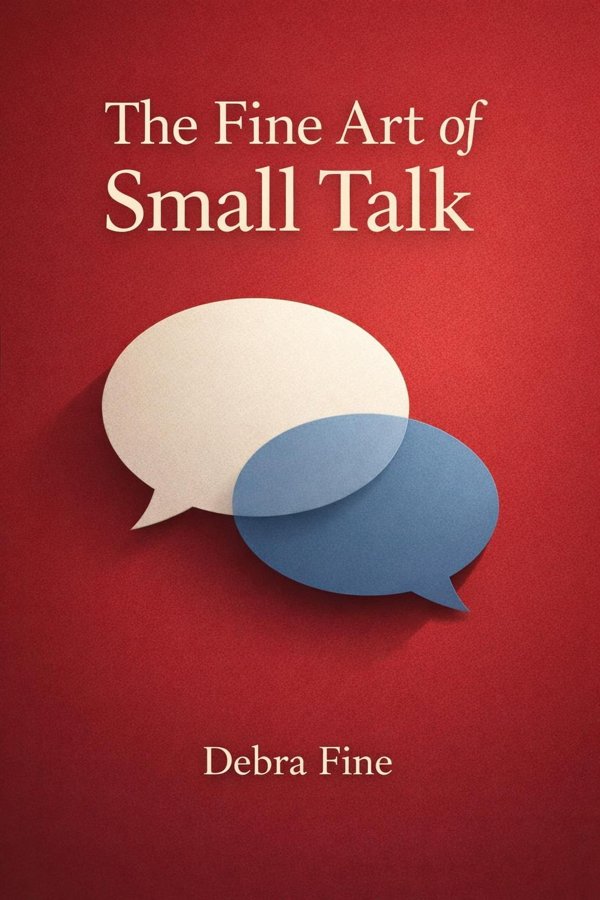
The Fine Art Of Small Talk: How to Start a Conversation, Keep It Going, Build Networking Skills—and Leave a Positive Impression!: Summary & Key Insights
by Debra Fine
 10 min11 chaptersAudio available
What Is The Fine Art Of Small Talk: How to Start a Conversation, Keep It Going, Build Networking Skills—and Leave a Positive Impression! About?
The Fine Art Of Small Talk: How to Start a Conversation, Keep It Going, Build Networking Skills—and Leave a Positive Impression! by Debra Fine is a communication book spanning 11 pages. This book offers practical guidance on mastering the art of conversation in social and professional settings. Debra Fine provides techniques for initiating dialogue, maintaining engaging exchanges, and gracefully exiting conversations. It emphasizes confidence-building and communication strategies that help readers connect meaningfully with others.
This FizzRead summary covers all 11 key chapters of The Fine Art Of Small Talk: How to Start a Conversation, Keep It Going, Build Networking Skills—and Leave a Positive Impression! in approximately 10 minutes, distilling the most important ideas, arguments, and takeaways from Debra Fine's work. Also available as an audio summary and Key Quotes Podcast.
The Fine Art Of Small Talk: How to Start a Conversation, Keep It Going, Build Networking Skills—and Leave a Positive Impression!
This book offers practical guidance on mastering the art of conversation in social and professional settings. Debra Fine provides techniques for initiating dialogue, maintaining engaging exchanges, and gracefully exiting conversations. It emphasizes confidence-building and communication strategies that help readers connect meaningfully with others.
Who Should Read The Fine Art Of Small Talk: How to Start a Conversation, Keep It Going, Build Networking Skills—and Leave a Positive Impression!?
This book is perfect for anyone interested in communication and looking to gain actionable insights in a short read. Whether you're a student, professional, or lifelong learner, the key ideas from The Fine Art Of Small Talk: How to Start a Conversation, Keep It Going, Build Networking Skills—and Leave a Positive Impression! by Debra Fine will help you think differently.
- ✓Readers who enjoy communication and want practical takeaways
- ✓Professionals looking to apply new ideas to their work and life
- ✓Anyone who wants the core insights of The Fine Art Of Small Talk: How to Start a Conversation, Keep It Going, Build Networking Skills—and Leave a Positive Impression! in just 10 minutes
Want the full summary?
Get instant access to this book summary and 100K+ more with Fizz Moment.
Get Free SummaryAvailable on App Store • Free to download
Key Chapters
The first obstacle to genuine connection lies within our own minds. Many fear small talk because they associate it with insincerity or dread awkward silences that expose vulnerability. I once believed small talk was superficial, reserved for extroverts, or unnecessary for people focused on competence. I learned how wrong that belief was.
The reality is that every rich conversation, every genuine relationship, begins with an exchange that might look small on the surface. Communication barriers arise from misconceptions—thinking we need to be brilliant or perfectly smooth, fearing judgment, assuming others aren’t interested. Beneath those fears lies self-consciousness. We watch ourselves instead of engaging others. My own transformation began when I stopped focusing on my performance and started focusing on the person in front of me.
Understanding this psychological shift is crucial. The purpose of small talk isn't to impress; it's to connect. Once we release the pressure to entertain or to perform, we can relax and listen. People crave acknowledgment more than amusement. When you remove internal noise—those whispers of 'I’m boring,' 'I’ll say the wrong thing,'—you clear space for genuine attention. That attention is what others perceive as confidence.
Another barrier stems from assumption. We assume others don’t wish to talk, we assume the environment is unfriendly, or that our words will be unwelcome. When we enter interactions with defensiveness, our body language closes off opportunities. Yet when we approach with curiosity and warmth, doors open naturally. In my workshops, I often remind participants: your smile and eye contact can dissolve more tension than any clever remark.
By recognizing and addressing these barriers—internal insecurity, fear of judgment, perfectionism—we begin dismantling the walls that cut us off from rich interactions. Small talk becomes not a test, but a gift.
Confident conversation does not begin with the tongue—it begins with the mind. Preparation means cultivating an attitude of openness before you even greet anyone. The most natural conversationalists are those who enter a room already curious, their minds primed with interest rather than self-doubt.
Before any social or professional engagement, I recommend the simple act of mental priming. Remind yourself that others are as anxious as you are. They too crave connection, validation, and relief from solitude. When you focus on what you can give—a moment of listening, encouragement, or humor—the fear of rejection fades.
Preparation also involves having conversational 'ammunition,' not in the sense of rehearsed lines, but broader awareness. Current events, local happenings, and light subjects—weather, travel, technology, family milestones—are all natural gateways. However, being prepared is less about topics and more about mindset: be genuinely interested. That authenticity will show in your tone, your eyes, and your posture.
I often visualize a conversation as a dance. Both partners contribute to rhythm and flow. If you enter a room with self-conscious stiffness, your partner will mirror it. But if you arrive relaxed and attentive, it signals safety. People gravitate toward emotional safety.
In truth, preparation is as emotional as it is practical. You can carry an aura of confidence simply by focusing on others, asking yourself before approaching: 'How can I make this person feel at ease?' That question changes everything. It turns fear into service.
+ 9 more chapters — available in the FizzRead app
All Chapters in The Fine Art Of Small Talk: How to Start a Conversation, Keep It Going, Build Networking Skills—and Leave a Positive Impression!
About the Author
Debra Fine is an American author, keynote speaker, and communication expert known for her work on interpersonal skills and networking. She specializes in teaching conversational techniques that enhance professional and personal relationships.
Get This Summary in Your Preferred Format
Read or listen to the The Fine Art Of Small Talk: How to Start a Conversation, Keep It Going, Build Networking Skills—and Leave a Positive Impression! summary by Debra Fine anytime, anywhere. FizzRead offers multiple formats so you can learn on your terms — all free.
Available formats: App · Audio · PDF · EPUB — All included free with FizzRead
Download The Fine Art Of Small Talk: How to Start a Conversation, Keep It Going, Build Networking Skills—and Leave a Positive Impression! PDF and EPUB Summary
Key Quotes from The Fine Art Of Small Talk: How to Start a Conversation, Keep It Going, Build Networking Skills—and Leave a Positive Impression!
“The first obstacle to genuine connection lies within our own minds.”
“Confident conversation does not begin with the tongue—it begins with the mind.”
Frequently Asked Questions about The Fine Art Of Small Talk: How to Start a Conversation, Keep It Going, Build Networking Skills—and Leave a Positive Impression!
The Fine Art Of Small Talk: How to Start a Conversation, Keep It Going, Build Networking Skills—and Leave a Positive Impression! by Debra Fine is a communication book that explores key ideas across 11 chapters. This book offers practical guidance on mastering the art of conversation in social and professional settings. Debra Fine provides techniques for initiating dialogue, maintaining engaging exchanges, and gracefully exiting conversations. It emphasizes confidence-building and communication strategies that help readers connect meaningfully with others.
You Might Also Like

Magic Words: The Science and Secrets Behind Seven Words That Motivate, Engage, and Influence
Tim David
10 min
Talking Across The Divide: How to Communicate with People You Disagree with and Maybe Even Change the World
Justin Lee
10 min
The Exceptional Presenter: A Proven Formula to Open Up! and Own the Room
Timothy J. Koegel
10 min
4 Essential Keys to Effective Communication in Love, Life, Work--Anywhere!: Including the 12-Day Communication Challenge!
Bento C. Leal III
10 min
Active Listening Techniques: 30 Practical Tools to Hone Your Communication Skills
Nisha Gupta
10 min
Bargaining for Advantage: Negotiation Strategies for Reasonable People
G. Richard Shell
10 minBrowse by Category
Ready to read The Fine Art Of Small Talk: How to Start a Conversation, Keep It Going, Build Networking Skills—and Leave a Positive Impression!?
Get the full summary and 100K+ more books with Fizz Moment.