
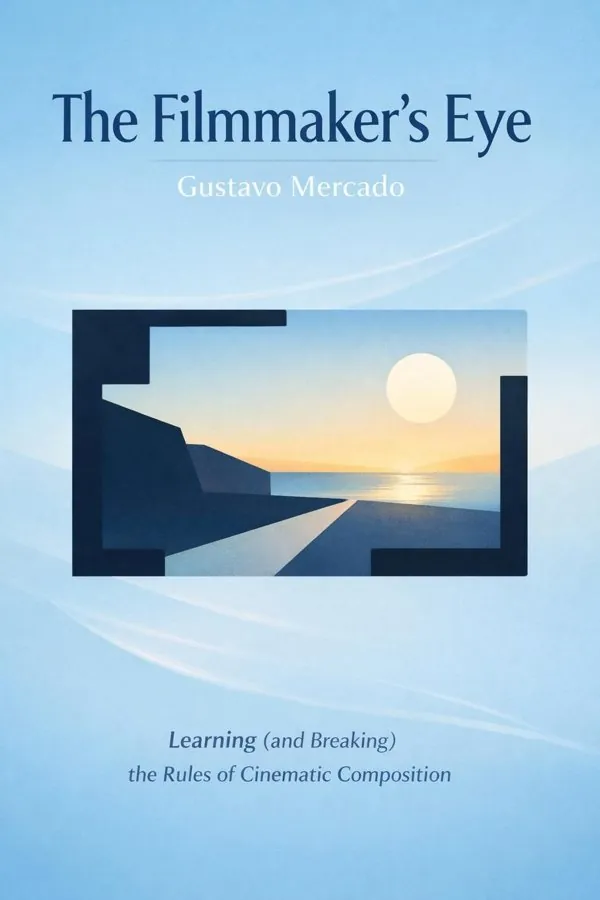
The Filmmaker's Eye: Learning (and Breaking) the Rules of Cinematic Composition: Summary & Key Insights
 10 min6 chaptersAudio available
What Is The Filmmaker's Eye: Learning (and Breaking) the Rules of Cinematic Composition About?
The Filmmaker's Eye: Learning (and Breaking) the Rules of Cinematic Composition by Gustavo Mercado is a film book spanning 6 pages. The Filmmaker's Eye es una guía visual que explora los principios de la composición cinematográfica. A través de ejemplos de películas reales, Gustavo Mercado analiza cómo los directores utilizan el encuadre, la perspectiva, la luz y el movimiento de cámara para contar historias visualmente efectivas. El libro ofrece un enfoque práctico para aprender las reglas del lenguaje visual y cómo romperlas de manera creativa para lograr un impacto narrativo.
This FizzRead summary covers all 6 key chapters of The Filmmaker's Eye: Learning (and Breaking) the Rules of Cinematic Composition in approximately 10 minutes, distilling the most important ideas, arguments, and takeaways from Gustavo Mercado's work. Also available as an audio summary and Key Quotes Podcast.
The Filmmaker's Eye: Learning (and Breaking) the Rules of Cinematic Composition
The Filmmaker's Eye es una guía visual que explora los principios de la composición cinematográfica. A través de ejemplos de películas reales, Gustavo Mercado analiza cómo los directores utilizan el encuadre, la perspectiva, la luz y el movimiento de cámara para contar historias visualmente efectivas. El libro ofrece un enfoque práctico para aprender las reglas del lenguaje visual y cómo romperlas de manera creativa para lograr un impacto narrativo.
Who Should Read The Filmmaker's Eye: Learning (and Breaking) the Rules of Cinematic Composition?
This book is perfect for anyone interested in film and looking to gain actionable insights in a short read. Whether you're a student, professional, or lifelong learner, the key ideas from The Filmmaker's Eye: Learning (and Breaking) the Rules of Cinematic Composition by Gustavo Mercado will help you think differently.
- ✓Readers who enjoy film and want practical takeaways
- ✓Professionals looking to apply new ideas to their work and life
- ✓Anyone who wants the core insights of The Filmmaker's Eye: Learning (and Breaking) the Rules of Cinematic Composition in just 10 minutes
Want the full summary?
Get instant access to this book summary and 100K+ more with Fizz Moment.
Get Free SummaryAvailable on App Store • Free to download
Key Chapters
The frame is the first and most powerful storytelling tool in cinema. It is both inclusion and exclusion, clarity and concealment. When I choose what enters the frame, I am choosing what the viewer will experience as reality. Every decision—the angle, aspect ratio, distance, and boundaries of that frame—immediately defines emotional proximity.
In 'The Filmmaker’s Eye', I explore how the frame functions as a visual contract with the audience. A wide shot establishes context; a close-up denies it. A centered composition can convey order or intimacy, while an off-center one can communicate unease, imbalance, or anticipation. The viewer’s eye is constantly guided, sometimes subtly manipulated, to feel rather than simply observe.
Framing choices are not neutral—they are rhetorical. A camera at eye level invites empathy; from below, it grants dominance; from above, vulnerability. I emphasize that understanding these effects equips filmmakers to make conscious decisions rather than intuitive guesses. The art lies in transforming space and boundaries into narrative meaning.
Through case studies—such as how 'Rear Window' traps us within a voyeur’s limited perspective, or how 'The Shining' uses symmetrical framing to evoke dread—I demonstrate how composition creates mood long before the first line of dialogue. As filmmakers, our goal is not just to show, but to command attention, to orchestrate the viewer’s orbit around story and emotion.
Cinema’s grammar is written through shot types. Each shot type—not only wide, medium, or close-up, but also over-the-shoulder, point-of-view, and insert—has its own expressive potential. In the book, I urge filmmakers to think of shots as words in a sentence: alone, each has meaning; combined, they create syntax.
An establishing shot introduces context and spatial relationships. It prepares the viewer to enter a visual world. What follows—the medium shot—invites us into dialogue and action. Then the close-up, suddenly intimate, makes us feel what the character feels. I emphasize that manipulation of shot distance is manipulation of emotional distance. The closer the camera, the deeper the psychological engagement.
Understanding perspective extends beyond mere shot type. It’s about the emotional viewpoint—whose eyes we borrow, whose experience we share. When we shift perspective mid-scene, we shift allegiance and comprehension. Think of 'The Godfather’s' carefully plotted framing during power transitions: what begins with conversational parity turns into dominance as the camera subtly lowers, giving Michael Corleone visual mastery.
By analyzing dozens of film examples, I show that the shape of storytelling lies in the flow between these shots. Composition makes the cut meaningful. To compose with intent is to anticipate how each shot lives within the film’s rhythm, much like musical phrasing. The filmmaker’s eye always sees not only the shot in the present but how it converses with the next.
+ 4 more chapters — available in the FizzRead app
All Chapters in The Filmmaker's Eye: Learning (and Breaking) the Rules of Cinematic Composition
About the Author
Gustavo Mercado es un cineasta, fotógrafo y profesor de producción cinematográfica. Ha trabajado en numerosos proyectos de cortometrajes y enseña técnicas de composición y narrativa visual en instituciones de arte y cine. Su experiencia práctica y académica se refleja en su enfoque pedagógico sobre la creación cinematográfica.
Get This Summary in Your Preferred Format
Read or listen to the The Filmmaker's Eye: Learning (and Breaking) the Rules of Cinematic Composition summary by Gustavo Mercado anytime, anywhere. FizzRead offers multiple formats so you can learn on your terms — all free.
Available formats: App · Audio · PDF · EPUB — All included free with FizzRead
Download The Filmmaker's Eye: Learning (and Breaking) the Rules of Cinematic Composition PDF and EPUB Summary
Key Quotes from The Filmmaker's Eye: Learning (and Breaking) the Rules of Cinematic Composition
“The frame is the first and most powerful storytelling tool in cinema.”
“Cinema’s grammar is written through shot types.”
Frequently Asked Questions about The Filmmaker's Eye: Learning (and Breaking) the Rules of Cinematic Composition
The Filmmaker's Eye: Learning (and Breaking) the Rules of Cinematic Composition by Gustavo Mercado is a film book that explores key ideas across 6 chapters. The Filmmaker's Eye es una guía visual que explora los principios de la composición cinematográfica. A través de ejemplos de películas reales, Gustavo Mercado analiza cómo los directores utilizan el encuadre, la perspectiva, la luz y el movimiento de cámara para contar historias visualmente efectivas. El libro ofrece un enfoque práctico para aprender las reglas del lenguaje visual y cómo romperlas de manera creativa para lograr un impacto narrativo.
You Might Also Like
Cinematic Motion: A Workshop for Staging Scenes
Steven D. Katz
10 min
Film Directing: Shot by Shot: Visualizing from Concept to Screen
Steven D. Katz
10 min
In the Blink of an Eye: A Perspective on Film Editing
Walter Murch
10 min
Master Shots: 100 Advanced Camera Techniques to Get an Expensive Look on Your Low-Budget Movie
Christopher Kenworthy
10 min
On the Art of the Cinema
Kim Jong Il
10 minBrowse by Category
Ready to read The Filmmaker's Eye: Learning (and Breaking) the Rules of Cinematic Composition?
Get the full summary and 100K+ more books with Fizz Moment.