
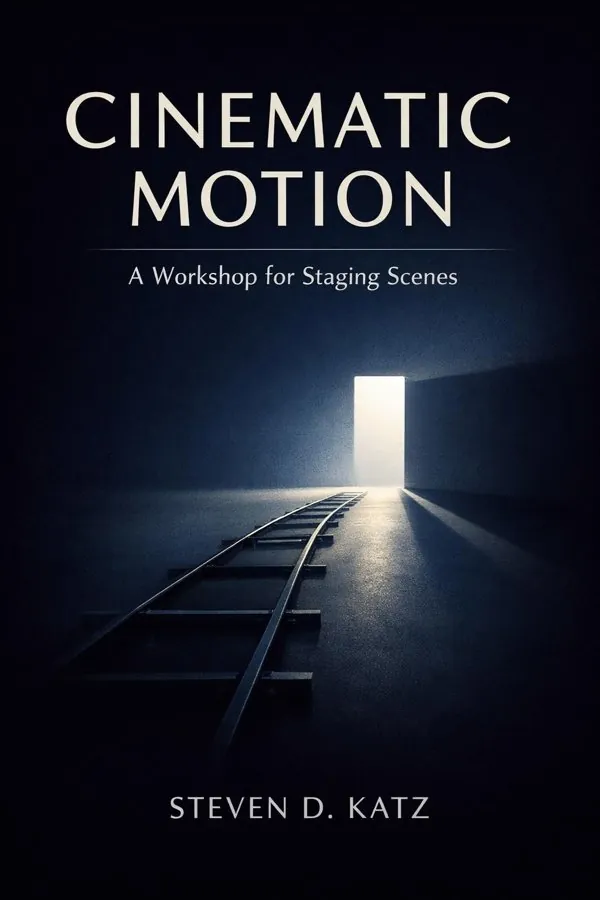
Cinematic Motion: A Workshop for Staging Scenes: Summary & Key Insights
 10 min10 chaptersAudio available
What Is Cinematic Motion: A Workshop for Staging Scenes About?
Cinematic Motion: A Workshop for Staging Scenes by Steven D. Katz is a film book spanning 10 pages. Cinematic Motion: A Workshop for Staging Scenes is a practical guide for filmmakers, directors, and cinematographers that explores the visual language of cinema. Written by Steven D. Katz, the book provides detailed instruction on how to design and stage scenes for maximum emotional and visual impact. It builds upon the author’s earlier work, Film Directing: Shot by Shot, and focuses on the dynamic aspects of camera movement, blocking, and composition to enhance storytelling.
This FizzRead summary covers all 10 key chapters of Cinematic Motion: A Workshop for Staging Scenes in approximately 10 minutes, distilling the most important ideas, arguments, and takeaways from Steven D. Katz's work. Also available as an audio summary and Key Quotes Podcast.
Cinematic Motion: A Workshop for Staging Scenes
Cinematic Motion: A Workshop for Staging Scenes is a practical guide for filmmakers, directors, and cinematographers that explores the visual language of cinema. Written by Steven D. Katz, the book provides detailed instruction on how to design and stage scenes for maximum emotional and visual impact. It builds upon the author’s earlier work, Film Directing: Shot by Shot, and focuses on the dynamic aspects of camera movement, blocking, and composition to enhance storytelling.
Who Should Read Cinematic Motion: A Workshop for Staging Scenes?
This book is perfect for anyone interested in film and looking to gain actionable insights in a short read. Whether you're a student, professional, or lifelong learner, the key ideas from Cinematic Motion: A Workshop for Staging Scenes by Steven D. Katz will help you think differently.
- ✓Readers who enjoy film and want practical takeaways
- ✓Professionals looking to apply new ideas to their work and life
- ✓Anyone who wants the core insights of Cinematic Motion: A Workshop for Staging Scenes in just 10 minutes
Want the full summary?
Get instant access to this book summary and 100K+ more with Fizz Moment.
Get Free SummaryAvailable on App Store • Free to download
Key Chapters
Every time the camera moves, it changes what the audience feels. In staging a scene, you’re not merely arranging bodies within space—you’re orchestrating human energy. Blocking defines relationships, and camera movement interprets them. When an actor crosses the frame, when another stays rooted, those movements express dominance, vulnerability, or resistance. How the camera responds to that behavior—whether it moves in tandem, resists, or observes neutrally—is a statement of empathy or objectivity.
I often tell my students: don’t move the camera unless you have a reason. Yet the reason doesn’t have to be psychological; it can be rhythmic, compositional, or even thematic. A slow, deliberate dolly might mirror a character’s internal focus. A sudden pan might puncture complacency or shock. Blocking, in turn, is your fundamental blueprint—how actors traverse and inhabit the spatial design. You should think of your set as a topographical map, where every route communicates power, hierarchy, or intimacy. The intersection of these two elements—the physical movement of actors and the calibrated motion of the camera—creates visual music.
When that harmony is achieved, the result is invisible but palpable. The viewer feels drawn into the experience rather than noticing technique. That is your measure of success: emotional transparency through technical mastery.
Motion defines character relationships far more vividly than dialogue. Consider two characters: one sits while the other paces. Even before a word is spoken, we sense restlessness versus control, initiative versus reflection. Blocking becomes an architecture of emotion—one that the camera must decode. Your task as a director is to design this architecture so that meaning unfolds seamlessly within the viewer’s perception.
A well-staged scene uses space as narrative tension. If characters stand too close or too far without intention, the emotional geometry collapses. But when spatial distances are chosen thoughtfully—through arcs of movement, entrances, and eyelines—the subtext becomes visible. The camera’s angle and path must acknowledge these relationships. A moving camera can join an alliance or intrude upon it. It can follow to express sympathy or stay detached to observe judgment.
In every scene, think of motion as conversation. Each shift in proximity or direction alters emotional rhythm. The technique is not about aesthetic flourish; it’s about aligning physical movement with psychological truth.
+ 8 more chapters — available in the FizzRead app
All Chapters in Cinematic Motion: A Workshop for Staging Scenes
About the Author
Steven D. Katz is an American filmmaker, educator, and author known for his influential books on film directing and visual storytelling. His works, including Film Directing: Shot by Shot and Cinematic Motion, are widely used in film schools and by professionals seeking to master the craft of cinematic composition and movement.
Get This Summary in Your Preferred Format
Read or listen to the Cinematic Motion: A Workshop for Staging Scenes summary by Steven D. Katz anytime, anywhere. FizzRead offers multiple formats so you can learn on your terms — all free.
Available formats: App · Audio · PDF · EPUB — All included free with FizzRead
Download Cinematic Motion: A Workshop for Staging Scenes PDF and EPUB Summary
Key Quotes from Cinematic Motion: A Workshop for Staging Scenes
“Every time the camera moves, it changes what the audience feels.”
“Motion defines character relationships far more vividly than dialogue.”
Frequently Asked Questions about Cinematic Motion: A Workshop for Staging Scenes
Cinematic Motion: A Workshop for Staging Scenes by Steven D. Katz is a film book that explores key ideas across 10 chapters. Cinematic Motion: A Workshop for Staging Scenes is a practical guide for filmmakers, directors, and cinematographers that explores the visual language of cinema. Written by Steven D. Katz, the book provides detailed instruction on how to design and stage scenes for maximum emotional and visual impact. It builds upon the author’s earlier work, Film Directing: Shot by Shot, and focuses on the dynamic aspects of camera movement, blocking, and composition to enhance storytelling.
More by Steven D. Katz
You Might Also Like
Film Directing: Shot by Shot: Visualizing from Concept to Screen
Steven D. Katz
10 min
In the Blink of an Eye: A Perspective on Film Editing
Walter Murch
10 min
Master Shots: 100 Advanced Camera Techniques to Get an Expensive Look on Your Low-Budget Movie
Christopher Kenworthy
10 min
On the Art of the Cinema
Kim Jong Il
10 min
The Filmmaker's Eye: Learning (and Breaking) the Rules of Cinematic Composition
Gustavo Mercado
10 minBrowse by Category
Ready to read Cinematic Motion: A Workshop for Staging Scenes?
Get the full summary and 100K+ more books with Fizz Moment.