
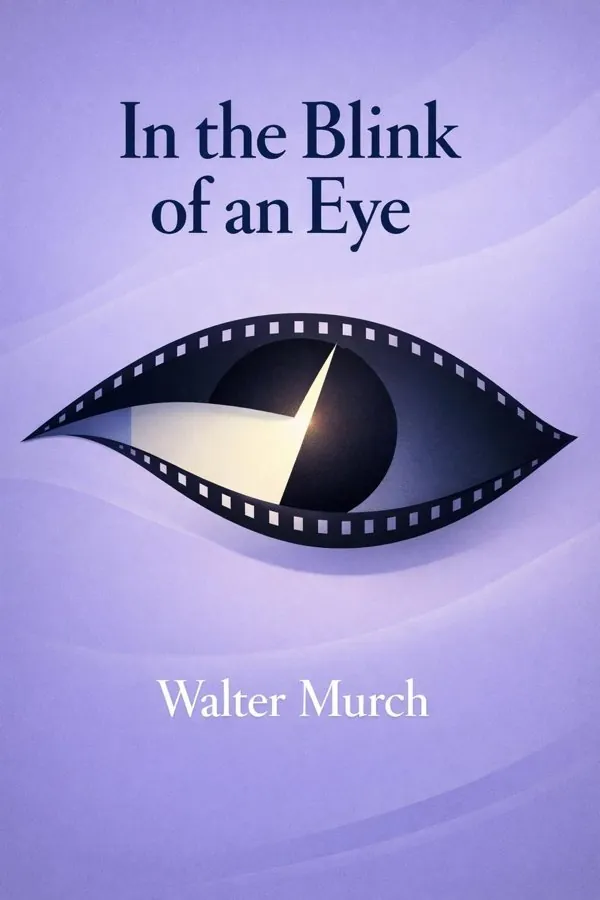
In the Blink of an Eye: A Perspective on Film Editing: Summary & Key Insights
by Walter Murch
 10 min9 chaptersAudio available
Key Takeaways from In the Blink of an Eye: A Perspective on Film Editing
A great cut often feels natural because it mirrors something deeply human: the way attention shifts in the mind.
Not all editing principles are equally important.
The most polished edit in the world fails if it does not move the audience.
Although editing often happens in a separate room and later in production, it is not a solitary art detached from the director’s vision.
Many of the best editorial decisions happen before they can be fully explained.
What Is In the Blink of an Eye: A Perspective on Film Editing About?
In the Blink of an Eye: A Perspective on Film Editing by Walter Murch is a film book spanning 11 pages. What makes one cut feel invisible and inevitable, while another feels jarring or empty? In In the Blink of an Eye, legendary film editor and sound designer Walter Murch offers a rare look into the hidden craft that shapes how movies think, feel, and move. Drawing on his work on landmark films such as Apocalypse Now, The Conversation, and The English Patient, Murch explains editing not as technical assembly but as an artistic act guided by emotion, rhythm, psychology, and intuition. At the heart of the book is a deceptively simple idea: a film cut resembles a blink. Just as we blink when thought shifts or emotion changes, a cut can mark a transition in attention, meaning, or feeling. From that insight, Murch develops a sophisticated philosophy of editing, including his famous “Rule of Six,” his reflections on the editor-director relationship, and his views on the transition from physical film to digital systems. This book matters because it reveals how cinema truly works beneath the surface. It is essential not only for editors and filmmakers, but for anyone curious about storytelling, perception, and the invisible decisions that shape powerful art.
This FizzRead summary covers all 9 key chapters of In the Blink of an Eye: A Perspective on Film Editing in approximately 10 minutes, distilling the most important ideas, arguments, and takeaways from Walter Murch's work. Also available as an audio summary and Key Quotes Podcast.
In the Blink of an Eye: A Perspective on Film Editing
What makes one cut feel invisible and inevitable, while another feels jarring or empty? In In the Blink of an Eye, legendary film editor and sound designer Walter Murch offers a rare look into the hidden craft that shapes how movies think, feel, and move. Drawing on his work on landmark films such as Apocalypse Now, The Conversation, and The English Patient, Murch explains editing not as technical assembly but as an artistic act guided by emotion, rhythm, psychology, and intuition.
At the heart of the book is a deceptively simple idea: a film cut resembles a blink. Just as we blink when thought shifts or emotion changes, a cut can mark a transition in attention, meaning, or feeling. From that insight, Murch develops a sophisticated philosophy of editing, including his famous “Rule of Six,” his reflections on the editor-director relationship, and his views on the transition from physical film to digital systems.
This book matters because it reveals how cinema truly works beneath the surface. It is essential not only for editors and filmmakers, but for anyone curious about storytelling, perception, and the invisible decisions that shape powerful art.
Who Should Read In the Blink of an Eye: A Perspective on Film Editing?
This book is perfect for anyone interested in film and looking to gain actionable insights in a short read. Whether you're a student, professional, or lifelong learner, the key ideas from In the Blink of an Eye: A Perspective on Film Editing by Walter Murch will help you think differently.
- ✓Readers who enjoy film and want practical takeaways
- ✓Professionals looking to apply new ideas to their work and life
- ✓Anyone who wants the core insights of In the Blink of an Eye: A Perspective on Film Editing in just 10 minutes
Want the full summary?
Get instant access to this book summary and 100K+ more with Fizz Moment.
Get Free SummaryAvailable on App Store • Free to download
Key Chapters
A great cut often feels natural because it mirrors something deeply human: the way attention shifts in the mind. Murch’s central metaphor is that the film cut resembles a blink. We do not blink randomly; we blink at meaningful moments, often when a thought completes, an emotion changes, or our focus resets. In the same way, a well-placed cut can register an internal transition, not just an external change in camera angle.
This idea transforms editing from a mechanical process into a psychological one. The editor is not simply deciding where one shot ends and another begins. The editor is asking: when does the audience naturally need to reorient? When has a feeling landed? When has a thought completed? A cut that arrives too soon can feel nervous or confusing; one that arrives too late can feel dull or heavy. The most effective cuts often align with the audience’s unspoken mental timing.
You can see this in dialogue scenes. A cut may occur not when a character finishes speaking, but when another character silently understands, reacts, or shifts emotionally. In action scenes, the cut might come at the instant the viewer has absorbed the essential movement, not after every detail has been shown. Even in documentaries or video essays, transitions feel stronger when they follow a completed idea rather than arbitrary pacing.
Murch’s insight also suggests that editing is rooted in empathy. To cut well, you must sense how viewers process images, emotion, and information moment by moment. The editor becomes a guide for consciousness itself.
Actionable takeaway: When deciding where to cut, ask not “Where does the shot end?” but “Where does the thought or feeling change?”
Not all editing principles are equally important. Murch’s most famous contribution is the Rule of Six, a hierarchy of criteria for judging whether a cut works. In order of importance, they are: emotion, story, rhythm, eye-trace, two-dimensional plane of screen, and three-dimensional space of action. This ranking is revealing because it places human impact above technical correctness.
Emotion comes first because the audience must feel something. Story follows because the cut must clarify what matters in the narrative. Rhythm concerns timing and pulse. Eye-trace refers to where the viewer is looking on the screen and how smoothly attention travels across the cut. The final two criteria involve continuity: preserving screen direction and spatial logic. These matter, but Murch argues they matter less than many editors are taught to believe.
This is liberating. A cut can violate spatial continuity and still succeed if it preserves emotional truth and narrative clarity. Many memorable scenes do exactly that. A reaction shot inserted slightly “wrong” in continuity may still be perfect if it reveals the character’s true state at the right moment. Conversely, a perfectly matched cut can feel dead if it contributes nothing emotionally.
The Rule of Six offers editors a practical framework for difficult decisions. When two possible cuts both work on paper, the better one is often the one that better serves feeling, then story, then rhythm. The framework also helps directors and producers understand why a scene may feel off even when continuity seems clean.
Actionable takeaway: Evaluate every cut using Murch’s hierarchy, and if you must sacrifice something, sacrifice technical neatness before emotion or story.
The most polished edit in the world fails if it does not move the audience. Murch insists that emotion is the primary criterion of editing because film is experienced first as feeling and only afterward as analysis. Viewers may not consciously notice a cut, but they instantly sense whether a scene feels true, tense, intimate, funny, or heartbreaking.
This principle changes how an editor approaches footage. Instead of asking only which shot is sharpest, best composed, or most continuous, the editor asks which shot carries the right emotional charge. Sometimes that means choosing an imperfect take because a glance, pause, breath, or stumble reveals more humanity than a technically superior version. A tiny flicker in an actor’s face can matter more than flawless camera alignment.
Think about a breakup scene. One version may preserve clean shot-reverse-shot structure, while another lingers unexpectedly on the person who says nothing. The second choice may break expected rhythm, but if it allows the audience to feel the emotional rupture, it is probably stronger. The same principle applies to suspense, comedy, and even informational content. In a documentary interview, the emotional honesty of a pause can be more persuasive than efficient trimming.
Murch’s emphasis on emotion also explains why editing is inseparable from ethics and judgment. Editors shape not only events but sympathy, tension, and meaning. They decide when viewers are allowed to connect, when they are forced to confront, and when they are released.
Actionable takeaway: In every scene, identify the dominant emotion first, then cut to intensify and clarify that feeling even if it means rejecting the most “perfect” technical option.
Many of the best editorial decisions happen before they can be fully explained. Murch treats intuition as essential to editing, but he does not present it as magic. Rather, intuition is the result of long exposure to story, image, sound, and human behavior. It is the mind’s fast way of integrating countless signals at once.
Editors often know a cut is wrong before they know why. A scene may drag, a transition may feel forced, or a reaction shot may arrive half a second too late. Later, the editor can analyze the issue in terms of rhythm, eye-trace, or emotional emphasis. But the first alert often comes as instinct. For Murch, this is not irrationality; it is expertise operating beneath conscious language.
This matters because beginners often overvalue explicit rules and undervalue felt experience. Technical knowledge is necessary, but editing also depends on sensitivity to timing, silence, tension, and release. The more films you watch closely, the more performances you study, and the more scenes you cut, the more refined your intuition becomes. It is a craft of repetition and perception.
At the same time, intuition needs testing. Editors must compare options, screen work for others, and remain open to surprise. Sometimes what feels bold in isolation proves confusing to an audience. Intuition is strongest when paired with reflection and revision.
Actionable takeaway: Trust your first emotional response to a cut, but then verify it by rewatching, comparing alternatives, and observing how real viewers experience the scene.
Audiences tend to think of editing as something done to pictures, but Murch’s career as both editor and sound designer gives him a wider perspective: sound is not secondary to image. In many cases, sound guides the cut, shapes expectation, and smooths transitions more powerfully than visuals alone. The ear can prepare the mind for a change before the eye fully registers it.
This is why sound bridges are so effective. A line of dialogue, ambient noise, or musical cue can begin before the image changes, allowing one scene to flow into the next with emotional continuity. Conversely, a sharp sound cut can create shock, humor, or disorientation. Silence, too, is an editorial tool. Removing background sound at the right moment can make a glance or gesture feel enormous.
Murch’s approach encourages editors to think in terms of audiovisual design rather than image sequencing alone. For example, a scene change from a crowded restaurant to a lonely bedroom may feel abrupt visually, but if the sound of clinking glasses fades into the hum of a bedside lamp or traffic outside, the transition gains psychological logic. In suspense scenes, letting us hear danger before we see it can heighten tension. In drama, lingering on a character while we hear someone else offscreen can shift power and meaning.
Modern creators across film, podcasts, online video, and advertising can apply this lesson. People often accept visual roughness if the sound design is coherent, but they rarely forgive sound that feels emotionally disconnected.
Actionable takeaway: Edit with your ears as carefully as your eyes, and test whether sound can motivate, soften, or sharpen each transition more effectively than picture alone.
One of editing’s greatest paradoxes is that its highest achievement often goes unnoticed. Murch describes editing as an invisible art because when it works well, viewers are absorbed in the story rather than admiring the cuts. This does not mean editing should be bland or anonymous. It means the technique is fully integrated into the experience of the film.
Invisible editing serves attention. It keeps the audience oriented emotionally and narratively without constantly reminding them of the mechanism. Continuity systems evolved for this reason, but Murch’s point is broader: invisibility is not merely matching eyelines or screen direction. It is creating a flow so persuasive that each cut feels inevitable.
Yet invisibility does not exclude boldness. A sudden jump, an elliptical transition, or a disruptive juxtaposition can still feel “invisible” at a deeper level if it expresses the scene’s emotional or psychological truth. In other words, the audience may notice the cut stylistically, but they will not resist it if it belongs to the film’s inner logic. The real problem is not visibility; it is arbitrariness.
This insight helps explain why flashy editing can age quickly when it chases novelty instead of meaning. Techniques become memorable for the wrong reasons when they interrupt rather than deepen the experience. Good editing disappears into dramatic effect, even when formally ambitious.
Actionable takeaway: Review your edits asking, “Does this draw attention to itself, or does it deepen the viewer’s immersion?” Keep the latter and reconsider the former unless self-conscious style is truly the point.
Murch wrote during a period when editing was shifting from physical film to digital systems, and his reflections remain remarkably relevant. He acknowledges that technology changes workflow, speed, access, and experimentation. Digital tools make it easier to try alternate versions, move scenes around, and work with enormous amounts of material. But these advances do not replace the editor’s judgment.
This distinction is crucial. New tools can encourage better work by lowering friction, yet they can also create endless options that blur decision-making. When everything is instantly adjustable, it becomes easier to postpone commitment. Murch suggests that constraints once imposed by physical film had certain advantages: they required thoughtfulness, discipline, and respect for process. Digital freedom is powerful, but only when guided by clear artistic priorities.
His view applies strongly today, in an era of nonlinear editing software, AI-assisted workflows, and constant content production. Faster editing does not automatically mean better storytelling. More transitions, more angles, and more revisions do not guarantee greater impact. The same core questions remain: What should the audience feel? What do they need to understand? When should attention shift?
The lesson extends beyond cinema. Writers, designers, and creators in all media face the same temptation to confuse technical possibility with artistic necessity. Tools matter, but they serve perception and meaning, not the other way around.
Actionable takeaway: Use technology to explore options quickly, but decide cuts according to emotion, story, and rhythm rather than the sheer convenience of endless digital manipulation.
What an editor removes is often more important than what remains. Murch’s philosophy repeatedly points to subtraction as the essence of editing. The editor does not simply assemble all available material into a complete sequence. The editor creates meaning by deciding what the audience should not see, when information should be withheld, and how gaps invite participation.
This is one reason editing feels so powerful. A cut can compress time, imply causality, conceal motivation, or force viewers to infer emotional connection. Show too much and a film becomes heavy-handed; show too little and it becomes obscure. The art lies in choosing the right absence. Audiences are not passive receivers of information. They are active interpreters, and well-judged omission engages their intelligence.
For example, a scene may not need the character entering a room, crossing to a chair, and sitting down. Cutting directly to the moment that matters preserves energy. More subtly, a reaction not shown can be more haunting than one spelled out. In thriller editing, withholding the source of a sound can intensify fear. In drama, cutting away before tears fall can preserve dignity and emotional complexity.
Murch’s case studies from his own work reinforce that editing is really the shaping of perception. The power of cinema often lies between shots, where viewers connect fragments into a whole. In that sense, editing is not merely about footage but about the mind completing patterns.
Actionable takeaway: In every scene, ask what can be removed without losing clarity, then cut further until only what is emotionally and narratively essential remains.
All Chapters in In the Blink of an Eye: A Perspective on Film Editing
About the Author
Walter Murch is an American film editor, sound designer, director, and writer whose work has had a major influence on modern cinema. Born in 1943, he became known for combining technical innovation with deep artistic insight, particularly in the fields of editing and sound. His film credits include The Conversation, Apocalypse Now, The Godfather Part III, and The English Patient, and he has won multiple Academy Awards for his contributions to film editing and sound. Murch is widely admired not only for his craftsmanship but also for his ability to explain the creative principles behind cinematic storytelling. In his writing and public speaking, he has helped generations of filmmakers understand editing as a psychological and emotional art, not merely a technical process.
Get This Summary in Your Preferred Format
Read or listen to the In the Blink of an Eye: A Perspective on Film Editing summary by Walter Murch anytime, anywhere. FizzRead offers multiple formats so you can learn on your terms — all free.
Available formats: App · Audio · PDF · EPUB — All included free with FizzRead
Download In the Blink of an Eye: A Perspective on Film Editing PDF and EPUB Summary
Key Quotes from In the Blink of an Eye: A Perspective on Film Editing
“A great cut often feels natural because it mirrors something deeply human: the way attention shifts in the mind.”
“Not all editing principles are equally important.”
“The most polished edit in the world fails if it does not move the audience.”
“Although editing often happens in a separate room and later in production, it is not a solitary art detached from the director’s vision.”
“Many of the best editorial decisions happen before they can be fully explained.”
Frequently Asked Questions about In the Blink of an Eye: A Perspective on Film Editing
In the Blink of an Eye: A Perspective on Film Editing by Walter Murch is a film book that explores key ideas across 9 chapters. What makes one cut feel invisible and inevitable, while another feels jarring or empty? In In the Blink of an Eye, legendary film editor and sound designer Walter Murch offers a rare look into the hidden craft that shapes how movies think, feel, and move. Drawing on his work on landmark films such as Apocalypse Now, The Conversation, and The English Patient, Murch explains editing not as technical assembly but as an artistic act guided by emotion, rhythm, psychology, and intuition. At the heart of the book is a deceptively simple idea: a film cut resembles a blink. Just as we blink when thought shifts or emotion changes, a cut can mark a transition in attention, meaning, or feeling. From that insight, Murch develops a sophisticated philosophy of editing, including his famous “Rule of Six,” his reflections on the editor-director relationship, and his views on the transition from physical film to digital systems. This book matters because it reveals how cinema truly works beneath the surface. It is essential not only for editors and filmmakers, but for anyone curious about storytelling, perception, and the invisible decisions that shape powerful art.
You Might Also Like
Cinematic Motion: A Workshop for Staging Scenes
Steven D. Katz
10 min
Film Directing: Shot by Shot: Visualizing from Concept to Screen
Steven D. Katz
10 min
Master Shots: 100 Advanced Camera Techniques to Get an Expensive Look on Your Low-Budget Movie
Christopher Kenworthy
10 min
On the Art of the Cinema
Kim Jong Il
10 min
The Filmmaker's Eye: Learning (and Breaking) the Rules of Cinematic Composition
Gustavo Mercado
10 minBrowse by Category
Ready to read In the Blink of an Eye: A Perspective on Film Editing?
Get the full summary and 100K+ more books with Fizz Moment.