
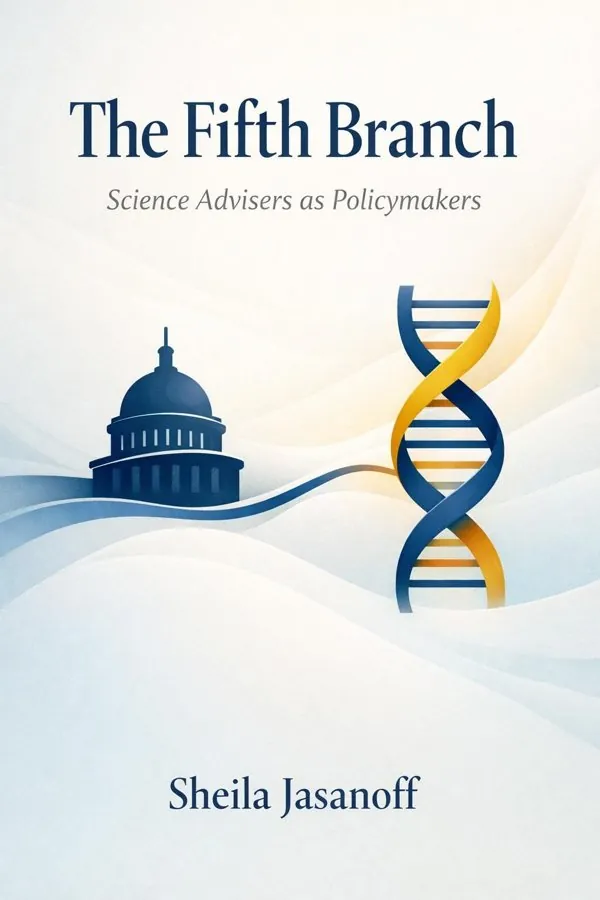
The Fifth Branch: Science Advisers as Policymakers: Summary & Key Insights
 10 min7 chaptersAudio available
What Is The Fifth Branch: Science Advisers as Policymakers About?
The Fifth Branch: Science Advisers as Policymakers by Sheila Jasanoff is a politics book spanning 7 pages. This book examines the role of science advisers in shaping public policy in the United States. Sheila Jasanoff explores how scientific expertise interacts with political decision-making, analyzing case studies from environmental regulation, biotechnology, and risk assessment. The work argues that science advisers act as a 'fifth branch' of government, mediating between scientific knowledge and democratic governance.
This FizzRead summary covers all 7 key chapters of The Fifth Branch: Science Advisers as Policymakers in approximately 10 minutes, distilling the most important ideas, arguments, and takeaways from Sheila Jasanoff's work. Also available as an audio summary and Key Quotes Podcast.
The Fifth Branch: Science Advisers as Policymakers
This book examines the role of science advisers in shaping public policy in the United States. Sheila Jasanoff explores how scientific expertise interacts with political decision-making, analyzing case studies from environmental regulation, biotechnology, and risk assessment. The work argues that science advisers act as a 'fifth branch' of government, mediating between scientific knowledge and democratic governance.
Who Should Read The Fifth Branch: Science Advisers as Policymakers?
This book is perfect for anyone interested in politics and looking to gain actionable insights in a short read. Whether you're a student, professional, or lifelong learner, the key ideas from The Fifth Branch: Science Advisers as Policymakers by Sheila Jasanoff will help you think differently.
- ✓Readers who enjoy politics and want practical takeaways
- ✓Professionals looking to apply new ideas to their work and life
- ✓Anyone who wants the core insights of The Fifth Branch: Science Advisers as Policymakers in just 10 minutes
Want the full summary?
Get instant access to this book summary and 100K+ more with Fizz Moment.
Get Free SummaryAvailable on App Store • Free to download
Key Chapters
The story of the fifth branch begins after World War II, when the success of scientific mobilization for the war effort inspired a new model of governance. Science was seen as the ultimate instrument of national strength and rational progress. Federal agencies expanded their research arms, advisory committees proliferated, and professional expertise became central to the very definition of competent government.
In this climate, the boundary between scientific inquiry and political action blurred. Agencies such as the Environmental Protection Agency (EPA) and the Food and Drug Administration (FDA) were staffed by people trained to think scientifically, even as they were tasked with enforcing laws that embodied ethical and social judgments. The Cold War amplified this reliance on science: nuclear strategy, health policy, and environmental monitoring all demanded forms of expertise that few public officials could themselves evaluate. Thus emerged an institutional need for intermediaries – scientists who could speak both to their peers and to policymakers. It was through these intermediaries that the federal government’s faith in science translated into administrative reality.
Yet with their growing influence came controversy. The advisory structure that had promised impartiality began to show signs of strain. The postwar dream of science as neutral truth-giver gave way to the recognition that advice is always framed by institutional interests, by norms of credibility and trust, and by the cultural assumptions scientists share with the societies they inhabit. To understand the fifth branch’s evolution, we must first acknowledge this profoundly social character of scientific knowledge – that expertise, too, is made, negotiated, and authorized.
The conceptual foundation of *The Fifth Branch* lies in understanding science as a social practice deeply intertwined with political and legal norms. Policymakers like to imagine science as offering ‘facts’ that can guide decisions; scientists often prefer to see politics as something that begins only after the facts are established. In practice, these two realms are never separate. Whenever an advisory committee sets a standard for ‘acceptable risk,’ or defines ‘significant exposure,’ it is making both a scientific and a moral judgment.
Legal frameworks reinforce this interdependence. U.S. administrative law requires agencies to justify their rules in rational, evidence-based terms. Judicial review thus becomes a powerful mechanism for deciding what counts as legitimate science. Courts, when reviewing regulatory actions, must grapple with the meaning of scientific uncertainty, methodological soundness, and peer credibility. A crucial argument I make is that science in the policy sphere operates under a hybrid logic – part epistemic, part normative. Its authority derives not from pure truth alone, but from its ability to fit within established legal and procedural forms.
Seen this way, the fifth branch is not a rogue institution but a cultural innovation: a mechanism by which democratic societies translate scientific complexity into legitimate public policy. Yet the very processes that lend science political authority – standardization, consensus-building, expert review – also obscure the contestable, value-laden character of expertise. By examining these processes sociologically and legally, we begin to see how democracy and science are co-produced, each shaping the boundaries of the other.
+ 5 more chapters — available in the FizzRead app
All Chapters in The Fifth Branch: Science Advisers as Policymakers
About the Author
Sheila Jasanoff is a professor of Science and Technology Studies at Harvard University’s Kennedy School of Government. Her research focuses on the relationship between science, technology, and law, and she is recognized as a leading scholar in the field of science policy and governance.
Get This Summary in Your Preferred Format
Read or listen to the The Fifth Branch: Science Advisers as Policymakers summary by Sheila Jasanoff anytime, anywhere. FizzRead offers multiple formats so you can learn on your terms — all free.
Available formats: App · Audio · PDF · EPUB — All included free with FizzRead
Download The Fifth Branch: Science Advisers as Policymakers PDF and EPUB Summary
Key Quotes from The Fifth Branch: Science Advisers as Policymakers
“The story of the fifth branch begins after World War II, when the success of scientific mobilization for the war effort inspired a new model of governance.”
“The conceptual foundation of *The Fifth Branch* lies in understanding science as a social practice deeply intertwined with political and legal norms.”
Frequently Asked Questions about The Fifth Branch: Science Advisers as Policymakers
The Fifth Branch: Science Advisers as Policymakers by Sheila Jasanoff is a politics book that explores key ideas across 7 chapters. This book examines the role of science advisers in shaping public policy in the United States. Sheila Jasanoff explores how scientific expertise interacts with political decision-making, analyzing case studies from environmental regulation, biotechnology, and risk assessment. The work argues that science advisers act as a 'fifth branch' of government, mediating between scientific knowledge and democratic governance.
You Might Also Like

Antifa: The Anti-Fascist Handbook
Mark Bray
10 min
Attack from Within: How Disinformation Is Sabotaging America
Barbara McQuade
10 min
Coercion, Capital, and European States, AD 990–1992
Charles Tilly
10 min
Digital Democracy: Concepts, Methodologies, Tools, and Applications
Various Authors
10 min
Fascism
Stanley G. Payne
10 min
Fire And Fury: Inside The Trump White House
Michael Wolff
10 minBrowse by Category
Ready to read The Fifth Branch: Science Advisers as Policymakers?
Get the full summary and 100K+ more books with Fizz Moment.