
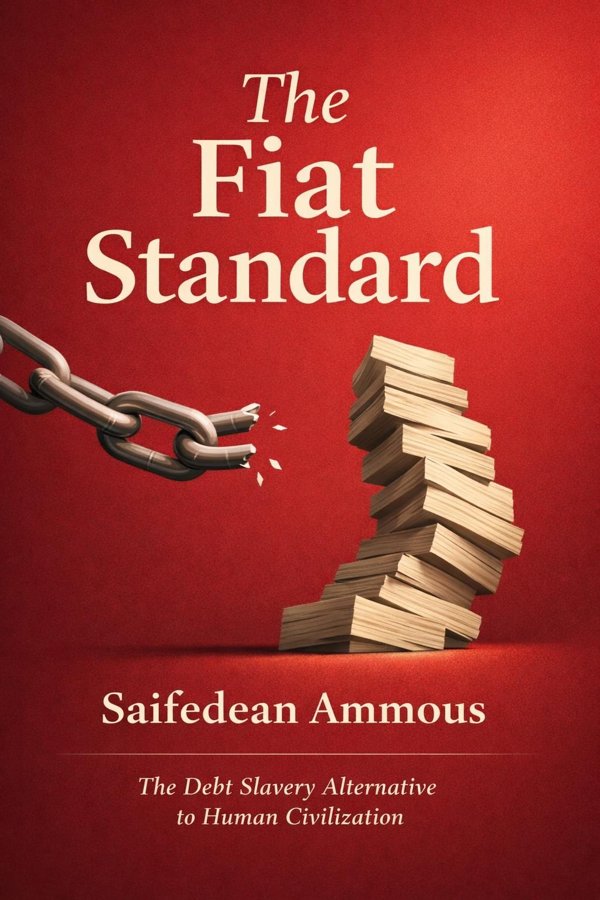
The Fiat Standard: The Debt Slavery Alternative to Human Civilization: Summary & Key Insights
 10 min9 chaptersAudio available
Key Takeaways from The Fiat Standard: The Debt Slavery Alternative to Human Civilization
Civilizations do not just choose money; money quietly shapes the civilization they become.
Ammous explains that the fiat system rests on central banking, commercial bank credit creation, and fractional reserve lending.
A society’s time horizon is often a monetary phenomenon.
Debt can finance growth, but under fiat conditions it can also become a system of social control.
Booms are exciting precisely because they hide the seeds of busts.
What Is The Fiat Standard: The Debt Slavery Alternative to Human Civilization About?
The Fiat Standard: The Debt Slavery Alternative to Human Civilization by Saifedean Ammous is a economics book spanning 5 pages. What if the modern world’s deepest problems are not random policy failures, but predictable consequences of the kind of money we use? In The Fiat Standard, economist Saifedean Ammous argues that fiat money—currency created and managed by governments and central banks—does far more than facilitate exchange. It shapes how societies borrow, save, invest, consume, educate, produce energy, and even imagine the future. As a follow-up to The Bitcoin Standard, this book broadens the discussion from Bitcoin itself to a sweeping critique of the monetary order that dominates the world today. Ammous contends that when money can be expanded at will, incentives across society become distorted. Debt grows faster than productivity, long-term planning gives way to short-term political fixes, and economic dependence deepens. He contrasts this with the discipline of sound money, which he believes encourages savings, capital formation, accountability, and civilizational progress. Whether or not readers agree with all his conclusions, the book offers a provocative framework for understanding inflation, debt, central banking, and Bitcoin’s appeal. Ammous writes with the authority of a trained economist and one of the most influential monetary thinkers in the Bitcoin space.
This FizzRead summary covers all 9 key chapters of The Fiat Standard: The Debt Slavery Alternative to Human Civilization in approximately 10 minutes, distilling the most important ideas, arguments, and takeaways from Saifedean Ammous's work. Also available as an audio summary and Key Quotes Podcast.
The Fiat Standard: The Debt Slavery Alternative to Human Civilization
What if the modern world’s deepest problems are not random policy failures, but predictable consequences of the kind of money we use? In The Fiat Standard, economist Saifedean Ammous argues that fiat money—currency created and managed by governments and central banks—does far more than facilitate exchange. It shapes how societies borrow, save, invest, consume, educate, produce energy, and even imagine the future. As a follow-up to The Bitcoin Standard, this book broadens the discussion from Bitcoin itself to a sweeping critique of the monetary order that dominates the world today.
Ammous contends that when money can be expanded at will, incentives across society become distorted. Debt grows faster than productivity, long-term planning gives way to short-term political fixes, and economic dependence deepens. He contrasts this with the discipline of sound money, which he believes encourages savings, capital formation, accountability, and civilizational progress. Whether or not readers agree with all his conclusions, the book offers a provocative framework for understanding inflation, debt, central banking, and Bitcoin’s appeal. Ammous writes with the authority of a trained economist and one of the most influential monetary thinkers in the Bitcoin space.
Who Should Read The Fiat Standard: The Debt Slavery Alternative to Human Civilization?
This book is perfect for anyone interested in economics and looking to gain actionable insights in a short read. Whether you're a student, professional, or lifelong learner, the key ideas from The Fiat Standard: The Debt Slavery Alternative to Human Civilization by Saifedean Ammous will help you think differently.
- ✓Readers who enjoy economics and want practical takeaways
- ✓Professionals looking to apply new ideas to their work and life
- ✓Anyone who wants the core insights of The Fiat Standard: The Debt Slavery Alternative to Human Civilization in just 10 minutes
Want the full summary?
Get instant access to this book summary and 100K+ more with Fizz Moment.
Get Free SummaryAvailable on App Store • Free to download
Key Chapters
Civilizations do not just choose money; money quietly shapes the civilization they become. Ammous begins by tracing the long historical shift from commodity money such as gold and silver toward fiat currency issued by states and administered by central banks. Under commodity standards, money was costly to produce, naturally limiting supply growth and rewarding saving, patience, and capital accumulation. Fiat money changed that relationship. Once currencies were detached from redeemable commodities, governments gained the power to expand the money supply far more easily, especially during wars, recessions, and political crises.
Ammous argues that this shift was not merely technical. It transformed the structure of economic life. Instead of money being a relatively stable measuring rod, it became a political instrument. That meant prices, interest rates, and credit conditions were increasingly shaped by policy rather than by decentralized market judgments. In practice, this encouraged larger governments, chronic deficits, and a financial system built around perpetual intervention.
A practical example is the difference between saving under a gold-like standard and saving under inflationary fiat conditions. In a harder-money environment, households can expect money to preserve purchasing power more reliably. In a fiat environment, they are pushed into riskier investments simply to avoid erosion from inflation. That changes behavior across generations.
Ammous’s larger point is that monetary history is civilizational history. The movement away from sound money altered incentives at every level of society, from households to empires. Actionable takeaway: examine any major economic problem—inflation, debt, housing bubbles, pension stress—by asking first what kind of money system made it possible.
Most people imagine money as something earned before it is spent, but modern finance often works in reverse: money is created through lending first, and repayment is expected later. Ammous explains that the fiat system rests on central banking, commercial bank credit creation, and fractional reserve lending. Central banks issue base money and influence the price of credit through interest rates, reserve policies, and asset purchases. Commercial banks then expand the effective money supply by issuing loans far in excess of physical reserves, creating deposit money in the process.
This arrangement gives the economy extraordinary flexibility, but Ammous sees that flexibility as dangerous. Because money creation is no longer tied closely to prior savings, credit can expand beyond the economy’s real productive capacity. That can temporarily create the illusion of prosperity—booming asset markets, cheap financing, abundant consumption—but it often ends in inflation, misallocated capital, or financial crisis.
Consider housing markets. When central banks suppress interest rates and banks aggressively extend mortgage credit, home prices can rise far faster than incomes. Buyers interpret higher prices as wealth, while policymakers celebrate apparent growth. Yet the gains are often debt-driven rather than productivity-driven. When rates rise or credit tightens, the fragility becomes obvious.
Ammous emphasizes that fiat money creation also redistributes wealth. Those closest to newly created money—governments, large banks, major corporations, asset owners—benefit first, while wage earners and savers often bear the later inflationary effects. Understanding this mechanism helps explain why many people feel poorer even when official indicators suggest growth. Actionable takeaway: when evaluating economic news, look beyond spending and credit expansion and ask whether real savings and productive output are growing too.
A society’s time horizon is often a monetary phenomenon. Ammous argues that fiat money systematically weakens long-term thinking because it reduces the reward for saving and increases the incentive to borrow, speculate, and consume now. If money is expected to lose purchasing power over time, then holding cash becomes costly. Households are nudged toward debt-financed lifestyles, businesses are encouraged to chase short-term earnings, and governments become even more comfortable funding promises through deficits.
The key concept here is time preference: the degree to which people prefer present consumption over future benefits. Ammous, drawing from Austrian economics, claims that sound money lowers time preference by making saving more effective, while fiat money raises it by punishing delayed gratification. This does not affect only financial portfolios. It influences family planning, business investment, educational priorities, and political culture.
A simple example is retirement planning. Under a stable monetary regime, ordinary saving can preserve value over long periods. Under inflationary fiat conditions, savers must become investors, often entering stock, bond, or property markets not from skill or conviction but from necessity. This financialization turns daily life into a defensive struggle against currency debasement.
Ammous also suggests that institutions behave similarly. Politicians favor visible short-run benefits over long-run sustainability because fiat systems make borrowing politically easier. Businesses prioritize quarterly performance when cheap credit and asset inflation dominate valuation. The result is a culture of immediacy.
Not everyone will accept this argument in full, but it offers a powerful lens: monetary design may shape moral and social behavior more deeply than we assume. Actionable takeaway: build habits that resist high-time-preference pressures—save deliberately, avoid unnecessary leverage, and evaluate choices by their long-term rather than immediate payoff.
Booms are exciting precisely because they hide the seeds of busts. Ammous argues that fiat money distorts production by sending false signals through artificially cheap credit and manipulated interest rates. In a market economy, interest rates help coordinate time: they reflect the tradeoff between present and future consumption and help entrepreneurs assess whether long-term projects are supported by real savings. When central banks suppress rates, businesses may interpret easy money as evidence of abundant capital, even when no such real savings exist.
This creates malinvestment—projects that appear profitable under distorted monetary conditions but prove unsustainable later. Entire sectors can expand on weak foundations: real estate booms, venture capital excesses, overbuilt infrastructure, and zombie companies surviving on cheap debt. International trade can also become imbalanced as reserve-currency countries finance imports with financial claims rather than productive exports.
For ordinary people, these distortions show up in surprising ways. A city may see luxury apartment towers rise while basic affordability worsens. Stock markets may soar while productivity stagnates. Businesses may prioritize financial engineering over making better goods. In each case, the monetary environment rewards appearances of growth rather than durable value creation.
Ammous’s broader claim is that fiat economies become increasingly financialized. Success goes not necessarily to the most productive firms, but often to those best positioned to access credit, arbitrage policy, or benefit from asset inflation. This weakens competitive discipline and makes economies less resilient.
The practical lesson is to separate nominal growth from real progress. More credit, higher valuations, and larger spending totals do not automatically mean healthier production. Actionable takeaway: whether as an investor, worker, or entrepreneur, look for businesses and sectors built on genuine demand, strong cash flow, and real productivity rather than easy financing.
Who controls money gains unusual influence over society’s priorities. One of Ammous’s central claims is that fiat money dramatically expands state power by allowing governments to spend beyond current taxation. Under harder monetary constraints, states must fund their ambitions through explicit taxation or borrowing that markets closely discipline. Under fiat systems, central banks can absorb government debt, suppress borrowing costs, and indirectly monetize deficits. This makes large-scale war, welfare programs, bailouts, and bureaucratic expansion easier to sustain.
Ammous sees this not as a neutral administrative convenience but as a profound political transformation. When citizens can be taxed through inflation rather than visible legislation, democratic accountability weakens. Costs are dispersed, delayed, and obscured. The public notices rising prices, deteriorating purchasing power, and asset inequality, but the causal chain is hard to trace. That opacity protects policymakers.
Recent examples make the argument concrete. Massive emergency spending programs can be launched quickly when governments know central banks stand ready to backstop bond markets. While such actions may stabilize crises in the short term, Ammous warns that they normalize extraordinary intervention and make future restraint politically harder.
He also links fiat finance to moral hazard. If large institutions expect rescue, they take greater risks. If governments can defer painful tradeoffs through monetary expansion, they postpone reform. Over time, this creates a culture where responsibility is diluted and scale is rewarded.
Even readers who support activist monetary policy may benefit from Ammous’s challenge: convenience in financing can erode institutional discipline. Money is never just economic plumbing; it is constitutional power by other means. Actionable takeaway: pay close attention to how public spending is financed, not just what it funds, and treat inflation as a political issue as much as an economic one.
Inflation is not just what happens at the grocery store; it is what happens when money loses its ability to coordinate reality. Ammous criticizes the narrow tendency to define inflation only as a rise in consumer price indices. In his view, inflation begins with monetary expansion itself, and its consequences ripple across assets, wages, savings behavior, family budgets, and institutional trust. A society can experience major monetary distortion even when official price baskets appear relatively subdued.
One reason is that newly created money does not affect all sectors equally. It may first lift stock prices, government bond markets, real estate values, or luxury assets long before it visibly raises everyday consumer costs. This uneven transmission benefits those with financial exposure and disadvantages those who depend mainly on wages or cash savings. It also creates the false impression that inflation is mild while inequality quietly widens.
Think of a young worker trying to buy a first home. Official inflation may seem manageable, but housing prices can race far ahead of earnings because asset markets are especially sensitive to low rates and credit expansion. To that person, inflation is not abstract—it is the widening distance between effort and ownership.
Ammous therefore urges readers to see inflation as a systemic process rather than a single statistic. It changes how people save, how businesses invest, and how governments justify intervention. It also damages trust in the price system, which is essential for rational economic calculation.
The practical implication is clear: personal financial planning must account for asset inflation, not just consumer inflation. Actionable takeaway: measure your own cost of living using the assets and necessities that matter most in your life—housing, healthcare, education, energy—not only headline inflation figures.
The strongest critique of a system often comes from the possibility of a real alternative. For Ammous, Bitcoin matters because it reintroduces monetary scarcity into a world defined by discretionary expansion. He presents Bitcoin not merely as a speculative asset or payment network, but as a form of sound money engineered for the digital age: decentralized, difficult to debase, globally transferable, and independent of state monetary management.
This matters because Ammous believes money should be something governments and central banks cannot manipulate for short-term goals. Bitcoin’s fixed supply schedule, predictable issuance, and resistance to censorship make it, in his view, the clearest contrast to fiat currency. Where fiat rewards leverage and political discretion, Bitcoin encourages saving, financial sovereignty, and long-term planning.
He does not claim transition would be easy. Bitcoin remains volatile, technically demanding for many users, and embedded in legal, tax, and regulatory environments designed around fiat institutions. But Ammous sees volatility as partly a result of monetization: an emerging monetary asset discovering global demand. He also argues that many criticisms of Bitcoin overlook the structural damage of the existing fiat order.
A practical application of his argument is personal diversification. Readers need not become maximalists to appreciate Bitcoin as insurance against monetary instability. Holding some savings in an asset with a capped supply can serve as a hedge against inflationary policy or banking fragility.
Ammous’s larger point is philosophical: monetary choice should be open to market competition, not monopolized by the state. Bitcoin is important because it makes that competition possible again. Actionable takeaway: if the thesis resonates, study Bitcoin seriously before dismissing it—focus on custody, monetary properties, and long-term allocation rather than short-term price excitement.
A civilization cannot plan wisely if the price of time itself is politically manipulated. In the book’s broadest argument, Ammous connects monetary systems to cultural and civilizational outcomes. He suggests that sound money is not just good economics; it is a precondition for sustainable progress. Stable money allows individuals and institutions to compare costs across time, save for the future, invest in durable projects, and coordinate complex production without constant fear of debasement.
When monetary signals are distorted, the damage spreads well beyond finance. Ammous extends his critique into areas such as education, healthcare, energy, and public policy. He argues that fiat-driven incentives favor scale over efficiency, debt over savings, bureaucracy over accountability, and consumption over stewardship. Institutions become larger but less effective because their budgets can expand without corresponding productivity gains.
For example, healthcare spending may balloon while outcomes improve only marginally, partly because abundant credit, insurance distortions, and state subsidies shield providers and consumers from direct price feedback. Similarly, energy policy can become more ideological and less economically disciplined when funding costs are politically suppressed.
Whether or not every example convinces, Ammous pushes readers to see money as foundational infrastructure for social coordination. Honest money supports honest accounting, and honest accounting supports responsible civilization. If the measuring rod keeps changing, planning becomes political guesswork.
His final implication is optimistic as well as critical: changing money can change behavior. Better incentives can foster thrift, resilience, entrepreneurship, and genuine wealth creation over time. Actionable takeaway: adopt a long-term lens in both personal and professional life, and favor systems, institutions, and investments that rely on transparency, real feedback, and durable value rather than monetary distortion.
All Chapters in The Fiat Standard: The Debt Slavery Alternative to Human Civilization
About the Author
Saifedean Ammous is a Lebanese-American economist, author, and commentator known for his work on monetary theory, Austrian economics, and Bitcoin. He earned a PhD in Sustainable Development from Columbia University and has taught economics at the Lebanese American University. Ammous gained international recognition with The Bitcoin Standard, a book that helped popularize Bitcoin as a form of sound money and became highly influential in cryptocurrency circles. His writing focuses on the relationship between money, time preference, capital accumulation, and civilization. In The Fiat Standard, he extends that analysis into a broader critique of government-issued money and debt-based finance. Ammous is regarded as one of the most prominent advocates of Bitcoin’s monetary thesis and a distinctive voice in contemporary debates over inflation, central banking, and economic freedom.
Get This Summary in Your Preferred Format
Read or listen to the The Fiat Standard: The Debt Slavery Alternative to Human Civilization summary by Saifedean Ammous anytime, anywhere. FizzRead offers multiple formats so you can learn on your terms — all free.
Available formats: App · Audio · PDF · EPUB — All included free with FizzRead
Download The Fiat Standard: The Debt Slavery Alternative to Human Civilization PDF and EPUB Summary
Key Quotes from The Fiat Standard: The Debt Slavery Alternative to Human Civilization
“Civilizations do not just choose money; money quietly shapes the civilization they become.”
“Most people imagine money as something earned before it is spent, but modern finance often works in reverse: money is created through lending first, and repayment is expected later.”
“A society’s time horizon is often a monetary phenomenon.”
“Debt can finance growth, but under fiat conditions it can also become a system of social control.”
“Booms are exciting precisely because they hide the seeds of busts.”
Frequently Asked Questions about The Fiat Standard: The Debt Slavery Alternative to Human Civilization
The Fiat Standard: The Debt Slavery Alternative to Human Civilization by Saifedean Ammous is a economics book that explores key ideas across 9 chapters. What if the modern world’s deepest problems are not random policy failures, but predictable consequences of the kind of money we use? In The Fiat Standard, economist Saifedean Ammous argues that fiat money—currency created and managed by governments and central banks—does far more than facilitate exchange. It shapes how societies borrow, save, invest, consume, educate, produce energy, and even imagine the future. As a follow-up to The Bitcoin Standard, this book broadens the discussion from Bitcoin itself to a sweeping critique of the monetary order that dominates the world today. Ammous contends that when money can be expanded at will, incentives across society become distorted. Debt grows faster than productivity, long-term planning gives way to short-term political fixes, and economic dependence deepens. He contrasts this with the discipline of sound money, which he believes encourages savings, capital formation, accountability, and civilizational progress. Whether or not readers agree with all his conclusions, the book offers a provocative framework for understanding inflation, debt, central banking, and Bitcoin’s appeal. Ammous writes with the authority of a trained economist and one of the most influential monetary thinkers in the Bitcoin space.
More by Saifedean Ammous
You Might Also Like

Business Adventures
John Brooks
10 min
Nudge
Richard H. Thaler, Cass R. Sunstein
10 min
The Hitchhiker"s Guide to the Galaxy
Douglas Adams
10 minThe Muqaddimah
Ibn Khaldun
10 minThe Outsiders
William N. Thorndike
10 min
A Little History of Economics
Niall Kishtainy
10 minBrowse by Category
Ready to read The Fiat Standard: The Debt Slavery Alternative to Human Civilization?
Get the full summary and 100K+ more books with Fizz Moment.