
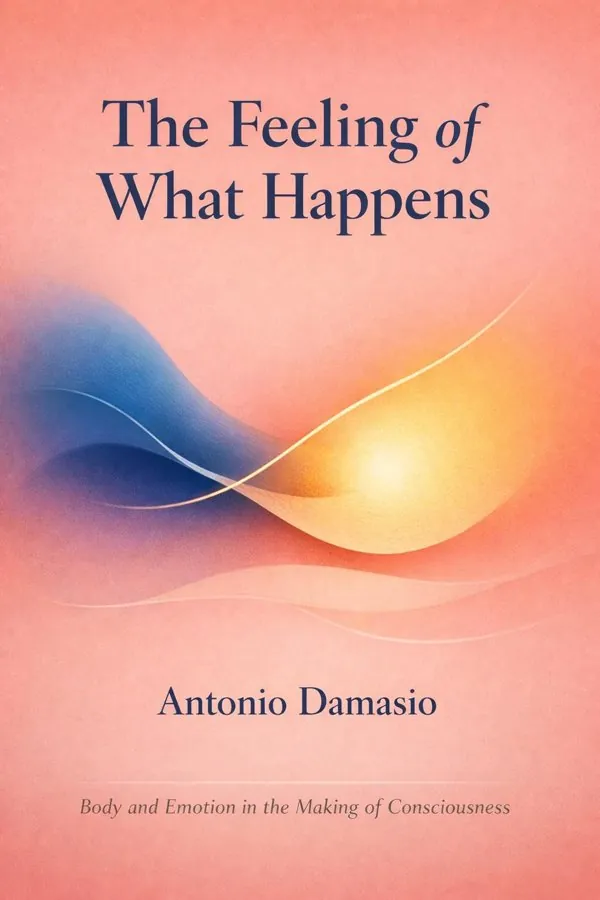
The Feeling of What Happens: Body and Emotion in the Making of Consciousness: Summary & Key Insights
 10 min6 chaptersAudio available
What Is The Feeling of What Happens: Body and Emotion in the Making of Consciousness About?
The Feeling of What Happens: Body and Emotion in the Making of Consciousness by Antonio Damasio is a neuroscience book spanning 6 pages. In this influential work, neuroscientist Antonio Damasio explores how emotions and bodily states are integral to the emergence of consciousness. He argues that the sense of self arises from the brain’s mapping of the body’s internal states, linking emotion, feeling, and reason in a unified theory of mind. Drawing on neurological case studies and evolutionary insights, Damasio presents a compelling account of how consciousness develops from the interplay between body and brain.
This FizzRead summary covers all 6 key chapters of The Feeling of What Happens: Body and Emotion in the Making of Consciousness in approximately 10 minutes, distilling the most important ideas, arguments, and takeaways from Antonio Damasio's work. Also available as an audio summary and Key Quotes Podcast.
The Feeling of What Happens: Body and Emotion in the Making of Consciousness
In this influential work, neuroscientist Antonio Damasio explores how emotions and bodily states are integral to the emergence of consciousness. He argues that the sense of self arises from the brain’s mapping of the body’s internal states, linking emotion, feeling, and reason in a unified theory of mind. Drawing on neurological case studies and evolutionary insights, Damasio presents a compelling account of how consciousness develops from the interplay between body and brain.
Who Should Read The Feeling of What Happens: Body and Emotion in the Making of Consciousness?
This book is perfect for anyone interested in neuroscience and looking to gain actionable insights in a short read. Whether you're a student, professional, or lifelong learner, the key ideas from The Feeling of What Happens: Body and Emotion in the Making of Consciousness by Antonio Damasio will help you think differently.
- ✓Readers who enjoy neuroscience and want practical takeaways
- ✓Professionals looking to apply new ideas to their work and life
- ✓Anyone who wants the core insights of The Feeling of What Happens: Body and Emotion in the Making of Consciousness in just 10 minutes
Want the full summary?
Get instant access to this book summary and 100K+ more with Fizz Moment.
Get Free SummaryAvailable on App Store • Free to download
Key Chapters
To grasp consciousness, we must first understand the organism itself — the living body that sustains every mental act. The brain is constantly engaged in the task of mapping the body’s internal states: heartbeat, temperature, hormonal flux, and visceral tension all generate patterns that the brain continuously watches over. These mappings do not appear to consciousness directly, yet they are the silent scaffolding upon which the sense of self is built.
In my research, I found that the brainstem and somatosensory cortices maintain a permanent image of the body’s condition, a kind of dynamic mirror of our internal terrain. This representation is not decorative; it enables regulation and prediction. The organism adjusts itself to ensure continued survival. The most ancient parts of the nervous system are invested in this homeostatic watchfulness. Long before we think or reflect, we *feel* the stability or threat to our bodily integrity.
From this biological substrate emerges the self. The self is not an abstract essence but a process: the ongoing narrative the brain constructs about the organism’s state in relation to its environment. When we consider consciousness, we must imagine it not as a detached flame flickering atop the brain but as a field in which body and world continuously meet. Every perception, every thought, carries the mark of the body that experiences it.
This is the beginning of selfhood: a living system aware, at least implicitly, of its own existence as it acts. The sense of self originates not from cognition alone but from the biological reality of being an organism that feels its own regulation.
One of the pivotal distinctions I emphasize in this book is between emotion and feeling. Though often conflated in colloquial speech, they refer to different levels of the same phenomenon. Emotion is fundamentally a set of bodily responses orchestrated by the brain — patterns of heart rate changes, hormonal adjustments, facial expressions, and motor activities. Feeling, by contrast, is what happens when the mind becomes aware that those emotional changes are occurring.
Consider fear. When danger looms, the body responds automatically: the heart races, muscles tense, pupils dilate. These are emotions in action — biological programs honed by evolution. But when the mind detects these changes, when it *feels* the racing heart and interprets it as a sign of threat, consciousness emerges in the form of the experience called fear. Without that awareness, emotion remains purely physiological. With feeling, it becomes part of the self’s narrative.
This distinction allows us to understand why emotions play such a crucial role in consciousness. They are the signals through which the body informs the brain about its state of viability. Feelings translate those signals into subjective qualities — they make the machinery of life felt within the theater of mind. The feeling is not an accessory; it is the experiential echo of the body’s regulation.
In studying patients whose brain lesions disrupted emotional processing, I found that without emotion, reason collapses. Decision-making requires the intuition of value, the emotional weight that tells us what matters. Feelings of joy, sadness, and empathy are the guides that allow rationality to navigate the complexity of life. The mind without feeling is blind to its own interests.
+ 4 more chapters — available in the FizzRead app
All Chapters in The Feeling of What Happens: Body and Emotion in the Making of Consciousness
About the Author
Antonio Damasio is a Portuguese-American neuroscientist and professor known for his pioneering research on the neural basis of emotions, decision-making, and consciousness. He is the author of several acclaimed books, including 'Descartes’ Error' and 'Self Comes to Mind', and serves as Director of the Brain and Creativity Institute at the University of Southern California.
Get This Summary in Your Preferred Format
Read or listen to the The Feeling of What Happens: Body and Emotion in the Making of Consciousness summary by Antonio Damasio anytime, anywhere. FizzRead offers multiple formats so you can learn on your terms — all free.
Available formats: App · Audio · PDF · EPUB — All included free with FizzRead
Download The Feeling of What Happens: Body and Emotion in the Making of Consciousness PDF and EPUB Summary
Key Quotes from The Feeling of What Happens: Body and Emotion in the Making of Consciousness
“To grasp consciousness, we must first understand the organism itself — the living body that sustains every mental act.”
“One of the pivotal distinctions I emphasize in this book is between emotion and feeling.”
Frequently Asked Questions about The Feeling of What Happens: Body and Emotion in the Making of Consciousness
The Feeling of What Happens: Body and Emotion in the Making of Consciousness by Antonio Damasio is a neuroscience book that explores key ideas across 6 chapters. In this influential work, neuroscientist Antonio Damasio explores how emotions and bodily states are integral to the emergence of consciousness. He argues that the sense of self arises from the brain’s mapping of the body’s internal states, linking emotion, feeling, and reason in a unified theory of mind. Drawing on neurological case studies and evolutionary insights, Damasio presents a compelling account of how consciousness develops from the interplay between body and brain.
More by Antonio Damasio


You Might Also Like
Anxious
Joseph LeDoux
10 min
Hallucinations
Oliver Sacks
10 min
The Biological Mind: How Brain, Body, and Environment Collaborate to Make Us Who We Are
Alan Jasanoff
10 min
The Feeling of Life Itself: Why Consciousness Is Widespread but Can't Be Computed
Christof Koch
10 min
The No-Nonsense Meditation Book
Steven Laureys
10 min
A General Theory of Love
Thomas Lewis, Fari Amini, Richard Lannon
10 minBrowse by Category
Ready to read The Feeling of What Happens: Body and Emotion in the Making of Consciousness?
Get the full summary and 100K+ more books with Fizz Moment.