
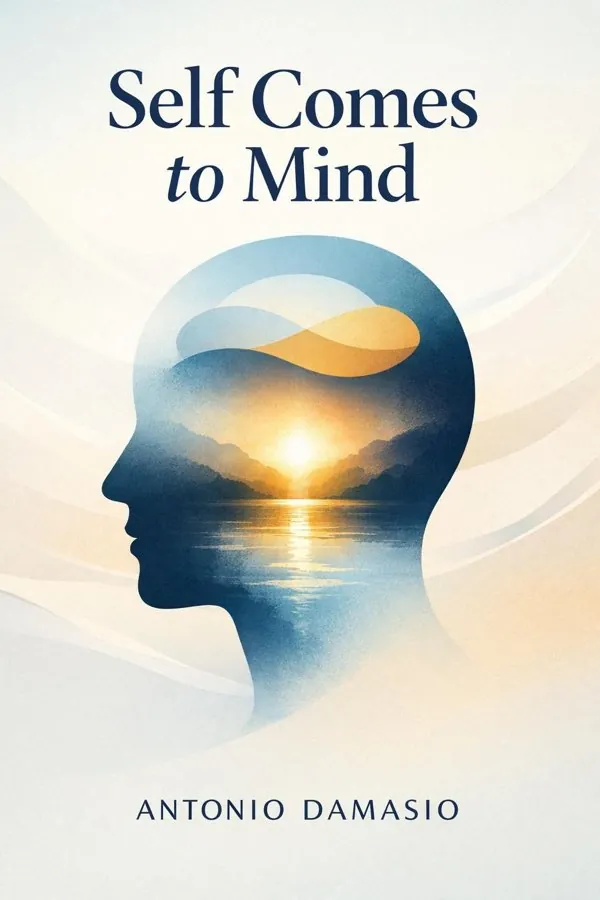
Self Comes to Mind: Constructing the Conscious Brain: Summary & Key Insights
 10 min12 chaptersAudio available
What Is Self Comes to Mind: Constructing the Conscious Brain About?
Self Comes to Mind: Constructing the Conscious Brain by Antonio Damasio is a neuroscience book spanning 12 pages. In this groundbreaking work, neuroscientist Antonio Damasio explores how the human brain constructs the mind and the sense of self. Drawing on decades of research, he explains how consciousness emerges from biological processes and how emotions and feelings play a central role in shaping our sense of identity. The book bridges neuroscience, philosophy, and psychology to offer a comprehensive theory of consciousness.
This FizzRead summary covers all 12 key chapters of Self Comes to Mind: Constructing the Conscious Brain in approximately 10 minutes, distilling the most important ideas, arguments, and takeaways from Antonio Damasio's work. Also available as an audio summary and Key Quotes Podcast.
Self Comes to Mind: Constructing the Conscious Brain
In this groundbreaking work, neuroscientist Antonio Damasio explores how the human brain constructs the mind and the sense of self. Drawing on decades of research, he explains how consciousness emerges from biological processes and how emotions and feelings play a central role in shaping our sense of identity. The book bridges neuroscience, philosophy, and psychology to offer a comprehensive theory of consciousness.
Who Should Read Self Comes to Mind: Constructing the Conscious Brain?
This book is perfect for anyone interested in neuroscience and looking to gain actionable insights in a short read. Whether you're a student, professional, or lifelong learner, the key ideas from Self Comes to Mind: Constructing the Conscious Brain by Antonio Damasio will help you think differently.
- ✓Readers who enjoy neuroscience and want practical takeaways
- ✓Professionals looking to apply new ideas to their work and life
- ✓Anyone who wants the core insights of Self Comes to Mind: Constructing the Conscious Brain in just 10 minutes
Want the full summary?
Get instant access to this book summary and 100K+ more with Fizz Moment.
Get Free SummaryAvailable on App Store • Free to download
Key Chapters
To understand how the self comes to mind, we must begin with life itself. Long before there was a nervous system or a brain, there was the imperative of homeostasis—the drive to regulate internal balance in changing environments. Every cell, every organism, must survive by keeping its inner conditions within viable limits. This simple biological necessity is the origin of mind.
Across evolution, organisms developed increasingly sophisticated mechanisms to manage homeostasis. At a certain level of complexity, nervous systems emerged to coordinate these functions more efficiently. What began as chemical signaling evolved into neural patterns that could represent the state of the organism. The essence of mind begins when the organism not only regulates itself but also forms representations of this regulation—maps of its own internal state.
This biological scaffolding is crucial, because consciousness cannot appear in a vacuum. It arises from a structure whose primary function is life regulation. From the unfolding of this evolutionary process—from single cells to brains capable of massive integration—comes the story of how consciousness took its first breath in the natural order. Without the precarious balance of homeostasis, there would be no feeling, no sense of self to protect, no mind to imagine its own continuity.
The first and most fundamental layer of self I call the proto-self. It is not conscious, not reflective, not imbued with narrative. Rather, it is a collection of neural patterns that map the state of the living body moment by moment. It is what allows an organism to maintain itself—to sense hunger, temperature, pressure, balance, the signals of every viscera that sustains life.
The brainstem and subcortical structures are central here. They continuously register the state of the body through mapped representations—neural codes that track the heart’s rhythm, the expansion of the lungs, the chemistry of the blood. This mapping is automatic and primordial. It provides a substrate for future selves. In a sense, the proto-self is the foundation of the edifice of consciousness: we cannot become aware of ourselves without first having a body to be represented.
Even though the proto-self lacks subjectivity, it makes the conscious mind possible. It delivers the raw material—the living body’s vital state—from which feeling arises. Consciousness, as I describe it, begins when the proto-self’s activity is brought into relation with events in the world, when the organism begins to know that something is happening to it. In this recognition, the core self is born.
+ 10 more chapters — available in the FizzRead app
All Chapters in Self Comes to Mind: Constructing the Conscious Brain
About the Author
Antonio Damasio is a Portuguese-American neuroscientist and professor of neuroscience, psychology, and philosophy at the University of Southern California. He is best known for his research on the neural basis of emotions, decision-making, and consciousness, and is the author of several influential books including 'Descartes' Error' and 'The Feeling of What Happens.'
Get This Summary in Your Preferred Format
Read or listen to the Self Comes to Mind: Constructing the Conscious Brain summary by Antonio Damasio anytime, anywhere. FizzRead offers multiple formats so you can learn on your terms — all free.
Available formats: App · Audio · PDF · EPUB — All included free with FizzRead
Download Self Comes to Mind: Constructing the Conscious Brain PDF and EPUB Summary
Key Quotes from Self Comes to Mind: Constructing the Conscious Brain
“To understand how the self comes to mind, we must begin with life itself.”
“The first and most fundamental layer of self I call the proto-self.”
Frequently Asked Questions about Self Comes to Mind: Constructing the Conscious Brain
Self Comes to Mind: Constructing the Conscious Brain by Antonio Damasio is a neuroscience book that explores key ideas across 12 chapters. In this groundbreaking work, neuroscientist Antonio Damasio explores how the human brain constructs the mind and the sense of self. Drawing on decades of research, he explains how consciousness emerges from biological processes and how emotions and feelings play a central role in shaping our sense of identity. The book bridges neuroscience, philosophy, and psychology to offer a comprehensive theory of consciousness.
More by Antonio Damasio

You Might Also Like
Anxious
Joseph LeDoux
10 min
Hallucinations
Oliver Sacks
10 min
The Biological Mind: How Brain, Body, and Environment Collaborate to Make Us Who We Are
Alan Jasanoff
10 min
The Feeling of Life Itself: Why Consciousness Is Widespread but Can't Be Computed
Christof Koch
10 min
The No-Nonsense Meditation Book
Steven Laureys
10 min
A General Theory of Love
Thomas Lewis, Fari Amini, Richard Lannon
10 minBrowse by Category
Ready to read Self Comes to Mind: Constructing the Conscious Brain?
Get the full summary and 100K+ more books with Fizz Moment.