
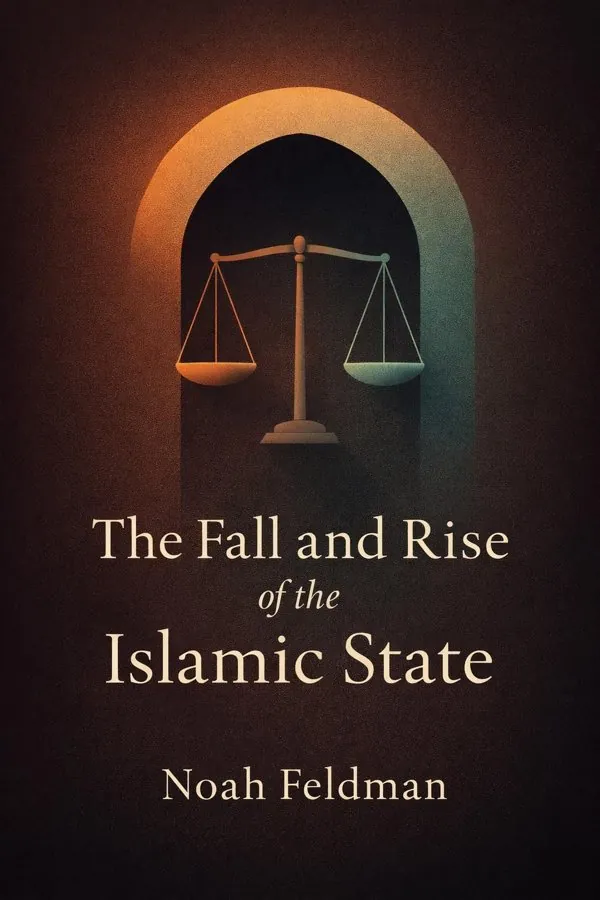
The Fall and Rise of the Islamic State: Summary & Key Insights
by Noah Feldman
 10 min10 chaptersAudio available
What Is The Fall and Rise of the Islamic State About?
The Fall and Rise of the Islamic State by Noah Feldman is a politics book spanning 10 pages. In this influential work, legal scholar Noah Feldman examines the historical and political evolution of Islamic governance, tracing how the classical Islamic state declined under colonialism and how modern movements have sought to revive it. Feldman explores the interplay between Sharia, constitutionalism, and democracy, arguing that the Islamic state’s resurgence reflects a complex negotiation between faith, law, and modern political legitimacy.
This FizzRead summary covers all 10 key chapters of The Fall and Rise of the Islamic State in approximately 10 minutes, distilling the most important ideas, arguments, and takeaways from Noah Feldman's work. Also available as an audio summary and Key Quotes Podcast.
The Fall and Rise of the Islamic State
In this influential work, legal scholar Noah Feldman examines the historical and political evolution of Islamic governance, tracing how the classical Islamic state declined under colonialism and how modern movements have sought to revive it. Feldman explores the interplay between Sharia, constitutionalism, and democracy, arguing that the Islamic state’s resurgence reflects a complex negotiation between faith, law, and modern political legitimacy.
Who Should Read The Fall and Rise of the Islamic State?
This book is perfect for anyone interested in politics and looking to gain actionable insights in a short read. Whether you're a student, professional, or lifelong learner, the key ideas from The Fall and Rise of the Islamic State by Noah Feldman will help you think differently.
- ✓Readers who enjoy politics and want practical takeaways
- ✓Professionals looking to apply new ideas to their work and life
- ✓Anyone who wants the core insights of The Fall and Rise of the Islamic State in just 10 minutes
Want the full summary?
Get instant access to this book summary and 100K+ more with Fizz Moment.
Get Free SummaryAvailable on App Store • Free to download
Key Chapters
To understand what the Islamic state once was, we need to start in the age of the caliphate, when law and religion were woven seamlessly into political life. The Islamic polity was not a theocracy in the Christian sense. The caliph or sultan ruled, but he did not legislate divine law. Instead, law—Sharia—was interpreted and developed by the *ulama*, independent scholars who saw themselves as guardians of the public good and interpreters of God’s will.
This relationship between ruler and scholar was foundational. The ruler provided political stability and defense; the scholars supplied legitimacy. Neither could fully function without the other. The law was not a tool of the state—it was, rather, its conscience. Sharia offered more than rules; it represented the collective memory of interpretation, a conversation stretching across centuries, binding society in a moral order that limited political excess.
This balance of power—between divine law and worldly rule—was the hallmark of classical Islamic governance. It is important to recognize that in this equilibrium, the *ulama* held real leverage. They could withhold legitimacy from an unjust ruler, and their rulings shaped the daily lives of ordinary Muslims. Law was above politics, and in that placement lay its moral force.
At the heart of Islamic governance lay Sharia, a term often misunderstood in contemporary debates. In the classical sense, Sharia was not a fixed code but a living, interpretive process. It combined the scriptural sources—the Qur’an and Hadith—with evolving methods of reasoning, analogy, and consensus. This flexibility made it dynamic, capable of adapting to new circumstances without losing its divine reference point.
My argument is that Sharia functioned, in effect, as a kind of constitution for the premodern Islamic world. It defined the limits of authority, articulated fundamental norms, and provided checks on the exercise of power. When political authority acted contrary to the law, it risked not just civil rebellion but moral delegitimization.
In modern constitutional theory, we often look to written charters as the source of state legitimacy. But Sharia fulfilled a similar role through an unwritten yet universally recognized structure of authority. The community accepted that God’s law was supreme, yet also that human interpretation was necessary. That delicate combination of divine sovereignty and human reasoning created space for rationality and pluralism long before their modern articulation.
+ 8 more chapters — available in the FizzRead app
All Chapters in The Fall and Rise of the Islamic State
About the Author
Noah Feldman is an American legal scholar, historian, and professor at Harvard Law School. His research focuses on constitutional law, religion, and the relationship between law and political authority in the Islamic world. Feldman has written extensively on constitutional design and the role of religion in modern governance.
Get This Summary in Your Preferred Format
Read or listen to the The Fall and Rise of the Islamic State summary by Noah Feldman anytime, anywhere. FizzRead offers multiple formats so you can learn on your terms — all free.
Available formats: App · Audio · PDF · EPUB — All included free with FizzRead
Download The Fall and Rise of the Islamic State PDF and EPUB Summary
Key Quotes from The Fall and Rise of the Islamic State
“To understand what the Islamic state once was, we need to start in the age of the caliphate, when law and religion were woven seamlessly into political life.”
“At the heart of Islamic governance lay Sharia, a term often misunderstood in contemporary debates.”
Frequently Asked Questions about The Fall and Rise of the Islamic State
The Fall and Rise of the Islamic State by Noah Feldman is a politics book that explores key ideas across 10 chapters. In this influential work, legal scholar Noah Feldman examines the historical and political evolution of Islamic governance, tracing how the classical Islamic state declined under colonialism and how modern movements have sought to revive it. Feldman explores the interplay between Sharia, constitutionalism, and democracy, arguing that the Islamic state’s resurgence reflects a complex negotiation between faith, law, and modern political legitimacy.
You Might Also Like
Antifa: The Anti-Fascist Handbook
Mark Bray
10 min
Attack from Within: How Disinformation Is Sabotaging America
Barbara McQuade
10 min
Coercion, Capital, and European States, AD 990–1992
Charles Tilly
10 min
Digital Democracy: Concepts, Methodologies, Tools, and Applications
Various Authors
10 min
Fascism
Stanley G. Payne
10 min
Fire And Fury: Inside The Trump White House
Michael Wolff
10 minBrowse by Category
Ready to read The Fall and Rise of the Islamic State?
Get the full summary and 100K+ more books with Fizz Moment.