
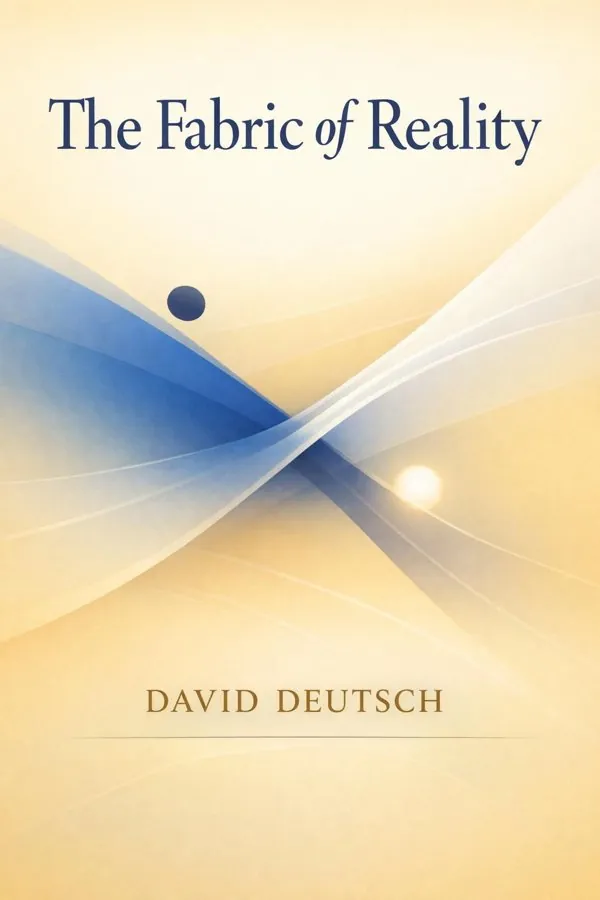
The Fabric of Reality: The Science of Parallel Universes—and Its Implications: Summary & Key Insights
 10 min11 chaptersAudio available
What Is The Fabric of Reality: The Science of Parallel Universes—and Its Implications About?
The Fabric of Reality: The Science of Parallel Universes—and Its Implications by David Deutsch is a popular_sci book spanning 11 pages. In this groundbreaking work, physicist David Deutsch presents a unified vision of reality that connects quantum physics, epistemology, evolution, and computation. He argues that these four strands together form the fabric of reality, offering a new understanding of the universe and our place within it. Deutsch explores the implications of the multiverse theory, the nature of knowledge, and the potential of artificial intelligence, proposing a bold framework for understanding everything from the laws of physics to the meaning of existence.
This FizzRead summary covers all 11 key chapters of The Fabric of Reality: The Science of Parallel Universes—and Its Implications in approximately 10 minutes, distilling the most important ideas, arguments, and takeaways from David Deutsch's work. Also available as an audio summary and Key Quotes Podcast.
The Fabric of Reality: The Science of Parallel Universes—and Its Implications
In this groundbreaking work, physicist David Deutsch presents a unified vision of reality that connects quantum physics, epistemology, evolution, and computation. He argues that these four strands together form the fabric of reality, offering a new understanding of the universe and our place within it. Deutsch explores the implications of the multiverse theory, the nature of knowledge, and the potential of artificial intelligence, proposing a bold framework for understanding everything from the laws of physics to the meaning of existence.
Who Should Read The Fabric of Reality: The Science of Parallel Universes—and Its Implications?
This book is perfect for anyone interested in popular_sci and looking to gain actionable insights in a short read. Whether you're a student, professional, or lifelong learner, the key ideas from The Fabric of Reality: The Science of Parallel Universes—and Its Implications by David Deutsch will help you think differently.
- ✓Readers who enjoy popular_sci and want practical takeaways
- ✓Professionals looking to apply new ideas to their work and life
- ✓Anyone who wants the core insights of The Fabric of Reality: The Science of Parallel Universes—and Its Implications in just 10 minutes
Want the full summary?
Get instant access to this book summary and 100K+ more with Fizz Moment.
Get Free SummaryAvailable on App Store • Free to download
Key Chapters
Let’s begin with what many regard as the most extraordinary claim: the existence of parallel universes. The Everett interpretation of quantum mechanics, which I defend here, is not a speculative addition to physics—it is physics taken seriously. Quantum theory tells us that particles don’t have definite positions or states until measured; they exist in a superposition of possibilities. But when measurement occurs, the equations don’t 'collapse'—instead, the universe splits, or rather, it already contains all outcomes. Every quantum interaction leads to a branching of reality, forming a vast, unimaginably complex multiverse.
In everyday life, we act as though reality is unique. We say an electron went through one slit or another, but quantum mechanics shows that it went through both. The old Copenhagen interpretation pretends the story ends when observers enter; it insists reality is indeterminate until observed. Everett’s formulation drops that human-centered illusion. Each outcome exists in a separate, equally real universe. The multiverse isn’t an abstract mathematical space—it is the physical structure of reality.
This view solves puzzles that have haunted physics: it explains interference as interaction between worlds, randomness as a manifestation of branching probabilities, and it ties together the deterministic laws underlying quantum evolution with the apparent indeterminacy of our experience. The world feels probabilistic to us only because we inhabit one branch of the multiverse, where we observe just our limited outcome.
To see this properly is to shed the last vestiges of mysticism attached to quantum mechanics. Reality is not absurd or paradoxical—it is simply more vast than our intuition allows.
A central claim of my philosophy is that knowledge is not a collection of observations but a network of explanations. Good explanations, I argue, are hard to vary while still accounting for what they explain. This criterion captures what makes scientific theories valuable: they don’t merely describe; they account for why the world must be as it is.
Consider myths or ad hoc theories. They can always be altered—Zeus can throw thunderbolts to account for storms, but the details can shift with every retelling. Scientific theories, in contrast, resist alteration. Quantum theory, relativity, evolution—each makes precise claims that cannot be freely changed without losing explanatory power. This rigidity is not a limitation but a strength: it ensures that when a theory survives testing, it does so by virtue of describing reality accurately.
I argue against the idea that science progresses by accumulating data or by consensus. What distinguishes science is the creation of explanations that survive relentless criticism. A theory’s predictive success matters, but what truly grounds it is its explanatory depth—the way it connects disparate phenomena under a single framework. In the fabric of reality, this means that our quest for understanding must always be creative, critical, and open to improvement. We never simply 'collect facts'; we generate bold conjectures and refine them through reason and evidence.
+ 9 more chapters — available in the FizzRead app
All Chapters in The Fabric of Reality: The Science of Parallel Universes—and Its Implications
About the Author
David Deutsch is a British physicist at the University of Oxford, known as one of the founders of quantum computation. He developed the concept of the universal quantum computer and has contributed significantly to the interpretation of quantum mechanics known as the many-worlds theory. His work bridges physics, philosophy, and computation, making him one of the most influential thinkers in modern science.
Get This Summary in Your Preferred Format
Read or listen to the The Fabric of Reality: The Science of Parallel Universes—and Its Implications summary by David Deutsch anytime, anywhere. FizzRead offers multiple formats so you can learn on your terms — all free.
Available formats: App · Audio · PDF · EPUB — All included free with FizzRead
Download The Fabric of Reality: The Science of Parallel Universes—and Its Implications PDF and EPUB Summary
Key Quotes from The Fabric of Reality: The Science of Parallel Universes—and Its Implications
“Let’s begin with what many regard as the most extraordinary claim: the existence of parallel universes.”
“A central claim of my philosophy is that knowledge is not a collection of observations but a network of explanations.”
Frequently Asked Questions about The Fabric of Reality: The Science of Parallel Universes—and Its Implications
The Fabric of Reality: The Science of Parallel Universes—and Its Implications by David Deutsch is a popular_sci book that explores key ideas across 11 chapters. In this groundbreaking work, physicist David Deutsch presents a unified vision of reality that connects quantum physics, epistemology, evolution, and computation. He argues that these four strands together form the fabric of reality, offering a new understanding of the universe and our place within it. Deutsch explores the implications of the multiverse theory, the nature of knowledge, and the potential of artificial intelligence, proposing a bold framework for understanding everything from the laws of physics to the meaning of existence.
More by David Deutsch
You Might Also Like

Structures: Or Why Things Don"t Fall Down
J.E. Gordon
10 min
The Road to Wigan Pier
George Orwell
10 min
Bonk: The Curious Coupling of Science and Sex
Mary Roach
10 min
First Bite: How We Learn to Eat
Bee Wilson
10 min
In Pursuit Of The Unknown: 17 Equations That Changed The World
Ian Stewart
10 min
Napoleon's Buttons: 17 Molecules That Changed History
Penny Le Couteur and Jay Burreson
10 minBrowse by Category
Ready to read The Fabric of Reality: The Science of Parallel Universes—and Its Implications?
Get the full summary and 100K+ more books with Fizz Moment.