
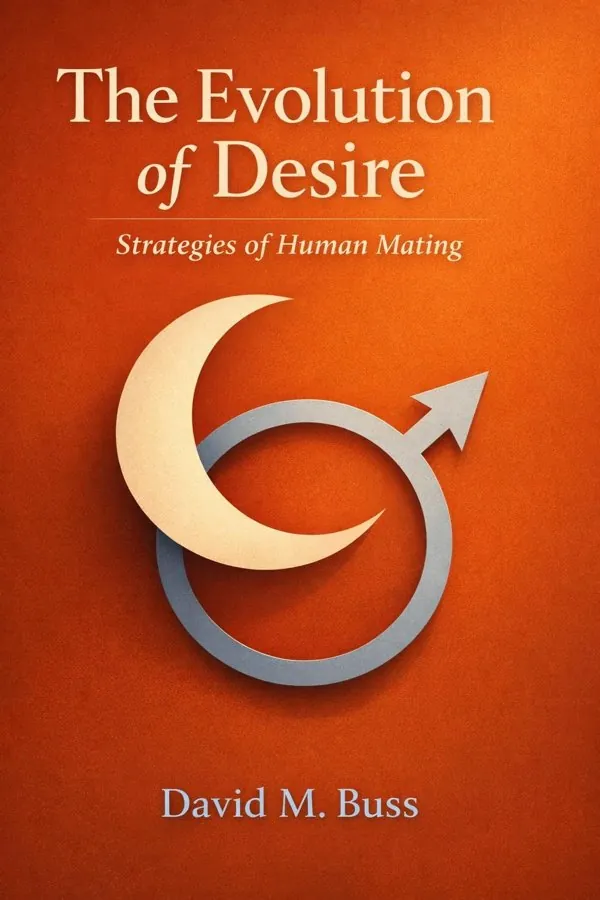
The Evolution of Desire: Strategies of Human Mating: Summary & Key Insights
 10 min8 chaptersAudio available
What Is The Evolution of Desire: Strategies of Human Mating About?
The Evolution of Desire: Strategies of Human Mating by David M. Buss is a psychology book spanning 8 pages. In this groundbreaking work, evolutionary psychologist David M. Buss explores the complex strategies humans use in the pursuit of love, sex, and long-term relationships. Drawing on decades of cross-cultural research, Buss reveals how evolutionary pressures have shaped human mating behavior, from attraction and jealousy to infidelity and mate selection. The book integrates scientific evidence with vivid real-world examples to explain why men and women often want different things—and how these desires have evolved to maximize reproductive success.
This FizzRead summary covers all 8 key chapters of The Evolution of Desire: Strategies of Human Mating in approximately 10 minutes, distilling the most important ideas, arguments, and takeaways from David M. Buss's work. Also available as an audio summary and Key Quotes Podcast.
The Evolution of Desire: Strategies of Human Mating
In this groundbreaking work, evolutionary psychologist David M. Buss explores the complex strategies humans use in the pursuit of love, sex, and long-term relationships. Drawing on decades of cross-cultural research, Buss reveals how evolutionary pressures have shaped human mating behavior, from attraction and jealousy to infidelity and mate selection. The book integrates scientific evidence with vivid real-world examples to explain why men and women often want different things—and how these desires have evolved to maximize reproductive success.
Who Should Read The Evolution of Desire: Strategies of Human Mating?
This book is perfect for anyone interested in psychology and looking to gain actionable insights in a short read. Whether you're a student, professional, or lifelong learner, the key ideas from The Evolution of Desire: Strategies of Human Mating by David M. Buss will help you think differently.
- ✓Readers who enjoy psychology and want practical takeaways
- ✓Professionals looking to apply new ideas to their work and life
- ✓Anyone who wants the core insights of The Evolution of Desire: Strategies of Human Mating in just 10 minutes
Want the full summary?
Get instant access to this book summary and 100K+ more with Fizz Moment.
Get Free SummaryAvailable on App Store • Free to download
Key Chapters
At the center of evolutionary psychology lies Darwin’s theory of sexual selection—the idea that certain traits evolve not merely for survival but for securing mates. In humans, this has produced astonishing complexity in our preferences, courtship rituals, and emotional experiences.
As I explored global patterns of attraction, I found evidence that men and women have distinct yet complementary mating incentives. Men are often drawn to physical indicators of fertility—youth, clear skin, symmetrical features—because these signal reproductive potential. Women, conversely, are more attentive to cues of resource acquisition, protection, and long-term stability. These divergences are not cultural quirks; they are adaptive fingerprints left by ancestral conditions.
Sexual selection explains why attraction can seem so arbitrary yet feel so inevitable. Beauty, for instance, is not merely social fashion but evolved sensory bias. The very traits we call beautiful—smooth skin, waist-to-hip ratio, bright eyes—once stood for health and fertility. Similarly, ambition and confidence in men often reflect dominance, which increased survival odds for offspring.
But sexual selection also gave rise to internal conflicts. Humans pursue both short-term and long-term mating strategies, often simultaneously. Under certain conditions, men and women each may benefit from short-term mating—men can spread genes more widely, while women can sometimes procure superior genetics for offspring—but those same strategies carry risks. Long-term bonding, meanwhile, assures parental investment and stability. These dual pressures have shaped the psychological tension between lust and love, desire and devotion, faithfulness and temptation.
To understand human attraction is to see the mind as a negotiation between these evolutionary demands. Every emotional impulse that drives us toward another person can be traced back to ancient selective problems, and each solution carries a cost. Recognizing this dichotomy—between reproduction and relationship—grounds the rest of the book’s analysis.
When I began mapping male mating strategies across cultures, a consistent pattern emerged. Men exhibit powerful preferences for youth and physical indicators of fertility because these traits maximize reproductive success. In evolutionary terms, men who favored fertile mates had more surviving children—and over millennia, those preferences became embedded in male psychology.
Short-term mating strategies for men often involve risk-taking, status-seeking, and direct sexual pursuit. In societies where opportunity permits, men may seek multiple partners to increase reproductive chances. Yet this strategy comes with evolutionary trade-offs—each pursuit of quantity limits investment in offspring quality. What’s striking is that men possess cognitive mechanisms for both approaches: short-term tactics to exploit opportunity, and long-term commitment mechanisms to ensure lineage stability.
Competition among men forms another fundamental aspect. Rivalry, dominance, and mate guarding behaviors emerge not from cultural scripts but from evolved drives to secure access to women. Aggression, ambition, and even physical posturing function as signals intended to attract mates or deter rivals. Male jealousy—often more intense toward sexual infidelity than emotional betrayal—evolved because paternity uncertainty threatens reproductive success. The pain men feel at suspected betrayal is an adaptive alarm, not mere insecurity.
These dynamics explain much of modern behavior—from displays of success to the obsession with youth in female attractiveness ideals. But evolution doesn’t dictate destiny; it provides tendencies. Awareness of these patterns allows men to recognize when their instinctual drives serve or undermine their deeper relational goals.
+ 6 more chapters — available in the FizzRead app
All Chapters in The Evolution of Desire: Strategies of Human Mating
About the Author
David M. Buss is an American evolutionary psychologist and professor at the University of Texas at Austin. He is one of the founders of the field of evolutionary psychology and has authored numerous influential works on human mating, personality, and social behavior.
Get This Summary in Your Preferred Format
Read or listen to the The Evolution of Desire: Strategies of Human Mating summary by David M. Buss anytime, anywhere. FizzRead offers multiple formats so you can learn on your terms — all free.
Available formats: App · Audio · PDF · EPUB — All included free with FizzRead
Download The Evolution of Desire: Strategies of Human Mating PDF and EPUB Summary
Key Quotes from The Evolution of Desire: Strategies of Human Mating
“At the center of evolutionary psychology lies Darwin’s theory of sexual selection—the idea that certain traits evolve not merely for survival but for securing mates.”
“When I began mapping male mating strategies across cultures, a consistent pattern emerged.”
Frequently Asked Questions about The Evolution of Desire: Strategies of Human Mating
The Evolution of Desire: Strategies of Human Mating by David M. Buss is a psychology book that explores key ideas across 8 chapters. In this groundbreaking work, evolutionary psychologist David M. Buss explores the complex strategies humans use in the pursuit of love, sex, and long-term relationships. Drawing on decades of cross-cultural research, Buss reveals how evolutionary pressures have shaped human mating behavior, from attraction and jealousy to infidelity and mate selection. The book integrates scientific evidence with vivid real-world examples to explain why men and women often want different things—and how these desires have evolved to maximize reproductive success.
You Might Also Like
The Body Keeps the Score
Bessel van der Kolk
10 min
Surrounded by Idiots
Thomas Erikson
10 min
Emotional Intelligence
Daniel Goleman
10 min
Attached
Amir Levine
10 min
Why Does He Do That
Lundy Bancroft
10 min
Women Who Run with the Wolves
Clarissa Pinkola Estés
10 minBrowse by Category
Ready to read The Evolution of Desire: Strategies of Human Mating?
Get the full summary and 100K+ more books with Fizz Moment.