
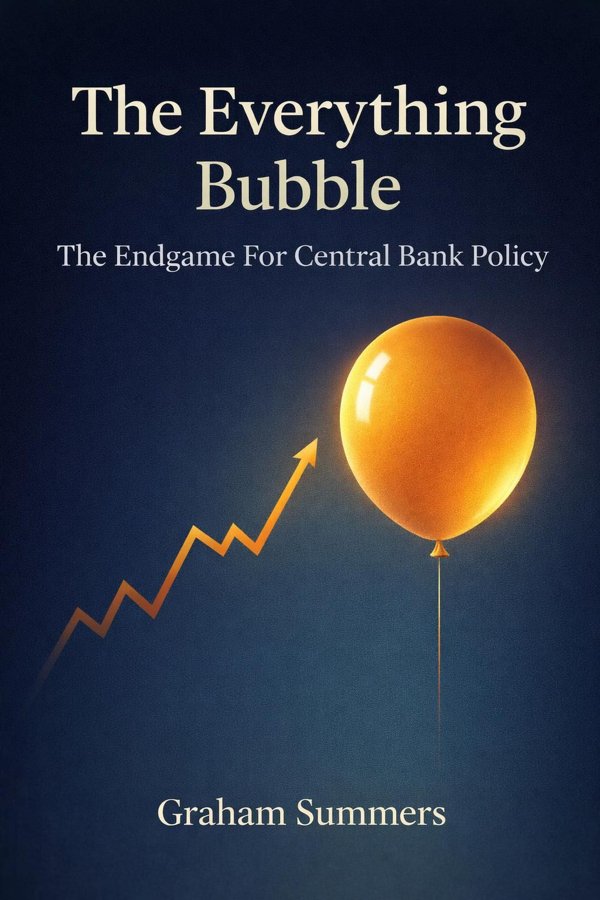
The Everything Bubble: The Endgame For Central Bank Policy: Summary & Key Insights
 10 min4 chaptersAudio available
What Is The Everything Bubble: The Endgame For Central Bank Policy About?
The Everything Bubble: The Endgame For Central Bank Policy by Graham Summers is a finance book spanning 4 pages. In this book, financial analyst Graham Summers explains how central bank policies since the 2008 financial crisis have inflated asset prices across markets, creating what he calls the 'Everything Bubble.' He explores the mechanisms behind quantitative easing, zero interest rate policies, and the resulting distortions in global markets. Summers argues that these policies have set the stage for a major financial reckoning and provides insights into how investors can prepare for the eventual collapse of this bubble.
This FizzRead summary covers all 4 key chapters of The Everything Bubble: The Endgame For Central Bank Policy in approximately 10 minutes, distilling the most important ideas, arguments, and takeaways from Graham Summers's work. Also available as an audio summary and Key Quotes Podcast.
The Everything Bubble: The Endgame For Central Bank Policy
In this book, financial analyst Graham Summers explains how central bank policies since the 2008 financial crisis have inflated asset prices across markets, creating what he calls the 'Everything Bubble.' He explores the mechanisms behind quantitative easing, zero interest rate policies, and the resulting distortions in global markets. Summers argues that these policies have set the stage for a major financial reckoning and provides insights into how investors can prepare for the eventual collapse of this bubble.
Who Should Read The Everything Bubble: The Endgame For Central Bank Policy?
This book is perfect for anyone interested in finance and looking to gain actionable insights in a short read. Whether you're a student, professional, or lifelong learner, the key ideas from The Everything Bubble: The Endgame For Central Bank Policy by Graham Summers will help you think differently.
- ✓Readers who enjoy finance and want practical takeaways
- ✓Professionals looking to apply new ideas to their work and life
- ✓Anyone who wants the core insights of The Everything Bubble: The Endgame For Central Bank Policy in just 10 minutes
Want the full summary?
Get instant access to this book summary and 100K+ more with Fizz Moment.
Get Free SummaryAvailable on App Store • Free to download
Key Chapters
To trace this story honestly, we must begin in 2008. The global financial system was teetering under the weight of overleveraged banks and the aftermath of the U.S. housing collapse. In response, central banks—led by the U.S. Federal Reserve—intervened with a scale of policy intervention never before witnessed. Interest rates were slashed to near zero almost overnight, and trillions in liquidity were injected into the system through quantitative easing. These measures temporarily restored market confidence, but they also set in motion a far deeper distortion.
The intent behind QE was to lower borrowing costs and stimulate lending and investment. Yet because the transmission mechanism favored financial markets over real economic productivity, liquidity flooded into asset prices rather than wages or capital investment. Stock markets recovered rapidly, corporate bonds rallied, and real estate prices stabilized—all long before the underlying fundamentals improved. By 2013, it became clear: the crisis response had succeeded not by solving debt problems but by transmuting them into inflated valuations across every major investment class. The recovery wasn’t organic; it was chemically induced.
By the time I began writing this book, it was impossible to ignore that central banks had created an environment dependent on endless stimulus. Economies that once relied on innovation and productive expansion began to rely on asset inflation to signal health. The era of the 'Everything Bubble' was born—a time when stocks, bonds, property, and even speculative assets rose together, not through genuine growth, but through monetary distortion.
The key to understanding the Everything Bubble lies in unpacking how central banks operate. When the Federal Reserve, the European Central Bank, and their peers engage in QE, they effectively create new money electronically and use it to purchase securities—typically government bonds and sometimes mortgage-backed assets. This expands their balance sheets dramatically while driving interest rates to historically low levels. The newly created liquidity doesn’t sit idle; it seeks returns, and in an environment where safe yields have vanished, investors chase riskier and higher-priced assets instead.
Over time, this mechanism pushed valuations to heights disconnected from any rational income or earnings basis. For example, corporations began issuing debt cheaply to repurchase their own shares, artificially boosting stock prices. Households, lured by cheap mortgages, drove property prices upward again. Meanwhile, bond investors accepted ridiculously low yields, confident central banks would always support them. All these behaviors fed one another, building layers of fragility under the surface.
Global spillover effects were massive. Emerging markets, tethered to dollar funding through trade and debt, found themselves whiplashed as U.S. policy oscillated between easing and tightening. Each major action by the Fed rippled through foreign exchange markets and global capital flows. The cheap money era stoked leverage everywhere—from Chinese corporate debt to European sovereign bonds. In a world awash with liquidity, mispricing of risk became the new normal.
As I examine these forces in the book, I emphasize that this isn’t the story of one rogue institution—it’s the architecture of a global system built on artificial stability. A decade of relentless central bank activity shifted not only market behavior but investor psychology itself. Risk was replaced by faith in intervention. That faith is the unseen foundation of the Everything Bubble.
+ 2 more chapters — available in the FizzRead app
All Chapters in The Everything Bubble: The Endgame For Central Bank Policy
About the Author
Graham Summers is a financial strategist and the Chief Market Strategist at Phoenix Capital Research. He is known for his macroeconomic analysis and commentary on central bank policy, market cycles, and global financial trends.
Get This Summary in Your Preferred Format
Read or listen to the The Everything Bubble: The Endgame For Central Bank Policy summary by Graham Summers anytime, anywhere. FizzRead offers multiple formats so you can learn on your terms — all free.
Available formats: App · Audio · PDF · EPUB — All included free with FizzRead
Download The Everything Bubble: The Endgame For Central Bank Policy PDF and EPUB Summary
Key Quotes from The Everything Bubble: The Endgame For Central Bank Policy
“To trace this story honestly, we must begin in 2008.”
“The key to understanding the Everything Bubble lies in unpacking how central banks operate.”
Frequently Asked Questions about The Everything Bubble: The Endgame For Central Bank Policy
The Everything Bubble: The Endgame For Central Bank Policy by Graham Summers is a finance book that explores key ideas across 4 chapters. In this book, financial analyst Graham Summers explains how central bank policies since the 2008 financial crisis have inflated asset prices across markets, creating what he calls the 'Everything Bubble.' He explores the mechanisms behind quantitative easing, zero interest rate policies, and the resulting distortions in global markets. Summers argues that these policies have set the stage for a major financial reckoning and provides insights into how investors can prepare for the eventual collapse of this bubble.
More by Graham Summers
You Might Also Like


Browse by Category
Ready to read The Everything Bubble: The Endgame For Central Bank Policy?
Get the full summary and 100K+ more books with Fizz Moment.