
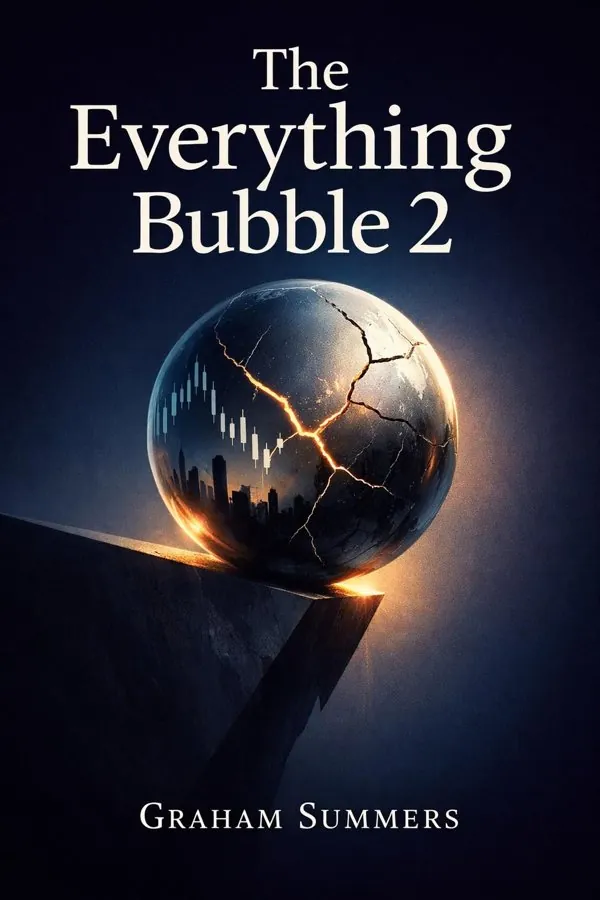
The Everything Bubble 2: The Endgame for Central Bank Policy: Summary & Key Insights
 10 min5 chaptersAudio available
What Is The Everything Bubble 2: The Endgame for Central Bank Policy About?
The Everything Bubble 2: The Endgame for Central Bank Policy by Graham Summers is a finance book spanning 5 pages. In this follow-up to his first book, Graham Summers analyzes the consequences of years of central bank intervention and monetary expansion. He argues that the global financial system has entered a critical phase where asset bubbles across stocks, bonds, and real estate are interconnected, forming what he calls the 'Everything Bubble.' The book explores how these policies have distorted markets, what the potential endgame scenarios look like, and how investors can prepare for the coming financial reset.
This FizzRead summary covers all 5 key chapters of The Everything Bubble 2: The Endgame for Central Bank Policy in approximately 10 minutes, distilling the most important ideas, arguments, and takeaways from Graham Summers's work. Also available as an audio summary and Key Quotes Podcast.
The Everything Bubble 2: The Endgame for Central Bank Policy
In this follow-up to his first book, Graham Summers analyzes the consequences of years of central bank intervention and monetary expansion. He argues that the global financial system has entered a critical phase where asset bubbles across stocks, bonds, and real estate are interconnected, forming what he calls the 'Everything Bubble.' The book explores how these policies have distorted markets, what the potential endgame scenarios look like, and how investors can prepare for the coming financial reset.
Who Should Read The Everything Bubble 2: The Endgame for Central Bank Policy?
This book is perfect for anyone interested in finance and looking to gain actionable insights in a short read. Whether you're a student, professional, or lifelong learner, the key ideas from The Everything Bubble 2: The Endgame for Central Bank Policy by Graham Summers will help you think differently.
- ✓Readers who enjoy finance and want practical takeaways
- ✓Professionals looking to apply new ideas to their work and life
- ✓Anyone who wants the core insights of The Everything Bubble 2: The Endgame for Central Bank Policy in just 10 minutes
Want the full summary?
Get instant access to this book summary and 100K+ more with Fizz Moment.
Get Free SummaryAvailable on App Store • Free to download
Key Chapters
The origins of what I call the Everything Bubble lie in the desperate measures taken after the Great Financial Crisis. In 2008, the world’s financial system was on the brink. Policymakers faced the complete freezing of credit markets and the failure of major banks. In response, central banks—most powerfully the Federal Reserve—embraced a radical experiment: Quantitative Easing (QE). By lowering interest rates to zero and purchasing vast amounts of government and mortgage debt, they injected trillions of dollars of liquidity into the system.
At first, these policies seemed to work. Stock indices recovered, bond yields fell, and consumer confidence returned. Yet what looked like revival was, in truth, an illusion built on borrowed time. With rates suppressed, investors were pushed further out on the risk curve, seeking returns wherever they could find them. Pension funds and institutions that once relied on safe yields were forced into equities and high-yield debt. The liquidity meant for real economic recovery instead inflated financial asset prices.
Central banks continued to double down. Each potential market wobble—be it in 2011 during the Eurozone crisis or in 2015 during China’s slowdown—was met with renewed monetary easing. Their message was clear: risk would always be backstopped. This conviction of perpetual support gave rise to moral hazard. Investors ceased to assess risk properly, believing central banks would always intervene.
The Everything Bubble thus became a byproduct of policy addiction. Stocks were expensive because money was cheap. Bonds were expensive because yields were suppressed. Real estate was expensive because credit was endless. Every sector, from Silicon Valley startups to sovereign debt markets, operated under the same distortion. And beneath this boom lurked the same structural weakness: an economy built not on productivity or innovation, but on monetary expansion and leverage.
In theory, central banks control markets through policy decisions. But over the past decade, I’ve witnessed a dangerous inversion: markets now control central banks. Monetary authorities have become captive to investor expectations. Every asset downturn is treated as an emergency demanding intervention. This feedback loop—where markets demand liquidity and central banks comply—sustains the Everything Bubble.
Consider the role of perception. Every press conference from the Federal Reserve, every phrase in its minutes, is scrutinized to divine how supportive policy will remain. Volatility itself has become an enemy policymakers fear, not a normal component of price discovery. As a result, free markets no longer operate on fundamentals but on the anticipation of liquidity. In essence, policy has replaced price discovery with narrative management.
This dynamic creates a self-reinforcing system. Artificial stimulus inflates asset valuations, higher valuations breed confidence, and that confidence in turn pressures central banks to prevent any correction. By 2019, the Fed faced what I call an impossible choice: stop easing and risk market collapse, or keep easing and risk systemic inflation. Their choice to keep the liquidity flowing in effect signaled that the financial system had entered a perpetual dependence on intervention.
Investor psychology has adapted accordingly. In equity markets, traditional metrics—earnings, revenues, dividends—have become less relevant than the trajectory of central bank policy. Valuation ratios hover at historic highs, yet capital continues to pour in because the cost of money remains near zero. In the bond market, yields are so suppressed that investors willingly accept negative real returns, convinced that prices will stay buoyant through policy support. And across these markets, leverage multiplies fragility. The moment trust in central bank omnipotence falters, this entire edifice will tremble.
+ 3 more chapters — available in the FizzRead app
All Chapters in The Everything Bubble 2: The Endgame for Central Bank Policy
About the Author
Graham Summers is a financial analyst and Chief Market Strategist at Phoenix Capital Research. He is known for his macroeconomic insights and commentary on central banking, market cycles, and systemic risk. His work focuses on helping investors navigate complex global financial trends.
Get This Summary in Your Preferred Format
Read or listen to the The Everything Bubble 2: The Endgame for Central Bank Policy summary by Graham Summers anytime, anywhere. FizzRead offers multiple formats so you can learn on your terms — all free.
Available formats: App · Audio · PDF · EPUB — All included free with FizzRead
Download The Everything Bubble 2: The Endgame for Central Bank Policy PDF and EPUB Summary
Key Quotes from The Everything Bubble 2: The Endgame for Central Bank Policy
“The origins of what I call the Everything Bubble lie in the desperate measures taken after the Great Financial Crisis.”
“In theory, central banks control markets through policy decisions.”
Frequently Asked Questions about The Everything Bubble 2: The Endgame for Central Bank Policy
The Everything Bubble 2: The Endgame for Central Bank Policy by Graham Summers is a finance book that explores key ideas across 5 chapters. In this follow-up to his first book, Graham Summers analyzes the consequences of years of central bank intervention and monetary expansion. He argues that the global financial system has entered a critical phase where asset bubbles across stocks, bonds, and real estate are interconnected, forming what he calls the 'Everything Bubble.' The book explores how these policies have distorted markets, what the potential endgame scenarios look like, and how investors can prepare for the coming financial reset.
More by Graham Summers
You Might Also Like



Browse by Category
Ready to read The Everything Bubble 2: The Endgame for Central Bank Policy?
Get the full summary and 100K+ more books with Fizz Moment.