
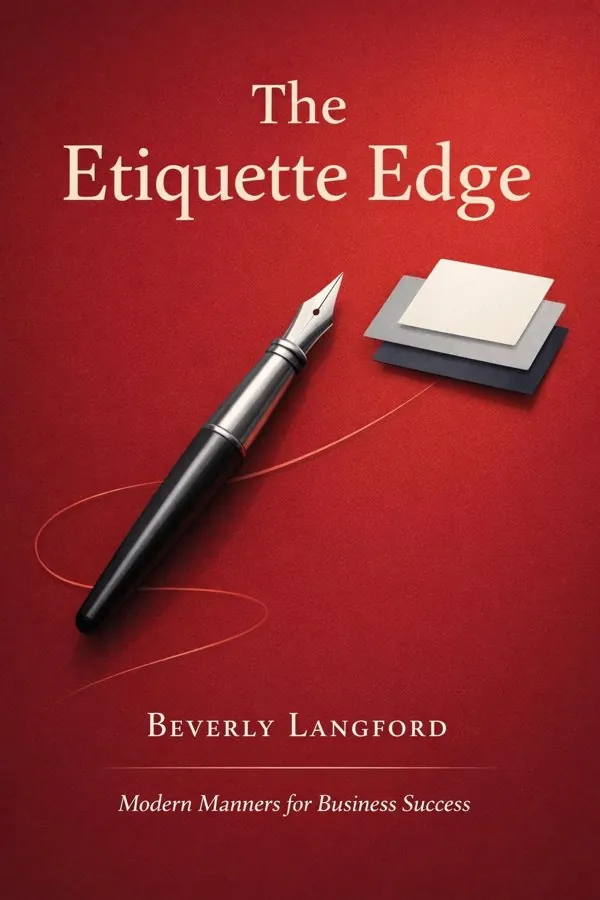
The Etiquette Edge: Modern Manners for Business Success: Summary & Key Insights
 10 min10 chaptersAudio available
Key Takeaways from The Etiquette Edge: Modern Manners for Business Success
A career is built not only on what you know, but on how consistently you honor other people’s dignity.
Before people evaluate your ideas, they evaluate how you deliver them.
In modern work, your inbox and messaging habits often speak louder than your handshake.
When conversation is mediated by a phone or camera, professionalism depends even more on deliberate behavior.
The most effective networkers are rarely the loudest people in the room.
What Is The Etiquette Edge: Modern Manners for Business Success About?
The Etiquette Edge: Modern Manners for Business Success by Beverly Langford is a communication book spanning 11 pages. In business, talent may open the door, but etiquette often determines whether you are invited to stay, trusted, and promoted. In The Etiquette Edge, Beverly Langford reframes etiquette as a practical career skill rather than a set of old-fashioned rules. Her message is simple but powerful: modern manners are really about respect, awareness, and the ability to make other people feel valued in every professional interaction. From email and meetings to networking, dining, leadership, and cross-cultural communication, she shows how everyday behavior shapes credibility and influence. What makes this book especially useful is its focus on real workplace situations. Langford does not treat etiquette as superficial polish. She presents it as a strategic advantage that helps professionals avoid missteps, communicate with clarity, strengthen relationships, and stand out in competitive environments. In a world of fast messages, hybrid teams, and constant impression-making, these skills matter more than ever. Langford brings strong authority to the subject as a communication consultant, educator, and expert in interpersonal effectiveness. Her guidance blends professional standards with emotional intelligence, making this book a practical roadmap for anyone who wants to succeed with competence and grace.
This FizzRead summary covers all 10 key chapters of The Etiquette Edge: Modern Manners for Business Success in approximately 10 minutes, distilling the most important ideas, arguments, and takeaways from Beverly Langford's work. Also available as an audio summary and Key Quotes Podcast.
The Etiquette Edge: Modern Manners for Business Success
In business, talent may open the door, but etiquette often determines whether you are invited to stay, trusted, and promoted. In The Etiquette Edge, Beverly Langford reframes etiquette as a practical career skill rather than a set of old-fashioned rules. Her message is simple but powerful: modern manners are really about respect, awareness, and the ability to make other people feel valued in every professional interaction. From email and meetings to networking, dining, leadership, and cross-cultural communication, she shows how everyday behavior shapes credibility and influence.
What makes this book especially useful is its focus on real workplace situations. Langford does not treat etiquette as superficial polish. She presents it as a strategic advantage that helps professionals avoid missteps, communicate with clarity, strengthen relationships, and stand out in competitive environments. In a world of fast messages, hybrid teams, and constant impression-making, these skills matter more than ever.
Langford brings strong authority to the subject as a communication consultant, educator, and expert in interpersonal effectiveness. Her guidance blends professional standards with emotional intelligence, making this book a practical roadmap for anyone who wants to succeed with competence and grace.
Who Should Read The Etiquette Edge: Modern Manners for Business Success?
This book is perfect for anyone interested in communication and looking to gain actionable insights in a short read. Whether you're a student, professional, or lifelong learner, the key ideas from The Etiquette Edge: Modern Manners for Business Success by Beverly Langford will help you think differently.
- ✓Readers who enjoy communication and want practical takeaways
- ✓Professionals looking to apply new ideas to their work and life
- ✓Anyone who wants the core insights of The Etiquette Edge: Modern Manners for Business Success in just 10 minutes
Want the full summary?
Get instant access to this book summary and 100K+ more with Fizz Moment.
Get Free SummaryAvailable on App Store • Free to download
Key Chapters
A career is built not only on what you know, but on how consistently you honor other people’s dignity. Langford argues that business etiquette begins with civility: the habit of recognizing that everyone’s time, presence, and contribution matter. This is not a cosmetic layer added to competence. It is the social foundation that allows competence to be seen, trusted, and rewarded.
Civility appears in small acts that are easy to overlook: greeting people warmly, arriving on time, listening without distraction, saying thank you, and responding promptly. These behaviors communicate reliability and respect. Their absence sends the opposite message. A technically strong employee who interrupts, dismisses others, or behaves carelessly can quickly damage trust. Meanwhile, a person who consistently treats others well often becomes known as dependable, professional, and easy to work with.
Langford shows that civility has practical consequences. It lowers friction in teams, prevents unnecessary conflict, and creates goodwill that helps during stressful moments. In offices, on calls, and at client events, people remember how you made them feel. Being courteous does not mean being passive or overly formal. It means choosing behavior that supports productive relationships even when pressure is high.
For example, acknowledging a receptionist, thanking a colleague for quick help, or introducing a junior team member in a meeting all reinforce a culture of respect. These gestures may seem minor, but they shape reputation over time.
Actionable takeaway: Treat every interaction as a chance to signal respect. Practice three habits daily: acknowledge people by name, protect their time, and respond with courtesy even under pressure.
Before people evaluate your ideas, they evaluate how you deliver them. One of Langford’s central themes is that communication is never neutral: your words, tone, pace, body language, and listening style all broadcast your personal brand. In professional settings, people often infer character from communication habits. Clarity suggests competence. Calmness suggests confidence. Careless phrasing suggests poor judgment.
Strong communication starts with verbal discipline. Professionals who ramble, interrupt, or speak too quickly create confusion and weaken their impact. By contrast, concise and well-structured speech helps others understand and trust your message. Langford emphasizes that listening is just as important as speaking. Many workplace misunderstandings happen because people prepare responses instead of truly hearing what others mean.
Nonverbal behavior also matters. Eye contact, posture, facial expression, and attentiveness shape the emotional tone of a conversation. Looking at your phone while someone speaks, crossing your arms defensively, or failing to acknowledge a point can undermine rapport. On the other hand, open posture, measured tone, and thoughtful pauses convey presence and control.
Consider two employees presenting the same proposal. One rushes, overexplains, and ignores questions. The other speaks clearly, pauses to confirm understanding, and responds respectfully. The second speaker is more likely to be remembered as credible, even if both ideas are equally strong.
Langford’s insight is that communication etiquette is not about sounding polished for its own sake. It is about making interactions easier, clearer, and more respectful for everyone involved.
Actionable takeaway: Before important conversations, ask yourself three questions: What is my main point? What tone will build trust? How can I show that I am listening as carefully as I speak?
In modern work, your inbox and messaging habits often speak louder than your handshake. Langford highlights email and digital communication as major arenas where professionalism is either reinforced or undermined. Because digital messages are fast and easy to send, people often forget they are permanent records of judgment, tone, and respect.
Good digital etiquette begins with purpose. Every email should have a clear subject line, a concise message, and an obvious next step. Long, vague, emotionally charged, or poorly edited emails waste time and create confusion. Tone matters especially online because readers cannot hear your voice or see your expression. A brief message meant as efficiency may sound cold; a rushed response may sound dismissive.
Langford advises professionals to think before hitting send. Ask whether the message is necessary, whether the audience is correct, and whether the wording will still seem appropriate if forwarded. Reply-all abuse, careless copying, excessive urgency markers, and sloppy grammar can all damage credibility. The same principles apply to instant messaging and collaborative platforms. Speed should not replace judgment.
Digital courtesy also means respecting boundaries. Not every issue deserves a late-night email, repeated follow-up, or all-caps emphasis. Professionals who use technology thoughtfully reduce stress for others and make collaboration smoother. For example, summarizing decisions after a meeting, using bullet points for action items, and responding within a reasonable timeframe all show reliability.
Langford’s broader point is that etiquette has evolved with technology, but the principle remains unchanged: communicate in ways that are clear, considerate, and useful.
Actionable takeaway: Use a simple digital checklist before sending messages: Is it clear, necessary, respectful, and easy for the recipient to act on?
When conversation is mediated by a phone or camera, professionalism depends even more on deliberate behavior. Langford explores telephone and video conferencing etiquette as extensions of executive presence. Without the natural cues of face-to-face interaction, small habits become amplified: lateness, background noise, multitasking, poor introductions, and talking over others all signal disregard.
Telephone etiquette begins with readiness. Answering professionally, identifying yourself, and getting to the point politely help establish trust. On conference calls, participants should minimize interruptions, avoid speakerphone problems when possible, and state their name before speaking if the group is large. Since listeners cannot rely on facial expressions, verbal clarity and tone become essential.
Video meetings add another layer. Your environment, lighting, camera angle, and visible attention all influence perception. Looking off-screen repeatedly, appearing disorganized, or joining from a distracting setting suggests that the meeting is not important to you. Langford recommends preparing as seriously for virtual meetings as for in-person ones: test technology, arrive early, mute strategically, and stay visually engaged.
She also emphasizes inclusive behavior. In group calls, strong etiquette means making space for quieter participants, not dominating airtime, and acknowledging contributions. A skilled host or participant uses names, summarizes decisions, and ensures people leave with clarity.
As remote and hybrid work become normal, these behaviors increasingly shape how colleagues and clients assess reliability and leadership potential. Presence is no longer limited to the conference room.
Actionable takeaway: For every phone or video meeting, prepare your setup, open with professionalism, and practice one rule consistently: be as attentive and organized online as you would be in the room.
The most effective networkers are rarely the loudest people in the room. Langford reframes networking as the art of building genuine, mutually beneficial relationships rather than collecting contacts or delivering polished self-promotion. This shift matters because people are more likely to trust someone who shows curiosity, generosity, and follow-through than someone who only tries to impress.
Good networking starts with mindset. Instead of asking, “How can this person help me?” ask, “How can I learn from, support, or connect with this person?” This approach changes body language, questions, and tone. It leads to more authentic conversations and better long-term results. Langford stresses the importance of introductions, remembering names, asking thoughtful questions, and listening for common ground.
Follow-up is where many people fail. A pleasant conversation at an event means little if it is never continued. Sending a brief note, sharing a relevant article, making an introduction, or thanking someone for advice turns a moment into a relationship. Professional etiquette also means not monopolizing people, not pushing too hard, and recognizing context. A networking event is a place to begin rapport, not demand favors.
For example, a young professional who asks a senior leader about industry trends and later sends a concise thank-you note with one specific takeaway leaves a stronger impression than someone who delivers a rehearsed pitch and disappears. Relationships grow through repeated evidence of sincerity and professionalism.
Langford’s view of networking is especially useful for people who dislike traditional schmoozing. Etiquette makes networking less performative and more human.
Actionable takeaway: At your next event, focus on quality over quantity. Aim to have three meaningful conversations, ask thoughtful questions, and follow up within 48 hours with something relevant and respectful.
Few workplace experiences expose etiquette failures more quickly than a bad meeting. Langford treats meetings as concentrated tests of professionalism because they involve time management, communication, hierarchy, collaboration, and follow-through all at once. A meeting that starts late, wanders aimlessly, excludes voices, or ends without decisions wastes more than time; it weakens trust and morale.
Meeting etiquette begins before anyone enters the room. Organizers should clarify the purpose, invite only necessary participants, and provide enough context for meaningful discussion. Attendees have responsibilities too: arrive prepared, review materials, contribute constructively, and stay mentally present. Checking email, whispering side comments, or dominating the discussion signals disrespect for everyone else’s time.
Langford also emphasizes the etiquette of participation. Strong contributors do not just speak; they help the group think. They build on others’ ideas, disagree without hostility, and summarize points clearly. Inclusive etiquette matters here: inviting quieter people to contribute, crediting ideas accurately, and keeping the discussion on track improves both outcomes and relationships.
After the meeting, professionalism continues. Decisions, owners, and deadlines should be documented. Failure to follow up can make even a productive discussion meaningless. In collaborative environments, reputation often depends less on brilliance in the room than on reliability afterward.
A manager who opens with an agenda, keeps the conversation focused, acknowledges contributions, and sends clear action items demonstrates respect and competence simultaneously. That is etiquette serving performance.
Actionable takeaway: Whether you lead or attend meetings, adopt one standard: never waste collective time. Prepare beforehand, contribute thoughtfully, and leave every meeting with clear next steps.
What feels polite in one culture may feel abrupt, vague, or even disrespectful in another. Langford includes cross-cultural etiquette to show that modern manners require more than good intentions. In increasingly global workplaces, professionals need the humility to recognize that their own norms are not universal.
Cross-cultural etiquette begins with observation and curiosity. Differences may appear in greetings, eye contact, punctuality, decision-making, conversational directness, hierarchy, gift-giving, and attitudes toward silence. A professional who assumes everyone shares the same expectations may unintentionally offend or confuse others. Langford encourages readers to do basic research before international meetings and to ask respectful clarifying questions when uncertain.
The deeper principle is adaptability without insincerity. You do not need to become an expert in every culture, but you do need to pay attention and avoid acting as though your default style is the only correct one. For instance, some cultures value direct disagreement while others prefer more indirect phrasing to preserve harmony. Understanding this distinction can improve negotiations and teamwork.
Cross-cultural etiquette also strengthens inclusion inside domestic workplaces. Diverse teams often include different communication rhythms and expectations around authority, formality, and feedback. A considerate professional learns to interpret behavior more carefully and judge less quickly.
Langford’s lesson is especially relevant in global business, where a small etiquette failure can damage trust more quickly than a technical error. Respect across differences is both a moral and strategic advantage.
Actionable takeaway: Before working with people from unfamiliar backgrounds, research key norms, observe carefully, and replace assumptions with respectful questions. Cultural intelligence starts with curiosity and restraint.
Professionalism is easiest when everything is going smoothly; etiquette proves its value when tensions rise. Langford addresses difficult situations to show that true manners are not ceremonial behaviors for easy moments, but stabilizing habits for stressful ones. Conflict, criticism, mistakes, and discourtesy are unavoidable in business. How you respond can either deepen the problem or strengthen your reputation.
A key principle is emotional self-management. Reacting impulsively to rude emails, public criticism, or frustrating colleagues often creates lasting damage. Etiquette does not mean avoiding hard conversations. It means handling them with restraint, clarity, and respect. This includes discussing problems privately when possible, focusing on behavior rather than personal attacks, and choosing language that solves rather than escalates.
Langford also stresses the importance of apology and recovery. When you make a mistake, a prompt and sincere apology can restore more trust than defensiveness ever will. Similarly, when others behave poorly, setting boundaries calmly is often more effective than retaliation. For example, if someone interrupts repeatedly in a meeting, you can say, “I’d like to finish my point, and then I’m happy to hear your view,” instead of matching their aggression.
Leadership is tested in these moments as well. People notice who stays composed, who blames others, and who helps restore order. Professionals with strong etiquette know how to disagree firmly without becoming disrespectful.
Langford’s larger insight is that difficult moments are reputation accelerators. Under pressure, character becomes visible.
Actionable takeaway: In tense situations, pause before responding, address issues directly but respectfully, and ask yourself one question: Will this response solve the problem or simply express my frustration?
People do not separate your manners from your leadership; they read one through the other. Langford connects etiquette to leadership and personal branding by showing that influence depends on consistent signals of respect, fairness, discretion, and reliability. Titles may grant authority, but everyday behavior determines whether others willingly trust and follow you.
For leaders, etiquette is not ceremonial polish. It appears in how they welcome new employees, run meetings, give feedback, recognize contributions, handle confidentiality, and treat people with less formal power. A leader who is courteous only to senior executives reveals weakness, not strength. Real leadership etiquette is most visible in moments where no social reward is guaranteed: thanking support staff, correcting privately rather than humiliating publicly, and sharing credit generously.
Personal branding grows from these repeated patterns. Many professionals think of brand as appearance, confidence, or visibility. Langford broadens the concept. Your brand is what others come to expect from interacting with you. Are you thoughtful? Prepared? Respectful? Difficult? Trustworthy? Etiquette shapes these answers every day.
This matters for advancement because opportunities often flow toward people who combine capability with ease of interaction. When stakeholders know you communicate well, show up prepared, and treat others decently, they are more likely to recommend you, hire you, or put you in front of clients.
Langford’s message is elegant: etiquette is not separate from reputation management; it is one of its most reliable engines. The professional edge comes from making respect habitual.
Actionable takeaway: Audit the reputation your habits create. Ask trusted colleagues what three words describe working with you, then strengthen the behaviors that make your professionalism visible and consistent.
All Chapters in The Etiquette Edge: Modern Manners for Business Success
About the Author
Beverly Langford is an American author, communication consultant, and educator whose work focuses on business etiquette, interpersonal communication, and professional effectiveness. She has taught at Georgia State University and has helped individuals and organizations strengthen leadership presence, workplace civility, and relationship skills. Langford is known for presenting etiquette not as rigid formality, but as a practical framework for showing respect, building trust, and communicating with confidence in modern professional environments. Her writing connects traditional principles of courtesy with contemporary business realities such as email, networking, meetings, and cross-cultural collaboration. In The Etiquette Edge, she draws on her academic and consulting background to offer clear, actionable guidance for professionals who want to improve both their conduct and their career prospects.
Get This Summary in Your Preferred Format
Read or listen to the The Etiquette Edge: Modern Manners for Business Success summary by Beverly Langford anytime, anywhere. FizzRead offers multiple formats so you can learn on your terms — all free.
Available formats: App · Audio · PDF · EPUB — All included free with FizzRead
Download The Etiquette Edge: Modern Manners for Business Success PDF and EPUB Summary
Key Quotes from The Etiquette Edge: Modern Manners for Business Success
“A career is built not only on what you know, but on how consistently you honor other people’s dignity.”
“Before people evaluate your ideas, they evaluate how you deliver them.”
“In modern work, your inbox and messaging habits often speak louder than your handshake.”
“When conversation is mediated by a phone or camera, professionalism depends even more on deliberate behavior.”
“The most effective networkers are rarely the loudest people in the room.”
Frequently Asked Questions about The Etiquette Edge: Modern Manners for Business Success
The Etiquette Edge: Modern Manners for Business Success by Beverly Langford is a communication book that explores key ideas across 10 chapters. In business, talent may open the door, but etiquette often determines whether you are invited to stay, trusted, and promoted. In The Etiquette Edge, Beverly Langford reframes etiquette as a practical career skill rather than a set of old-fashioned rules. Her message is simple but powerful: modern manners are really about respect, awareness, and the ability to make other people feel valued in every professional interaction. From email and meetings to networking, dining, leadership, and cross-cultural communication, she shows how everyday behavior shapes credibility and influence. What makes this book especially useful is its focus on real workplace situations. Langford does not treat etiquette as superficial polish. She presents it as a strategic advantage that helps professionals avoid missteps, communicate with clarity, strengthen relationships, and stand out in competitive environments. In a world of fast messages, hybrid teams, and constant impression-making, these skills matter more than ever. Langford brings strong authority to the subject as a communication consultant, educator, and expert in interpersonal effectiveness. Her guidance blends professional standards with emotional intelligence, making this book a practical roadmap for anyone who wants to succeed with competence and grace.
You Might Also Like

Magic Words: The Science and Secrets Behind Seven Words That Motivate, Engage, and Influence
Tim David
10 min
Talking Across The Divide: How to Communicate with People You Disagree with and Maybe Even Change the World
Justin Lee
10 min
The Exceptional Presenter: A Proven Formula to Open Up! and Own the Room
Timothy J. Koegel
10 min
4 Essential Keys to Effective Communication in Love, Life, Work--Anywhere!: Including the 12-Day Communication Challenge!
Bento C. Leal III
10 min
Active Listening Techniques: 30 Practical Tools to Hone Your Communication Skills
Nisha Gupta
10 min
Bargaining for Advantage: Negotiation Strategies for Reasonable People
G. Richard Shell
10 minBrowse by Category
Ready to read The Etiquette Edge: Modern Manners for Business Success?
Get the full summary and 100K+ more books with Fizz Moment.