
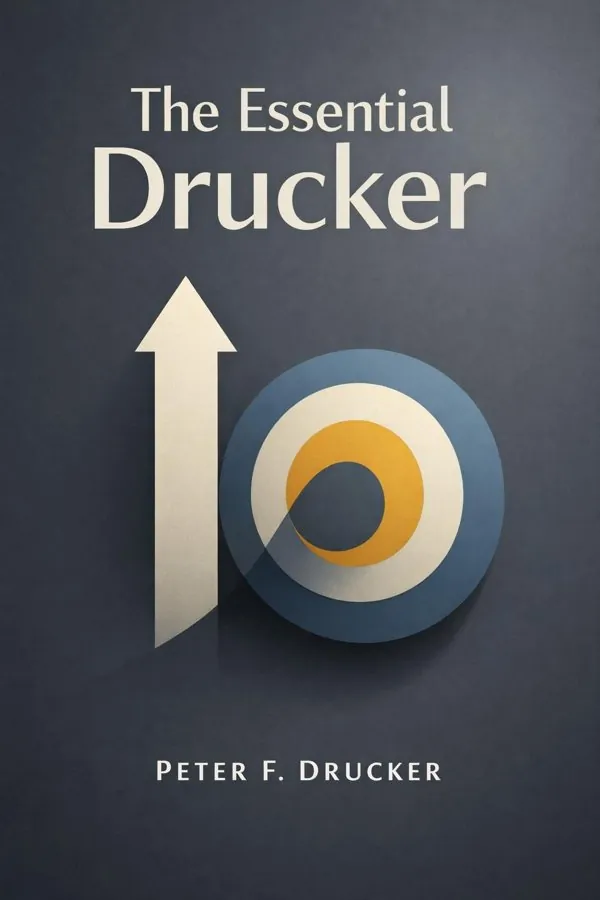
The Essential Drucker: The Best of Sixty Years of Peter Drucker's Essential Writings on Management: Summary & Key Insights
 10 min11 chaptersAudio available
What Is The Essential Drucker: The Best of Sixty Years of Peter Drucker's Essential Writings on Management About?
The Essential Drucker: The Best of Sixty Years of Peter Drucker's Essential Writings on Management by Peter F. Drucker is a leadership book spanning 11 pages. This book is a comprehensive collection of Peter F. Drucker’s most influential writings on management, covering six decades of his work. It distills his key ideas on leadership, innovation, decision-making, and organizational effectiveness, offering timeless insights for managers and executives seeking to understand and apply Drucker’s principles in modern business contexts.
This FizzRead summary covers all 11 key chapters of The Essential Drucker: The Best of Sixty Years of Peter Drucker's Essential Writings on Management in approximately 10 minutes, distilling the most important ideas, arguments, and takeaways from Peter F. Drucker's work. Also available as an audio summary and Key Quotes Podcast.
The Essential Drucker: The Best of Sixty Years of Peter Drucker's Essential Writings on Management
This book is a comprehensive collection of Peter F. Drucker’s most influential writings on management, covering six decades of his work. It distills his key ideas on leadership, innovation, decision-making, and organizational effectiveness, offering timeless insights for managers and executives seeking to understand and apply Drucker’s principles in modern business contexts.
Who Should Read The Essential Drucker: The Best of Sixty Years of Peter Drucker's Essential Writings on Management?
This book is perfect for anyone interested in leadership and looking to gain actionable insights in a short read. Whether you're a student, professional, or lifelong learner, the key ideas from The Essential Drucker: The Best of Sixty Years of Peter Drucker's Essential Writings on Management by Peter F. Drucker will help you think differently.
- ✓Readers who enjoy leadership and want practical takeaways
- ✓Professionals looking to apply new ideas to their work and life
- ✓Anyone who wants the core insights of The Essential Drucker: The Best of Sixty Years of Peter Drucker's Essential Writings on Management in just 10 minutes
Want the full summary?
Get instant access to this book summary and 100K+ more with Fizz Moment.
Get Free SummaryAvailable on App Store • Free to download
Key Chapters
When people hear the word ‘management,’ they often think of control, hierarchy, or authority. But genuine management has little to do with status. It is, at its heart, a practice of responsibility and performance. Managers exist to contribute to others — to make resources, human and otherwise, produce results. This means management is not defined by rank but by task.
In my lifelong observation, management emerged historically not as a tool for domination but as an expression of social responsibility. With the rise of industrial organizations came the need to coordinate human effort toward common goals. The manager became the organ of that purpose. The first task is always to ask: what results are expected of this organization, and how can we convert its mission into performance? Only then do issues of structure, efficiency, or procedure take meaning.
True management is therefore a moral and social function. It holds in trust the resources of society, particularly its most valuable one — people. It must use knowledge and systems to deliver performance, but always under the constraint that these serve human needs and community welfare. Managers are therefore custodians rather than commanders, judged not by what they control but by what they enable others to achieve.
There is only one valid definition of business purpose: to create a customer. Everything else — profits, products, technology — results from that. Profit is the condition for survival; it is not the reason for existence. The customer is the foundation upon which the enterprise rests, and thus the center of managerial thinking.
If this is true, the two central functions of business become clear: marketing and innovation. Marketing is not selling; it is the process of understanding the customer so deeply that the product or service fits him perfectly and sells itself. Innovation, on the other hand, is the specific instrument of entrepreneurship — the act of endowing resources with new wealth-producing capacity.
Neglect either of these, and the organization begins to decay. When managers focus on internal efficiencies rather than customer realities, they start to manage costs instead of opportunities. But the essence of business lies outside — in the dynamics of markets, technology, and human expectation. To manage for customers is therefore to manage for the future.
+ 9 more chapters — available in the FizzRead app
All Chapters in The Essential Drucker: The Best of Sixty Years of Peter Drucker's Essential Writings on Management
About the Author
Peter F. Drucker (1909–2005) was an Austrian-born American management consultant, educator, and author, widely regarded as the father of modern management theory. His work shaped the study and practice of management, emphasizing effectiveness, innovation, and the human dimension of organizations.
Get This Summary in Your Preferred Format
Read or listen to the The Essential Drucker: The Best of Sixty Years of Peter Drucker's Essential Writings on Management summary by Peter F. Drucker anytime, anywhere. FizzRead offers multiple formats so you can learn on your terms — all free.
Available formats: App · Audio · PDF · EPUB — All included free with FizzRead
Download The Essential Drucker: The Best of Sixty Years of Peter Drucker's Essential Writings on Management PDF and EPUB Summary
Key Quotes from The Essential Drucker: The Best of Sixty Years of Peter Drucker's Essential Writings on Management
“When people hear the word ‘management,’ they often think of control, hierarchy, or authority.”
“There is only one valid definition of business purpose: to create a customer.”
Frequently Asked Questions about The Essential Drucker: The Best of Sixty Years of Peter Drucker's Essential Writings on Management
The Essential Drucker: The Best of Sixty Years of Peter Drucker's Essential Writings on Management by Peter F. Drucker is a leadership book that explores key ideas across 11 chapters. This book is a comprehensive collection of Peter F. Drucker’s most influential writings on management, covering six decades of his work. It distills his key ideas on leadership, innovation, decision-making, and organizational effectiveness, offering timeless insights for managers and executives seeking to understand and apply Drucker’s principles in modern business contexts.
More by Peter F. Drucker
The Effective Executive: The Definitive Guide to Getting the Right Things Done
Peter F. Drucker
10 min
The Practice of Management
Peter F. Drucker
10 min
Managing Oneself
Peter F. Drucker
10 min
Innovation and Entrepreneurship: Practice and Principles
Peter F. Drucker
10 minYou Might Also Like

Extreme Ownership
Jocko Willink
10 min
Dare to Lead
Brene Brown
10 min
Leaders Eat Last
Simon Sinek
10 min
The 21 Irrefutable Laws of Leadership
John Maxwell
10 min
Start With Why
Simon Sinek
10 min
How to Lead When You're Not in Charge
Clay Scroggins
10 minBrowse by Category
Ready to read The Essential Drucker: The Best of Sixty Years of Peter Drucker's Essential Writings on Management?
Get the full summary and 100K+ more books with Fizz Moment.