
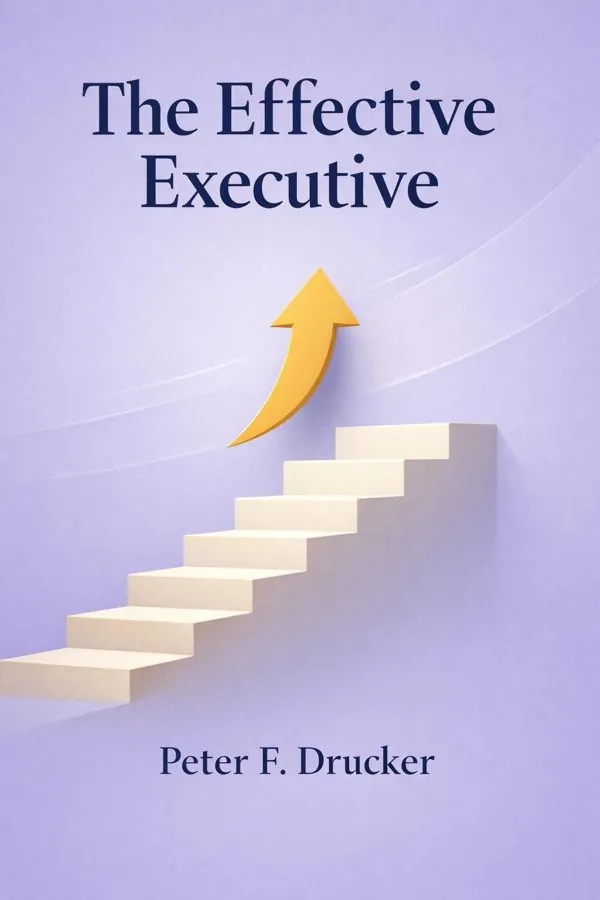
The Effective Executive: The Definitive Guide to Getting the Right Things Done: Summary & Key Insights
 10 min8 chaptersAudio available
What Is The Effective Executive: The Definitive Guide to Getting the Right Things Done About?
The Effective Executive: The Definitive Guide to Getting the Right Things Done by Peter F. Drucker is a leadership book spanning 8 pages. In this classic management book, Peter F. Drucker explores what makes executives effective and how they can focus on results rather than effort. He outlines key practices such as managing time, focusing on contributions, making strengths productive, setting priorities, and making effective decisions. The book remains a cornerstone of modern management thinking, emphasizing that effectiveness can be learned and is essential for leadership success.
This FizzRead summary covers all 8 key chapters of The Effective Executive: The Definitive Guide to Getting the Right Things Done in approximately 10 minutes, distilling the most important ideas, arguments, and takeaways from Peter F. Drucker's work. Also available as an audio summary and Key Quotes Podcast.
The Effective Executive: The Definitive Guide to Getting the Right Things Done
In this classic management book, Peter F. Drucker explores what makes executives effective and how they can focus on results rather than effort. He outlines key practices such as managing time, focusing on contributions, making strengths productive, setting priorities, and making effective decisions. The book remains a cornerstone of modern management thinking, emphasizing that effectiveness can be learned and is essential for leadership success.
Who Should Read The Effective Executive: The Definitive Guide to Getting the Right Things Done?
This book is perfect for anyone interested in leadership and looking to gain actionable insights in a short read. Whether you're a student, professional, or lifelong learner, the key ideas from The Effective Executive: The Definitive Guide to Getting the Right Things Done by Peter F. Drucker will help you think differently.
- ✓Readers who enjoy leadership and want practical takeaways
- ✓Professionals looking to apply new ideas to their work and life
- ✓Anyone who wants the core insights of The Effective Executive: The Definitive Guide to Getting the Right Things Done in just 10 minutes
Want the full summary?
Get instant access to this book summary and 100K+ more with Fizz Moment.
Get Free SummaryAvailable on App Store • Free to download
Key Chapters
Every executive exists for one reason only: to contribute. Not to maintain routines, attend meetings, or produce reports, but to deliver results that matter to the organization’s mission. The essence of executive responsibility lies in asking a simple question: What can I contribute that will make a difference? This shift from activity to contribution transforms not only your performance but also your relationships with colleagues. Instead of competing for visibility or protecting turf, you begin to think and act in terms of shared results.
The true measure of an executive is not effort, but effect. The organization pays for performance, not good intentions. Yet most people focus instinctively on effort—how hard they work, how many hours they invest. The effective executive reverses this instinct. To begin, he studies the needs of the situation, the goals of the institution, and the strengths of the people around him. Then he shapes his own work to contribute to those ends. When you make contribution your guiding principle, your time, decisions, and relationships all begin to reorient themselves toward effectiveness.
A focus on contribution also clarifies communication. When people understand what they must contribute, they no longer rely on arbitrary orders or vague expectations. They coordinate by purpose. This spirit of mutual contribution, not hierarchy, breeds effectiveness across the organization.
Everything that executives do requires time. Yet time is the scarcest resource. Unlike money or manpower, time cannot be stored, borrowed, or replaced. Once spent, it is gone forever. The first step toward effectiveness, then, is to know where your time goes. Few executives truly know this. They may imagine they spend their days making decisions or setting direction, but when they record their actual time, they often discover it is consumed by interruptions, routine matters, or crises originating elsewhere.
That is why I insist on time recording as the foundation of effectiveness. Keep a log for several weeks. Watch patterns emerge. You will be amazed at how much time vanishes in unproductive fragments. Once you have recorded your time, analyze it systematically. Identify activities that waste time because they are unnecessary, that could be done by someone else, or that achieve nothing important. Then start pruning—relentlessly.
After elimination comes consolidation. Fragmented time cannot be effective time. You must carve out large blocks of uninterrupted time to concentrate on substantial tasks, whether they involve thinking, problem-solving, or decision-making. Only extended time enables depth. The most effective people guard their time as their most valuable asset. They delegate properly, manage meetings tightly, and develop habits that convert trivial time losses into meaningful achievement time. Remember: time, once gone, is gone for good. Knowing thy time is the beginning of self-management and the entry to true effectiveness.
+ 6 more chapters — available in the FizzRead app
All Chapters in The Effective Executive: The Definitive Guide to Getting the Right Things Done
About the Author
Peter F. Drucker (1909–2005) was an Austrian-born American management consultant, educator, and author. Known as the father of modern management, Drucker wrote extensively on organizational behavior, economics, and leadership. His work has influenced generations of business leaders and remains foundational in management education worldwide.
Get This Summary in Your Preferred Format
Read or listen to the The Effective Executive: The Definitive Guide to Getting the Right Things Done summary by Peter F. Drucker anytime, anywhere. FizzRead offers multiple formats so you can learn on your terms — all free.
Available formats: App · Audio · PDF · EPUB — All included free with FizzRead
Download The Effective Executive: The Definitive Guide to Getting the Right Things Done PDF and EPUB Summary
Key Quotes from The Effective Executive: The Definitive Guide to Getting the Right Things Done
“Every executive exists for one reason only: to contribute.”
“Everything that executives do requires time.”
Frequently Asked Questions about The Effective Executive: The Definitive Guide to Getting the Right Things Done
The Effective Executive: The Definitive Guide to Getting the Right Things Done by Peter F. Drucker is a leadership book that explores key ideas across 8 chapters. In this classic management book, Peter F. Drucker explores what makes executives effective and how they can focus on results rather than effort. He outlines key practices such as managing time, focusing on contributions, making strengths productive, setting priorities, and making effective decisions. The book remains a cornerstone of modern management thinking, emphasizing that effectiveness can be learned and is essential for leadership success.
More by Peter F. Drucker
The Practice of Management
Peter F. Drucker
10 min
The Essential Drucker: The Best of Sixty Years of Peter Drucker's Essential Writings on Management
Peter F. Drucker
10 min
Managing Oneself
Peter F. Drucker
10 min
Innovation and Entrepreneurship: Practice and Principles
Peter F. Drucker
10 minYou Might Also Like

Extreme Ownership
Jocko Willink
10 min
Dare to Lead
Brene Brown
10 min
Leaders Eat Last
Simon Sinek
10 min
The 21 Irrefutable Laws of Leadership
John Maxwell
10 min
Start With Why
Simon Sinek
10 min
How to Lead When You're Not in Charge
Clay Scroggins
10 minBrowse by Category
Ready to read The Effective Executive: The Definitive Guide to Getting the Right Things Done?
Get the full summary and 100K+ more books with Fizz Moment.